科技+红利杠铃策略

Search documents
港股开盘:恒指跌0.54%、科指跌1.11%,科网股及汽车股走低,券商股分化,中金公司涨超7%
Jin Rong Jie· 2025-12-18 01:32
Market Overview - The Hong Kong stock market opened lower on December 18, with the Hang Seng Index down 0.54% at 25,330.83 points, the Hang Seng Tech Index down 1.11% at 5,397.34 points, and the National Enterprises Index down 0.62% at 8,788.92 points [1] - Major tech stocks declined, including Alibaba down 1.99%, Tencent down 0.66%, JD.com down 0.8%, Xiaomi down 2.04%, NetEase down 0.86%, Meituan down 0.59%, Kuaishou down 1.69%, and Bilibili down 0.26% [1] - Automotive stocks weakened, with Xpeng Motors dropping over 2% [1] - Chinese brokerage stocks showed mixed performance, with China International Capital Corporation (CICC) rising over 7% while China Merchants Securities fell over 1% [1] Company News - China International Capital Corporation (CICC) is planning a stock swap to absorb and merge with Dongxing Securities and Xinda Securities, with resumption of trading on December 18 [2] - Ronshine China reported a total contract sales of approximately 3.492 billion yuan for the first 11 months, a year-on-year decrease of 49.6% [3] - Wanbang Investment reported revenue of 164 million HKD for the year ending September 30, 2025, a year-on-year increase of 1.6%, but a loss of 640 million HKD, widening by 309.61% [3] - Corning Jereh Pharmaceutical's IND application for JSKN027 has been officially accepted by the CDE [4] - Yanda Pharmaceutical's globally innovative radiopharmaceutical GPN01530 has been approved for clinical research in the U.S. [4] - China CNR Corporation signed approximately 53.31 billion yuan in major contracts over the past three months [5] - Bofull Property reported a loss attributable to shareholders of 216 million HKD, a year-on-year decrease of 63.88% [6] - SenseTime plans to issue shares at a discount of over 8% to raise approximately 3.15 billion HKD [7] - Minth Group has entered into a strategic cooperation agreement with a robotics company [8] - Xunce is offering 22.5 million H-shares for subscription starting today until next Tuesday [9] Institutional Insights - According to浦银国际, the Hong Kong stock market sentiment index has been volatile since November due to fluctuating expectations of U.S. Federal Reserve interest rate cuts and corrections in the U.S. AI sector. The forward P/E ratio of the Hang Seng Index is currently 12.7 times, down 5% from its highest point this year. In the absence of new catalysts, the market sentiment may enter a period of oscillation and repair, but a pessimistic outlook is not warranted. A rotation in short-term styles and investment themes is expected, with the "Tech + Dividend" barbell strategy remaining effective [17] - 银河证券 suggests that the government's policies aimed at "stabilizing growth and the stock market" will continue to shape sector trends. A moderately loose liquidity environment, ongoing capital market optimization, and the rebuilding of investor confidence are expected to drive the securities sector's upward momentum. The current environment is conducive to the acceleration of medium- to long-term capital entering the market, maintaining high market activity, and showcasing a "healthy bull" trend [18] - 中信建投 indicates that the securities sector is expected to experience continuous growth driven by favorable policies in 2026, with a new growth cycle beginning in 2025. However, brokerage stocks have underperformed due to a lack of independent catalysts and lingering pessimism from previous years. The three core favorable factors—serving new productive forces, medium- to long-term capital entering the market, and opportunities for brokerage internationalization—are not yet fully priced in by the market, but are expected to gradually materialize post-2026, providing solid support for medium- to long-term performance resilience [18]

港股速报|港股突发 狂买超70亿港元!
Mei Ri Jing Ji Xin Wen· 2025-12-17 16:41
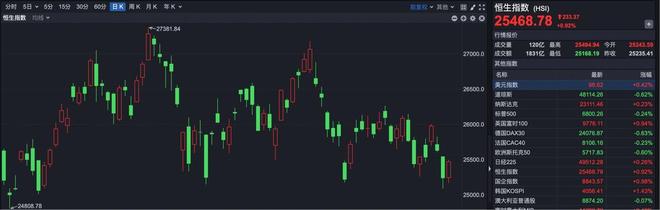
Market Overview - The Hong Kong stock market experienced a rebound, with the Hang Seng Index closing at 25,468.78 points, up 233.37 points, a rise of 0.92% [1] - The Hang Seng Tech Index closed at 5,457.95 points, increasing by 55.44 points, a gain of 1.03% [3] Capital Flow - Despite the market rebound, trading volume remained low, with total turnover exceeding 180 billion HKD, indicating that the main buying force was from southbound funds [5] - Southbound funds recorded a net purchase of 7.909 billion HKD in Hong Kong stocks, marking the largest single-day net inflow in December [5] Sector Performance - Airline stocks showed strong performance, with China Southern Airlines rising over 5%, Air China increasing over 4%, and China Eastern Airlines up over 3% [7] - Domestic airlines reported impressive passenger load factors for November, with China Eastern Airlines at 87.37%, up 3.04 percentage points year-on-year; China Southern Airlines at 86.29%, up 1.36 percentage points; and Air China at 83.3%, up 4 percentage points [7] - Insurance stocks saw gains in the afternoon, with China Life Insurance rising over 4% [8] - The semiconductor sector rebounded, with Hua Hong Semiconductor increasing over 3% and SMIC up over 2% [8] Analyst Insights - CITIC Securities noted that the passenger load factors for airlines during the off-peak season were high, ranging from 85.3% to 93.2%, and highlighted the potential for improved profitability in the fourth quarter due to recovering business demand and stable exchange rates [8] - Standard Chartered maintains an "overweight" rating on Chinese stocks, predicting the Hang Seng Index will range between 28,000 and 30,000 points over the next 12 months [9] - Ping An International observed that the sentiment index for the Hong Kong market has been volatile since November, with the forward P/E ratio for the Hang Seng Index at 12.7 times, down 5% from its peak earlier in the year [9]

浦银国际:短期港股市场情绪或将进入震荡修复期 “科技+红利”杠铃策略依然有效
智通财经网· 2025-12-16 09:11
Core Viewpoint - The sentiment index for the Hong Kong stock market has been volatile since November, influenced by fluctuating expectations of Federal Reserve interest rate cuts and a pullback in the US AI sector. Although concerns about an AI bubble remain, the sentiment index has shown some recovery following the Fed's anticipated rate cut. The Hang Seng Index's forward P/E ratio is currently at 12.7 times, down 5% from its highest point this year. In the absence of new catalysts, the market sentiment may enter a period of oscillation and recovery, but it may not be the right time for a full-scale bottom-fishing strategy [1][2]. Market Sentiment Analysis - As of December 10, the sentiment index constructed by the company stands at 59.1, a significant drop from November's high of 83, and is near the past year's moving average at -0.5 standard deviations. However, it has not reached extreme weakness (below -1 standard deviation) or entered the pessimistic zone (below 40) [2]. - The sentiment index has been affected by liquidity factors and the pullback in the US AI sector. The index experienced a rapid decline but has since recovered somewhat due to the Fed's rate cut [2][3]. Indicator Performance - Among the 13 indicators that make up the sentiment index, only 2 indicators show strong improvement (weight: 15.4%), namely increased stock buybacks and a decline in the put/call ratio for Hang Seng Index options. Conversely, 9 indicators have weakened (weight: 69.2%), including decreased main board trading volume, lower IPO fundraising amounts, a declining RSI index, reduced total trading volume through the Stock Connect, and an increase in market risk premium. Two indicators remained stable, namely the Hang Seng Index volatility index and the stock-bond yield spread (weight: 15.4%) [3]. Short-term Investment Strategy - The market is expected to maintain a volatile trend, with potential rotation in styles and investment themes. Due to the lack of new catalysts and uncertainties surrounding future Fed rate cuts, incremental capital allocation may focus more on scarce assets, while valuation expansion potential is limited. Therefore, earnings performance is likely to dictate market trends. The recommended short-term investment strategy is a "barbell strategy" that balances risk and reward, focusing on both technology and dividend stocks [4]. - On the dividend side, traditional defensive sectors such as banking, insurance, telecommunications, public utilities, and energy are highlighted, along with a focus on the consumer sector. On the technology side, attention should be given to Hong Kong companies with reasonable valuations and strong AI attributes, as well as opportunities in the A-share computing power industry and AI application layer [4].
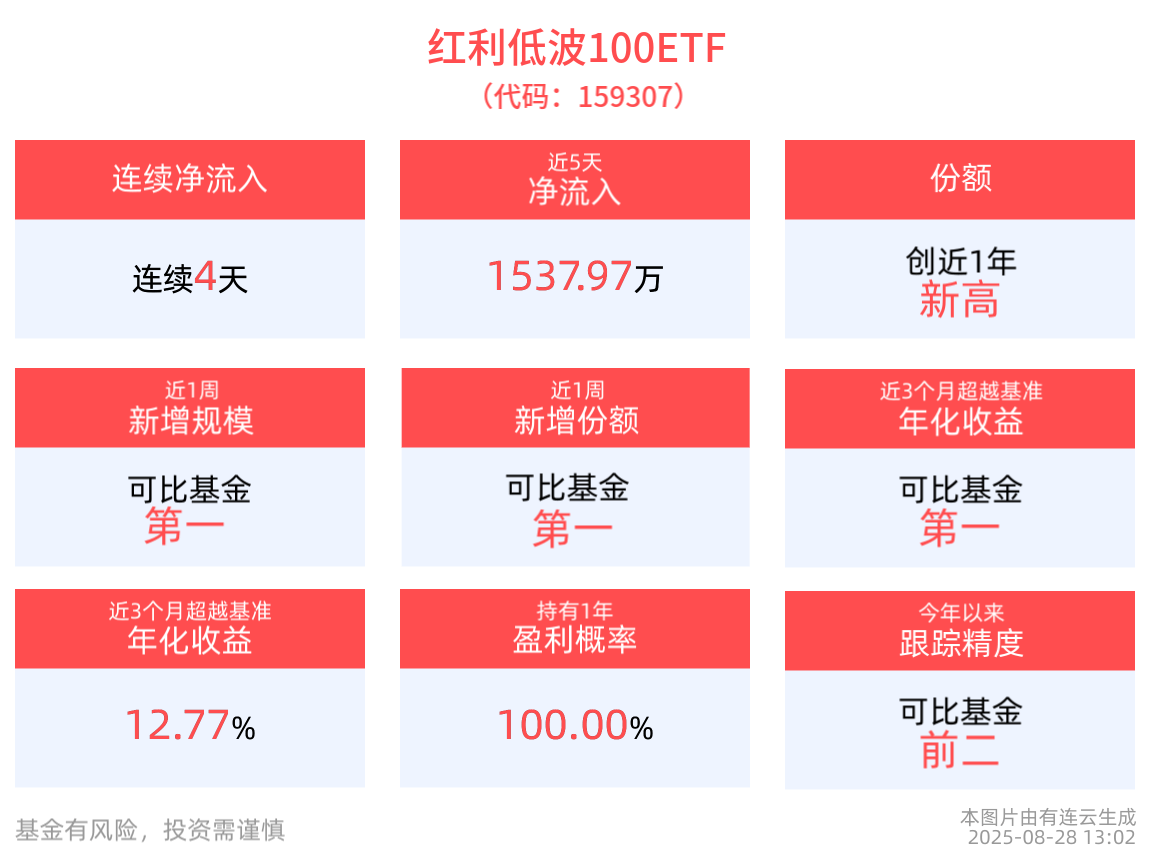
红利低波100ETF(159307)近1周新增规模居同类产品第一,港股红利ETF博时(513690)备受资金关注,红利资产或仍具备一定的吸引力
Sou Hu Cai Jing· 2025-08-28 05:54
Core Viewpoint - The market experienced a collective decline on August 27, 2025, with significant drops in various indices, indicating a potential correction phase after previous gains [8][9][10]. Group 1: Market Performance - The CSI Dividend Low Volatility 100 Index fell by 0.36% as of August 28, 2025, with notable gainers including Solar Energy (up 3.95%) and Huayu Automotive (up 3.02%), while TianDi Technology led the decline (down 3.79%) [3]. - The Hang Seng High Dividend Yield Index rose by 0.33%, with China National Offshore Oil Corporation increasing by 4.29% [6]. - The CSI All Share Free Cash Flow Index decreased by 0.12%, with Jiejia Weichuang leading gains at 16.46% [7]. Group 2: Liquidity and Trading Activity - The trading volume for the CSI Dividend Low Volatility 100 ETF was 10.39 million yuan, with a turnover rate of 0.83% [3]. - The Hang Seng High Dividend ETF saw a trading volume of 121 million yuan, with a turnover rate of 2.55% [6]. - The CSI All Share Free Cash Flow ETF had a trading volume of 3.22 million yuan, indicating active market participation [7]. Group 3: Market Sentiment and Analysis - The recent market decline is attributed to profit-taking after significant prior gains, psychological factors related to high-profile stocks, and tightening regulatory measures [9][10][11][12]. - Analysts suggest that the core driving logic of the bull market remains intact, and the current adjustment may be beneficial for long-term market health [13]. - The market may shift from broad-based gains to a focus on fundamental verification and structural opportunities [13][14]. Group 4: Fund Performance and Metrics - The CSI Dividend Low Volatility 100 ETF has seen a net inflow of 15.38 million yuan over four days, with a recent net asset value increase of 21.00% over the past year [16][18]. - The Hang Seng High Dividend ETF has achieved a net value increase of 50.34% over the past two years, ranking in the top 11.66% among similar funds [22][23]. - The CSI All Share Free Cash Flow ETF has a maximum drawdown of 3.31% since inception, indicating relatively low risk compared to peers [25].