稳外贸稳外资

Search documents
中国信保:更好助力稳外贸稳外资
Jin Rong Shi Bao· 2026-02-03 01:34
Core Viewpoint - China Export & Credit Insurance Corporation (Sinosure) emphasizes the importance of fulfilling its role in supporting foreign trade and contributing to high-quality development during the 14th Five-Year Plan period, with a focus on achieving the goals set for 2026 [1][2]. Group 1: Strategic Goals for 2026 - Sinosure aims to take on the political responsibility of stabilizing foreign trade and engage in a long-term battle for foreign trade "breakthrough 2.0" [2]. - The company plans to solidify the foundation of its core policy business and actively contribute to the construction of a strong domestic market and balanced import-export development [2]. - Sinosure will enhance its claims and compensation processes, improve fund utilization efficiency, and elevate the quality of credit services [2]. Group 2: Party Building and Governance - The company is committed to advancing strict party governance and enhancing the quality of party building to lead high-quality performance [2]. - Sinosure will focus on deepening the understanding of Xi Jinping's Thought on Socialism with Chinese Characteristics for a New Era as a foundation for its operations [2]. - The organization emphasizes the importance of political capability development and building a high-quality, professional talent team [2]. Group 3: Operational Arrangements for 2026 - Sinosure's operational plan includes taking on the political responsibility for stabilizing foreign trade and enhancing the effectiveness of its core policy business [3]. - The company will promote reform and innovation, ensuring that comprehensive reforms are effectively implemented [3]. - Sinosure will maintain a systemic perspective to strengthen its governance foundation while balancing business development with risk prevention [3].
从地方两会看今年经济增长点和产业发力点
Shang Hai Zheng Quan Bao· 2026-02-02 18:44
Core Viewpoint - Local governments are focusing on expanding domestic demand, promoting technological innovation, and stabilizing foreign trade and investment as key directions for economic growth and industrial development in 2026 [1] Economic Growth Targets - Over 20 provinces have set economic growth targets around 5% for 2026, with Beijing, Henan, and Jilin among those aiming for this figure [2] - Tianjin and Liaoning have set their targets at approximately 4.5%, while Zhejiang and Jiangxi aim for a range of 5% to 5.5% [2] - CPI growth targets are set around 2% for several regions, aligning with national expectations for inflation [2] Consumption and Investment Strategies - Regions are focusing on enhancing effective demand, with Beijing planning to develop policies to increase residents' income and consumption capacity [3] - Investment strategies include stabilizing investment scales and implementing large-scale projects, with Jiangxi planning to complete investments of around 1.1 trillion yuan [3] - The investment approach aims to stabilize consumption and enhance investment, promoting structural optimization and market vitality [3] Development of New Productive Forces - 2026 is identified as a critical year for integrating "Artificial Intelligence+" into the real economy, with provinces like Henan and Zhejiang focusing on AI applications across various sectors [4] - The emphasis is on nurturing emerging industries and utilizing digital and green technologies to transform traditional sectors [4] Stabilizing Foreign Trade and Investment - Various regions are implementing policies to stabilize foreign trade and investment, with Hubei aiming to maintain export levels and support enterprise quality improvements [5] - The development of service trade and digital trade is highlighted, with initiatives to strengthen traditional markets and expand into RCEP member countries [6] - The Ministry of Commerce is planning a comprehensive set of policies to support foreign trade enterprises, focusing on cost reduction and efficiency improvement [6]
2026年稳外贸稳外资,商务部官宣建设国家数字贸易示范区
第一财经· 2026-01-26 13:49
Core Viewpoint - In 2025, China's foreign trade and foreign investment achieved remarkable results, with total import and export reaching 45.47 trillion yuan, a growth of 3.8%, marking a historical high. The country established over 70,000 new foreign enterprises, a 19.1% increase, attracting foreign investment of 747.69 billion yuan [3][11]. Group 1: Foreign Trade Performance - In 2025, China's foreign trade maintained a growth rate of 3.8% despite global economic slowdown and rising protectionism, achieving a record high in trade volume [6]. - China engaged in trade with 249 countries and regions, with significant growth in trade volume with 14 countries exceeding 1 trillion yuan, 62 countries exceeding 100 billion yuan, and 137 countries exceeding 10 billion yuan [7]. - The share of the top ten trading partners in China's total foreign trade decreased to 47.7%, indicating a more balanced trade structure [8]. Group 2: Foreign Investment Trends - In 2025, actual foreign investment in the service sector reached 545.12 billion yuan, accounting for 72.9% of total foreign investment, reflecting a historical high [12][13]. - High-tech industries saw significant foreign investment growth, with e-commerce services, medical equipment manufacturing, and aerospace manufacturing increasing by 75%, 42.1%, and 22.9% respectively [12]. - The revised "Encouraging Foreign Investment Industry Catalog" aims to attract more foreign investment in advanced manufacturing, modern services, and high-tech sectors, effective from February 1, 2026 [14]. Group 3: Policy Initiatives - The Ministry of Commerce plans to enhance policies to stabilize foreign trade and investment, focusing on service market opening and promoting trade innovation [4][9]. - The establishment of national digital trade demonstration zones and the promotion of digital trade standards are key initiatives for future growth [9]. - The government will optimize foreign investment support policies, ensuring equal treatment for foreign enterprises and encouraging their participation in various economic activities [13].


全国政协召开2025年度宏观经济形势分析座谈会
Xin Lang Cai Jing· 2026-01-21 22:38
Core Viewpoint - The meeting emphasized the importance of understanding and implementing the economic strategies outlined by the Central Committee, focusing on the achievements and challenges of China's economic development during the "14th Five-Year Plan" period and the upcoming "15th Five-Year Plan" [1][2]. Group 1: Economic Development Strategies - The People's Political Consultative Conference (PPCC) will focus on significant theoretical and practical issues related to economic and social development during the "15th Five-Year Plan" period, organizing research and discussions to support high-quality policy recommendations [2]. - The meeting highlighted the need for collaboration between the party and government to promote policy understanding, stabilize expectations, and enhance public confidence in the economic outlook [2]. Group 2: Key Areas of Focus - Participants discussed various topics including the integration of artificial intelligence with industry innovation, boosting consumption and investment, ensuring fiscal sustainability, and developing a modern industrial system [2]. - The consensus among attendees was that achieving high-quality economic development in 2025 relies on the leadership of General Secretary Xi Jinping and the unified direction of the Central Committee [2].
全国政协召开2025年度宏观经济形势分析座谈会王沪宁出席并讲话
Xin Hua Cai Jing· 2026-01-21 06:22
Core Insights - The National Committee of the Chinese People's Political Consultative Conference (CPPCC) held a meeting to analyze the macroeconomic situation for 2025, emphasizing the importance of understanding the achievements of the past year and the "14th Five-Year Plan" period [1] - Wang Huning highlighted the need for the CPPCC to focus on major theoretical and practical issues related to economic and social development during the "15th Five-Year Plan" period, advocating for high-quality political consultation and advice [2] Group 1 - The meeting was attended by key political figures, including Wang Huning, who stressed the importance of aligning thoughts and actions with the Central Committee's economic decisions [1] - The CPPCC aims to enhance its role in promoting economic stability and growth by conducting research and providing recommendations on various economic issues [2] - Participants discussed topics such as the integration of artificial intelligence with industry, promoting consumption and investment, and ensuring food security, all aimed at achieving high-quality economic development by 2025 [2] Group 2 - The meeting was chaired by Vice Chairman Wang Yong, with other vice chairpersons and officials from relevant departments present to gather opinions and suggestions [3] - The focus was on collaborative efforts between the CPPCC and government to stabilize expectations and build confidence in the economy [2]
财政部最新报告:用好用足更加积极的财政政策!
证券时报· 2025-11-07 11:08
Core Viewpoint - The report emphasizes that since 2025, China's fiscal policy has become more proactive, focusing on stabilizing employment, businesses, markets, and expectations, while enhancing coordination with other policies to promote sustained economic recovery [2][3]. Fiscal Policy Execution - The fiscal operation in the first half of 2025 was generally stable, with good budget execution and a continuous recovery in fiscal revenue, particularly in tax income [3]. - The central government allocated 300 billion yuan for long-term special bonds to support consumption, alongside 7.279 billion yuan for service industry development, aimed at stimulating consumption in rural areas [4]. Investment and Consumption - The fiscal policy has been working to boost consumption and expand investment, with the issuance of long-term special bonds starting in April, completing 42.7% of the annual issuance target in the first half, which is 17.7 percentage points faster than the previous year [4]. - A new special debt limit of 4.4 trillion yuan was fully allocated to local governments by April, achieving 49.1% of the annual limit in the first half, which is 11 percentage points faster than the previous year [4]. Foreign Trade and Investment - The Ministry of Finance has effectively utilized tariff adjustments to stabilize foreign trade and investment, implementing temporary import tariff rates lower than the most-favored-nation rates on 935 items since January 1, 2025 [5]. - The expansion of high-standard free trade zones and cooperation with trade partners on tax reductions has been highlighted as a strategy to enhance market confidence [5]. Fiscal Management Pilot - The Ministry of Finance has initiated a pilot program for fiscal management in 12 provinces, focusing on improving resource allocation and budget management, with 11 key tasks set to achieve breakthroughs in two years [7][8]. - A national platform for the sharing of state-owned assets has been established, facilitating over 200 asset adjustments and saving more than 40 million yuan in budget funds [8]. Future Fiscal Policy Directions - The report outlines six key areas for future fiscal policy, including the effective use of proactive fiscal measures, support for employment and foreign trade, fostering new growth drivers, improving living standards, risk prevention, and enhancing fiscal governance [11][12][13].

财政政策出现边际变化——政策周观察第51期
一瑜中的· 2025-10-20 13:19
Group 1: Domestic Policy Changes - The Ministry of Finance announced a central fiscal allocation of 500 billion yuan to local governments, which is an increase of 100 billion yuan compared to last year, aimed at supporting local financial capacity and addressing government investment project debts [2][15]. - The total potential investment increment for the fourth quarter is nearly 1 trillion yuan, combining the new fiscal allocation with previously announced fiscal tools [2]. - The upcoming 20th Central Committee's Fourth Plenary Session will discuss the "14th Five-Year Plan" and is expected to release a summary on October 23, with detailed suggestions to follow [4]. Group 2: International Relations - A video call was held between Chinese and U.S. officials, agreeing to expedite a new round of economic and trade consultations, indicating ongoing communication despite tensions [3][10]. - The Chinese government reiterated its stance on trade disputes, emphasizing a willingness to negotiate while also standing firm against unilateral measures from the U.S. [13][14]. Group 3: Economic Outlook and Measures - The Premier emphasized the need for a broader perspective on the current economic situation, advocating for effective investment and consumption measures to stimulate domestic demand and ensure a strong economic recovery [9]. - The government plans to implement counter-cyclical adjustments and enhance support for key projects to stabilize the economy and achieve development goals [9][15]. Group 4: Recent Policy Announcements - The Ministry of Finance announced adjustments to the duty-free shopping policy for Hainan, expanding the range of duty-free goods and allowing more flexibility for travelers [14]. - A press conference highlighted the fiscal revenue and expenditure situation for the first three quarters of 2025, with plans to continue early allocation of local government debt limits for 2026 to support key projects [15].

国务院总理李强强调:加快科技成果转化,发展创业投资基金
FOFWEEKLY· 2025-10-15 10:01
Group 1 - The meeting highlighted that China's economy has shown resilience and vitality despite facing challenges, with new positive developments emerging [2] - Experts and entrepreneurs provided suggestions for better implementation of macro policies and addressing current issues [2] - Li Qiang emphasized the importance of a broader perspective in understanding the current economic situation, particularly in relation to the five-year plan and the long-term trends of economic development [2][3] Group 2 - Li Qiang called for enhanced counter-cyclical adjustments and effective implementation of total policies to stimulate economic growth [3] - There is a focus on expanding domestic demand and strengthening the domestic circulation, with measures to boost consumption and effective investment [3] - The government aims to create a favorable industrial ecosystem, promote cooperation among businesses, and accelerate the transformation of technological achievements [3]

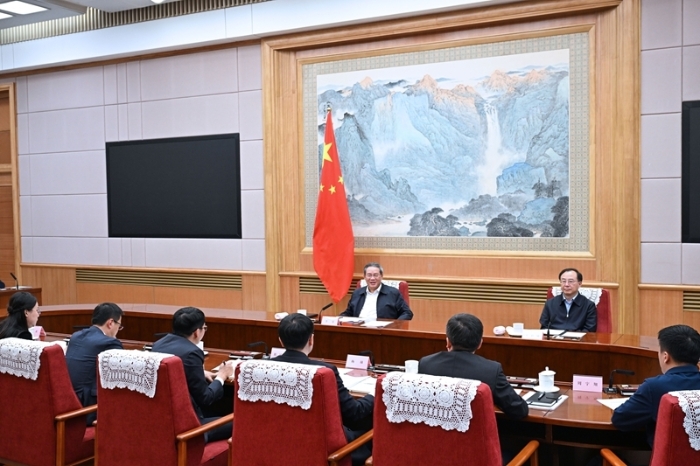
李强主持召开经济形势专家和企业家座谈
Xin Hua She· 2025-10-15 02:30
Core Viewpoint - The meeting chaired by Premier Li Qiang emphasizes the resilience and vitality of China's economy amidst challenges, highlighting the importance of macroeconomic policies and the need for continuous efforts to stimulate domestic demand and enhance market vitality [3][4]. Economic Situation - Experts and entrepreneurs noted that despite facing difficulties, China's economy has shown strong resilience and progress this year, with new bright spots emerging [1][3]. - The meeting acknowledged the complex external environment and challenges in economic operations, but emphasized the effective implementation of proactive macro policies by various regions and departments [3]. Policy Recommendations - There is a call for enhanced implementation of counter-cyclical adjustments and sustained efforts in total policy measures to boost economic recovery [4]. - The focus is on expanding domestic demand, strengthening the domestic circulation, and effectively utilizing various consumption promotion measures to stimulate market vitality [4]. Industry Development - The meeting highlighted the need to create a first-class industrial ecosystem, addressing issues of disorder and irrational competition within industries [4]. - It emphasized the importance of deepening cooperation among enterprises of different sizes and accelerating the transformation of technological achievements [4]. Foreign Trade and Investment - Support for stabilizing foreign trade and investment is crucial, with an emphasis on exploring diversified markets and improving overseas service systems [4]. - The implementation of significant foreign investment projects is also a priority to enhance economic growth [4].
总理座谈会上,发言的8位专家和企业家是谁→
Di Yi Cai Jing Zi Xun· 2025-10-15 02:18
Core Viewpoint - The Chinese government is focusing on implementing counter-cyclical adjustments and enhancing macroeconomic policies to stabilize and stimulate economic growth in response to current challenges [2][4]. Group 1: Economic Policy and Measures - The government emphasizes the need for continuous macroeconomic policy support, particularly in the fourth quarter, which is seen as a critical period for economic performance [2][4]. - New incremental measures are expected, including increased fiscal spending, potential interest rate cuts by the central bank, and stronger support for the real estate market [2][4]. - The issuance of long-term special bonds totaling 1.3 trillion yuan is aimed at supporting key projects and expanding effective investment [5]. Group 2: Domestic Demand and Investment - Expanding domestic demand is identified as a key strategy for stabilizing growth, with a focus on enhancing consumer spending and effective investment [5]. - Recent data shows a decline in domestic demand indicators, with retail sales growth slowing to 3.4% year-on-year in August, the lowest for the year [5]. - The government is implementing new policy tools, including a 500 billion yuan financial instrument aimed at bolstering project capital [6]. Group 3: Foreign Trade and Investment - The government is committed to stabilizing foreign trade and investment, with efforts to diversify markets and enhance overseas service systems [6]. - In the first three quarters, China's total goods trade reached 33.61 trillion yuan, reflecting a year-on-year growth of 4% [6]. - The trade value in September was 4.04 trillion yuan, marking an 8% increase year-on-year, the highest monthly growth rate this year [6]. Group 4: Industry Competition and Governance - The government is taking steps to address irrational competition in various industries, promoting cooperation among businesses and enhancing the innovation ecosystem [7][8]. - Recent measures include the release of industry-specific growth plans and regulations to maintain fair market competition [7]. - Data indicates improvements in industry profitability, with raw material manufacturing profits rising by 22.1% year-on-year from January to August [8].