
美元信用替代

Search documents
纽约期金突破5100美元,上海金ETF、黄金ETF易方达、金ETF南方、黄金ETF、黄金ETF华夏、金ETF等涨超4%
Ge Long Hui· 2026-02-04 07:26
Group 1 - The core viewpoint of the articles indicates a significant rise in gold prices, with spot gold surpassing $5080 per ounce and New York futures exceeding $5100 per ounce, driven by a decline in the dollar index and market sentiment [1][2] - Gold ETFs, including those from various fund companies, have seen increases of over 4%, reflecting the strong performance of gold as an asset class [1] - The traditional research framework for gold pricing, which relies on the dollar and real interest rates, has lost its explanatory power, with non-framework factors gaining prominence [2] Group 2 - Central banks, particularly in non-Western countries, are accelerating gold purchases to replace foreign exchange reserves, indicating a growing consensus of distrust in the dollar [2] - The supply rigidity of gold mining, combined with large-scale central bank purchases, is expected to create a physical shortage and support long-term price increases, with projections suggesting prices could reach $8000 [2] - Short-term trading risks are highlighted, with a current "naked long" market state and high volatility, suggesting potential for a market correction [2][3] Group 3 - Recent volatility in precious metals is attributed to the nomination of Kevin Warsh as the next Federal Reserve Chair, which has led to a rebound in the dollar index and profit-taking in the market [3] - Despite short-term fluctuations, the long-term support factors for gold remain intact, and it is expected to return to a steady upward trend after market adjustments [3] - Silver, due to its dual industrial and financial attributes, has experienced significant price increases but is now under pressure, suggesting a cautious approach for investors [3]
金价大幅回落,刚买的金饰能退吗?法律人士解读
Yang Shi Xin Wen· 2026-02-03 06:32
Core Insights - The international precious metals market has experienced significant volatility, with gold prices dropping over 11% in a single day and silver plummeting by 31.37%, marking the worst single-day performance in nearly 46 years [1][2] - Major state-owned banks and exchanges have issued risk warnings and adjusted business rules in response to the market fluctuations [4][5] Market Reactions - Several state-owned banks, including Construction Bank and Industrial and Commercial Bank of China, have raised the minimum investment amount for personal gold accumulation and issued risk alerts regarding the volatility of precious metal prices [5] - The Shanghai Futures Exchange has increased margin requirements and price limits for silver futures contracts, reflecting ongoing adjustments to manage market risks [5][7] Institutional Responses - The China Securities Regulatory Commission has noted that the recent price drops were anticipated, as evidenced by the suspension of subscription services for gold and silver open-end funds by various institutions [2] - The Chicago Mercantile Exchange has also raised margin requirements for multiple precious metal futures, indicating a broader trend of tightening risk management measures across global exchanges [7] Consumer Impact - Consumers who recently purchased gold jewelry are inquiring about return policies, with the ability to return items largely dependent on the purchase channel and specific merchant policies [10][12] - Legal experts have indicated that while some platforms allow returns under certain conditions, the imposition of restocking fees may apply, and consumers may face challenges in claiming refunds solely based on price drops [10][12] Market Dynamics - The recent downturn in precious metals is attributed to a combination of macroeconomic policy shifts, technical corrections, and leveraged fund liquidations, highlighting the inherent risks associated with high-reward investments in this sector [12]




金价大幅回落 刚买的金饰能退吗?法律人士解读
Yang Shi Xin Wen· 2026-02-02 23:57
Core Viewpoint - The international precious metals market has experienced significant volatility, with gold prices dropping over 11% and silver plummeting by 31.37%, marking the worst single-day performance in nearly 46 years. This has prompted banks and exchanges to issue risk warnings and adjust business rules to mitigate market fluctuations [1][2]. Group 1: Market Reactions - Major state-owned banks, including Industrial and Commercial Bank of China and China Construction Bank, have issued risk warnings and adjusted their business rules to protect against market volatility [2][5]. - The Chicago Mercantile Exchange has raised margin requirements for various precious metal futures, including platinum and palladium, effective February 2, to ensure that margin covers trading risks [3]. - The Shanghai Futures Exchange has also increased the price fluctuation limits and margin requirements for silver futures, marking the fourth warning issued recently [5]. Group 2: Consumer Concerns - Consumers are questioning whether they can return recently purchased gold jewelry due to the price drop. The ability to return items largely depends on the purchase channel and the seller's policies [4][6]. - Some retailers have stated that they will not accept returns based solely on price declines, with certain fees applied for returns, which has raised concerns about fairness and transparency [6]. - Legal experts emphasize that consumers may find it challenging to claim returns based solely on price drops, as the nature of gold as an investment complicates standard return policies [6]. Group 3: Market Dynamics - The recent price drop is attributed to multiple factors, including changes in macroeconomic policy expectations and technical corrections, highlighting the inherent risks and rewards in the precious metals market [7]. - Experts suggest that the decline in precious metals is part of a broader rebalancing of asset allocation in response to changing monetary policy expectations, with a potential shift towards assets with clearer returns, such as the US dollar and government bonds [3].
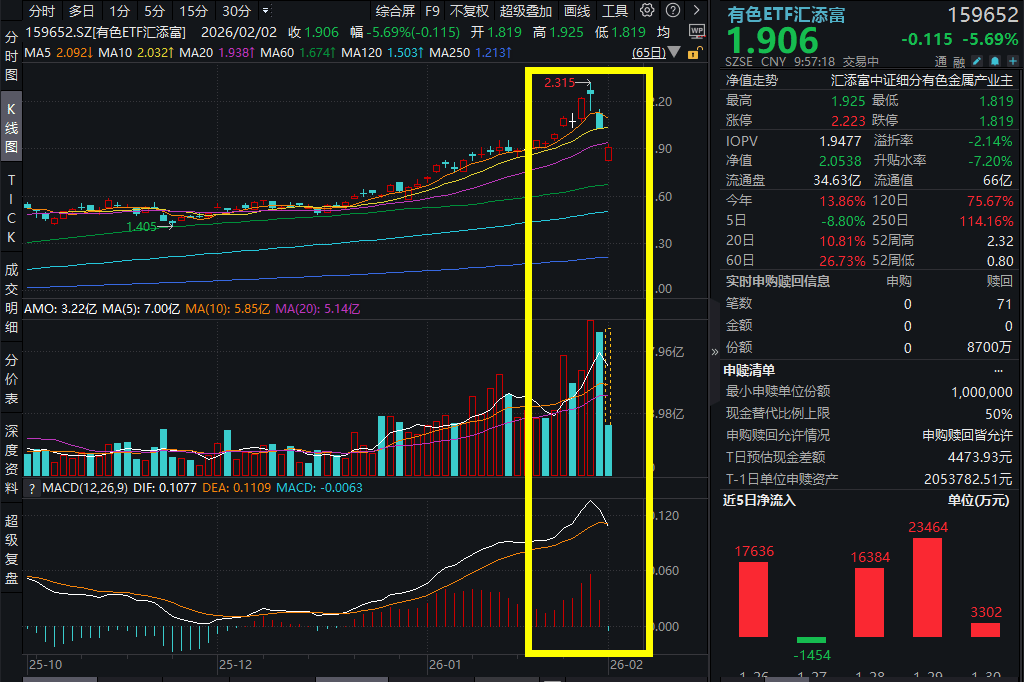
金银重挫!有色板块大幅异动,中金黄金等跌停,紫金矿业跌超4%,有色ETF汇添富(159652)跌超5%!短期情绪释放?还是基本面转向?
Sou Hu Cai Jing· 2026-02-02 02:38
Core Viewpoint - The global precious metals market has experienced a significant pullback, with spot gold dropping over 6% on February 2, reflecting a fragile structure after a sharp short-term rise. The long-term outlook for the non-ferrous sector remains strong due to factors such as the restructuring of the monetary credit system, supply-side rigidity, and new demand dynamics, although short-term risks of correction should be monitored [1][3]. Group 1: Market Reactions and Trends - The non-ferrous sector has shown volatility, with traditional valuation models becoming ineffective as market sentiment and geopolitical factors increasingly influence prices [3]. - The nomination of Waller as the next Federal Reserve Chair has led to expectations of policy shifts, including a significant reduction in the Fed's balance sheet, which could impact liquidity and future interest rate cuts [3]. - On January 30, international gold prices recorded their largest single-day drop in 40 years, indicating heightened volatility and risk in the gold market, prompting experts to advise caution among investors [3]. Group 2: Investment Opportunities and Risks - The non-ferrous sector presents both long-term investment opportunities and short-term risks, necessitating a rational approach from investors based on their risk tolerance [1]. - The recent performance of the non-ferrous ETF Huatai-PineBridge (159652) indicates a significant drop in component stocks, with many experiencing declines of over 5% [2][6]. - Despite the recent downturn, the long-term fundamentals for industrial metals like copper, aluminum, and tin remain strong, with expectations for price recovery post-correction [7]. Group 3: Future Outlook - Analysts suggest that the current market dynamics, including high global debt and geopolitical uncertainties, provide a solid foundation for precious metal prices to trend positively in the long run [4]. - The non-ferrous ETF Huatai-PineBridge (159652) is highlighted for its comprehensive coverage of various metal sectors, positioning it well to benefit from the ongoing supercycle in non-ferrous metals [5][9]. - The ETF's index has shown a cumulative return leading its peers, with a significant portion of its gains driven by earnings rather than valuation increases, indicating a favorable investment environment [11][12].






短期黄金波动加剧,提防“火中取栗”烫手!
Yang Zi Wan Bao Wang· 2026-01-30 04:20
Group 1 - On January 30, gold and silver prices experienced a significant decline, with spot gold falling below $5160 per ounce, a drop of 4.13%, and spot silver dropping below $108 per ounce, down 8.22% [1] - The London spot gold saw increased volatility, reaching $5594 per ounce, while COMEX gold futures rose by 1.97% to $5408.30 per ounce [1] - The Shanghai Gold Exchange and Shanghai Futures Exchange announced adjustments to margin requirements and price limits for various futures contracts, signaling a cooling in trading activity [1] Group 2 - According to Huaxin Securities, the traditional framework for analyzing gold's price surge is limited, attributing it to a combination of a short-term decline in the US dollar index and long-term shifts in dollar credit dynamics [2] - The report indicates that as the cracks in dollar credit widen, the long-term logic for gold's price increase strengthens, but there are risks associated with short-term trading strategies [2] - Future strategies may involve capital rotation towards Bitcoin, NASDAQ, or A/H shares, as well as a potential shift towards oil or energy stocks, and industrial metals like copper [2]