
美加利差

Search documents
油价支撑贸易扰动并存 美加央行立场分化
Jin Tou Wang· 2026-02-03 12:22
Core Viewpoint - The Canadian dollar (CAD) is experiencing fluctuations influenced by multiple macroeconomic factors and market sentiment, with its performance closely tied to international oil prices, the US-Canada interest rate differential, trade relations, and economic fundamentals [1][2]. Group 1: Oil Prices and CAD Correlation - The CAD is highly correlated with international oil prices, which have recently reached near four-month highs due to improved supply-demand dynamics and expectations of global economic recovery, benefiting Canada's trade surplus and capital inflows [1]. - A previous drop in oil prices to $60 per barrel, combined with a weak Canadian economy, led to the CAD depreciating against the USD, hitting a sixteen-month low [1]. Group 2: Monetary Policy Impact - Divergence in monetary policy between the US and Canada is affecting CAD movements, with the Federal Reserve maintaining interest rates and the market pricing in two rate cuts in 2026, which has led to a weaker USD and supported the CAD [1]. - The Bank of Canada also kept rates unchanged, causing the CAD to be more sensitive to oil price fluctuations rather than USD volatility [1]. Group 3: Trade Relations and Market Sentiment - Trade tensions between the US and Canada, particularly the proposed 50% tariff on Canadian aircraft imports, have raised market concerns and led to a short-term rebound of the USD against the CAD [2]. - Ongoing negotiations in the steel and aluminum sectors, as well as the review of the mainland free trade agreement, will further influence CAD movements [2]. Group 4: Technical Analysis and Short-term Outlook - The USD/CAD exchange rate is in a downward channel, having broken below the 1.36 mark, with technical indicators showing mixed signals for short-term direction [2]. - The CAD is expected to be influenced by oil prices, US-Canada trade developments, and US economic data, with the USD/CAD likely to fluctuate between 1.3450 and 1.3700 [2]. Group 5: Medium to Long-term Considerations - The medium to long-term trajectory of the CAD will depend on the stability of oil prices, changes in the US-Canada interest rate differential, and the strength of the Canadian economic recovery [2]. - While Canadian manufacturing shows signs of recovery, volatility in consumer spending may limit CAD appreciation [2].
加元央行按兵不动留悬念 美加博弈定生死
Jin Tou Wang· 2026-02-01 01:30
Core Viewpoint - The Canadian dollar (CAD) has shown strong performance against the US dollar, reaching a near two-year high, driven by the Bank of Canada's decision to maintain the benchmark interest rate, but faces challenges from trade uncertainties and economic data [1][2]. Group 1: Bank of Canada and Interest Rates - The Bank of Canada maintained its benchmark interest rate, aligning with market expectations, and revised its economic growth forecast upwards, indicating that inflation will fluctuate around policy targets [1]. - The central bank's cautious stance on future interest rate adjustments due to trade uncertainties has limited expectations for rate hikes, balancing market concerns about easing [1][2]. Group 2: Exchange Rate Dynamics - The narrowing interest rate differential between the US and Canada has provided temporary support for the CAD, as the market anticipates no further rate cuts from the Bank of Canada while the Federal Reserve may still lower rates [1][2]. - There is significant divergence in market expectations regarding the Bank of Canada's future actions, with some predicting potential rate hikes by year-end, while others warn of possible rate cuts due to economic weakness [1]. Group 3: Commodity Prices and Trade Relations - The CAD's performance is closely linked to oil prices, which remain weak due to oversupply, negatively impacting Canada's energy exports and overall economic fundamentals [2]. - Trade uncertainties, particularly related to the US-Mexico-Canada Agreement (USMCA) and potential tariffs, pose risks to Canadian exports and business investments, which could further pressure the CAD [2]. Group 4: Technical Analysis and Market Outlook - The CAD has shown initial bullish trends against the USD, but after reaching a near two-year high, it is currently in a consolidation phase with diminishing trading volume [2]. - The outlook for the CAD suggests limited upward momentum, likely maintaining a range-bound upward trend, with key focus on Canadian economic data, Federal Reserve policy guidance, and trade negotiations [3].
【2026年汇市展望】美元或进一步走弱 非美货币走势或分化
Sou Hu Cai Jing· 2026-01-04 08:26
Group 1: Core Insights - The US dollar index is expected to decline further in 2026, following a significant drop of 9.41% in 2025, the largest annual decline since 2017, influenced by a weakening US economy, tariff policies, and ongoing interest rate cuts by the Federal Reserve [1][5] - Analysts predict that the dollar will weaken against major currencies such as the euro, yen, and pound, with an estimated additional decline of about 3% by the end of 2026 [5][6] - The divergence in monetary policy among major central banks is expected to continue, with the Federal Reserve likely to maintain a loose monetary stance while other central banks may raise rates or keep them stable, further pressuring the dollar [4][8] Group 2: Currency Performance - The euro is projected to strengthen significantly, with an increase of over 13.4% against the dollar in 2025, reaching levels above 1.17 USD per euro, supported by improved economic conditions in the Eurozone [1][8] - The Australian dollar is expected to perform well in 2026, benefiting from stable economic growth and potential interest rate hikes, following a 7.84% appreciation in 2025 [9][11] - In contrast, the Japanese yen and British pound are anticipated to face weaker performance in 2026, with the yen potentially falling below the 160 mark against the dollar due to persistent low interest rates and economic uncertainties [10][13]

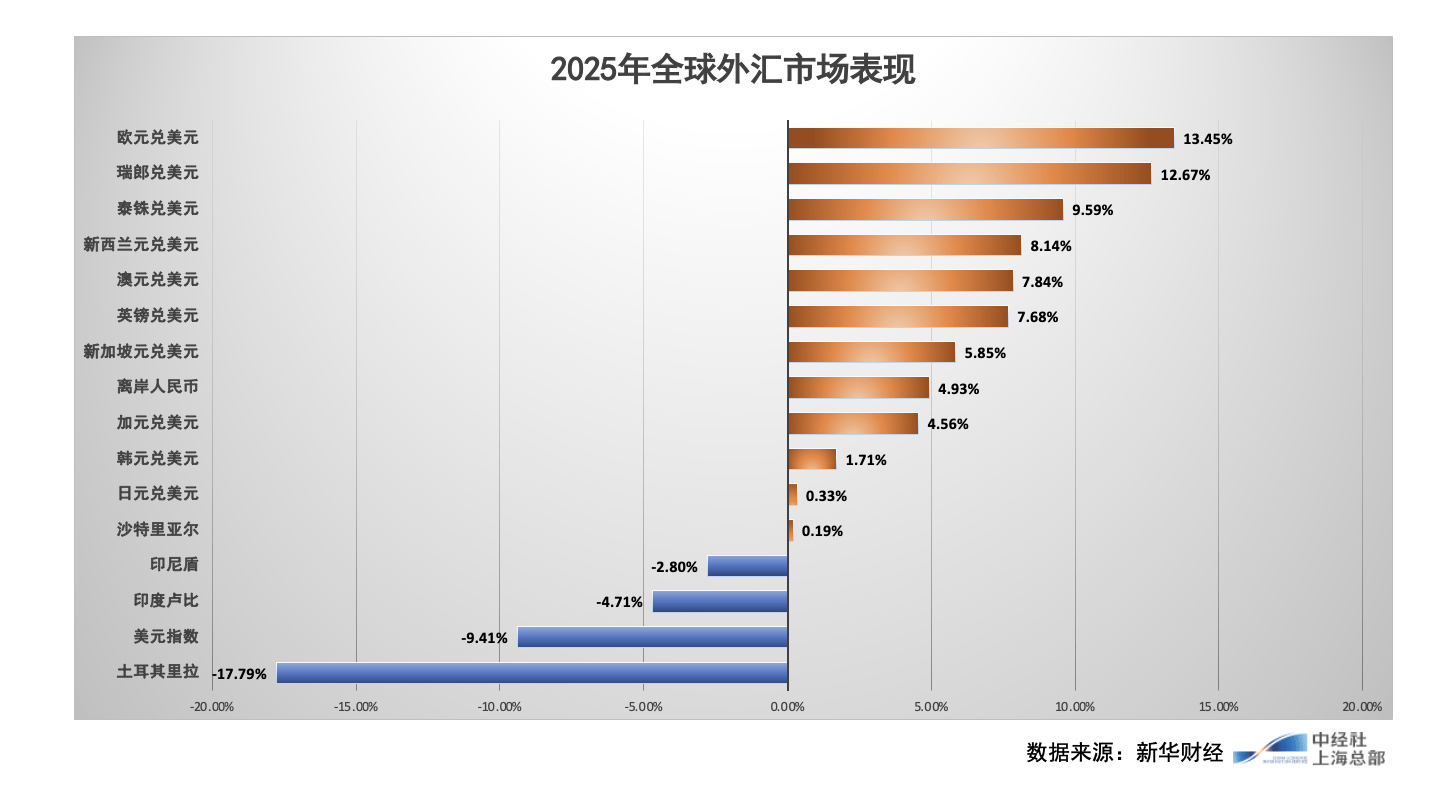
加元承压政策与油价成关键
Jin Tou Wang· 2025-12-30 02:25
Core Viewpoint - The USD/CAD exchange rate is under pressure due to the divergence in monetary policies between the Federal Reserve and the Bank of Canada, alongside fluctuations in oil prices [1][2] Group 1: Monetary Policy Divergence - The Federal Reserve is expected to implement three rate cuts totaling 75 basis points by March 2025, with a projected rate range of 3.50%-3.75% [1] - Despite the Fed's forecast of only one additional rate cut in 2026, market expectations lean towards further easing, with an 81.7% probability of maintaining rates in January [1] - The Bank of Canada has maintained a neutral to hawkish stance, keeping rates at 2.25% after four cuts totaling 100 basis points, leading to expectations of rate hikes in 2026 [1] Group 2: Economic Indicators - Canada's GDP grew by 2.6% in Q3, with employment figures exceeding expectations and the unemployment rate dropping to 6.5%, indicating economic resilience [1] - The narrowing interest rate differential between the US and Canada is a primary factor pressuring the USD/CAD exchange rate [1] Group 3: Commodity Correlation - The Canadian dollar, as a commodity currency, is closely linked to oil prices, with Canada being the largest oil supplier to the US [1] - Recent WTI crude oil prices rebounded to $57.20 per barrel, supported by geopolitical factors in the Middle East [1] - Although oil prices have dropped by 15.2% in 2025, the narrowing spread between WCS and WTI prices and supply chain concerns have attracted capital inflows into Canadian assets [1] Group 4: Technical Analysis - The USD/CAD has been in a downward trend since November, breaking below the 1.3700 support level and testing lower support levels around 1.3640-1.3660 [2] - If the exchange rate effectively breaks below the 1.3640 support, it may decline to the 1.3550-1.3580 range, while resistance levels are identified at 1.3720-1.3750 [2] - The medium-term outlook remains bearish, with a focus on the upcoming Federal Reserve meeting minutes and Bank of Canada guidance on interest rates and inflation [2]