美联储宽松预期

Search documents
长江有色:春节前镍市供需双淡观望主导 10日镍价或涨跌不大
Xin Lang Cai Jing· 2026-02-10 03:33
Group 1 - Nickel futures market shows a rebound driven by a weaker US dollar and improved sentiment in the US stock market, with LME nickel closing at 17,410, up 175 USD/ton, a 1.02% increase [1] - Domestic nickel futures also experienced a slight increase, with the main contract closing at 134,820 CNY/ton, up 1,210 CNY/ton, a 0.91% rise [1] - LME nickel inventory reported at 285,072 tons, a decrease of 210 tons from the previous trading day [1] Group 2 - The macroeconomic environment indicates a warming sentiment, with the overnight surge in LME nickel attributed to improved market conditions rather than fundamental changes [2] - The weakening US dollar has elevated industrial metal valuations, while a rebound in US tech stocks has increased risk appetite and attracted funds back into the non-ferrous sector [2] - Geopolitical tensions are providing support for nickel prices, with expectations of supply disruptions from key producing countries, particularly Indonesia, which plans to cut nickel mining quotas by 34% by 2026 [2] Group 3 - The nickel market is currently experiencing a dual warm macro environment, with expectations of recovery post-holiday supporting prices [2] - The demand for traditional stainless steel is weakening, while the demand for high-nickel batteries in the new energy sector remains robust, with a projected penetration rate exceeding 70% by 2026 [2] - Investment strategy suggests a cautious approach ahead of the holiday, avoiding high-risk positions while waiting for post-holiday recovery opportunities [2]


黄金连阳上涨,剑指5000关口,今日行情走势要点分析(2026.1.23)
Sou Hu Cai Jing· 2026-01-23 00:53
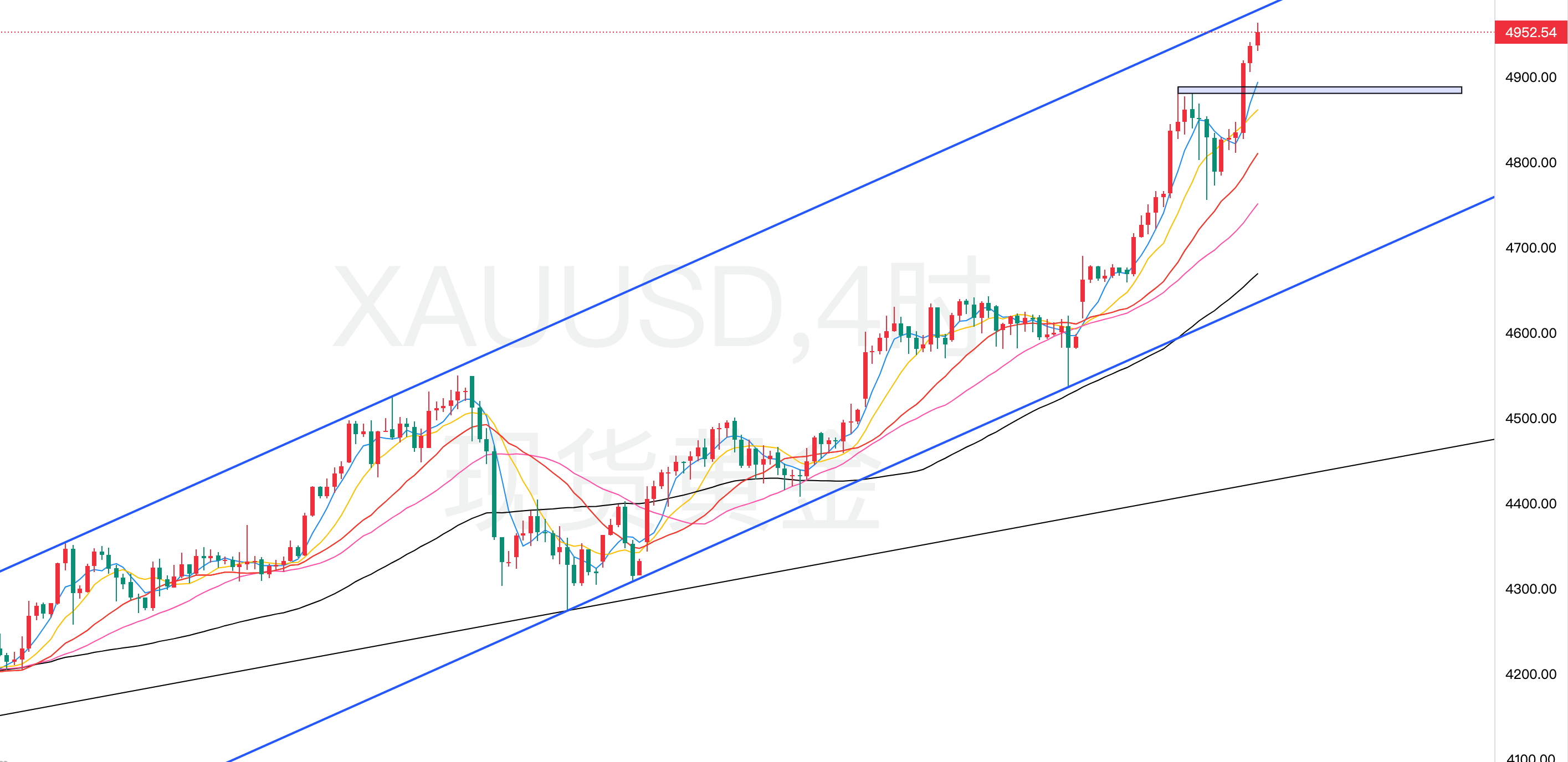
Core Viewpoint - The gold market is experiencing a bullish trend driven by geopolitical tensions, a weakening dollar, and expectations of monetary easing from the Federal Reserve, which collectively enhance the appeal of gold as a safe-haven asset [2]. Group 1: Fundamental Analysis - Geopolitical tensions are escalating, particularly regarding Greenland, with the U.S. and NATO ensuring "comprehensive and permanent access" to the region, which is increasing market risk aversion and driving funds into gold [2]. - The dollar index fell by 0.5% to 98.28, nearing a three-week low, which reduces the cost for overseas buyers of gold; market expectations suggest the Federal Reserve may cut rates by a total of 50 basis points in the second half of 2026, lowering the opportunity cost of holding gold [2]. - The rise in gold prices is also boosting other precious metals like silver, platinum, and palladium, supported by industrial demand driven by geopolitical tensions, a weaker dollar, and ongoing supply chain uncertainties [2]. Group 2: Technical Analysis - On the daily chart, gold prices have shown a four-day consecutive rise, indicating strong bullish momentum and a robust market buying interest, with all moving averages in a bullish alignment, suggesting a solid medium-term upward trend [3]. - Key support levels to watch are between 4830 and 4820, which are critical for maintaining the short-term bullish trend, while the price is currently diverging from the moving averages, indicating potential for a short-term pullback [3]. - On the four-hour chart, gold prices are continuing their upward trend, with a focus on the support level around 4888-4880, which is significant for maintaining the upward momentum; resistance levels are identified at 4980-5000, with 5000 being a key psychological barrier [5].
华尔街对白银后市看法
Sou Hu Cai Jing· 2026-01-16 08:57
Group 1 - Citigroup has significantly raised its silver price target for the next 0-3 months from $62/oz to $100/oz, while also bullish on gold at $5000/oz, driven by escalating geopolitical risks, persistent physical market shortages, and expectations of easing monetary policy due to doubts about the Federal Reserve's independence [1] - UBS predicts that silver may outperform gold by 2026, driven by industrial demand growth in sectors like renewable energy and AI, with a forecast of reaching $100/oz in the first half of the year, but potentially falling to around $75/oz by year-end due to the nearing end of the Fed's easing cycle [1] - Goldman Sachs emphasizes that silver is more sensitive to capital flows due to the lack of central bank reserve demand, predicting continued price increases but with significantly higher volatility and uncertainty compared to gold [1] Group 2 - JPMorgan maintains a cautious outlook, projecting an average silver price of $40.1/oz for 2026, acknowledging that geopolitical risks and global debt issues will support silver prices, but the pace of increase may be slower [2] - Bank of America provides a wide price range forecast for silver, suggesting it could peak between $135 and $309/oz, based on the expectation that gold reaching $5000/oz will drive silver's rise, alongside supply-demand gaps and industrial demand growth, though no specific timeline is given [2] Group 3 - GF Futures notes that bullish funds are significantly increasing their positions in silver through ETFs and physical delivery, driving prices higher, while global inventory tightness has not truly eased, potentially suppressing industrial demand [5] - The firm warns that the current high price levels may lead to a correction due to irrational price movements driven by short-term capital sentiment, suggesting a cautious approach with light long positions above $70/oz [5]


贵金属:贵金属日报2026-01-16-20260116
Wu Kuang Qi Huo· 2026-01-16 01:56
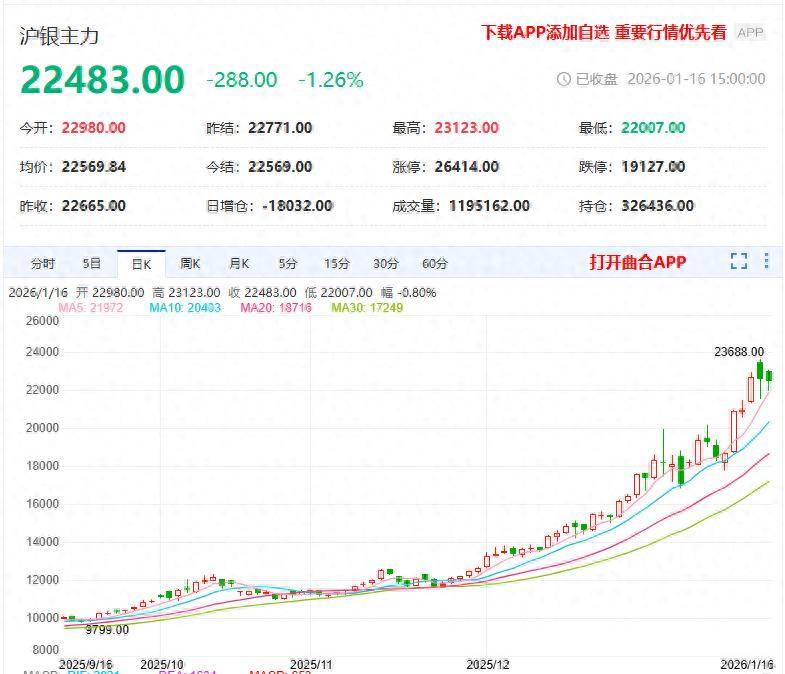
Group 1: Report Industry Investment Rating - No information provided Group 2: Core Viewpoints - The current international gold price is rising steadily, while the silver price is rising rapidly with significantly increased volatility, reflecting the setback of the Fed's independence and the supply - demand imbalance in the physical market. It is recommended to hold existing long positions, as opening new long or short positions involves high risks. The reference trading range for the main contract of Shanghai gold is 980 - 1100 yuan/gram, and for the main contract of Shanghai silver is 19050 - 25000 yuan/kilogram [4] Group 3: Summary by Directory 1. Market Quotes - Shanghai gold rose 0.04% to 1035.98 yuan/gram, and Shanghai silver rose 1.40% to 23089.00 yuan/kilogram. COMEX gold was reported at 4620.50 dollars/ounce, and COMEX silver at 92.21 dollars/ounce. The US 10 - year Treasury yield was 4.17%, and the US dollar index was 99.35 [2] - Trump announced not to impose tariffs on key metals such as silver, platinum, and palladium for the time being. In the short term, US silver inventories will further flow out. COMEX silver inventories decreased by 509 tons from 13989.5 tons at the beginning of this year to 13479 tons on January 15. The one - month spot lease rate dropped to 4% yesterday, alleviating the expectation of tight overseas spot supply. However, the outflow of New York silver inventories cannot change the structural shortage of silver. India's single - month imports in October last year exceeded 1700 tons, and it has greater import potential in the first quarter of this year due to new mortgage regulations [2] - Inflation data declined, supporting the market's expectation of the Fed's easing this year. The US CPI data was lower than expected. The year - on - year value of the US December CPI was 2.7%, in line with expectations and the previous value, and the month - on - month value was 0.3%, also in line with expectations. The year - on - year value of the US December core CPI was 2.6%, lower than the expected 2.7% and the same as the previous value, and the month - on - month value was 0.2%, lower than the expected 0.3% [3] 2. Key Data of Gold and Silver - Gold: The closing price of the active COMEX gold contract was 4620.50 dollars/ounce, down 0.29%; the trading volume was 22.32 million lots, down 23.12%; the CFTC - reported open interest was 48.81 million lots, up 1.30%; the inventory was 1124 tons, down 0.23%. The closing price of LBMA gold was 4610.85 dollars/ounce, up 0.09%. The closing price of the active SHFE gold contract was 1035.20 yuan/gram, down 0.52%; the trading volume was 39.29 million lots, down 2.23%; the open interest was 34.88 million lots, up 0.07%; the inventory was 100.15 tons, unchanged. The settled funds were 57.768 billion yuan, down 0.45%. The closing price of AuT + D was 1033.92 yuan/gram, down 0.36%; the trading volume was 45.45 tons, down 31.36%; the open interest was 186.24 tons, down 2.40% [6] - Silver: The closing price of the active COMEX silver contract was 92.21 dollars/ounce, down 1.05%; the CFTC - reported open interest was 15.32 million lots, down 2.64%; the inventory was 13480 tons, down 0.23%. The closing price of LBMA silver was 91.27 dollars/ounce, up 0.19%. The closing price of the active SHFE silver contract was 22665.00 yuan/kilogram, down 0.43%; the trading volume was 311.70 million lots, up 14.39%; the open interest was 74.36 million lots, up 0.69%; the inventory was 638.40 tons, up 1.54%. The settled funds were 45.504 billion yuan, up 0.25%. The closing price of AgT + D was 22684.00 yuan/kilogram, down 0.36%; the trading volume was 657.20 tons, down 19.09%; the open interest was 3125.288 tons, up 1.47% [6] 3. Price and Volume Charts - There are multiple charts showing the relationships between gold and silver prices, trading volumes, open interests, and other factors, including the relationship between COMEX gold price and the US dollar index, the relationship between COMEX gold price and actual interest rate, the relationship between SHFE gold price and trading volume, etc. [8][11][12][16][26][29][30][31] 4. Near - and Far - Month Structures and Spreads - There are charts and data showing the near - and far - month structures of COMEX gold and silver, as well as the spreads between different markets such as SHFE - COMEX and SGE - LBMA for gold and silver [21][22][34][37][39][48]
有色金属行业周报:有色板块集体走强,聚焦美联储领导层更迭后续影响-20260115
Western Securities· 2026-01-15 11:17
Investment Rating - The report maintains a positive outlook on the non-ferrous metals sector, highlighting opportunities driven by macroeconomic conditions and supply constraints [8][9]. Core Insights - The non-ferrous metals sector has shown significant strength, outperforming the Shanghai Composite Index by 4.74 percentage points, with a weekly increase of 8.56% [11]. - Key price movements include copper prices rising to $12,998.00 per ton, an increase of 4.31% week-on-week, and aluminum prices reaching $3,136.00 per ton, up 3.81% [22][25]. - The report emphasizes the importance of macroeconomic indicators, such as the U.S. non-farm payrolls and unemployment rate, which influence market expectations for Federal Reserve interest rate decisions [16][17]. Summary by Sections Market Review - The non-ferrous metals sector significantly outperformed the Shanghai Composite Index, with notable increases in various sub-sectors, including precious metals and industrial metals [11]. - The report details specific stock performances, with top gainers including Tianli Composite (+35.97%) and Yunnan Zhenye (+22.58%) [11]. Key Focus Areas & Price Changes - U.S. non-farm employment increased by 50,000 in December, with an unemployment rate of 4.4%, slightly below expectations, impacting market sentiment [16]. - Domestic CPI rose by 0.8% year-on-year in December, the highest in nearly two years, while PPI's decline narrowed to 1.9% [17]. - The Kamoa-Kakula copper smelter successfully produced its first batch of anode copper, with expected production of 380,000 to 420,000 tons of copper concentrate in 2026 [19]. - Baogang Co. set the price for rare earth concentrates at 26,834 yuan per ton for Q1 2026, with adjustments based on REO content [20]. Metal Prices & Inventory Changes - Industrial metals showed price increases, with copper and aluminum prices rising significantly, while inventories displayed mixed trends across different exchanges [22][24]. - Precious metals, particularly gold and silver, saw price increases driven by geopolitical factors and expectations of monetary easing by the Federal Reserve [37][38]. - Energy metals, including lithium and cobalt, continued to see price increases, with lithium prices reaching 143,200 yuan per ton, up 18.68% [42]. Strategic Metals & Investment Opportunities - The report highlights the ongoing price increases in tungsten and the potential for investment opportunities in this sector, driven by supply constraints and policy support [46][58]. - The strategic metals sector is expected to benefit from easing export restrictions and improved market conditions, with a focus on cobalt, antimony, and tungsten [58][59].
沪锡期货主力合约突破44万元/吨关口 一度触及涨停
Jin Tou Wang· 2026-01-15 02:15
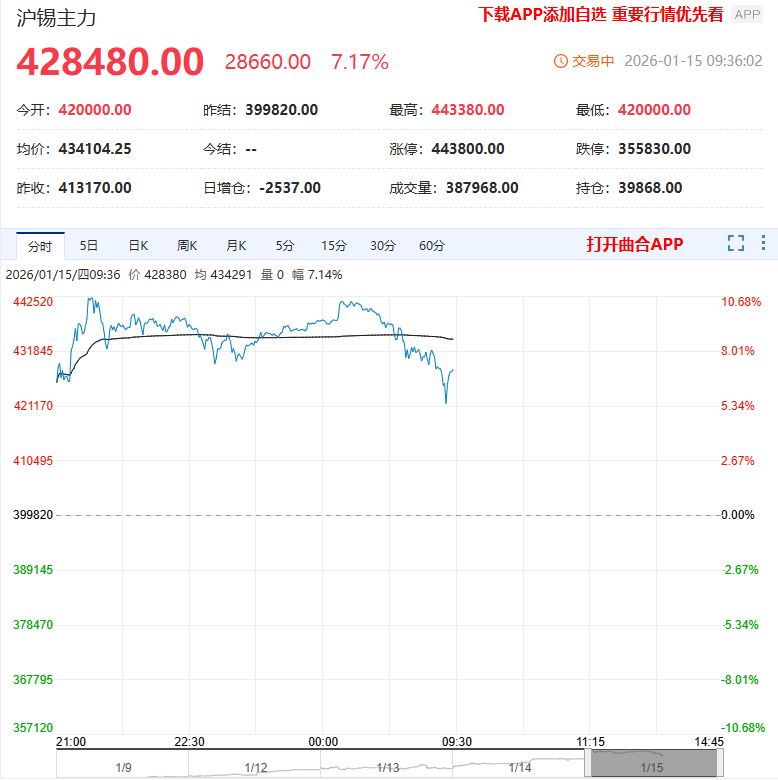
Group 1 - The core viewpoint is that the tin futures market in Shanghai has experienced a significant surge, with the main contract price exceeding 440,000 yuan/ton, reflecting a rise of over 7% [1] - Indonesia is expected to approve a nickel ore production quota of approximately 260 million tons for 2026, with an estimated tin production quota of 60,000 tons [1] - The export volume of tin from Indonesia in 2025 is projected to be 53,000 tons, representing a year-on-year increase of 13.21% [1] Group 2 - The ongoing internal armed conflicts in the Democratic Republic of the Congo, a key tin mining region, have raised concerns about supply disruptions [2] - Demand for tin is increasing due to industries such as AI servers, alongside expectations of monetary easing from the Federal Reserve and a strong overall metal sector [2] - Tin prices have surpassed historical ranges, indicating a sustained strong trend in the short term due to the limited availability of tin resources and potential supply shocks [2]
大宗商品市场 | 沪银大涨超14% 碳酸锂沪锡双双涨停
Sou Hu Cai Jing· 2026-01-12 11:01
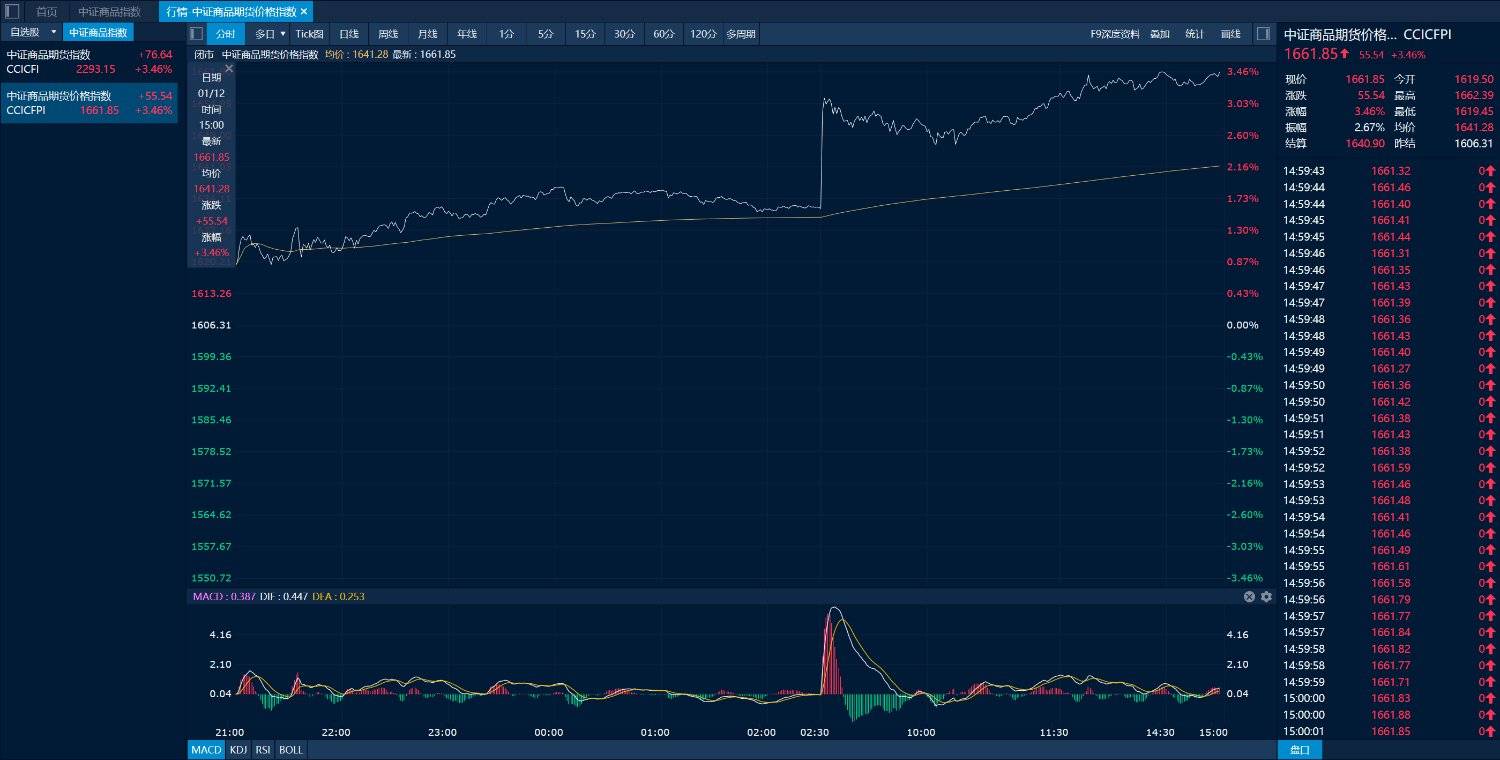
Group 1: Commodity Market Overview - On January 12, the domestic commodity futures market saw more gains than losses, with the main contract for silver rising over 14% and the main contract for carbon lithium and tin hitting the daily limit with increases of 9.00% and 8.00% respectively [1][2] - The China Securities Commodity Futures Price Index closed at 1661.85 points, up 55.54 points or 3.46% from the previous trading day, while the China Securities Commodity Futures Index closed at 2293.15 points, also up 76.64 points or 3.46% [1] Group 2: Metal Sector Performance - The metal sector remained active, driven by geopolitical tensions and expectations of Federal Reserve easing, with silver leading the market with a 14.42% increase [2] - The strong demand from AI and new energy developments, along with supply constraints and geopolitical disturbances, continued to attract investment in metals [2] - Despite increased margin requirements for silver futures by several exchanges, the market for silver remained robust, with expectations of continued upward price movement [2] Group 3: Energy and Chemical Sector Insights - The energy and chemical sectors were also buoyed by geopolitical concerns, with WTI crude oil opening strong above $59 per barrel due to fears of U.S. intervention in Iran [3] - Domestic chemical products saw widespread gains, with styrene rising over 3% and other products like polypropylene and PX also increasing by over 1% [3] - The shipping market experienced a rebound in bullish sentiment, with the main contract for the European shipping index rising over 11% [3] Group 4: Specific Commodity Challenges - The main contract for polysilicon opened high but fell significantly by the end of the day, down 2.89%, due to regulatory pressures and changes in market sentiment [4] - High-sulfur fuel oil did not follow the upward trend of crude oil, closing down 1.32%, as supply-side pressures continued to impact its price [4]
商品日报(1月12日):沪银大涨超14% 碳酸锂沪锡双双涨停
Sou Hu Cai Jing· 2026-01-12 09:56
Core Viewpoint - The domestic commodity futures market experienced a general increase on January 12, with significant gains in metals and energy sectors driven by geopolitical tensions and expectations of monetary easing from the Federal Reserve [1][3]. Group 1: Metal Sector - The lead in the commodity market was taken by silver, which surged by 14.42%, while lithium carbonate and tin both hit the daily limit with increases of 9.00% and 8.00% respectively [1][3]. - Other metals such as copper, palladium, platinum, and nickel also saw gains exceeding 3% to 5%, with gold rising by 2.57% and reaching a historical high above 1030 yuan per gram [3]. - The strong demand from AI and new energy sectors, coupled with supply constraints and geopolitical disturbances, continues to drive investment in metals, particularly silver, which has been in a supply deficit for five consecutive years [3]. Group 2: Energy Sector - The energy and chemical sectors also benefited from geopolitical concerns, with WTI crude oil opening strong above $59 per barrel due to fears of U.S. intervention in Iran and other geopolitical tensions [4]. - Despite the rebound in oil prices, analysts caution that the fundamental oversupply situation in the oil market remains unchanged, which could lead to a return to weaker prices if geopolitical premiums diminish [4]. - The chemical market saw broad increases, with styrene rising over 3% and other products like polypropylene and PX also gaining more than 1% [5]. Group 3: Silicon Sector - The polysilicon market faced downward pressure, closing down 2.89% due to regulatory concerns and the cancellation of export tax rebates, shifting market sentiment from strong expectations to a weaker reality [6]. - The regulatory environment is expected to change the dynamics of polysilicon production, moving towards market competition driven by technological advancements rather than prior industry coordination [6]. Group 4: High Sulfur Fuel Oil - Despite the overall strength in oil prices, high sulfur fuel oil saw a decline of 1.32% due to supply-side pressures, although demand for marine fuel oil is gradually recovering [7]. - The entry of Venezuelan heavy crude oil into the global market is anticipated to exert downward pressure on the price differentials for heavy sulfur crude and high sulfur cracking margins [7].
分析师:黄金长期前景依然乐观 但短期风险有所上升
Ge Long Hui· 2026-01-12 06:40
Core Viewpoint - The long-term outlook for gold remains positive, but short-term risks have increased due to high prices [1] Group 1: Market Dynamics - Spot gold prices have surpassed the $4600 mark, setting a new milestone amid strong macroeconomic and geopolitical forces [1] - A softening U.S. labor market has heightened expectations for more aggressive interest rate cuts by the Federal Reserve, acting as a key driver for gold prices [1] Group 2: Supporting Factors - The combination of expectations for Federal Reserve easing, continued inflows into ETFs, and robust physical demand supports the long-term bullish narrative for gold [1] - Investors are advised to maintain an optimistic yet cautious stance due to the historical high prices of gold and prepare for increased volatility [1]
2026年资产价格走势怎么看?5位首席给出答案
Xin Lang Cai Jing· 2026-01-11 15:08
Group 1 - The core logic for 2026 is "a rising tide lifts all boats," indicating that various asset classes will have opportunities, but volatility may increase compared to 2025 [4] - The stock market's key focus is not on index peaks but on whether new and old growth drivers can resonate together, with technology remaining the main theme [5] - The bond market is expected to experience wide fluctuations in interest rates, reflecting structural changes in the macro economy [5] Group 2 - From a country allocation perspective, the gradual appreciation of the RMB presents a revaluation opportunity for Chinese assets, which have medium to long-term allocation value [6] - Long-term prospects for equity assets are positive, but valuation has significantly increased since September 2024, necessitating a reduction in return expectations [6] - The commodity market is anticipated to enter a "super cycle" due to de-globalization and supply chain reconstruction, although participation requires careful risk management [6] Group 3 - The commodity market is expected to see a healthy rotation, transitioning from gold to industrial metals like copper and aluminum, and then to new energy products [7] - 2026 is projected to be a significant year for commodities, with both trends in gold and copper continuing, as well as potential for low-priced commodities to surge [8] - In a declining risk-free interest rate environment, asset allocation should prioritize offensive directions, particularly in the stock market and commodities [8]