
加元汇率

Search documents
油价支撑贸易扰动并存 美加央行立场分化
Jin Tou Wang· 2026-02-03 12:22
Core Viewpoint - The Canadian dollar (CAD) is experiencing fluctuations influenced by multiple macroeconomic factors and market sentiment, with its performance closely tied to international oil prices, the US-Canada interest rate differential, trade relations, and economic fundamentals [1][2]. Group 1: Oil Prices and CAD Correlation - The CAD is highly correlated with international oil prices, which have recently reached near four-month highs due to improved supply-demand dynamics and expectations of global economic recovery, benefiting Canada's trade surplus and capital inflows [1]. - A previous drop in oil prices to $60 per barrel, combined with a weak Canadian economy, led to the CAD depreciating against the USD, hitting a sixteen-month low [1]. Group 2: Monetary Policy Impact - Divergence in monetary policy between the US and Canada is affecting CAD movements, with the Federal Reserve maintaining interest rates and the market pricing in two rate cuts in 2026, which has led to a weaker USD and supported the CAD [1]. - The Bank of Canada also kept rates unchanged, causing the CAD to be more sensitive to oil price fluctuations rather than USD volatility [1]. Group 3: Trade Relations and Market Sentiment - Trade tensions between the US and Canada, particularly the proposed 50% tariff on Canadian aircraft imports, have raised market concerns and led to a short-term rebound of the USD against the CAD [2]. - Ongoing negotiations in the steel and aluminum sectors, as well as the review of the mainland free trade agreement, will further influence CAD movements [2]. Group 4: Technical Analysis and Short-term Outlook - The USD/CAD exchange rate is in a downward channel, having broken below the 1.36 mark, with technical indicators showing mixed signals for short-term direction [2]. - The CAD is expected to be influenced by oil prices, US-Canada trade developments, and US economic data, with the USD/CAD likely to fluctuate between 1.3450 and 1.3700 [2]. Group 5: Medium to Long-term Considerations - The medium to long-term trajectory of the CAD will depend on the stability of oil prices, changes in the US-Canada interest rate differential, and the strength of the Canadian economic recovery [2]. - While Canadian manufacturing shows signs of recovery, volatility in consumer spending may limit CAD appreciation [2].
BlueberryMarkets:油价走低叠加美元获支撑,美元兑加元延续上行
Sou Hu Cai Jing· 2026-02-02 08:51
Group 1 - The USD/CAD exchange rate continues to rise, trading around 1.3660, supported by a combination of factors including a decline in oil prices and a stronger USD [2] - The Canadian dollar's performance is closely linked to oil prices, as Canada is the largest oil exporter to the US, making its economy and currency sensitive to fluctuations in oil prices [2] - Recent declines in West Texas Intermediate (WTI) crude oil prices, which have fallen over 5% in the last four trading days to around $62.00 per barrel, have weakened the support for the Canadian dollar, facilitating the rise of the USD/CAD exchange rate [2] Group 2 - Uncertainty regarding the Federal Reserve's policy outlook and recent statements have bolstered the USD, with the nomination of Kevin Warsh as the next Fed Chair raising expectations for a potential shift towards a more cautious monetary policy [3] - Fed officials have indicated a preference for maintaining current interest rates, with St. Louis Fed President Alberto M. stating that the 3.50%-3.75% policy rate range is neutral, balancing economic growth and inflation pressures [3] - Progress in US fiscal policy, including an agreement in the Senate on government funding, has alleviated risks of a government shutdown, improving market sentiment and further supporting the USD [3]


加元汇率突破油价成博弈核心
Jin Tou Wang· 2026-01-28 02:55
Group 1: Currency Exchange Dynamics - The Canadian dollar (CAD) has significantly strengthened against the US dollar (USD), with a daily increase of 1.0618%, reaching a high of 1 CAD to 0.7374 USD, while also experiencing volatility with an 8-month low and a 16-month high [1] - The USD/CAD exchange rate has dropped below the critical level of 1.3700, hitting a new low of 1.3677 on January 26, indicating a bearish market dominated by short positions [1] - The divergence in monetary policy between the Bank of Canada (BoC) and the Federal Reserve (Fed) is a key factor supporting the CAD's performance, with the BoC maintaining a stable interest rate of 2.25% while the Fed's interest rate remains between 3.5% and 3.75% [1] Group 2: Oil Price Influence - The CAD is closely tied to international oil prices, with recent geopolitical risks raising supply concerns and stabilizing oil prices, which improves Canada's crude oil export outlook and supports the CAD [2] - However, long-term oil prices are pressured by global oversupply, and the potential resumption of Venezuelan oil imports by the US could exacerbate supply concerns, impacting Canadian crude exports [2] - The Canadian Prime Minister's plan to diversify oil exports aims to reduce reliance on the US, addressing long-term concerns for the CAD [2] Group 3: Economic Conditions - Canada's economic recovery is sluggish, with the unemployment rate rising to 6.8% in December 2025, reflecting a structural imbalance in employment and declining consumer confidence [2] - The Bank of Canada forecasts a GDP growth rate of only 1.1% for 2026, indicating weak fundamentals that limit the CAD's upward potential [2] - Trade uncertainties are highlighted by the upcoming summer 2026 review of the Canada-United States-Mexico Agreement (CUSMA), which could impact Canadian exports if terms change [2] Group 4: Technical Analysis - The USD/CAD exchange rate is currently weak, trading around 1.3677, with short-term support levels at 1.3600-1.3620 and resistance levels at 1.3760-1.3780 [3] - Institutions generally believe that the CAD's long-term appreciation potential is limited, with predictions of a moderate appreciation against the USD, centering around an exchange rate of 1.35 in 2026 [3] - Morgan Stanley suggests that the Fed's interest rate cuts will reinforce the USD's advantage, leading to a primarily volatile exchange rate in the short term [3]
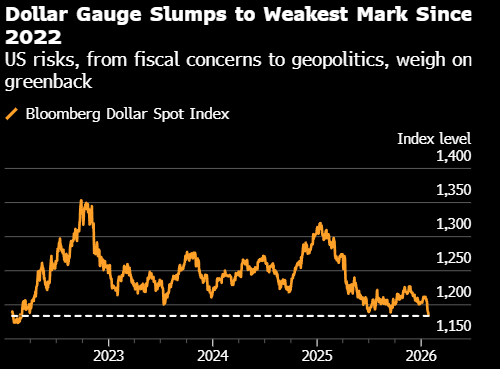
纽约汇市:美元跌至2022年以来最弱 欧元、英镑走高
Xin Lang Cai Jing· 2026-01-27 21:40
Core Viewpoint - The Bloomberg Dollar Index has fallen to its lowest level in nearly four years, driven by a rebound in the yen and uncertainties surrounding a potential government shutdown, leading to a weaker dollar that has strengthened the euro and pound to their highest levels since 2021 [1][4]. Group 1: Dollar Index and Currency Movements - The Bloomberg Dollar Index dropped 0.8%, falling below 1180 points, marking its lowest level since March 2022 [1][4]. - The USD/JPY pair decreased by 1% to 152.57, the lowest since October 30 [7]. - The euro rose by 0.9% to 1.1990, the highest since 2021, while the pound increased by 0.8% to 1.3791, also the strongest since 2021 [7]. Group 2: Market Sentiment and Economic Indicators - Concerns about potential government intervention in the currency market to support the yen and the rising likelihood of a government shutdown have intensified the dollar's downward trend, according to UBS strategist Vassili Serebriakov [1][4]. - The consumer confidence index fell to 84.5 in January, the lowest level since May 2014, as reported by the World Large Enterprises Association [4]. - The short-term options premium benefiting from the weaker dollar has expanded to the highest level since Bloomberg began collecting this data in 2011 [5]. Group 3: Central Bank Actions - Federal Reserve officials are widely expected to keep interest rates unchanged, with close attention on Chairman Powell's press conference following the policy decision [1][4]. - Japan's Finance Minister, after the G7 meeting, stated that they would coordinate closely with U.S. authorities to take appropriate action against currency fluctuations if necessary [7].
加元逼近五个月低位 政策分化油价成博弈核心
Jin Tou Wang· 2025-12-30 02:25
Group 1 - The core viewpoint of the articles indicates that the USD/CAD exchange rate is influenced by the divergence in monetary policy between the Federal Reserve and the Bank of Canada, alongside oil prices and geopolitical risks [1][2] Group 2 - The Federal Reserve completed its third rate cut of the year in December, totaling a 75 basis point reduction for the year, with a dovish outlook from Powell leading to expectations of continued easing [1] - The Bank of Canada maintained its interest rate at 2.25% for the second consecutive month in December after a total of 100 basis points cut during the year, signaling a potential rate hike in 2026 due to positive economic indicators [1] - The Canadian dollar is highly correlated with oil prices, with WTI crude stabilizing around $57.20 per barrel, driven by supply concerns from the Middle East, which supports the CAD [1] Group 3 - Ongoing trade uncertainties in North America, particularly regarding the USMCA negotiations and US tariffs on steel and aluminum, are exerting pressure on the Canadian dollar's fundamentals [2] - Technically, the USD/CAD has been in a downward trend since November, with key support levels at 1.3700 and 1.3640, indicating potential further declines [2] - The medium to long-term outlook for the exchange rate will depend on three main variables: the persistence of the policy divergence between the US and Canada, the recovery of oil prices, and the outcomes of trade negotiations [2]
加元:受关税及降息影响,12月美元兑汇率或降至1.3700
Sou Hu Cai Jing· 2025-09-18 14:11
Core Insights - The report from Deutsche Bank indicates that the Canadian dollar (CAD) is influenced by multiple factors, with the USD/CAD exchange rate expected to decline to 1.3700 by December [1] Group 1: Exchange Rate Predictions - Deutsche Bank forecasts that the USD/CAD exchange rate will decrease from the current 1.3782 to 1.3700 by December [1] - The report highlights that the CAD is likely to appreciate gradually against a weakening USD, while depreciating against the Euro [1] Group 2: Economic Factors - The Canadian dollar is under pressure due to uncertainties in US-Canada trade relations, which are expected to persist until resolved [1] - Following a 25 basis point interest rate cut by the Bank of Canada, further rate cuts may be anticipated to support the domestic economy [1] Group 3: Influencing Factors on USD - The report attributes potential weakness in the USD to the "unstable" political situation in the US, possible significant interest rate cuts, and risks to the independence of the Federal Reserve [1]
油价低迷拖累加元疲软 短期利好难改弱势格局
Jin Tou Wang· 2025-08-26 05:17
Group 1 - The Canadian dollar (CAD) is experiencing weakness due to the recent decline in international oil prices, which is closely linked to the performance of CAD as a commodity currency [1] - Despite a recent improvement in Canadian retail sales data providing a temporary boost to market sentiment, the overall outlook for CAD remains negative amid global economic slowdown and trade uncertainties [1] - CAD faces significant upward resistance and lacks the internal momentum for a sustained rebound unless oil prices trend upward or global risk appetite shifts significantly [1] Group 2 - If the USD/CAD exchange rate breaks above 1.3900, it may further test resistance levels at 1.3950 and the psychological level of 1.4000, with a potential new bullish trend if it surpasses the May high of 1.4015 [2] - The current rise in USD/CAD is primarily driven by the divergence in policies between the Federal Reserve and the Bank of Canada [2] - Key support levels for USD/CAD are in the range of 1.3855-1.3850, with further attention on 1.3800 and the 100-day moving average if it breaks below [2]
加拿大出口发展局:预测加元将保持稳定,2025年平均汇率为72美分。
news flash· 2025-07-16 10:35
Core Viewpoint - The Canadian Export Development Agency predicts that the Canadian dollar will remain stable, with an average exchange rate of 72 cents against the US dollar by 2025 [1] Group 1 - The forecast indicates a stable outlook for the Canadian dollar, suggesting resilience in the currency despite global economic fluctuations [1] - The average exchange rate projection of 72 cents reflects confidence in the Canadian economy's performance over the next few years [1]
市场分析:加元动能遭遇宏观逆风
news flash· 2025-06-16 12:45
Core Viewpoint - The Canadian dollar has appreciated by 3.5% against the US dollar in the second quarter, driven by rising oil prices and negative sentiment towards the US dollar, despite domestic economic challenges [1] Group 1: Economic Indicators - Domestic demand in Canada is weak, and the unemployment rate is rising, which casts a shadow over the outlook for the Canadian dollar [1] - The Canadian bank anticipates that the Bank of Canada will lower interest rates in July, contrary to current expectations, which may weaken the Canadian dollar [1] Group 2: Political and Market Dynamics - The recent throne speech in Ottawa marks a departure from the practices of the Trudeau era, making Canada more attractive for private capital [1] - The Canadian bank projects that the USD/CAD exchange rate will peak at 1.38 before trending towards 1.34 [1]
分析师:加元走强合乎逻辑 但进一步升值可能受限
news flash· 2025-05-29 12:18
Core Viewpoint - The strengthening of the Canadian dollar is logical following the U.S. federal court's blocking of the Trump administration's comprehensive tariff policy, but further appreciation may be limited [1] Group 1: Economic Factors - The close trade relationship between Canada and the U.S. supports the Canadian dollar due to reduced prospects for cross-border trade disruptions and improved growth expectations in the U.S. [1] - The upcoming release of the Federal Reserve's meeting minutes may lead to a further reduction in market expectations for interest rate cuts, which could suppress the appreciation of the Canadian dollar against the U.S. dollar [1]