美国优先外交政策

Search documents
特朗普外交新常态:绕过国会,重大决策均由“亲信圈子”敲定
Jin Shi Shu Ju· 2026-01-26 04:30
Group 1 - The meeting between officials from the US, Denmark, and Greenland was initially calm, with no discussions about military or financial takeover of Greenland [1] - The appointment of Jeff Landry as a special envoy for Greenland by President Trump and his subsequent statements about making Greenland part of the US surprised officials in Copenhagen and within the US government [1] - Trump's foreign policy approach has been characterized by a lack of consultation with traditional national security officials, leading to erratic policy decisions [1][2] Group 2 - The centralization of decision-making in Trump's administration has raised concerns about the potential long-term damage to relationships with key allies [2] - White House officials, including Stephen Miller, have emphasized the possibility of military action regarding Greenland, causing confusion and alarm among US allies [3] - Despite the rhetoric, military action against Greenland was reportedly never seriously considered [4] Group 3 - Trump's threats regarding Greenland have damaged the US's credibility among its closest allies, as noted by former Pentagon and White House officials [5] - The US already has a military presence in Greenland under a treaty with Denmark, which allows for the expansion of its operations there [5] Group 4 - Trump's approach to foreign policy has consistently marginalized experts and centralized decision-making among trusted allies, as seen in various international negotiations [6] - This pattern has also been evident in US policy towards Syria, where key decisions were made without input from traditional policy advisors [7]
美国防部:将国土防御列为首要任务
财联社· 2026-01-24 02:11
Core Viewpoint - The U.S. Department of Defense has released a new National Defense Strategy, prioritizing homeland security and emphasizing the previously overlooked Western Hemisphere [1][2]. Group 1 - The document denies any inclination towards isolationism while urging U.S. allies to take on more responsibilities and increase investments in the defense industrial base [2]. - The National Defense Strategy outlines how the Department of Defense will follow the guidance of the new National Security Strategy report, which is considered a foundational document for the U.S. Department of Defense [2]. - The strategy emphasizes that the primary task of the U.S. military is to defend the homeland, focusing on securing borders, combating drug terrorism, and protecting airspace [2]. Group 2 - The release of the National Security Strategy report in December 2025 details President Trump's "America First" foreign policy, which centers on U.S. core national interests and readjusts global security priorities [2].


美国防部发布《国家防务战略》 将国土防御列为首要任务
Yang Shi Xin Wen· 2026-01-24 01:52
Core Viewpoint - The U.S. Department of Defense has released a new version of the National Defense Strategy, prioritizing homeland security and emphasizing the need for allies to take on more responsibilities while increasing investment in the defense industrial base [1]. Group 1: National Defense Strategy Highlights - The National Defense Strategy (NDS) outlines how the Department of Defense will follow the guidance of the new National Security Strategy report, which is considered a foundational document for the Department [1]. - The document states that the primary mission of the U.S. military is to defend the homeland, with a focus on protecting U.S. interests throughout the Western Hemisphere [1]. - Key measures for "defending the homeland" include ensuring border security, combating drug terrorism, and protecting airspace [1]. Group 2: Context and Background - The new National Security Strategy report was released by the White House in December 2025, detailing President Trump's "America First" foreign policy and focusing on core national interests [1]. - The strategy indicates a shift in U.S. global security priorities, reflecting a re-evaluation of previously neglected regions, particularly the Western Hemisphere [1].
美国家安全战略报告调整全球安全优先事项
Ren Min Ri Bao· 2025-12-07 22:02
Core Viewpoint - The U.S. National Security Strategy report emphasizes an "America First" foreign policy, focusing on core national interests and adjusting global security priorities since President Trump's return to the White House [1][2]. Economic Aspects - The report highlights that economic security is fundamental to national security, advocating for a "rebalancing" of global trade relations and expanding U.S. access to critical minerals and materials [1]. - It calls for monitoring global supply chains and technological advancements, promoting U.S. re-industrialization through "strategic tariffs" and new technology applications [1]. - The report aims to strengthen the U.S. position in energy and finance sectors [1]. Military Aspects - The report stresses the need to prevent regional conflicts from escalating into global wars and to maintain the strongest nuclear deterrent [2]. - It proposes the development of next-generation missile defense systems, such as the "Iron Dome," and revitalizing the defense industrial base to address cost discrepancies in low-cost drones and expensive weapon systems [2]. - The report insists on ending the "free-riding" of allies and partners, requiring them to take on primary defense responsibilities in their regions and contribute more to collective defense [2].
俄总统新闻秘书:美国家安全战略不再将俄称为“直接威胁”是积极举措
Xin Hua She· 2025-12-07 11:22
Core Viewpoint - The latest U.S. National Security Strategy report no longer labels Russia as a "direct threat" and calls for cooperation in the field of strategic stability, which Russia views as a positive development [1]. Group 1: U.S. National Security Strategy - The report was released by the White House on December 4, outlining President Trump's "America First" foreign policy after his return to office in January [1]. - It emphasizes U.S. "core national interests" and readjusts global security priorities [1]. - The report identifies the swift negotiation to end the Ukraine crisis as a "core interest" of the U.S. [1]. Group 2: U.S.-Russia Relations - The report suggests a need to "rebuild strategic stability with Russia" [1]. - It also indicates a desire to "end the perception of NATO as a permanently expanding alliance" [1]. - Russia's response includes a commitment to further analyze the adjusted U.S. National Security Strategy [1].
【环球财经】欧盟高级官员回应美国家安全战略报告对欧批评
Xin Hua She· 2025-12-07 03:02
Core Viewpoint - The U.S. National Security Strategy report emphasizes a "America First" foreign policy under President Trump's administration, focusing on core national interests and adjusting global security priorities [1] Group 1: Criticism of Europe - The report sharply criticizes Europe, warning of a "severe prospect of civilizational decline" due to issues like immigration policy [1] - It suggests that U.S. policy towards Europe should prioritize "helping Europe correct its current trajectory" [1] Group 2: Response from the EU - The EU's High Representative for Foreign Affairs and Security Policy, Josep Borrell, responded by acknowledging that while the EU and the U.S. are allies, their opinions on various issues are not always fully aligned [1]
欧盟高级官员回应美国家安全战略报告对欧批评
Xin Hua She· 2025-12-07 01:18
Core Viewpoint - The U.S. National Security Strategy report emphasizes a "America First" foreign policy under President Trump's administration, focusing on core national interests and adjusting global security priorities [2] Group 1: Criticism of Europe - The report sharply criticizes Europe, warning of a "severe prospect of civilizational extinction" due to issues like immigration policy [2] - It suggests that U.S. policy towards Europe should prioritize "helping Europe correct its current trajectory" [2] Group 2: EU Response - The EU's High Representative for Foreign Affairs and Security Policy, Josep Borrell, responded by acknowledging that while the EU and the U.S. are allies, their opinions on various issues are not always fully aligned [2]
美副总统万斯访问英国 此前多次唱衰英国和工党
Xin Lang Cai Jing· 2025-08-08 07:55
Core Points - The visit of Vice President Vance to the UK has sparked renewed attention on his past critical remarks about the UK and its ruling Labour Party [1] - Vance's itinerary includes official activities, meetings, and cultural site visits, indicating a focus on diplomatic engagement [1] - The visit is also expected to include a meeting with American military personnel, highlighting the importance of military relations [1] Summary by Sections - **Visit Details** - Vice President Vance will meet with UK Foreign Secretary Lami during his visit [1] - The family will stay at Chevening, the official residence of the Foreign Secretary, and will also visit the picturesque Cotswolds [1] - **Past Remarks** - Vance has previously criticized the Labour Party's victory, suggesting the UK could become the first "truly Islamic state" with nuclear weapons [1] - He has also accused the UK of suppressing free speech and endangering the basic freedoms of religious figures [1] - **Lami's Position** - Lami has previously labeled Trump as an "extreme right-wing extremist" and "neo-Nazi," but has since downplayed these comments as "old news" [1]
40多年来美国第三次“退群”!联合国教科文组织“深表遗憾”
Xin Hua She· 2025-07-23 00:42
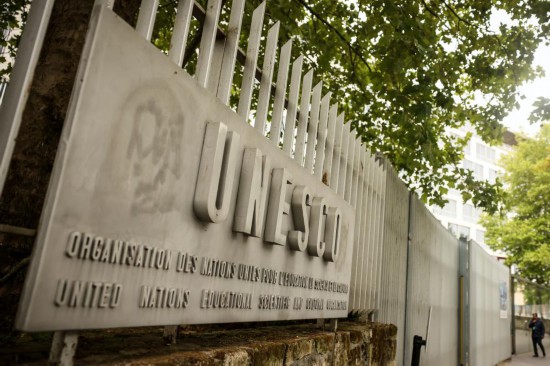
Core Points - The United States has announced its withdrawal from UNESCO, marking the third time in over 40 years that the U.S. has exited the organization [1][2] - The decision is attributed to concerns over UNESCO's focus on divisive social and cultural initiatives and its alignment with U.S. foreign policy priorities [2] - The withdrawal will take effect on December 31, 2026, according to UNESCO regulations [2] Responses - UNESCO's Director-General, Audrey Azoulay, expressed deep regret over the U.S. decision to withdraw [2] - French President Emmanuel Macron reaffirmed support for UNESCO as a guardian of global science, education, culture, and heritage, stating that the U.S. exit will not weaken the commitment to these causes [2] Historical Context - The U.S. has previously withdrawn from UNESCO twice: first in 1984 due to allegations of corruption and mismanagement, and again in 2017, before rejoining in 2023 [4]
真被中方等到?特朗普将下调对华关税,美国务院重组,信号很特殊
Sou Hu Cai Jing· 2025-04-28 11:48
Group 1 - The core issue revolves around the potential reduction of tariffs on China by the Trump administration, which may exceed 50%, contingent on China's response to U.S. tariffs [1] - The trade war initiated by the U.S. is emphasized, with a call for dialogue based on equality and mutual respect [1] - Analysts suggest that any tariff reduction would be largely symbolic and unlikely to change the fundamental trade dynamics between the U.S. and China [3] Group 2 - Trump's consideration to lower tariffs is seen as a strategy to boost the U.S. stock market and appease key supporters in agriculture and automotive sectors [3] - The U.S. government faces significant pressure, with rising consumer prices and potential supply chain issues highlighted by retail giants like Walmart [3] - Trump's need to maintain a favorable public image and demonstrate success in negotiations is noted as a driving factor behind the tariff discussions [5] Group 3 - The U.S. Treasury Secretary has acknowledged the unsustainability of the trade war, indicating a need for both nations to find ways to ease tensions [5] - A comprehensive restructuring plan for the U.S. State Department is underway, aiming to implement Trump's "America First" policy, which includes a 15% reduction in staff and the elimination of 132 offices [5][7] - The restructuring has received mixed reactions domestically, with Republican support and Democratic criticism regarding its potential impact on U.S. global influence [7]