美联储政策预期转向

Search documents
日经指数暴跌3%:全球资本为何集体“出逃”?
Sou Hu Cai Jing· 2025-11-18 10:59
Group 1 - The Nikkei 225 index experienced a significant drop of 3.93%, marking the largest single-day decline of the year, falling below the 17,000-point threshold [3] - The semiconductor sector was heavily impacted, with major companies like Tokyo Electron seeing stock prices plummet nearly 8%, following TSMC's downward revision of its 2024 semiconductor growth forecast [3] - A widespread sell-off occurred across all 33 industry sectors on the Tokyo Stock Exchange, indicating a rare and comprehensive market collapse [3] Group 2 - Other Asian markets also faced severe declines, with the South Korean Composite Index down 1.9%, the Hong Kong Hang Seng Index down 1.4%, and the Singapore Straits Times Index down 1.2%, highlighting a systemic decline in investor risk appetite across the region [4] - The depreciation of the yen against the dollar, which fell below 144, further pressured export-oriented companies, illustrating the dual impact of currency fluctuations on market performance [3][4] - Geopolitical risks, including ongoing tensions in the Middle East and the Russia-Ukraine conflict, have significantly undermined investor confidence, prompting a retreat from emerging markets to safer assets [5] Group 3 - Recent hawkish signals from multiple Federal Reserve officials regarding potential delays in interest rate cuts or even a resumption of rate hikes have contributed to market volatility and tightened global liquidity expectations [6] - The overall bleak outlook for the global economy, exacerbated by trade tensions and sluggish growth in major economies, is shaking long-term market confidence [6] - These factors are interlinked, creating a vicious cycle where geopolitical risks raise oil prices, increasing inflationary pressures, which in turn limit central bank policy options and hinder economic recovery [6]


道指大跌超500点,多数中概股下跌,逸仙电商跌近21%,小鹏跌10%,比特币跌破92000美元
21世纪经济报道· 2025-11-17 23:35
Market Overview - On November 18, U.S. stock indices collectively declined, with the Dow Jones dropping over 500 points, a decrease of approximately 1.2% [1] - The S&P 500 index fell over 2% in November, marking a reversal after six consecutive months of gains, and is down more than 3% from its historical peak [1] - The tech-heavy Nasdaq index has retreated over 5% from its record high [1] Stock Performance - Major tech stocks mostly fell, with Micron Technology down nearly 2%, Nvidia and Apple down over 1.8%, and Meta down 1.2%. Tesla, however, rose by 1.1% [2] - Google was a notable exception, initially rising 6% to reach a new all-time high, closing with a gain of just over 3%. Berkshire Hathaway reportedly increased its stake in Google during Q3 [2] - The Nasdaq Golden Dragon China Index fell by 1.21%, with significant declines in several Chinese stocks: Yatsen down nearly 21%, Manbang down over 11%, and XPeng down over 10% [2] Commodity and Cryptocurrency Market - Precious metals and base metals experienced widespread declines, with spot gold dropping nearly 2% to a low of $4006.80 per ounce, closing around $4045. Silver also fell over 1% [4] - The CME FedWatch Tool indicates a decrease in the probability of a 25 basis point rate cut by the Federal Reserve in December to 42.9% [4] - Cryptocurrencies faced significant downturns, with Bitcoin dipping below $92,000 and Ethereum also falling below $3,000. Over 160,000 traders were liquidated in the past 24 hours, with a liquidation amount of $851 million [4][6] Market Sentiment - The recent decline in Bitcoin is attributed to tightening U.S. dollar liquidity and changing Federal Reserve policy expectations, leading to increased funding costs that impact high-volatility assets [6] - An unusual phenomenon observed is the simultaneous decline of risk assets like Bitcoin and traditional safe-haven assets like gold, which raises concerns among analysts [6]

大摩:本轮美股上涨有坚实的基本面
Hua Er Jie Jian Wen· 2025-07-01 02:58
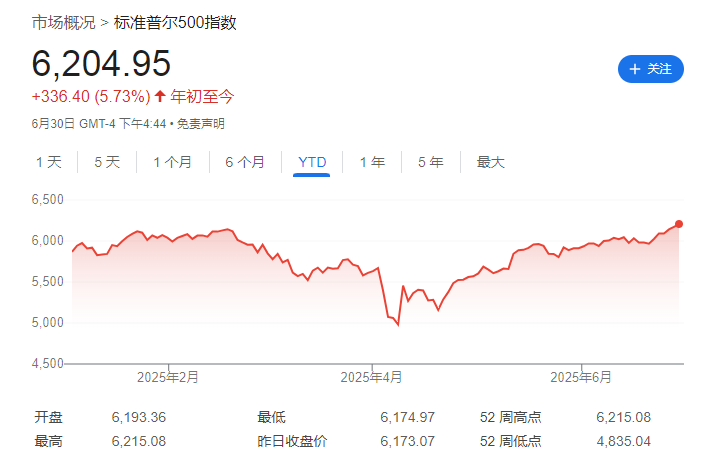
Group 1 - The core viewpoint of the article is that the recent rebound in the US stock market is supported by fundamental improvements, driven by three key factors: earnings expectations revision, a shift in Federal Reserve policy expectations, and a reduction in geopolitical and policy risks [1][10][12] Group 2 - Earnings expectations have significantly improved, with the breadth of earnings revisions rising from a low of -25% in mid-April to -5%, indicating a strong recovery in corporate earnings outlook [3][5] - Historical data suggests that similar V-shaped recoveries in earnings revisions often lead to strong market returns over the following 12 months [5] - The preference for large-cap quality stocks, represented by the "Magnificent Seven," continues to lead in earnings revisions and stock performance, while small-cap stocks lag behind historical highs [7][14] Group 3 - The market is increasingly pricing in potential interest rate cuts by the Federal Reserve, with Morgan Stanley predicting up to seven rate cuts by the end of next year, which could support stock valuations in the second half of this year [10][11] - Employment market data will be a key trigger for the Fed's policy shift, with significant private sector job growth below expectations potentially prompting earlier rate cuts [11] Group 4 - Geopolitical risks have eased, with oil prices dropping 14% since June 19, reducing inflationary pressures and potential threats to the business cycle [13] - The removal of concerns regarding the "capital tax" clause from the "Big Beautiful" plan alleviates risks related to foreign direct investment in the US [13] Group 5 - The current stock risk premium is at a 20-year low, while earnings risk is at a 20-year high, indicating a notable contradiction that warrants attention [14] - Long-term prospects remain optimistic, with AI-driven productivity improvements expected to contribute an additional 30 basis points to S&P 500 net profit margins by 2025-2026, expanding to 50 basis points by 2027 [16]
金价惊现大跳水,原因几何?
Sou Hu Cai Jing· 2025-05-14 15:00
Group 1 - The core point of the article is the significant drop in gold prices on May 12, with international spot gold falling below $3300 per ounce and reaching a low of $3207 per ounce, reflecting a notable daily decline [1] Group 2 - Geopolitical tensions have eased, leading to a decrease in safe-haven demand for gold, as evidenced by the calming signals from the India-Pakistan conflict and renewed negotiation proposals from Russia regarding Ukraine [3] - Expectations regarding the Federal Reserve's monetary policy have shifted, with a growing anticipation of delayed interest rate cuts, which could increase the opportunity cost of holding gold and subsequently lower its demand [4] Group 3 - Technical selling pressure has intensified, with a significant reduction in net long positions in gold and a high percentage of programmatic selling contributing to the price drop [5] Group 4 - Domestic consumption demand for gold has weakened post the May Day holiday, with reduced market demand and some brands resorting to discount promotions to accelerate inventory turnover, further exerting downward pressure on gold prices [7] Group 5 - The combined effects of geopolitical factors, monetary policy expectations, technical selling, and domestic demand fluctuations have collectively contributed to the sharp decline in gold prices on May 12 [9]