
股市过热

Search documents
中国股市14连阳,还会继续吗?
日经中文网· 2026-01-08 02:59
Core Viewpoint - The Shanghai stock market has shown signs of overheating, with the Shanghai Composite Index closing at 4085.7723 points on January 7, marking the longest streak of consecutive gains since its inception in 1993, with 14 consecutive trading days closing higher than opening prices [2][4]. Group 1: Market Performance - The Shanghai Composite Index's 14-day consecutive rise has surpassed the previous record of 13 days set by Japan's Nikkei index during the economic bubble in 1988 [4]. - Despite the index rising, major component stocks like China Agricultural Bank and China National Petroleum Corporation saw declines of 0.92% and 3.60% respectively, indicating that the main drivers of the index's rise are not the large-cap stocks [4][5]. - The main buyers in the market are individual investors, often referred to as "retail investors," who are shifting their funds from real estate to the stock market due to declining deposit rates [5][7]. Group 2: Economic Outlook - There is an expectation of economic stimulus policies to be introduced during the National People's Congress in March, which is contributing to the optimistic outlook for the market [7]. - The People's Bank of China has indicated a flexible approach to monetary policy, with expectations of a significant reduction in the reserve requirement ratio as early as February [7]. - Analysts predict that the Shanghai Composite Index could rise by 5% to 10% in the first quarter of 2026, driven by monetary easing and economic stimulus [7]. Group 3: Future Projections - In an optimistic scenario, the Shanghai Composite Index could reach 4800 points by 2026, while a pessimistic outlook could see it drop to 3500 points due to potential overheating and regulatory interventions [8]. - The index is currently above its 25-day moving average by approximately 4%, indicating some room before reaching the overheating threshold of 5% [7]. - The Relative Strength Index (RSI) has exceeded 85%, significantly above the "overbought" threshold of 70, suggesting that the market may be overheating [7].


【环球财经】东京股市两大股指显著下跌
Xin Hua Cai Jing· 2025-12-05 07:47
Market Overview - The Tokyo stock market experienced significant declines on December 5, with the Nikkei 225 index and the Tokyo Stock Exchange index both falling by 1.05% [1][2] - The Nikkei index closed down 536.55 points at 50,491.87 points, while the Tokyo Stock Exchange index fell 35.65 points to 3,362.56 points [2] Investor Behavior - There was a noticeable increase in profit-taking activities among investors, following a significant rise in the previous trading day and a lackluster performance in the overnight New York stock market [1] - The market opened lower and remained at low levels throughout the day, indicating a shift in investor sentiment [1] Interest Rates Impact - The rise in the yield of Japan's 10-year government bonds, reaching its highest level since July 2007, has heightened investor concerns about the short-term overheating of the stock market [1] Sector Performance - Most of the 33 industry sectors on the Tokyo Stock Exchange experienced declines, with rubber products, other products, and securities and commodity futures trading sectors showing the largest drops [2] - Only four sectors, including non-ferrous metals, information and communication, banking, and petroleum and coal products, managed to record gains [2] Notable Companies - Key companies such as Fast Retailing (the parent company of Uniqlo), Tokyo Electron, and Advantest saw significant declines in their stock prices [1]
东京股市震荡收跌
Xin Hua Wang· 2025-11-04 08:10
Core Viewpoint - The Tokyo stock market experienced a decline on November 4, with both major indices closing lower due to profit-taking by investors concerned about a potential short-term overheating of the market [1] Market Performance - The Nikkei 225 index closed down by 1.74%, while the Tokyo Stock Exchange Price Index fell by 0.65% [1] - The Nikkei index decreased by 914.14 points, ending at 51497.20 points; the Tokyo Stock Exchange index dropped by 21.69 points, closing at 3310.14 points [1] Sector Performance - Most of the 33 industry sectors on the Tokyo Stock Exchange saw declines, with the marine transportation, information and communication, and service sectors experiencing the largest drops [1] - Conversely, the airline transportation, glass and ceramic products, and petroleum and coal products sectors were among the top gainers [1]
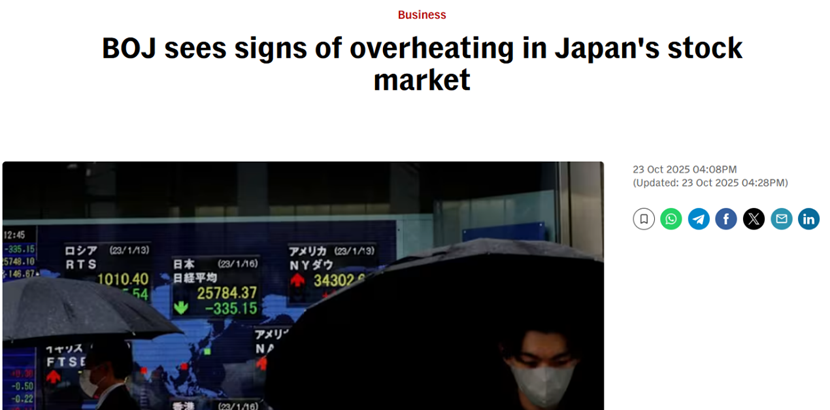
日本央行警告股市出现过热的早期迹象
Huan Qiu Wang· 2025-10-24 01:05
Group 1 - The Bank of Japan's financial system report indicates early signs of overheating in the Japanese stock market and warns that uncertainties in U.S. trade policy could lead to significant market corrections, impacting financial institutions [1] - The report highlights that rapid position adjustments and deleveraging by hedge funds during unexpected market changes could amplify asset price volatility, particularly if these adjustments occur in the global bond market, potentially affecting various financial instruments in Japan [1] Group 2 - Critics argue that the Bank of Japan's prolonged ultra-low interest rates and a weak yen have made investments in Japan cheaper for foreign investors, consequently driving up asset and property prices [4] - In April and May of this year, rumors regarding large-scale fiscal spending and potential increases in debt issuance led hedge funds to sell bonds, resulting in a significant spike in long-term Japanese government bond yields [4]
现货白银涨势凶猛 首次突破50美元大关
Sou Hu Cai Jing· 2025-10-09 12:44
Core Viewpoint - The price of spot silver has surged significantly due to market tightening, with investors increasingly seeking refuge in precious metals [1] Group 1: Price Movement - Spot silver prices rose over 2% in a single day, surpassing $50 per ounce, marking the highest daily figure since 1993 and exceeding the peak in 2011 [1] - Year-to-date, silver prices have increased by over 70%, outpacing the record rise in gold prices [1] Group 2: Market Drivers - Concerns over U.S. fiscal risks, an overheated stock market, and threats to the independence of the Federal Reserve have led investors to look for safe-haven assets [1] - A shortage of freely available silver in key London markets has supported prices and significantly increased the cost of borrowing silver [1]