股楼共振

Search documents
广发策略&地产 | 如何看待香港楼市回暖?——港股市场策略展望
Sou Hu Cai Jing· 2025-11-17 23:31
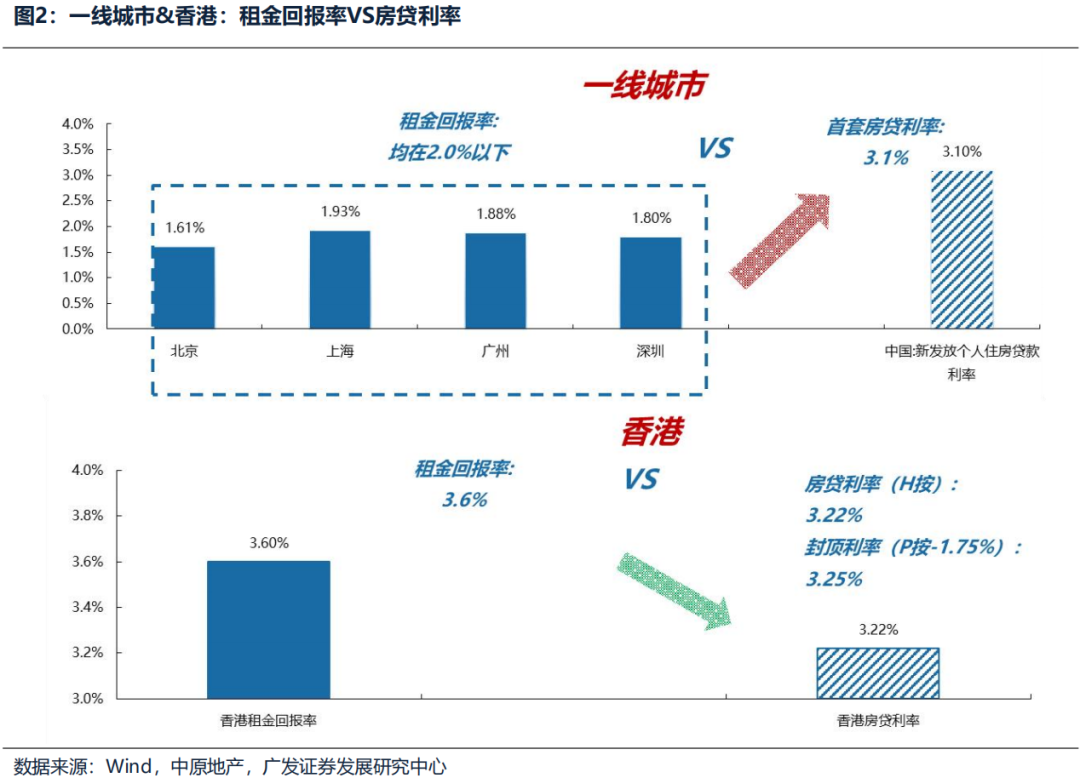
Group 1 - The core viewpoint is that the recent recovery in the Hong Kong property market is driven by improved funding conditions and stronger economic expectations, which will enhance capital market sentiment and create a positive feedback loop between the stock and property markets [2][4][10] - The rental yield in Hong Kong (3.6%) exceeds the mortgage rate (3.22%), contrasting with mainland China's first-tier cities where rental yields are below 2% [3][6] - Historical trends indicate that property market recoveries do not lead to a diversion of funds from the stock market; instead, they often coincide with improved liquidity and economic conditions, supporting stock market valuations [15][16][17] Group 2 - The Hong Kong property market has shown signs of recovery, with transaction volumes increasing significantly in recent months, supported by favorable government policies and a declining interest rate environment [24][32][36] - The average rental yield in Hong Kong has risen above 3.5%, making property investments more attractive, while the recent decline in mortgage rates has eased the financial burden on homebuyers [32][39] - The performance of the Hong Kong stock market is expected to benefit from the recovery in the property sector, as increased wealth effects and risk appetite may lead to a positive cycle between the two asset classes [10][15][36]


香港楼市出现回暖 提振资本市场情绪(附概念股)
Zhi Tong Cai Jing· 2025-11-17 00:50
Group 1 - The core viewpoint of the articles indicates that the Hong Kong property market is showing signs of recovery, driven by improved funding conditions and stronger economic expectations, which are expected to enhance market sentiment and create a positive feedback loop between the stock and property markets [1][2]. - In October, the number of existing property mortgage registrations reached 6,463, a month-on-month increase of 7.1%, marking the third consecutive month above 6,000 registrations [1]. - New property mortgage registrations fell to 595 in October, a decrease of 44% month-on-month, primarily due to a reduction in the number of large new developments launched that month [1]. Group 2 - Citigroup forecasts a 3% increase in residential property prices in 2026, indicating the beginning of a multi-year upward cycle [2]. - The report from Citigroup highlights several factors contributing to the anticipated recovery in the Hong Kong real estate market, including improved profit margins on new sales, stabilization in retail sales, and robust performance of prime office spaces [1]. - Local property-related stocks in Hong Kong include Kowloon Development (01997), Hysan Development (00014), Hang Lung Properties (00101), Sun Hung Kai Properties (00016), Henderson Land Development (00012), and Link REIT (00823) [3].





港股概念追踪|香港楼市出现回暖 提振资本市场情绪(附概念股)
智通财经网· 2025-11-17 00:38
Group 1 - The core viewpoint is that the Hong Kong property market is showing signs of recovery, driven by improved funding conditions and stronger economic expectations, which may enhance market sentiment and create a positive cycle between the stock and property markets [1] - In October, the number of existing property mortgage registrations reached 6,463, a month-on-month increase of 7.1%, indicating a stable upward trend in the property market [1] - The number of new property mortgage registrations fell to 595 in October, a decrease of 44% month-on-month, primarily due to a reduction in the number of large new projects launched [1] Group 2 - Citigroup's report is optimistic about the Hong Kong real estate market, predicting a recovery post-2025, with residential prices expected to rise by 3% in 2026 and enter a multi-year upward cycle [2][3] - The report highlights that retail sales, particularly luxury goods, are performing better than the market average, with expectations of stabilization in the mass market starting from May 2025 [2] - The office market is expected to see increased competition in 2026 after a record completion of new buildings in 2025, but core area Grade A office buildings are anticipated to perform steadily [2] Group 3 - Local Hong Kong property-related stocks include Kowloon Development (01997), Hysan Development (00014), Hang Lung Properties (00101), Sun Hung Kai Properties (00016), Henderson Land Development (00012), and Link REIT (00823) [4]
广发证券:香港股楼呈同向联动特征 楼市企稳有望进一步提振资本市场
智通财经网· 2025-11-16 23:31
Core Viewpoint - The current recovery in the Hong Kong property market is driven by improved funding conditions and stronger economic expectations, which will enhance capital market sentiment and create a positive cycle between the stock and property markets [1][10]. Group 1: Market Dynamics - The rental yield in Hong Kong (3.6%) exceeds the mortgage rate (3.22%), while in mainland China's first-tier cities, the rental yield is below 2%, which is lower than the mortgage rate of 3.1% [2]. - The recent stabilization and recovery of Hong Kong property prices have raised concerns among some investors about potential capital outflows from the stock market due to the property market's recovery [2]. - Historical trends show that recoveries in overseas real estate markets do not typically lead to a substitution effect with stock markets, as seen in various global financial crises [4]. Group 2: Liquidity and Economic Factors - Hong Kong's stock market liquidity is primarily influenced by global macroeconomic factors, such as Federal Reserve policies, geopolitical issues, and mainland China's economic fundamentals, rather than the property market [10]. - The current recovery in the Hong Kong property market is linked to improved funding conditions and rising risk appetite, which are expected to further boost capital market sentiment [10]. Group 3: Policy and Economic Environment - The active property transactions in Hong Kong are supported by continuous policy easing, including tax reductions for non-local buyers and lower mortgage rates due to the Federal Reserve's interest rate cuts [13]. - The average rental yield in Hong Kong has surpassed 3.5% this year, enhancing the attractiveness of property investments [13]. Group 4: Investment Strategy - The current rise in Hong Kong stocks is underpinned by strong fundamentals, suggesting a barbell strategy in asset allocation, with a focus on dividend stocks and growth assets [15]. - There is potential for capital inflows into core assets with global competitive advantages, such as technology and renewable energy sectors, as liquidity improves in the Hong Kong stock market [15].

70亿,大厂「抄底」香港地产
36氪· 2025-10-15 10:44
Core Viewpoint - The article discusses the potential recovery of the Hong Kong real estate market, driven by significant investments from major companies like Alibaba and the positive performance of the Hong Kong stock market, which historically leads the real estate market trends [4][7][17]. Group 1: Market Dynamics - Alibaba is reportedly negotiating to purchase the One Island East building in Hong Kong for approximately HKD 7 billion, indicating a shift from renting to owning office space in a recovering market [4][10]. - The Hong Kong stock market has shown strong performance, with the Hang Seng Index rising 54.22% year-to-date and the Hang Seng Tech Index increasing by 66.29%, suggesting a positive investment climate [5][30]. - Historical data indicates that the Hong Kong stock market often leads the real estate market, with the property price index lagging behind stock market movements by several months [5][28]. Group 2: Real Estate Trends - The Hong Kong private residential property price index has seen a continuous increase for four months, with a 0.4% rise in July, marking a cumulative increase of over 1% [12]. - Rental prices in Hong Kong have also been on the rise, with the rental index reaching 196.3 points in July, close to the historical high of 200.1 points in August 2019 [13][36]. - The rental yield in Hong Kong has improved, with some areas showing yields of 4%-5%, indicating a favorable environment for real estate investment [15][38]. Group 3: Future Outlook - The article suggests that the recovery of the Hong Kong real estate market may be supported by three main factors: the wealth effect from the stock market, supply-demand dynamics, and declining interest rates [34]. - Predictions indicate that the total transaction volume in the Hong Kong real estate market could reach between 58,000 to 60,000 units in 2025, with prices potentially stabilizing or increasing by up to 2% [32]. - Analysts remain optimistic about the market, with expectations of a 5%-10% increase in property prices and rents if the Federal Reserve continues to lower interest rates [41].