脱碳进程

Search documents
全球矿业研究 | 2026年金属市场的七大展望
彭博Bloomberg· 2026-02-25 06:05
Core Viewpoint - The article discusses the 2026 outlook for the metals and mining sector, focusing on three main themes: persistent safe-haven demand, supply structure changes driving divergence in base metals, and resource security becoming a policy priority [3][4]. Group 1: Precious Metals - Gold is expected to outperform the S&P 500 again in 2026, with an average price projected around $5,000 per ounce [3][6]. - Silver may experience a modest correction after a strong rally, but its average price is still anticipated to be significantly above market consensus [3][5]. Group 2: Supply Structure Changes - The copper market is expected to tighten, with prices likely to remain above $12,000 per ton, while nickel may see a price drop to around $15,000 due to oversupply unless Indonesia intervenes [4][5]. - The alumina market is projected to see price support from cost curves, with a potential decline limited to about 10% [4]. Group 3: Resource Security - Government funding is driving accelerated development of rare earth resources, with an estimated $10 billion in public sector investment expected [4][5]. - U.S. steel tariffs are likely to remain in place, benefiting domestic producers [4]. Group 4: Mining Companies Outlook - Major mining companies are reflecting a rebound in market risk appetite, with a trend of capital reallocation towards tangible assets [9]. - The structural supply constraints in metals, particularly copper, support price resilience, indicating potential upward revisions in profit forecasts [9]. Group 5: Silver Mining Companies - Silver mining companies, including Fresnillo, are expected to maintain strong performance in 2026, benefiting from high precious metal prices and robust operational execution [11]. - The consensus forecast predicts a 44% year-over-year increase in earnings for silver companies in 2026, based on silver and gold prices of $83 and $4,820 per ounce, respectively [11][12].


世界经济论坛《2026年全球合作晴雨表》:和平与安全合作下滑显著
Sou Hu Cai Jing· 2026-01-09 04:22
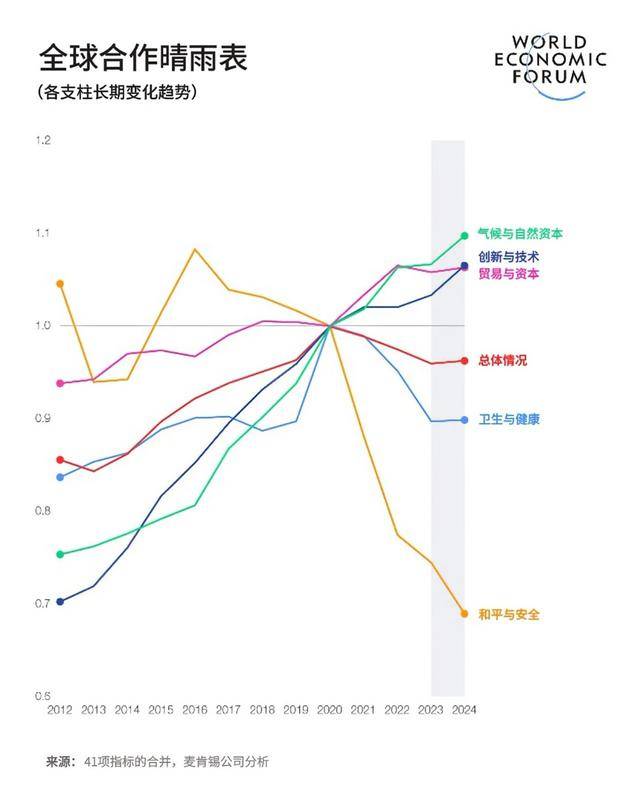
Core Insights - The World Economic Forum's "2026 Global Cooperation Index" indicates a shift towards trade and technology cooperation among like-minded countries, while peace and security cooperation has significantly declined [1] Trade and Capital - Overall cooperation in trade and capital remains above the 2019 baseline, but structural changes are profound; global goods trade continues to grow, yet at a slower pace than global economic development [3] - Trade flows are increasingly concentrating among like-minded partners, with many countries forming smaller alliances due to rising barriers in the multilateral trade system [3] Innovation and Technology - Cooperation in innovation and technology is strengthening despite tightening technology controls, leading to new development momentum [3] - There has been a significant increase in information technology services and talent mobility, with international bandwidth capacity expanding fourfold compared to pre-pandemic levels [3] - Restrictions on the flow of key resources, technologies, and knowledge are increasing, while new cooperation models are emerging, particularly in cutting-edge technologies like AI and 5G infrastructure among aligned nations [3] Climate and Natural Capital - Progress in climate and natural capital cooperation has been made, but it still falls short of global expectations [3] - The deployment of clean technologies reached a historical high in 2025, driven by expanded financing and global supply chain collaboration [3] - China contributed two-thirds of the new capacity in solar, wind, and electric vehicles, with other developing economies accelerating their efforts [3] Health and Wellness - Cooperation in health and wellness remains stable, showing resilience, but the global health assistance system faces significant pressure [4] - The overall level of health cooperation has not declined, partly due to ongoing improvements in health indicators post-pandemic [4] - However, the pressure on multilateral institutions has led to a blockage in health support funding, significantly reducing development aid, which poses severe challenges for low- and middle-income countries [4] Peace and Security - Cooperation in peace and security is continuously shrinking, with all monitored indicators below pre-pandemic levels [4] - Escalating conflict situations and rising military expenditures are evident, while global multilateral mediation mechanisms struggle to alleviate crises [4] - By the end of 2024, the number of forcibly displaced persons is projected to reach 123 million, a historical high, prompting new cooperation dynamics through regional peacekeeping mechanisms [4]
该国宣布:弃用美元!人民币直接付款!!
Sou Hu Cai Jing· 2026-01-07 05:17
Group 1 - The core point of the article is that Russia and China have established a reliable bilateral settlement system, primarily using the ruble and yuan for trade transactions [2][3]. - As of now, 99.1% of bilateral trade settlements between Russia and China are conducted in their respective currencies, an increase from the previously reported range of 90% to 95% [3]. - The bilateral trade volume between Russia and China is expected to exceed $200 billion by 2025, potentially reaching slightly above $220 billion, despite a current year-on-year decline of 8.7% [4]. Group 2 - Russia is China's largest supplier of oil and natural gas, and both countries are negotiating the details of a new gas pipeline through Mongolia to ensure long-term gas supply for Chinese consumers [4]. - The mutual visa exemption between Russia and China has significantly boosted tourism and people-to-people exchanges, with a notable increase in the number of Chinese students studying in Russia [6]. - The number of visa applications for Chinese citizens traveling to Russia for study purposes has increased by 25% year-on-year, indicating strong educational ties and a commitment to cultural cooperation [6].

铁矿石出口承压 必和必拓(BHP.US)全年利润下降26%
Zhi Tong Cai Jing· 2025-08-19 00:24
Group 1 - BHP's annual profit decreased by 26% due to weak demand, particularly for iron ore and coking coal, with a basic distributable profit of $10.2 billion, aligning with analyst expectations [1] - Revenue dropped by $4.4 billion over the past 12 months, primarily due to falling prices of iron ore and coal, although rising copper prices partially offset this impact [1] - The company raised its net debt range from $5 billion to $15 billion to $10 billion to $20 billion [1] Group 2 - CEO Mike Henry expressed a mixed outlook on the global economic landscape but remains confident in the long-term fundamentals for steelmaking materials, copper, and fertilizers [1] - BHP's copper business saw growth during this period, becoming a key growth area as demand is expected to surge with global electrification and decarbonization efforts [1] - The ongoing real estate crisis has led to an oversupply of steel, negatively impacting iron ore demand and limiting price increases for coking coal [1] Group 3 - BHP indicated that the external operating environment for fiscal year 2025 is influenced by complex and evolving global conditions, with increased policy uncertainty affecting investment and trade flows [2]