
茶产业资本化

Search documents
八马茶业上市:500亿亲家圈子,难掩酒热茶凉的资本脸色
Sou Hu Cai Jing· 2025-10-29 01:59
Core Viewpoint - Eight Horses Tea's debut on the Hong Kong Stock Exchange marked a significant milestone after a 12-year journey, reflecting the challenges faced by the traditional tea industry in capitalizing on market opportunities [1][3][15] Group 1: Company Overview - Eight Horses Tea opened at HKD 80, a 60% increase from its IPO price of HKD 50, with a trading volume of HKD 106 million on its first day, reaching a market capitalization close to HKD 7.2 billion [1] - The company was founded by the Wang brothers and initially focused on Tieguanyin tea, later expanding to cover six major tea categories [3][4] - The company faced multiple setbacks in its attempts to go public, including failed applications to various stock exchanges due to regulatory challenges and market conditions [3][4][5] Group 2: Industry Challenges - The Chinese tea industry has struggled with capital market integration, characterized by low standardization and high dependency on natural conditions, which complicates profitability and predictability [16][20] - The tea market is fragmented, with over 160,000 tea companies and a lack of dominant brands, making it difficult for any single company to achieve significant market share [11][12][20] - The traditional tea sector's reliance on physical retail channels contrasts with the more established brand and distribution models seen in the liquor industry, leading to a cautious approach from investors [17][18] Group 3: Governance and Business Model - Eight Horses Tea's governance structure is heavily influenced by family ties, raising concerns about potential conflicts of interest and decision-making diversity [7][9] - The company has established a complex network of alliances through familial connections with other businesses, which provides both support and scrutiny in the capital market [7][8] - The reliance on a franchise model for 92% of its stores raises questions about the sustainability of its business model, especially given recent declines in new store openings and purchasing volumes [12][18] Group 4: Market Position and Future Outlook - Despite aspirations to become the "Moutai of tea," Eight Horses Tea faces significant challenges in scaling and profitability compared to the liquor industry, where Moutai enjoys a dominant market position [11][12] - The company's revenue for 2024 is projected to exceed CNY 2 billion, but this is still significantly lower than the revenue generated by leading liquor brands [11][12] - The capital market's preference for innovative and high-growth companies poses a challenge for traditional tea enterprises, which often struggle to meet modern investor expectations [18][20]


八马茶业上市首日大涨|昇望基金投资“高端中国茶第一股”价值凸显
Sou Hu Cai Jing· 2025-10-28 09:17
Core Viewpoint - The successful listing of Baima Tea Industry on the Hong Kong Stock Exchange marks a significant milestone in the brand's 12-year journey towards capitalization, reflecting strong investor confidence in the Chinese tea industry and setting a benchmark for the upgrade of traditional industries [3][23]. Company Overview - Baima Tea Industry, established in 1997, is recognized as a leading enterprise in China's high-end tea sector, originating from a century-old tea-making family [3][7]. - The company has achieved a stable market position, ranking first in various categories within the Chinese tea market, including overall sales revenue and specific tea types such as Oolong and black tea [4][7]. Financial Performance - Baima Tea's revenue for the years 2022, 2023, 2024, and the first half of 2025 were reported as 1.818 billion, 2.122 billion, 2.143 billion, and 1.063 billion CNY respectively, with net profits of 166 million, 206 million, 224 million, and 120 million CNY [7]. - The company maintains a gross margin above 52% and has shown a consistent increase in net profit margin [7]. Market Reception - The stock's debut was met with enthusiasm, opening at 80.1 HKD with a 60.2% increase on the first day, leading to a market capitalization exceeding 7.195 billion HKD [3][7]. - The public offering attracted 169,000 applications, resulting in an oversubscription rate of 2,684 times, with total subscription funds reaching 120 billion HKD, setting a new record for tea companies in Hong Kong [3][7]. Brand and Cultural Impact - Baima Tea has a rich brand culture, recognized for its national intangible cultural heritage in "Tieguanyin production techniques," and has participated in significant international events, enhancing its global influence [9][20]. - The brand has consistently ranked first in customer satisfaction among Chinese tea chain brands for three consecutive years [9][20]. Technological Advancements - The company employs IoT technology to create "smart tea gardens," ensuring precise monitoring and management of agricultural practices [13][22]. - Baima Tea has implemented a fully automated production line and is a key player in the national industrial internet framework, enhancing supply chain efficiency and product traceability [13][22]. Channel Strategy - The company has developed a multi-channel strategy that integrates offline experiences with online sales, achieving significant sales growth during major shopping events [15][19]. - Baima Tea's innovative approach includes creating social spaces in physical stores and leveraging live-streaming to engage younger consumers [15][19]. Investment Insights - The investment logic behind Baima Tea's appeal includes insights into category potential, brand value elevation, channel efficiency, and technological barriers, positioning it as a strong player in the tea market [17][19][22]. - The company is seen as a model for capitalizing on the tea industry's growth potential, with a focus on high-repurchase categories and cultural branding [19][20].
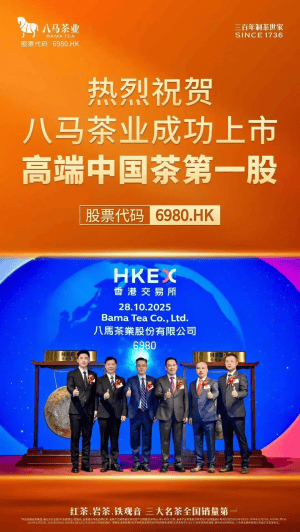
八马茶业通过港交所上市聆讯 加速全国与海外市场布局
Zhong Guo Jin Rong Xin Xi Wang· 2025-10-14 09:11
Core Viewpoint - Baima Tea has successfully passed the listing hearing at the Hong Kong Stock Exchange, marking a significant step towards its IPO and the advancement of capitalizing the Chinese tea industry [1][4]. Group 1: Company Overview - Baima Tea is a leading brand in China's high-end tea market, ranking first in sales revenue and the number of chain stores as of 2024 [1][2]. - The company has shown steady financial growth, with revenue increasing from RMB 1.818 billion in 2022 to RMB 2.143 billion in 2024, representing a compound annual growth rate (CAGR) of 8.57% [2]. - Net profit rose from RMB 166 million in 2022 to RMB 224 million in 2024, with a CAGR of 16.16% [2]. Group 2: Product and Market Position - Baima Tea offers a comprehensive range of tea products, including Oolong, black, red, green, white, and yellow teas, as well as tea-related products [2][3]. - The company has maintained a leading position in key product categories, with its Tieguanyin sales revenue ranking first in the country for over a decade [2][3]. Group 3: Production and Innovation - The company operates advanced production lines, including a seventh-generation intelligent production line in Wuyi Mountain, enhancing its digital and information-based production capabilities [3]. - Baima Tea has developed a multi-brand strategy, with its core brand recognized as a famous Chinese trademark since 2010 [3]. Group 4: International Expansion - Baima Tea has conducted global tasting events in over 30 countries and has represented Chinese tea at significant international occasions [3]. - The company aims to promote Chinese tea culture internationally, focusing on Southeast Asia and countries involved in the Belt and Road Initiative [3]. Group 5: Future Plans and Capital Utilization - The IPO is expected to provide capital support for Baima Tea's strategic initiatives, including expanding production bases and optimizing its offline store network [4]. - The company aims to enhance its online sales channels and invest in other participants in the Chinese tea industry [4].
中国最大高端茶企八马茶业通过港交所上市聆讯 多项数据行业第一
Xin Jing Bao· 2025-10-14 08:39
Core Insights - Baima Tea has successfully passed the listing hearing, marking a significant step towards its IPO and the capitalized development of the Chinese tea industry [1] - The company holds a leading position in the high-end tea market in China, ranking first in sales revenue and the number of specialty tea stores as of 2024 [2] - Baima Tea's financial performance shows steady growth, with revenue increasing from RMB 1.818 billion in 2022 to RMB 2.143 billion in 2024, representing a compound annual growth rate (CAGR) of 8.57% [2] - The company aims to use the funds raised from the IPO to support national expansion and internationalization strategies [2][4] Company Overview - Baima Tea originates from a century-old tea family, with tea-making skills tracing back to the Qing Dynasty [3] - The company offers a wide range of tea products, including Oolong, black, red, green, white, and yellow teas, as well as tea-related products [3] - Baima Tea has established a multi-brand strategy, with its core brand recognized as a famous Chinese trademark since 2010 [3] Market Position - Baima Tea has consistently ranked first in sales for various tea categories, including Tieguanyin for over 10 years, Wuyi Rock Tea for 5 years, and black tea for 4 years [3] - As of the latest data, Baima Tea operates over 3,700 stores nationwide and has more than 26 million members and over 40 million online followers [2] International Expansion - The company has hosted global tea tasting events in over 30 countries and represented Chinese tea at significant international occasions [4] - Baima Tea aims to expand into Southeast Asia and countries along the Belt and Road Initiative as part of its international strategy [4] Future Plans - The long-term goal of Baima Tea is to become the world's leading tea company, with plans to enhance production facilities, expand offline store networks, and improve online sales channels [4] - The company emphasizes the importance of quality products and stores, alongside technological innovation and digital empowerment in its future operations [4]
