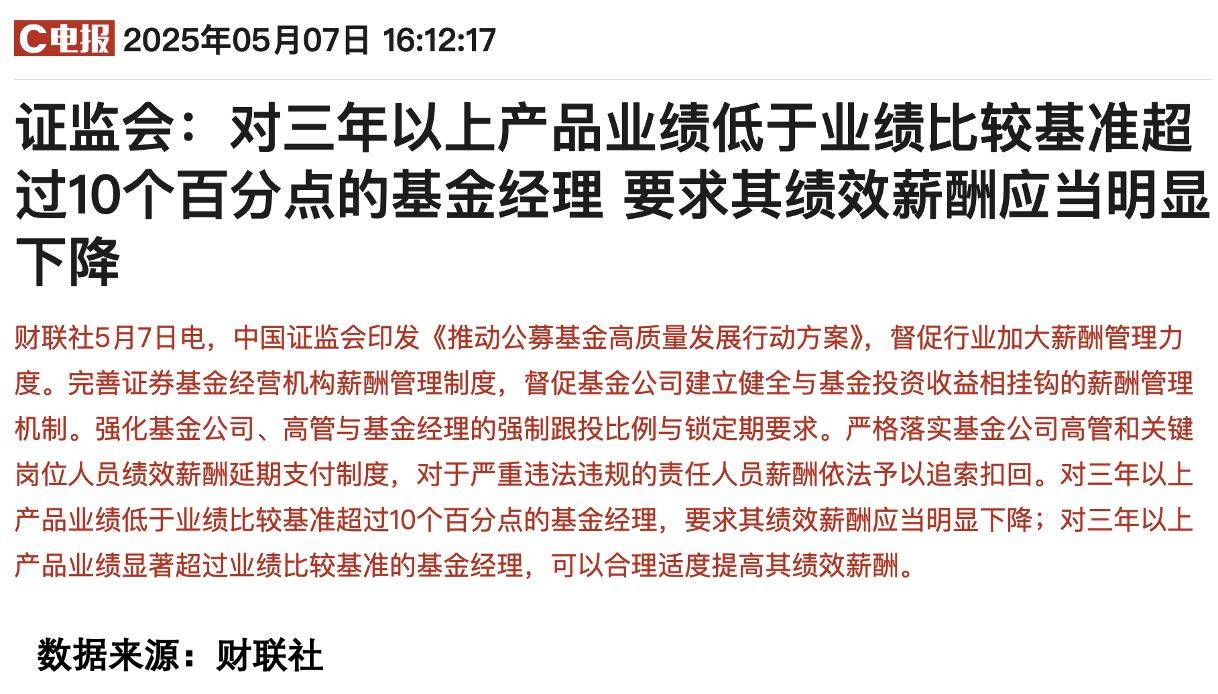
基金新规

Search documents
新规重塑基金圈,流量炒作被叫停,关键卡点难住所有人
Sou Hu Cai Jing· 2025-12-17 02:15
Core Viewpoint - The new regulatory draft for public offering securities investment fund sales is set to reshape the industry, requiring both practitioners and investors to adapt to new standards [1] Group 1: Assessment and Evaluation Changes - The new regulations emphasize detailed fee disclosures, aiming to address issues of hidden fees and inducements for frequent trading [4] - Fund managers, even those who significantly underperform, can still earn substantial management fees, raising questions about how the new rules will manage this situation [6] - Sales performance evaluation will shift from focusing solely on sales volume to a more complex KPI system, creating challenges for sales teams [8] Group 2: Promotion and Marketing Adjustments - The new rules prohibit misleading performance advertising, such as promoting short-term gains, and restrict performance disclosures to those over three years [11] - The practice of highlighting star fund managers is being phased out, with a focus now on investment strategies and themes instead [14] - The regulations aim to eliminate the "star-making" approach in fund promotions, as past performance does not guarantee future success [14] Group 3: Compliance and Operational Challenges - There are still unclear areas in compliance, particularly regarding the definition of "consideration" for ETF launches and the legality of certain sales practices [18] - The regulations signal a shift from a product-selling mentality to a service-oriented approach within the fund industry, indicating a move towards more responsible growth [19] - The industry is expected to face short-term challenges as it adjusts to these new operational standards [19]


科创债ETF国泰(551880)连续2日迎净流入,关注债市震荡中的结构性机会
Mei Ri Jing Ji Xin Wen· 2025-11-19 06:46
Core Viewpoint - The macroeconomic data for October validates the economic recovery path of "diminishing total volume and optimizing structure," despite challenges from real estate downturns and infrastructure investment declines [1] Group 1: Economic Conditions - The decline in real estate and the retreat in infrastructure investment are significant drags on the economy [1] - External risks remain a concern, but the resilience of manufacturing upgrades and service consumption provides notable support [1] Group 2: Bond Market Outlook - The bond market is expected to maintain volatility amid weak fundamentals, loose liquidity, and policy expectation dynamics [1] - Investors should pay attention to the impact of new fund regulations on the bond market following their implementation [1] Group 3: Long-term Implications of New Regulations - The new regulations are anticipated to stabilize the liability side of bond funds by filtering out truly long-term holding funds, reducing frequent fluctuations that disrupt bond funds [1] - This will promote a shift towards active management in bond funds, with institutions possessing strong research capabilities likely to attract institutional funds through "fixed income" products [1] Group 4: Investment Opportunities in Specific Bond Types - The Sci-Tech Bond ETF (551880) showcases unique investment value, capable of withstanding short-term bond market fluctuations due to its high-grade credit bond foundation [1] - It also benefits from ongoing policy support, allowing investors to share in the long-term development opportunities within the technology innovation sector, making it a quality allocation choice that balances risk and return [1]
暗潮涌动!10万亿市场迎来深刻变革
Zheng Quan Shi Bao Wang· 2025-11-10 04:48
Core Insights - The bond fund industry is undergoing significant changes driven by market and policy factors, with a notable contraction in bond fund sizes this year [1][4][5] Market Trends - The bond market has shrunk by nearly 170 billion yuan in the third quarter, with pure bond funds experiencing a substantial decrease of 770 billion yuan, while mixed bond funds saw an increase of approximately 500 billion yuan [1][3] - Over 70 public fund managers reported a decline in scale during the third quarter, primarily due to the significant reduction in bond fund sizes [2][3] Policy Impact - Recent policy adjustments, including changes to fund sales fees and performance benchmarks, have raised concerns about bond fund redemptions and contributed to market volatility [5][6][7] - The introduction of punitive redemption fees and the adjustment of performance benchmarks are expected to reshape the bond fund landscape, potentially stabilizing the market in the long term [7][10] Strategic Responses - Some public funds, such as 景顺长城基金, have successfully increased their bond fund sizes by focusing on mixed bond products, demonstrating the importance of strategic positioning in a changing market [8][9] - Smaller public funds are also adapting by enhancing their mixed bond fund offerings, indicating that there are still opportunities for growth despite the overall market contraction [9][11] Future Outlook - The bond fund sector is expected to continue playing a crucial role in residents' long-term asset allocation, with mixed bond products likely to gain acceptance due to their balanced risk-return profile [11][12] - The demand for stable, low-risk investment products will persist, positioning traditional bond funds and mixed bond products as essential components of wealth management strategies [12]
下周箭在弦上,基金调仓连锁反应非常大!
Sou Hu Cai Jing· 2025-05-18 14:18
Group 1 - The financial sector has shown signs of improvement, with indices rising quickly, attributed by some to the new fund regulations, although the validity of this claim is debated [1][4] - A significant number of fund managers have managed to outperform benchmarks this year, with over 60% of fund managers currently beating their benchmarks, particularly the CSI 300 [2][6] - The new fund regulations have provided opportunities for financial stocks to capitalize on the market dynamics, leading to a potential rally in the sector [4][5] Group 2 - The market has experienced a prolonged period of stagnation, particularly in the banking sector, which has been flat for over a year and a half, but recent movements indicate a potential for a larger market rally [5] - The current market environment presents challenges for retail investors, as they struggle to identify which stocks will break out amidst the volatility, with institutional investors often having the upper hand in this dynamic [9][11] - The concept of "institutional shaking" is highlighted, where institutions may sell off stocks to create buying opportunities, making it difficult for retail investors to discern true market movements [9][13] Group 3 - The analysis of trading behaviors through quantitative models has become more sophisticated, allowing for better identification of institutional trading patterns, which can indicate future stock movements [9][14] - The "panoramic K-line" data visualization technique is introduced, which combines various trading metrics to provide a clearer picture of market dynamics and institutional involvement [15]
公用事业ETF(560190)成分股分化,水电龙头长江电力领涨
Xin Lang Cai Jing· 2025-05-14 05:36
Group 1 - The public utility ETF (560190.SH) increased by 0.31%, while its associated index, the All Public Utilities Index (000995.CSI), decreased by 0.03% [1] - Major constituent stocks such as Changjiang Electric Power, Zhejiang Energy, and JinKai New Energy saw increases of 0.64%, 0.56%, and 1.25% respectively, indicating positive market sentiment [1] - Minsheng Securities reported that thermal power companies experienced steady growth in Q1 due to a significant drop in coal prices, with expectations for continued improvement in performance as the peak electricity consumption season approaches [1] Group 2 - Huayuan Securities highlighted that the public utility sector benefits from new fund regulations, leading to a notable increase in the valuation of low-covariance assets, with leading hydropower and thermal power companies showing strong risk-reward ratios [1] - Galaxy Securities' annual report indicated a clear performance divergence within the electricity sector, with hydropower and thermal power companies maintaining stable profitability, while nuclear and green energy sectors face short-term pressure [1] - Key companies like Changjiang Electric Power and China Nuclear Power continue to receive "recommended" ratings, reflecting institutional confidence in the long-term stability of core public utility assets [1]
基金圈大地震!没了铁饭碗,操盘手们开始这样玩
Sou Hu Cai Jing· 2025-05-09 08:17
Group 1 - The market is experiencing a mild rebound, influenced by the recent fund regulations that are being digested by investors [1][2] - The new fund regulations are expected to reshape the A-share market dynamics, as fund managers will adopt a more conservative approach to stock selection to maintain their income [2] - The sudden rise in bank stocks is attributed to fund managers needing to increase their holdings in this sector to meet performance benchmarks [2] Group 2 - Sectors that have been heavily bought by funds, such as technology stocks, are facing selling pressure as fund managers rebalance their portfolios [2][8] - The impact of the new regulations will take time to manifest, but the overall trend remains bullish for both stocks and bonds due to a loose monetary and credit environment [5][8] - Despite expectations of interest rate cuts benefiting bonds, long-term bond prices have not seen significant increases, indicating that credit easing is offsetting the effects of monetary easing [5] Group 3 - The recent regulatory measures aim to stabilize the A-share market, reducing the likelihood of significant declines [8] - Investors are advised to focus on longer-term trends rather than short-term fluctuations, as large institutional investors are accumulating positions quietly [8][10] - Understanding institutional trading strategies is crucial for investors to capitalize on market movements and avoid common pitfalls [12][17]