
通胀调控

Search documents
2026年2月19日印尼央行连续第四次维持4.75%基准利率不变
Sou Hu Cai Jing· 2026-02-19 10:55
Group 1 - The Bank of Indonesia has maintained the 7-day reverse repo rate at 4.75% for the fourth consecutive time, aligning with market expectations [1] - The decision aims to control inflation within the official target range of 2.5%±1%, stabilize the currency, and support economic growth amid global financial uncertainties [1] - The inflation rate in January 2026 was reported at 3.55% year-on-year, attributed to base effects, with the government and central bank coordinating measures to stabilize supply and prices [1] Group 2 - Since September 2024, the Bank of Indonesia has cut interest rates by a total of 150 basis points, reaching the lowest level since 2022 [1] - The central bank plans to continue interventions in the foreign exchange market to maintain currency stability and bolster market confidence, indicating that the Indonesian rupiah is undervalued relative to economic fundamentals [1] - The GDP growth forecast for 2026 remains unchanged at a range of 4.9% to 5.7%, with expectations of strengthened economic growth in the first quarter due to government stimulus and improved business confidence [2]
刚宣布,不降息!不降息
Zhong Guo Ji Jin Bao· 2025-12-18 11:14
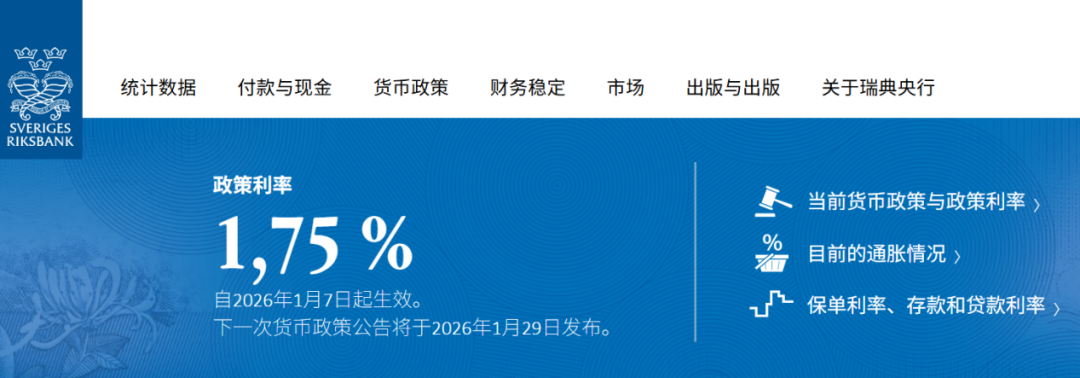
Group 1 - The core viewpoint of the article highlights that both the Swedish and Norwegian central banks have decided to maintain their current policy interest rates, signaling a potential end to the easing cycle in Europe [1][2][11] Group 2 - The Swedish central bank announced on December 18 that it would keep its key policy rate unchanged at 1.75%, aligning with market expectations [3][5] - The Swedish central bank noted that inflation remains close to its target of 2%, and economic growth has improved compared to previous forecasts, indicating a stronger economic activity [5][6] - The Swedish central bank's interest rate forecast for the fourth quarter of 2026 is projected to be 1.77%, with slight upward adjustments for 2027 and 2028 [6][7] Group 3 - The Norwegian central bank also announced on December 18 that it would maintain its policy rate at 4%, with a cautious outlook on future rate cuts [8][9] - The governor of the Norwegian central bank stated that inflation remains high, and the central bank is not in a hurry to lower rates, emphasizing the need for continued monetary tightening [9][10] - The Norwegian central bank has previously implemented significant rate hikes, and its current stance reflects a careful approach to future rate adjustments [10][11] Group 4 - Overall, central banks across Europe appear to be concluding their easing cycles, with several countries, including Switzerland, maintaining their current rates [11] - Market expectations suggest that many central banks may have ended their easing cycles, with a shift towards potential rate increases rather than further cuts [11]

美联储高层即将洗牌
Di Yi Cai Jing Zi Xun· 2025-12-04 00:25
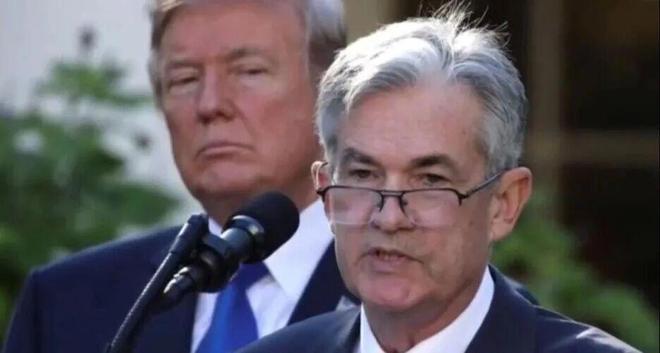
Core Viewpoint - The Trump administration has canceled interviews for candidates to replace Jerome Powell as the Federal Reserve Chair, with Kevin Hassett emerging as the frontrunner for the position amid ongoing economic uncertainties [2][3]. Group 1: Candidate Overview - Kevin Hassett, the current Director of the White House Council of Economic Advisers, is seen as a key figure in Trump's plan to reshape the Federal Reserve, having previously supported Trump's policies on tariffs and interest rates [3]. - As of December 3, Hassett has an over 80% probability of becoming the next Federal Reserve Chair according to Kalshi prediction market data [3]. Group 2: Powell's Position - If Hassett becomes the new Chair, he will face the challenge of restructuring the Federal Reserve, which currently has three members appointed by Biden and three by Trump [4]. - Powell's decision to remain on the Board after his term ends could create additional vacancies for Trump to fill, potentially increasing his influence over the Federal Reserve [5]. Group 3: Market Reactions - Wall Street anticipates that Hassett's nomination could lead to a bullish trend in risk assets, but uncertainty remains if Powell does not resign from the Board, which could hinder further appointments [7]. - Current market predictions for the Federal Funds rate in December 2026 are around 3.02%, but Hassett's stance suggests a lower neutral rate of 2% to 2.5% once inflation is under control [7]. Group 4: Economic Outlook - The NABE forecasts moderate economic growth in the U.S. for 2026, with a median growth rate of 2%, supported by stronger consumer spending and business investment, although new tariffs may reduce growth by 0.25 percentage points or more [8][9]. - Inflation is expected to slightly decrease to 2.6% in 2026, with ongoing tariff impacts being a significant factor [9].
美联储高层即将洗牌
第一财经· 2025-12-04 00:18
Core Viewpoint - The article discusses the potential appointment of Kevin Hassett as the new Chairman of the Federal Reserve, highlighting the implications of this change for U.S. monetary policy and the broader economic landscape under the Trump administration [3][5][9]. Group 1: Appointment of Kevin Hassett - Kevin Hassett is considered the frontrunner to succeed Jerome Powell as the Chairman of the Federal Reserve, with over 80% probability of his appointment according to Kalshi prediction market data [7]. - Hassett's previous role as the Chairman of the White House Council of Economic Advisers during Trump's first term positions him as a key figure in shaping economic policy [5][6]. - The cancellation of interviews for other candidates indicates a strong likelihood of Hassett's nomination, which could lead to significant changes in the Federal Reserve's approach to monetary policy [5][9]. Group 2: Implications for Federal Reserve Structure - If Hassett is appointed, he will face the challenge of restructuring the Federal Reserve, which currently has members appointed by both Trump and Biden [9]. - The potential departure of Powell from the Board could create additional vacancies, allowing for further influence from the Trump administration [10]. - The leadership team, if formed with Hassett, Kevin Warsh, and other supportive members, could represent a shift towards a more accommodative monetary policy stance [9]. Group 3: Market Reactions and Economic Outlook - Wall Street anticipates that Hassett's nomination could lead to a bullish trend in risk assets, although uncertainty remains if Powell does not resign promptly [12]. - Current market predictions for the federal funds rate in December 2026 are around 3.02%, but Hassett's views suggest a lower neutral rate of 2% to 2.5% [12]. - Economic forecasts indicate moderate growth for the U.S. economy in 2026, with a projected inflation rate of 2.6%, influenced by new tariffs that may dampen growth [13].
哈塞特接棒概率飙升至80%!美联储高层洗牌在即:鲍威尔去留牵动市场神经
Di Yi Cai Jing Zi Xun· 2025-12-03 23:59
Core Viewpoint - The Trump administration has canceled interviews for candidates to succeed Jerome Powell as the Federal Reserve Chair, with Kevin Hassett emerging as the frontrunner, facing significant challenges amid economic uncertainty [1][2]. Group 1: Candidate Overview - Kevin Hassett, the current Director of the White House Council of Economic Advisers, is seen as a key figure in Trump's plan to reshape the Federal Reserve [2]. - Hassett has a strong probability of becoming the next Fed Chair, with predictions indicating over 80% likelihood as of December 3 [3]. - Former Fed Governor Kevin Warsh is a primary competitor for the position, having publicly criticized the current Fed structure [4]. Group 2: Implications of Powell's Decision - If Powell does not resign from the Fed Board after his term, it could limit Trump's influence over the Fed [5]. - Powell's potential decision to remain on the Board could create a buffer against Trump's attempts to exert control over the central bank [5]. Group 3: Market Reactions - Wall Street anticipates that Hassett's nomination could lead to a bullish trend in risk assets, but uncertainty remains if Powell does not announce his resignation [6]. - Current market predictions for the federal funds rate in December 2026 are around 3.02%, but Hassett's stance suggests a lower neutral rate of 2% to 2.5% [6]. Group 4: Economic Outlook - The U.S. economy is expected to maintain resilient growth, with inflation projected to remain persistent, leading to only one additional rate cut next year after a potential cut in December [7]. - The National Association for Business Economics (NABE) forecasts a median economic growth rate of 2% for 2026, supported by stronger consumer spending and business investment, despite potential negative impacts from new tariffs [7].
2025年一季度货币政策报告解读
Wu Kuang Qi Huo· 2025-05-15 05:17
Report Highlights Investment Rating No investment rating for the industry is provided in the report. Core Viewpoints - The domestic economy had a good start in Q1 2025, but the foundation for economic recovery needs to be consolidated, and the external environment is complex with weakening global economic growth momentum. The economy's long - term positive trend remains unchanged [1][5]. - Monetary policy continues the moderately loose tone, with important adjustments in the intensity, rhythm of regulation, and the use of monetary policy tools. The MLF is gradually withdrawing from its policy - rate attribute [1][11]. - For the bond market, in the short term, short - end interest rates may decline due to loose liquidity, while long - term bonds may face pressure. In the medium term, the focus is on the rhythm of fiscal stimulus and overseas interest - rate cuts. Overall, the interest - rate center is expected to decline, but there may be phased adjustments [2][16]. Section Summaries Economic Situation - The Q1 2025 monetary policy report's judgment on the domestic and international economic situation follows the tone of the Politburo meeting. The domestic GDP grew 5.4% year - on - year, with simultaneous improvements in production, supply, consumption, and investment. However, external risks include trade risks, global debt risks, and financial market volatility risks [5]. - Domestically, effective demand needs further boosting, the traditional real - estate sector faces adjustment pressure, and the employment market needs continuous consolidation [6]. Monetary Policy - The overall loose monetary - policy tone continues, with the policy - intensity description changing from "adjusting at an appropriate time" to "flexibly grasping". There is an increased emphasis on stabilizing growth. In the short term, structural tools and credit supply may be the main means [7]. - The central bank will use various monetary - policy tools to maintain liquidity, with more focus on quantitative tools. The "interest rate" is removed from the tool description, and "resuming treasury - bond trading at an appropriate time" is mentioned [8]. - The report aims to balance supporting the real economy and maintaining the health of the banking system, and may guide the decline of deposit interest rates to reduce bank liabilities [10]. Incremental Information from Report Columns - MLF has gradually withdrawn from its policy - rate attribute since March 2025, and will mainly play a role in providing medium - term liquidity to the market in the future [11]. - The central bank pays attention to bond - market interest - rate risks, and may improve the system to suppress market risks and maintain interest - rate transmission efficiency [11]. - By comparing the government balance sheets of China, the US, and Japan, it shows that China's government debt is sustainable and there is still fiscal space [12]. - The inflation - control thinking has shifted, emphasizing the coordination of monetary policy with industrial and employment policies to improve the supply - demand structure and boost prices [13]. Market Outlook - For the bond market, short - end interest rates may decline due to loose liquidity in the short term, while long - term bonds may face pressure from short - term tariff negotiations and supply. If deposit interest rates are cut, it will be beneficial for the further decline of the interest - rate center. In the medium term, the focus is on the impact of fiscal stimulus and overseas interest - rate cuts [2][16].