金属超级周期

Search documents
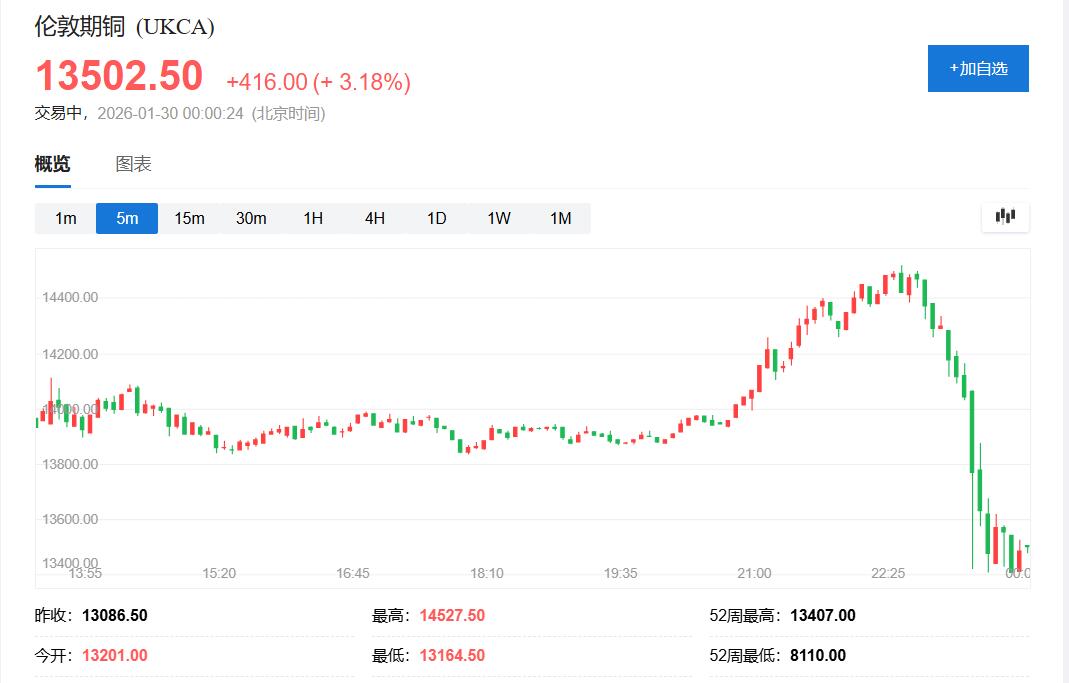
金银投机狂热蔓延!伦铜盘中涨超10%也新高,创2009年来最大涨幅
Hua Er Jie Jian Wen· 2026-01-29 18:09
Group 1: Market Trends - Copper prices surged, with LME three-month copper trading surpassing $14,500 per ton for the first time, marking an 11% intraday increase, the largest since 2009 [1] - The recent rally in commodities is driven by multiple factors, including a weaker dollar, geopolitical tensions increasing demand for physical assets, and expectations of a more accommodative monetary policy from the Federal Reserve [3][5] - Speculative trading activity has significantly increased, with Shanghai Futures Exchange reporting record trading volumes for copper contracts [4] Group 2: Supply and Demand Dynamics - Despite the price surge, analysts warn that the current copper price levels may not be sustainable due to a disconnect between market fundamentals and price movements, particularly with signs of ample supply [3][9] - China's refined copper demand is expected to decline by 8% year-on-year in Q4 2025, indicating potential weakness in demand [8] - The increase in copper prices has occurred despite rising inventories, with LME copper stocks increasing by 1,575 tons [9] Group 3: Long-term Outlook - Long-term demand for copper is supported by trends in energy transition and the expansion of global data centers, with projections indicating a significant increase in copper demand from data centers by 2026 [6][7] - The anticipated shift in U.S. monetary policy towards lower interest rates is expected to support copper prices in the long run [6][7] - Investment interest in copper is evolving towards a safe-haven asset, similar to gold, as evidenced by significant inflows into copper ETFs [7]

【历史性高光!】2025年金属市场“全面开花”,超级周期实锤
Xin Lang Cai Jing· 2025-12-25 04:05
Core Viewpoint - The global metal market in 2025 is experiencing unprecedented price surges across various metals, driven by a combination of supply-demand imbalances, policy adjustments, and industrial upgrades, marking the beginning of a new valuation cycle for the metal industry [1] Precious Metals - Gold prices have surpassed $4,500 per ounce, with an annual increase of over 60%, supported by global uncertainties and central bank purchases, with over 1,000 tons of net gold bought by central banks in 2025 [1] - Silver has doubled in price, driven by a 50% year-on-year increase in silver demand for photovoltaic applications, with industrial demand significantly boosting silver prices [2] - Platinum and palladium are supported by hydrogen energy and automotive recovery, with ETF holdings rising, indicating a positive market trend for these metals [2] Industrial Metals - Copper prices have reached over $12,200 per ton, with a year-on-year increase of over 30%, driven by demand from electric vehicles, photovoltaics, and AI data centers, while supply disruptions have led to a projected global refined copper shortage of 150,000 tons in 2025 [3] - Nickel prices have seen significant fluctuations due to policy changes in Indonesia and domestic stockpiling, with a potential for price recovery in 2026 as demand remains stable [3][4] New Energy Metals - Lithium prices have increased by 28% since July, supported by new regulations that eliminate inefficient production and rising demand from energy storage and electric vehicles, with a projected penetration rate of over 40% for new energy vehicles in 2025 [4] - Cobalt prices have surged over 130% due to tightened export quotas from the Democratic Republic of Congo, which holds 70% of global cobalt resources, highlighting the vulnerability of the supply chain [4] Strategic Metals - Strategic metals like tungsten, gallium, and germanium are experiencing price surges due to their irreplaceable roles in key industries, with China controlling 98% of global gallium production and 70% of germanium production, leading to an 84% increase in gallium prices in 2025 [5] - The combination of policy support and technological advancements is transforming strategic metals from mere resources into strategic assets, with ongoing value reassessment in the industry [5] 2026 Outlook - The metal market is expected to shift from broad increases to structural differentiation, with copper projected to reach $13,000 per ton due to limited supply and structural demand from new energy and AI [6] - Precious metals are likely to experience high volatility but remain supported by safe-haven and industrial demand, while strategic metals are expected to maintain a long-term bullish trend due to solidifying global pricing power [7] Conclusion - The 2025 metal market reflects a broader energy revolution and industrial upgrade, with metals playing a crucial role in supporting new productive forces, indicating a significant opportunity for those who can navigate the evolving landscape of supply-demand dynamics, policy, and technology [8]

国泰海通|金属新材料:流动性重回乐观,金属价格共振上行
国泰海通证券研究· 2025-12-01 14:11
Group 1: Precious Metals - The market is optimistic about liquidity returning, leading to a rise in precious metal prices, particularly silver, which has seen significant price increases due to tight balance and low inventory [1] - The prices of light rare earths have increased, while heavy rare earth prices have declined, with specific prices for praseodymium-neodymium oxide, dysprosium oxide, and terbium oxide reported at 567,000, 1,480,000, and 6,525,000 CNY per ton respectively, showing a mixed trend [1] Group 2: Copper - Copper prices are expected to perform strongly due to rising expectations of a Federal Reserve rate cut in December and an improving supply-demand balance, with a notable increase in market risk appetite [2] - The ongoing negotiations for copper concentrate long-term contracts are intensifying, reinforcing the consensus on supply tightness, while the market anticipates upcoming economic data that could further influence copper prices [2] Group 3: Aluminum - The weekly operating rate for aluminum processing has increased by 0.3% to 62.3%, indicating a positive trend in production, with various segments showing improvement due to year-end demand releases [2] - The macroeconomic sentiment is favorable, contributing to the sustained high-level fluctuations in aluminum prices [2] Group 4: Energy Metals - Lithium production has decreased seasonally, with a reported output of 22,000 tons, down by 265 tons, while inventory has also declined by 2,452 tons, indicating a tightening supply [3] - Cobalt prices remain high due to tight upstream raw material supplies, while downstream demand is cautious, leading to a strategic shift towards integrated cost advantages in cobalt production [3]