钢材需求预测

Search documents
东南亚和印度经济增长和钢材需求预测
Zhong Xin Qi Huo· 2026-02-11 10:18
1. Report Industry Investment Rating No relevant content provided. 2. Core Viewpoints of the Report - The ASEAN - 5 and India are in a stage of rapid development, and steel demand is highly concentrated in construction and infrastructure sectors. By 2030, their apparent steel consumption is expected to grow, with India having higher demand elasticity and greater incremental potential [2][3][121]. - The combined apparent steel consumption of the ASEAN - 5 and India may reach approximately 270 million tons in 2030, with a CAGR of about 5.8%, and an additional demand of approximately 116 million tons of iron ore. India is the main source of this increment [9][121]. - In a pessimistic scenario in 2026, China's steel demand will decline by about 10 million tons, while the ASEAN - 5 and India will drive an annual demand increment of about 14 million tons. The demand increment from emerging markets can offset the reduction in domestic demand in China, promoting the bottom - out and stabilization of ferrous metal prices [10][122][119]. 3. Summary According to Relevant Catalogs 3.1 Overview - Steel consumption in the ASEAN - 5 and India is highly concentrated in construction and infrastructure. Fluctuations in steel demand depend on infrastructure investment and urban construction. Per capita GDP, urbanization rate, and steel usage intensity can describe the development stage of each economy and have guiding significance for incremental projection [7]. - Each country has its own steel - demand characteristics. Malaysia and Thailand's steel - demand growth is stabilizing, Vietnam has high demand elasticity, Indonesia and the Philippines have an infrastructure - led demand structure, and India has prominent steel - demand growth potential [8][121]. 3.2 The Basic Situation of the ASEAN - 5 and India 3.2.1 Vietnam - In 2024, Vietnam's per capita GDP was approximately $4,717, and the urbanization rate was 40.2%, with manufacturing value - added accounting for about 23.4% of GDP. Its steel consumption in 2023 was about 21.17 million tons, with construction accounting for about 89%. Steel demand has medium - term elasticity and sustainability [12][13][124]. - Vietnam coordinates industrial upgrading and investment expansion by prioritizing manufacturing and infrastructure construction, such as the North - South high - speed railway and industrial park expansion [14][125]. 3.2.2 Malaysia - As of 2024, Malaysia's per capita GDP was approximately $11,867, and the urbanization rate was 80.12%, with manufacturing accounting for 24.1% of GDP. In 2023, its apparent steel consumption was about 6.7 million tons, with construction accounting for 63.2% [17][18][130]. - Malaysia uses "Ekonomi MADANI (2023)" as a reform framework and promotes infrastructure construction. The "New Industrial Master Plan 2030" focuses on advanced manufacturing [19][131]. 3.2.3 Thailand - By 2024, Thailand's per capita GDP was approximately $7,345, and the urbanization rate was 54.32%, with manufacturing added value accounting for about 24.3% of GDP. In 2023, its apparent steel consumption was about 16.08 million tons, with construction and infrastructure accounting for nearly 80% [22][23][134]. - Thailand uses the "20 - Year National Strategy 2018–2037" as a framework, promotes manufacturing transformation, and focuses on the construction of the Eastern Economic Corridor and the China - Thailand Railway [24][25][135]. 3.2.4 Indonesia - As of 2024, Indonesia's per capita GDP was approximately $4,925, and the urbanization rate was 59.2%, with manufacturing value - added accounting for about 19% of GDP. In 2023, its apparent steel consumption was about 176.5 million tons, with infrastructure and non - infrastructure buildings accounting for nearly 80% [30][31][138]. - Indonesia focuses on the construction of the new capital Nusantara and "Making Indonesia 4.0" to promote infrastructure investment and manufacturing transformation [32][139]. 3.2.5 Philippines - As of 2024, the Philippines' per capita GDP was approximately $3,985, and the urbanization rate was 48.6%, with manufacturing output accounting for about 15.7% of GDP. In 2023, its apparent steel consumption was about 9.45 million tons, with the construction sector accounting for 81% [39][40][143]. - The Philippines uses the "Philippine Development Plan (PDP) 2023–2028" as a framework, promotes infrastructure construction, and takes infrastructure investment as the main line [41][144]. 3.2.6 India - As of 2024, India's per capita GDP was approximately $2,697, and the urbanization rate was 36.9%, with manufacturing added value accounting for about 12.6% of GDP. In 2023, its apparent steel consumption was about 133 million tons, with construction, infrastructure, and engineering/packaging accounting for the vast majority [46][47][147]. - India promotes manufacturing revitalization and infrastructure construction through policies such as "Make in India" and the "PM Gati Shakti National Infrastructure Construction Plan". In the Union Budget 2025–26, a large amount of capital is allocated to infrastructure [48][50][148]. 3.3 The Core Driver of Steel Demand - Steel consumption in the ASEAN and India is highly concentrated in construction and infrastructure, with a proportion of 55% - 90%. Steel demand mainly depends on construction and infrastructure investment [66][68][156]. - The relationship between steel intensity of use (I - U) and per capita GDP typically shows an inverted U - shaped pattern. Low - income countries have higher steel - usage intensity elasticity, and this elasticity converges as per capita GDP increases [70][71][158]. - Per capita GDP and urbanization rate are key exogenous variables for studying steel demand in the ASEAN and India. The urbanization process is an important driving mechanism for steel demand [76][164]. 3.4 Steel Demand Forecasting in Southeast Asia and India - A Three - Model Approach - The ASEAN - 5's development path is closer to South Korea and Taiwan, while India is more like mainland China. When the per capita GDP reaches around $12,000 - 20,000, the growth of steel demand slows down [77][79][165]. - The IMF predicts that the per capita GDP of the six countries will grow, with India's growth rate exceeding 9%. The UNCTAD predicts that the urbanization rate increase of the six countries is limited. The population growth rate of India, the Philippines, and Indonesia is relatively fast [89][92][93]. - Three complementary forecasting models are constructed: elastic net regression, per capita steel consumption regression, and historical path trend benchmarking. The final projection value is obtained by a dynamic weighted average of the three models [101][102][185]. - By 2030, the total steel consumption of the ASEAN - 5 and India is expected to increase from 203.9 million tons in 2023 to 269.8 million tons, with a CAGR of about 4.1%. India is the main source of demand growth, with an expected increase of about 51 million tons [111][113][191]. - The increase in steel demand will lead to an increase in iron ore demand. By 2030, the combined iron ore demand of the ASEAN - 5 and India is approximately 4.73 billion tons, an increase of over 116 million tons compared to 2023 [116][193]. - In 2026, China's steel demand may decline by about 10 million tons in a pessimistic scenario, while the ASEAN - 5 and India will drive an annual demand increment of about 14 million tons. The emerging - market demand can offset the decline in China's demand [10][119][195].

建信期货钢材日评-20251223
Jian Xin Qi Huo· 2025-12-23 06:51
Report Summary 1. Report Industry Investment Rating No relevant content provided. 2. Core Viewpoint On December 22, the main contracts of rebar and hot-rolled coil futures showed a volatile and upward trend. Considering that the export of steel products has significantly decreased this year, the impact of export license management on some steel mills is expected to be limited. The support from the raw material end has reappeared. Although the spot price of coke is about to decline for the third consecutive round, the iron ore price has rebounded to the level of late November, which is of great significance for stabilizing the price center of steel products. The previous investment strategy of selling on rallies needs to be adjusted in a timely manner. The steel market may experience a certain degree of restorative rebound in the future [6][11]. 3. Summary by Directory 3.1 Market Review and Future Outlook - **Spot Market Dynamics and Technical Analysis**: On December 22, the prices of some rebar and hot-rolled coil spot markets increased. The prices of rebar in Hangzhou, Hefei, Wuhan, Kunming, Guiyang, and Lanzhou rose by 10 - 20 yuan/ton, while the price in Jinan decreased by 30 yuan/ton. The prices of hot-rolled coil in Hangzhou, Wuxi, Changchun, and Chengdu increased by 10 yuan/ton. The daily KDJ indicators of the 2605 contracts of rebar and hot-rolled coil continued to rise in a divergent manner. The daily MACD indicator of the rebar 2605 contract showed a golden cross, and the green bar of the daily MACD indicator of the hot-rolled coil 2605 contract has been narrowing for 5 consecutive trading days, approaching a golden cross [8]. - **Future Outlook**: On December 12, the Ministry of Commerce and the General Administration of Customs issued Announcement No. 79 of 2025, announcing the implementation of export license management for some steel products, which will help enhance China's pricing power for high-end steel products globally, track trade flows, standardize export order, and improve industry efficiency and product competitiveness. Fundamentally, the supply and demand have been weak recently. The production of the five major steel products reached a new low since September last year, the social inventory has further decreased to a new low since the end of January, and the weekly consumption reached a new low since mid-October and the second lowest since mid-September. Affected by the continuous production cuts of steel mills, the cost of steel products has first decreased and then increased since late November, showing an overall downward trend. In terms of raw materials, the port iron ore inventory has reached a new high of 155 million tons since April 2022, while steel mills have chosen to further reduce their inventory. The total inventory of imported ore of 247 sample steel mills has decreased to 87.24 million tons, a decrease of 13.1% compared with the beginning of October. In the past two weeks, the coke production of independent coking enterprises has significantly decreased and reached a new low since May last year. However, the decline in coking coal prices has led to continuous profitability of coking enterprises for 5 weeks, and the third round of price cuts for coke spot is about to be implemented. Recently, the customs clearance volume of Mongolian coal has increased significantly. On December 4, the 10-day moving average of the customs clearance volume of Mongolian coal at the Ganqimaodu Port reached 160,000 tons again, and further increased to 193,000 tons on December 13, an increase of 17.4% compared with the average since late November [9][10]. 3.2 Industry News - Multiple government departments have carried out inspections in 12 key regions across the country to combat illegal mining and seal up abandoned mines [12]. - The Metallurgical Industry Planning and Research Institute predicts that China's steel consumption in 2025 may be 808 million tons, a year-on-year decrease of 5.4%, and the demand in 2026 may be 800 million tons, a year-on-year decrease of 1.0% [12]. - As of December 15, the annual cumulative production of commercial coal by Zhunneng Group has exceeded the annual plan by 859,400 tons [12]. - Chongqing Iron and Steel plans to issue A-shares to specific investors, raising a maximum of 1 billion yuan [12]. - China Shenhua plans to acquire relevant assets worth 133.598 billion yuan [12]. - Western Mining's subsidiary has obtained a mining license for an iron polymetallic ore [12]. - Huaihe Energy states that its coal-fired power units are mainly supplied by long-term contracts and some market coal, and there is no plan to purchase coal from Mongolia and Indonesia [12]. - Huafu Securities predicts that coal supply will decline in 2026, and the overall coal market will improve. The central price of thermal coal is expected to rise to 770 yuan, and the central price of coking coal will stabilize at the bottom [12]. - As of December 18, the cumulative import and export freight volume of the Ganqimaodu Port has reached a record high, with significant growth in the import of copper concentrate powder, manganese ore, and the export of goods [12]. - In November 2025, China's coal exports increased year-on-year and month-on-month, while the import of coking coal decreased year-on-year and the import of thermal coal decreased year-on-year [12]. - China has requested consultations with India on its tariff measures for information and communication products and photovoltaic subsidy measures at the WTO [12]. - In November 2025, the iron ore export volume of Port Hedland decreased year-on-year and month-on-month, but the cumulative export volume from January to November increased year-on-year [14]. 3.3 Data Overview The report provides data charts on the social inventory of rebar and hot-rolled coil in major cities, the spot prices of rebar and hot-rolled coil in major markets, the weekly production of the five major steel products, the inventory of the five major steel products in steel mills, the blast furnace and electric furnace operating rates and capacity utilization rates, the national daily average pig iron production, the apparent consumption of the five major steel products, and the basis between the Shanghai rebar and hot-rolled coil spot and the May contracts [16][17][18].
报告预计2026年我国钢材需求量小幅下降
Di Yi Cai Jing· 2025-12-20 04:27
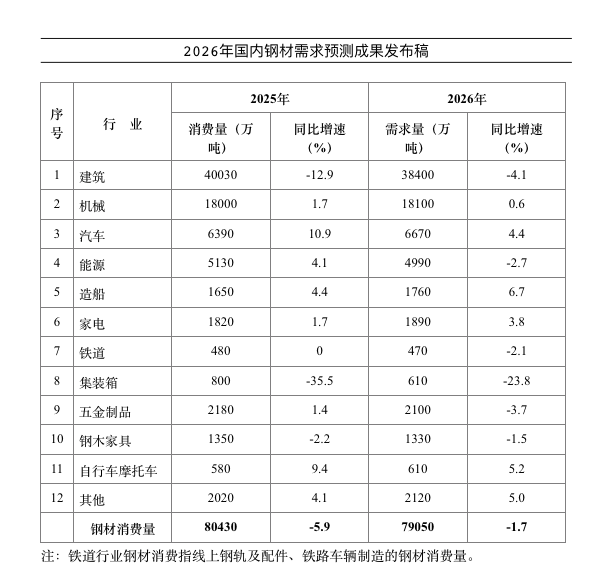
Global Steel Demand Forecast - The global steel demand is projected to reach 1.736 billion tons in 2026, reflecting a year-on-year growth of 1.0% [1] - In 2025, the global steel consumption is expected to decline to 1.719 billion tons, a decrease of 1.8% compared to the previous year [1] China's Steel Demand Outlook - China's steel consumption is anticipated to be 808 million tons in 2025, marking a decline of 5.4% year-on-year, and further decreasing to 800 million tons in 2026, a drop of 1.0% [1] - The report indicates that the decline in steel consumption in China is primarily due to insufficient domestic demand, particularly from the real estate sector [1] Sector-Specific Steel Consumption - The construction sector in China is projected to consume approximately 40 million tons of steel in 2025, down 12.9% year-on-year, and about 38.4 million tons in 2026, a decrease of 4.1% [2] - The machinery sector is expected to maintain a stable growth, with steel consumption estimated at 18 million tons in 2025, an increase of 1.7%, and 18.1 million tons in 2026, a growth of 0.6% [2] - The automotive industry is forecasted to consume 6.39 million tons of steel in 2025, reflecting a growth of 10.9%, and 6.67 million tons in 2026, a rise of 4.4% [3] Summary of Steel Consumption by Industry - The following table summarizes the steel consumption forecast for various industries in China: | Industry | 2025 Consumption (10,000 tons) | Year-on-Year Growth (%) | 2026 Demand (10,000 tons) | Year-on-Year Growth (%) | |------------------|-------------------------------|-------------------------|---------------------------|-------------------------| | Construction | 4003 | -12.9 | 3840 | -4.1 | | Machinery | 1800 | 1.7 | 1810 | 0.6 | | Automotive | 639 | 10.9 | 667 | 4.4 | | Energy | 513 | 4.1 | 499 | -2.7 | | Shipbuilding | 165 | 4.4 | 176 | 6.7 | | Home Appliances | 182 | 1.7 | 189 | 3.8 | | Railways | 48 | 0 | 47 | -2.1 | | Containers | 80 | -35.5 | 61 | -23.8 | | Hardware | 218 | 1.4 | 210 | -3.7 | | Steel-Wood Furniture | 135 | -2.2 | 133 | -1.5 | | Bicycles & Motorcycles | 58 | 9.4 | 61 | 5.2 | | Others | 202 | 4.1 | 212 | 5.0 | | **Total Steel Consumption** | **8043** | **-5.9** | **7905** | **-1.7** | [5]