铝供应短缺

Search documents
港股异动 | 中国宏桥(01378)涨超4% 供应短缺格局将支撑铝价 公司高比例分红回报投资者
智通财经网· 2026-02-16 02:53
Core Viewpoint - China Hongqiao (01378) has seen a stock price increase of over 4%, currently at 36.74 HKD, with a trading volume of 208 million HKD, driven by positive forecasts regarding aluminum supply and pricing [1] Group 1: Company Performance - China Hongqiao's profit forecast has been upgraded by CMB International, with the target price raised from 39 HKD to 45 HKD, maintaining a "Buy" rating [1] - The company is expected to achieve a core net profit of 26.262 billion CNY in 2025, representing a year-on-year growth of 7%, with a projected acceleration in net profit growth to 34% in 2026, primarily driven by rising aluminum prices [1] Group 2: Industry Context - The global aluminum supply shortage is expected to persist until 2026-2027, supported by high aluminum prices and declining bauxite prices [1] - Current aluminum production capacity utilization in China is nearing the policy limit of 99%, while new overseas production capacity is limited, which will help maintain a global aluminum market shortage [1] - The average aluminum price is projected to increase by 15% year-on-year in 2026 [1] Group 3: Dividend Policy - China Hongqiao is recognized as a leading player in the global aluminum industry, with an alumina production capacity of 19 million tons and an electrolytic aluminum production capacity of 6.46 million tons, making it the second-largest aluminum producer globally [1] - The company has announced a shareholder return plan for the next three years (2025-2027), committing to a minimum cash dividend payout ratio of 80% due to its mature development stage and lack of significant capital expenditure plans [1] - The dividend payout ratio is noted to be the highest in the aluminum industry [1]
中国宏桥涨超4% 供应短缺格局将支撑铝价 公司高比例分红回报投资者
Zhi Tong Cai Jing· 2026-02-16 02:53
Group 1 - The core viewpoint is that China Hongqiao's stock price has increased by over 4%, reaching HKD 36.74, with a trading volume of HKD 208 million [1] - CMB International has raised its profit forecast for China Hongqiao, increasing the target price from HKD 39 to HKD 45, maintaining a "Buy" rating due to a global aluminum supply shortage expected to last until 2026-2027 [1] - The current aluminum production capacity utilization in China is close to the policy limit of 99%, with limited new capacity coming online overseas, supporting a sustained global aluminum market shortage [1] Group 2 - China Hongqiao is a leading player in the global aluminum industry, with an alumina production capacity of 19 million tons and an electrolytic aluminum production capacity of 6.46 million tons, making it the second-largest aluminum producer globally [1] - The company has announced a shareholder return plan for the next three years (2025-2027), committing to a minimum cash dividend payout ratio of 80% due to its mature development stage and lack of significant capital expenditure plans [1] - The company’s core net profit is expected to reach CNY 26.262 billion in 2025, a year-on-year increase of 7%, with a projected profit growth rate of 34% in 2026 driven primarily by rising aluminum prices [1]
热门资产,直线跳水!高盛,突然空袭!
券商中国· 2026-01-15 06:57
Core Viewpoint - The article discusses the recent sharp decline in copper prices, with warnings from Goldman Sachs and Citigroup indicating that the current price surge may have peaked, leading to potential risks of a price correction in the near future [2][7][8]. Group 1: Market Performance - On January 15, the main copper futures contract in Shanghai experienced a significant drop, falling nearly 3% at one point, and closing with a decline of 2.21% at 101,870 yuan per ton [2]. - In the international market, copper prices also fell, with London copper down 1.27%, nickel down 1.55%, aluminum down 0.9%, and tin down 0.5% as of 14:00 Beijing time [4]. Group 2: Price Trends and Predictions - Copper prices have surged nearly 24% since November 20, 2025, raising concerns about sustainability [5]. - Goldman Sachs has indicated that the recent price increase was primarily driven by speculative trading and expectations of U.S. tariffs on key minerals, which have now eased, leading to a potential price correction [6][7]. - Citigroup warns that January may represent the peak price for copper in 2026, predicting a return to around $13,000 per ton as a more sustainable level unless unexpected macroeconomic factors arise [8]. Group 3: Supply and Demand Dynamics - The easing of tariff concerns has led to a decrease in copper premiums in the U.S., which previously supported high prices due to tight supply [6]. - Citigroup highlights that aluminum is facing a significant supply shortage, with a short-term target price of $3,400 per ton and a mid-term outlook of $3,500 per ton due to rising electricity costs affecting production [8].


内外盘铝价齐飞,长江A00铝较节前大涨1450元/吨
Xin Lang Cai Jing· 2026-01-06 05:03
Group 1 - The aluminum market is experiencing a significant price surge, with domestic and international prices reaching new highs, attracting investor attention [1][2] - The Shanghai aluminum price hit 24,335 yuan per ton, marking a 2.65% increase, while the London Metal Exchange (LME) aluminum price reached $3,115.5 per ton, the highest since April 2022 [1][2] - Concerns over potential supply shortages are driving the price increases, with production disruptions and rising demand contributing to a widening supply-demand gap [2][4] Group 2 - The current domestic aluminum inventory stands at 703,000 tons, which is higher than the same period last year, indicating some short-term supply security, but long-term pressures remain [2] - In the spot market, aluminum ingot prices have risen significantly, with average transaction prices increasing by 1,450 yuan to 23,910 yuan per ton, although the spread between spot and futures prices has widened [3] - The widening spread indicates a contradiction in the market, where strong demand coexists with caution from downstream enterprises regarding high prices [3][5] Group 3 - Short-term forecasts suggest that aluminum prices may continue to rise due to external factors such as geopolitical tensions and low overseas inventories [4] - The market is characterized by high volatility and significant disagreement among traders, which may lead to larger price fluctuations in the future [4] - Investors are advised to adopt a cautious approach, waiting for price corrections before entering the market to mitigate risks associated with high prices [6]

基本面方面表现平稳 短期铝价预计延续整固盘整
Jin Tou Wang· 2025-12-21 01:20
Core Viewpoint - The aluminum market is experiencing a slight increase in prices and a reduction in inventory levels, with expectations for continued demand despite potential short-term fluctuations due to seasonal factors [1][4][5] Group 1: Market Performance - As of December 19, 2025, the main contract for Shanghai aluminum futures closed at 22,185 CNY/ton, with a weekly increase in open interest by 290 contracts [1] - During the week of December 15-19, the aluminum futures opened at 22,085 CNY/ton, reaching a high of 22,240 CNY/ton and a low of 21,610 CNY/ton, resulting in a weekly change of 0.11% [1] Group 2: Supply and Demand Dynamics - In October 2025, global primary aluminum production was reported at 6.0154 million tons, while consumption was 6.1241 million tons, leading to a supply shortage of 108,700 tons [2] - From January to October 2025, global primary aluminum production totaled 61.2165 million tons, with consumption at 62.1720 million tons, resulting in a cumulative supply shortage of 955,500 tons [2] - Nimba Mining plans to restart mining operations with a target of exporting 10 million tons by 2026, having already exported 680,000 tons of bauxite [2] Group 3: Inventory Levels - As of December 18, 2025, the inventory of electrolytic aluminum ingots was 578,000 tons, a decrease of 18,000 tons, while aluminum rod inventory in major domestic consumption areas was 119,500 tons, down by 7,000 tons [2] Group 4: Institutional Insights - According to Shenwan Hongyuan Futures, the Federal Reserve has room for a 50 to 100 basis point rate cut, but no immediate action is necessary given the current economic outlook [4] - The short-term supply of electrolytic aluminum is stable, with limited production growth expected in December, while demand remains acceptable despite a slight decline in downstream operating rates [4] - Nanhua Futures notes that the core Consumer Price Index (CPI) rose by 2.6% year-on-year in November, which may increase the likelihood of a Federal Reserve rate cut, while the aluminum market is expected to maintain a strong outlook in the medium term [5]


忘掉黄金吧,现在是铝的高光时刻
Hua Er Jie Jian Wen· 2025-10-30 06:05
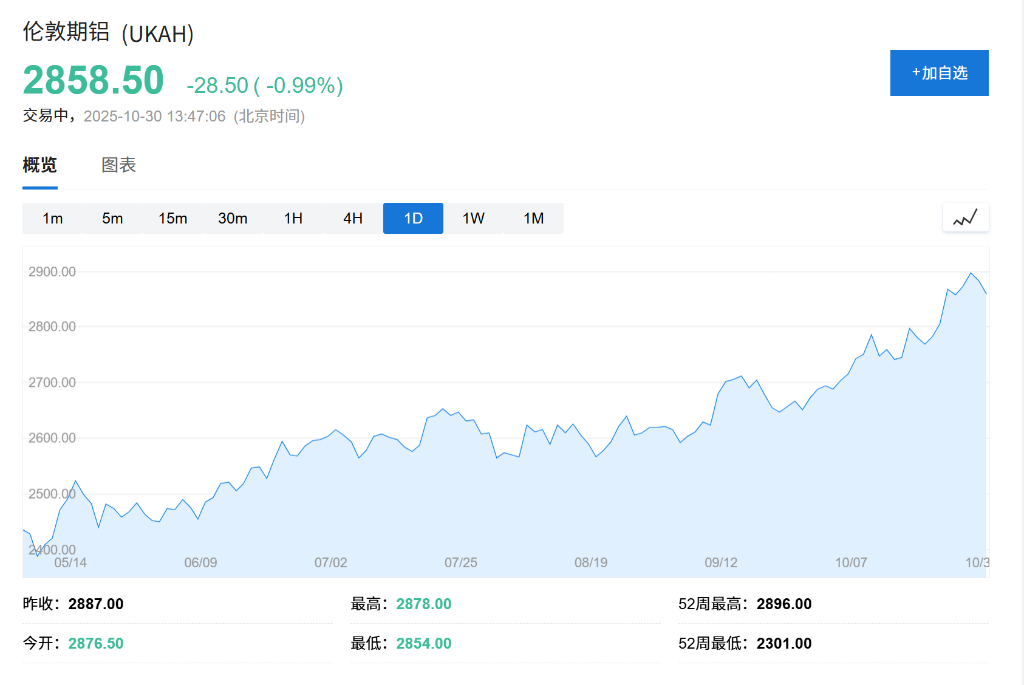
Core Insights - Aluminum is gaining market attention, with prices nearing $2,900 per ton, marking a three-year high and within the top 5% of the price range from 1990 to 2025, indicating a potential structural shortage in the coming years [1][3] - The global aluminum supply surplus is expected to narrow by 2026, leading to a projected supply deficit of approximately 1.4 million tons by 2027, driven by increasing demand from sectors like electric vehicles and renewable energy [3][6] - China, as the largest producer and consumer of aluminum, is approaching its production capacity limit of 45 million tons, which could impact global supply dynamics [3][5] Industry Demand and Supply Dynamics - The demand for aluminum is significantly driven by electric vehicles, which use about 150 pounds more aluminum than internal combustion engine vehicles, and by the solar power sector, where aluminum is the second-largest metal input after steel [4] - Global aluminum production is facing challenges, particularly in Europe, where smelters are closing due to the expiration of long-term cheap electricity contracts, contributing to a tightening supply situation [6] - Indonesia is emerging as a key player in the aluminum market, with potential plans for new smelting facilities that could increase its production fivefold by 2030, positioning it as the fourth-largest producer globally [7][8] Market Outlook - Analysts suggest a dual outcome for the aluminum market: either prices will rise significantly, impacting the global economy, or the supply chain will become increasingly reliant on Chinese companies operating overseas [3][9] - The most likely scenario is a moderate price increase alongside a gradual rise in overseas production from countries like Indonesia, leading to a market adjustment to higher prices and deeper reliance on Chinese supply chains [9]