银发产业

Search documents
锁凌燕:老龄化加速,及早推动商业保险供给侧改革
Sou Hu Cai Jing· 2025-12-22 03:09
Group 1 - The macroeconomic environment in 2025 presents both opportunities and challenges, with China showcasing resilience amid global economic fluctuations [1] - The central economic work conference has set the tone for 2026 as "seeking progress while maintaining stability, improving quality and efficiency" [1] - The focus is on balancing short-term recovery with long-term transformation, emphasizing sustainable consumption growth and the synergy between "internal circulation" and "high-level opening up" strategies [1] Group 2 - The rapid aging population necessitates early reforms in the supply side of commercial insurance, which is crucial for addressing long-term care and wealth transfer needs [3] - The development of pension finance is identified as a strategic pillar for enhancing the stability of the pension system and improving residents' welfare [3] - Insurance can provide comprehensive solutions that include pension protection products, risk management, and healthcare services integration [3][4] Group 3 - Product design should leverage expertise in lifelong annuity schemes and risk management to enhance financial resilience across family life cycles [4] - There is a need for inclusive and customized commercial medical insurance and long-term care products to improve the long-term health security network [4] - Collaborative planning between pensions, medical insurance, and long-term care services is essential for reducing overall pension costs [4] Group 4 - The "14th Five-Year Plan" emphasizes the importance of improving people's livelihoods and the role of commercial insurance in supplementing social security [5] - The insurance sector is positioned as a key player in the multi-tiered pension system, contributing to the operation of basic pension funds and supporting the development of enterprise annuities [5] - The insurance industry is encouraged to enhance its investment capabilities to support economic development and promote consumption, particularly among the elderly population [5]


“十五五”首席观察|专访锁凌燕:老龄化加速,及早推动商业保险供给侧改革
Bei Jing Shang Bao· 2025-12-21 05:36
Core Viewpoint - The insurance industry is positioned to play a crucial role in enhancing pension finance and addressing the challenges posed by an aging population during the "14th Five-Year Plan" period, with a focus on collaborative efforts across the "three pillars" of pension finance [1][5]. Group 1: Pension Finance and Insurance Industry - In 2026, the insurance industry will focus on pension finance as a core area, with policies and market forces driving the collaboration of the "three pillars" from design to implementation [1]. - The insurance sector is expected to fill gaps in basic social security through inclusive products and services, while addressing longevity risks and capital preservation pressures with annuity schemes and cross-cycle risk management [1][5]. - The development of pension finance is seen as a strategic pillar for enhancing the long-term stability of the pension system and improving residents' welfare [5]. Group 2: Investment Strategies and Challenges - The value of insurance funds as "patient capital" will become more prominent, requiring a shift from being "simple investors" to "professional experts" through enhanced long-term assessment mechanisms and deep industry research [2][8]. - The insurance industry must address challenges such as low interest rates and the balance of risks and returns in technology investments while ensuring long-term investment stability and solvency [8][10]. - A focus on professional depth and risk management is essential for the insurance sector to transition from passive "value guardians" to active "value creators" [10]. Group 3: Product Innovation and Consumer Needs - The insurance industry faces a mismatch between personalized consumer demands and standardized products, necessitating fundamental reforms in product design and service ecosystems [12]. - Advanced technologies like big data and AI can help the insurance sector provide more personalized services and products by analyzing customer needs and optimizing risk management [13][14]. - The integration of insurance products with health management and long-term care services is crucial for reducing overall pension costs and enhancing the resilience of the pension finance system [6][14]. Group 4: Regulatory and Ethical Considerations - The insurance industry must balance technological innovation with compliance and ethical standards, particularly as AI applications evolve from single-point solutions to comprehensive empowerment across the value chain [14][15]. - There is a need for regulatory frameworks that not only correct errors but also allow for experimentation and innovation within the insurance sector [15].

前七个月我国数字新消费蓬勃发展
Yang Shi Wang· 2025-08-19 12:36
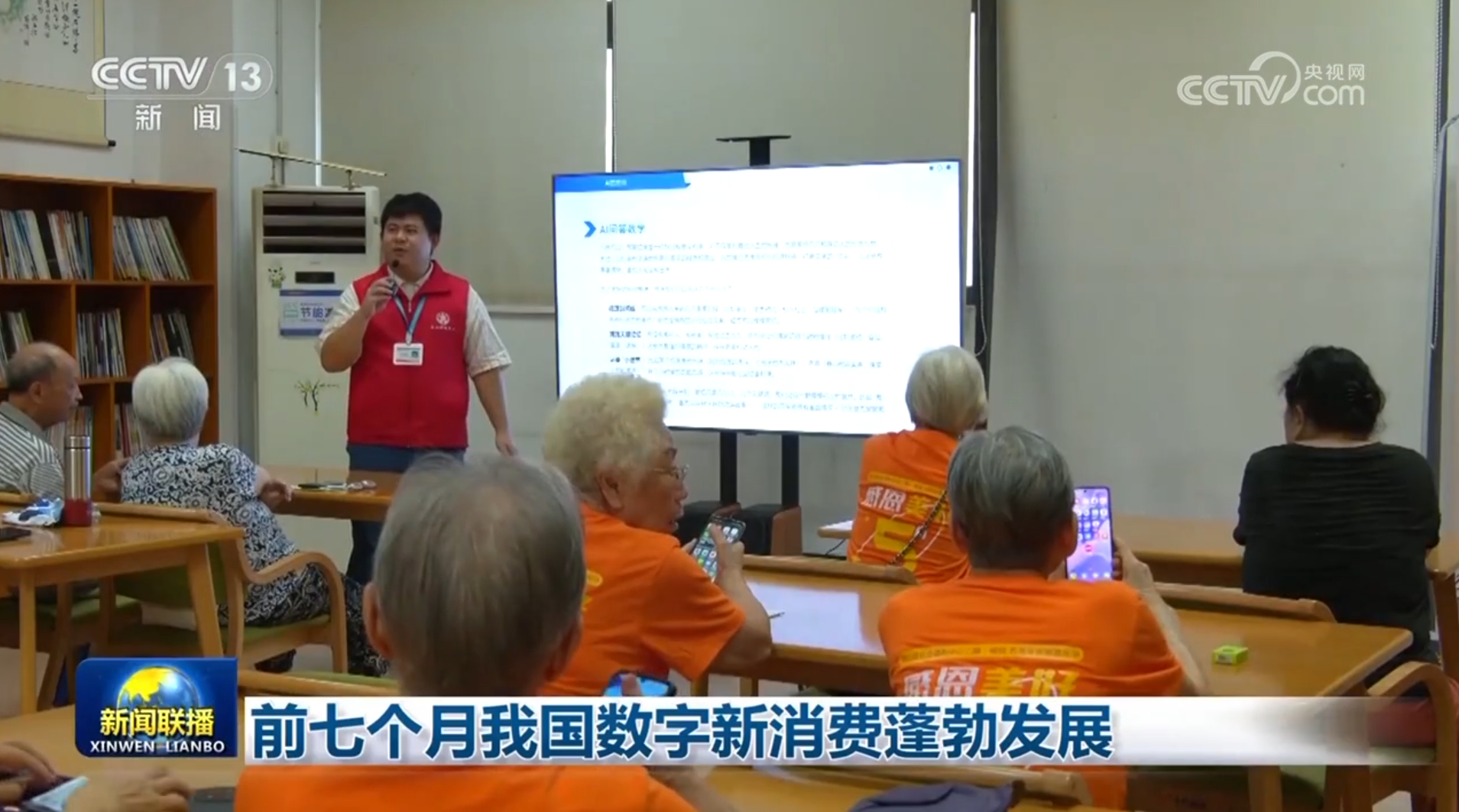
Group 1 - The core viewpoint is that digital consumption is thriving in China, driven by advancements in digital infrastructure such as 5G and artificial intelligence, which are expanding consumption scenarios [1] Group 2 - In the elderly care sector, over 300,000 digital classrooms have been established nationwide to teach seniors skills like using AI to prevent fraud, with revenue from smart elderly care technology services and wearable devices increasing by 33.7% and 32.6% year-on-year, respectively [3] Group 3 - The digital consumption landscape is broadening beyond elderly care, with products like smart home devices and AI glasses gaining popularity; in July, the manufacturing value added for smart drones and smart vehicle equipment increased by 80.8% and 21% year-on-year, respectively, while the production of civilian drones rose by 18.9% [5] Group 4 - New digital consumption models are emerging, with mobile internet users experiencing double-digit growth in data usage for six consecutive months; in the first seven months of this year, instant retail and live e-commerce transaction volumes also saw double-digit growth across various sectors, including food, beauty, pharmaceuticals, and travel [7]
这个夏天,“邮”你来辩|第二届中邮保险•紫荆杯全国高校金融普及教育辩论赛初赛圆满落幕
清华金融评论· 2025-08-14 10:21
Core Viewpoint - The article highlights the successful completion of the preliminary round of the second "Zijing Cup" National College Financial Education Debate Competition, focusing on themes such as digital economy, silver-haired industry, inclusive finance, and digital finance [1][6]. Group 1: Competition Overview - The preliminary round featured debate teams from 48 universities across the country, with 24 teams advancing to the next round [1]. - The event was organized by Tsinghua Wudaokou in collaboration with China Post Insurance, showcasing the engagement of young talents in financial discourse [1]. Group 2: Debate Themes - The debates centered on critical issues including the role of young people in upgrading the silver-haired industry, emphasizing the need for professional capability leapfrogging and intergenerational equity [11][23]. - Discussions on digital finance highlighted the necessity of balancing business transformation efficiency with risk prevention, stressing that a robust regulatory framework can accelerate high-quality development [12][13]. Group 3: Key Insights from Judges and Participants - Judges noted the complex mindset of young participants, who seek both professional growth through technological advancements in elder care and emotional fulfillment from their contributions to society [7]. - Participants argued that the silver-haired industry requires a shift in perspective, recognizing elderly individuals as active societal participants rather than passive recipients of services [23]. Group 4: Financial Culture and Economic Service - The debate emphasized that the sustainable development of China's financial culture relies on adhering to the fundamental purpose of serving the real economy while adapting to innovations in the digital economy [18][20]. - The importance of opportunity equality in inclusive finance was highlighted, asserting that without it, sustainability becomes meaningless [15].
实训室内学照护
Ren Min Ri Bao Hai Wai Ban· 2025-08-13 01:01
Core Viewpoint - The article highlights the transformation of vocational education in response to the aging population in China, particularly through the establishment of specialized programs in elder care and health management [2] Group 1: Industry Response - The aging population in China has created a demand for skilled professionals in the "silver economy" sector [2] - Laiwu Vocational and Technical College has formed a "Smart Health and Care Professional Group" by integrating four specialized programs: Nursing, Rehabilitation Therapy, Elderly Health and Management, and Smart Elderly Services and Management [2] Group 2: International Collaboration - The college has partnered with Finland's Rovaniemi University of Applied Sciences to establish the "China-Finland Health and Care Academy" [2] - This collaboration includes the introduction of international courses and the establishment of "bilingual and dual-teacher" classrooms, providing students with opportunities for overseas study and cross-border services [2]