
防御

Search documents
持仓观望?
第一财经· 2026-03-13 10:38
Market Overview - The A-share market indices are experiencing a volatile adjustment pattern, with the Shanghai Composite Index dipping to 4086.85 points before rebounding, driven by sectors like infrastructure and wind power, but facing pressure again towards the end of trading [3] - The Shenzhen Component Index weakened due to the drag from technology and new energy sectors, while the ChiNext Index saw a narrower decline supported by lithium battery materials [3] Sector Performance - There is a clear divergence in stock performance, with more stocks declining than rising. The cyclical and defensive infrastructure sectors are the main market drivers, with wind power equipment, chemicals, fertilizers, home appliances, and construction decoration leading the gains. In contrast, previously strong technology growth sectors like AI computing, semiconductor equipment, solar energy, and commercial aerospace are collectively weakening [5] Trading Volume and Capital Flow - The trading volume in both markets has slightly decreased, indicating a state of existing capital adjustment and competition. The capital structure shows a shift from high-valuation technology growth sectors to low-valuation cyclical and defensive sectors, with an increased proportion of trading volume in the Shanghai market, highlighting a growing risk aversion among investors [6] Institutional and Retail Investor Behavior - Institutional investors are clearly shifting their positions, moving funds from high-volatility growth sectors to low-valuation, high-dividend, and performance-stable defensive sectors. They are taking profits in computing, electronics, communications, media, and new energy, while increasing positions in power equipment, basic chemicals, coal, oil and petrochemicals, and banks. Retail investors are also adjusting their positions in line with market style changes, chasing high-priced precious metals and state-owned enterprises while selling off AI and semiconductor sectors that are experiencing corrections [8]


汉家江湖气宗玩法新解
Xin Lang Cai Jing· 2026-01-13 06:22
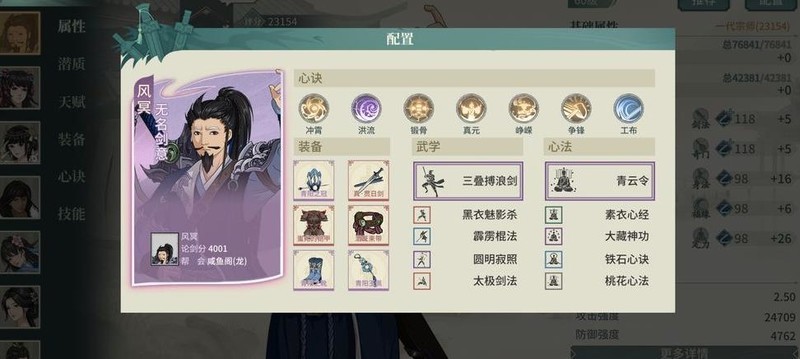
Group 1 - The focus of the strategy is on defense, with an emphasis on maintaining a defensive configuration rather than aggressive attacks [1][16] - When internal energy is abundant, techniques like Bone Forging (16), Rivalry (20), and Great Store (25) can significantly enhance defense and damage reduction, achieving a total damage reduction of 61, which is the maximum limit [3][18] - The use of specific weapons and attributes is recommended for optimal performance against short-range enemies, with a priority on enhancing strength attributes [3][18] Group 2 - The character with 32 Jade True can significantly increase combat power upon reaching level 33, primarily used for shield-breaking output, with dual strength attributes already refined [5][20] - The character Tai Chi Shen Hui is noted for its strong survival and healing capabilities, performing well even without resources for 80 days, making it a reliable partner in combat [7][22] - Other character options are deemed less ideal, with specific recommendations for configurations that maximize damage reduction and combat effectiveness [10][25] Group 3 - The substitute character is designed specifically to counter the position of Cangyuan, requiring coordination with other counter roles [12][29] - The overall cultivation of characters tends to have low usage rates, suggesting that new players may find value in the configurations while experienced players should make their own decisions [15][29]
2026“开门红”
第一财经· 2026-01-05 11:07
Core Viewpoint - The market shows a significant upward trend, driven by technology and consumer sectors, with notable contributions from the insurance and semiconductor industries [3][4]. Market Performance - The Shenzhen Composite Index's growth is primarily attributed to the technology and consumer sectors, with the ChiNext Index leading the gains [3]. - A total of 4,180 stocks increased in value, indicating a broad market rally across various sectors including technology, healthcare, software, and consumer goods [4]. - The trading volume in both markets reached 15 trillion yuan, a 24.5% increase, surpassing recent averages, reflecting a shift from "stock game" to "incremental inflow" of capital [5]. Capital Flow and Investor Sentiment - Institutional investors are focusing on a dual strategy of "technology growth + defensive" allocations, with significant capital inflows into electronics, medical devices, and insurance sectors, while withdrawing from high-valuation sectors like telecommunications and aerospace [7]. - Retail investors are favoring short-term speculative plays, particularly in sectors like robotics and AI applications, which are gaining traction due to policy support and technological advancements [7]. Investor Positioning - 66.79% of investors anticipate a market rise in the next trading day, while 33.21% expect a decline, indicating a bullish sentiment overall [13]. - The average investment position shows that 43.15% of investors are fully invested, while 6.77% are in cash positions [17].

战略数据研究 | 专题报告:人民币升值下的”春季躁动“机会有何不同
Changjiang Securities· 2025-12-27 11:58
Group 1: Market Overview - The Shanghai Composite Index achieved an "eight consecutive days" rise, supported by strong domestic capital, with trading volumes exceeding 1.9 trillion CNY on December 25 and 26[4] - The offshore RMB/USD exchange rate has recently strengthened, breaking the 7.0 mark, influenced by the US interest rate cuts and a weaker dollar, becoming a key variable for future market trends[4] Group 2: Investment Strategy - The recommended trading strategy during this RMB appreciation phase is a mid-term focus on "pan-technology" and a short-term defensive approach, emphasizing sectors like commercial aerospace, robotics, and AI applications[1] - Investors are advised to maintain a low position in defensive stocks such as paper and aviation, which directly benefit from RMB appreciation, especially during the annual report forecast period[1] Group 3: Beneficiary Sectors - Beneficiary sectors are categorized into three tiers: - Tier 1: Cost and debt improvement sectors that directly benefit from RMB appreciation, showing high elasticity[4] - Tier 2: Core assets driven by capital flow, benefiting from increased attractiveness of RMB-denominated assets[4] - Tier 3: Asset revaluation opportunities due to the intrinsic value enhancement of RMB-denominated assets[4] Group 4: Historical Context - Since 2017, the RMB has experienced three rapid appreciation phases, each with different underlying logic and market conditions, including core asset bull markets and significant recovery in exports[5] - The current phase differs from previous ones, characterized by domestic capital dominance and a focus on technology-driven growth rather than economic recovery[6]