非标融资

Search documents
非标融资和政府债托底社融,实体信贷收缩,对消费与投资拖累大!
Sou Hu Cai Jing· 2025-12-13 20:11
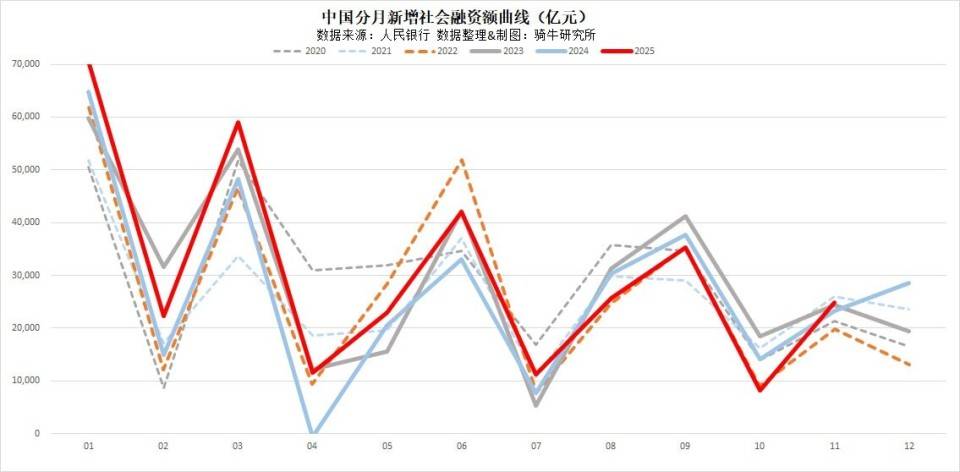
Group 1 - In November 2025, new social financing increased by 6.9% year-on-year, primarily supported by non-standard financing and government bonds, while core credit demand from the real economy remained weak [2][4][8] - Non-standard financing became the main contributor, with trust loans and other non-standard assets increasing significantly, indicating a reliance on flexible funding channels to support infrastructure and local projects [4][6] - Government bonds played a leading role, with net issuance of 1.2 trillion yuan in November, but the growth rate declined due to a high base effect, highlighting the increasing share of government-related financing in total social financing [6][7] Group 2 - Resident loans continued to contract, reflecting weak real estate cycles and insufficient consumer spending, with a significant year-on-year decrease in new resident loans [9][11] - The real estate market showed signs of weakness, with high household savings rates and declining property prices, leading to a lack of purchasing intent among residents [12][13] - Consumer confidence dropped, exacerbated by external pressures such as high global inflation and domestic supply excess, indicating a need for policy shifts to stimulate consumption [13][14] Group 3 - Corporate funding needs increased year-on-year, but the debt structure revealed a lack of confidence in future investments, with a notable preference for short-term financing over long-term expansion [14][17] - New short-term loans surged, while medium- to long-term loans saw a decline, reflecting a cautious approach among businesses amid low demand and economic uncertainty [17][19] - Fixed asset investment showed a rare decline, indicating insufficient capital formation and the need for improved business environments and tax incentives to stimulate long-term demand [19][20] Group 4 - Fiscal policy is expected to shift focus from replacing local hidden debts to promoting fixed asset investment in 2026, aiming to support economic growth [20][22] - The central economic work conference emphasized maintaining active fiscal policies, with potential measures to boost investment in real estate and infrastructure [22][23] - However, challenges remain regarding investment efficiency amid existing overcapacity, and the potential for government debt to exceed credit could further dampen household and corporate demand [22][23]

11月金融数据解读:企业融资多渠道回暖
Guoxin Securities· 2025-12-13 13:19
Financial Data Overview - In November, China's new social financing (社融) reached 2.49 trillion yuan, exceeding the expected 2.02 trillion yuan[2] - New RMB loans amounted to 390 billion yuan, lower than the expected 504.3 billion yuan[2] - M2 growth year-on-year was 8.0%, slightly below the expected 8.2%[2] Economic Insights - The financial data indicates stabilization in total volume with structural differentiation, as social financing growth remained steady at 8.5% month-on-month[5] - Corporate loans showed marginal improvement, with non-standard and direct financing rebounding significantly, suggesting a potential bottoming out of manufacturing investment sentiment[5] - Government deposits decreased significantly year-on-year, indicating an acceleration in government spending, which is crucial for supporting the economy[5] Credit and Loan Analysis - Credit data remains weak, with five consecutive months of year-on-year declines, particularly in household loans, which decreased by 476.3 billion yuan[5][14] - New corporate loans increased by 610 billion yuan year-on-year, with short-term loans rising by 1 trillion yuan, indicating improved corporate financing demand[12] - Household loans showed a negative growth of 206.3 billion yuan, reflecting low consumer and housing demand[14] Financing Structure - Government bond financing increased by 1.2 trillion yuan, becoming the main source of social financing growth for the month[16] - Direct corporate financing reached 451.1 billion yuan, up 170.2 billion yuan year-on-year, with credit bonds contributing significantly[18] - The overall financing structure indicates a shift towards non-standard and direct financing, which has been more resilient compared to traditional bank loans[5][18] Monetary Indicators - Total deposits increased by 1.41 trillion yuan, but this was a decrease of 760 billion yuan year-on-year, with M2 growth continuing to decline[22] - M1 growth rate fell to 4.9%, reflecting limited changes in actual monetary circulation[22] - The widening gap between M2 and M1 growth rates indicates a potential liquidity issue in the economy[22]
12月,又到了一年一度城投疯狂融资的季节……
Sou Hu Cai Jing· 2025-12-06 09:07
Core Viewpoint - The financing rush in December for urban investment platforms in China is a critical period marked by urgent funding needs due to year-end project settlements, debt maturities, and fiscal balancing requirements [1][3][4] Group 1: December Financing Rush - The December financing frenzy is driven by three key deadlines: year-end project settlements, maturing debts, and fiscal balancing [3][4] - Urban investment platforms face a 30% increase in monthly funding needs due to project settlements that must be completed before the Chinese New Year [3] - The peak of urban investment bond maturities occurs at year-end, creating a "dam" of debt that must be addressed to avoid project halts and regional credit risks [3][4] Group 2: Financing Strategies - The tightening of formal financing channels has led urban investment platforms to adopt various innovative financing methods, including financing leases and commercial factoring [6][7] - Some urban investment platforms are utilizing asset-backed securities (ABS) to secure funding, with rates as low as 1.85% for certain projects, showcasing a trend towards more sophisticated financing solutions [7] - The urgency of December financing has resulted in a focus on speed rather than cost, with platforms rapidly exploring multiple financing options to meet immediate needs [7] Group 3: High-Cost Financing Challenges - Urban investment platforms are increasingly reliant on high-cost non-standard financing due to strict bank lending criteria, with annualized costs exceeding 20% in some cases [9] - The dilemma of high-cost financing reflects the pressing need for funds to maintain ongoing projects and pay workers, despite the financial strain it imposes [9] - Some platforms are attempting to shift their financing strategies towards securing policy funds and reducing reliance on high-cost borrowing [9] Group 4: Broader Implications - The December financing activities are not merely financial maneuvers but are essential for sustaining urban infrastructure projects and ensuring economic development [11][12] - The ongoing efforts to secure funding highlight the balance between immediate financial needs and long-term urban development goals [11][12] - The challenges faced during this period may be viewed as part of the broader transition of local economies in China, emphasizing the importance of effective financing in urbanization [12]

社融由财政支撑——2025年5月金融数据解读【陈兴团队•财通宏观】
陈兴宏观研究· 2025-06-13 16:00
Group 1 - The core viewpoint of the article highlights that effective financing demand is currently insufficient, with social financing maintaining a year-on-year increase primarily due to government bond financing, while credit remains weak due to various factors affecting corporate financing willingness [1][2][4] - In May, the social financing scale increased by 2.29 trillion yuan, with a year-on-year increase narrowing to 227.1 billion yuan, supported mainly by direct financing, particularly government bond issuance [2][4] - The M1 growth rate rebounded in May, influenced by a low base effect from the previous year and improved cash flow for enterprises due to government bond issuance [1][8] Group 2 - In May, new RMB loans amounted to 620 billion yuan, with a year-on-year decrease narrowing to 330 billion yuan, indicating a shift in the residential loan sector from a year-on-year increase to a decrease [4][6] - Corporate loans increased by 5.3 trillion yuan, driven by both short-term and medium-to-long-term loans, although bill financing remained weak with a year-on-year decrease [6][8] - The M2 year-on-year growth rate slightly declined to 7.9% in May, while the difference between M2 and M1 growth rates narrowed, indicating a stabilization in social financing stock growth at 8.7% [8]