
政府债券

Search documents
全国两会精神学习系列之三:2026年政府债券如何发力?
Zhong Cheng Xin Guo Ji· 2026-03-25 03:19
1. Report Industry Investment Rating - There is no information about the report industry investment rating in the provided content. 2. Core Viewpoints of the Report - The report analyzes the key points of government bonds in 2026 based on the Government Work Report and the Budget Report, including maintaining a narrow - deficit ratio of 4%, a slight increase in the broad - deficit scale, changes in special treasury bonds, stable new special bond quotas, and suggestions for making good use of government bonds [3][4]. 3. Summary by Relevant Catalogs 3.1 Narrow - deficit ratio remains at 4%, broad - deficit slightly rises to 13.89 trillion to ensure necessary expenditure - **Narrow - deficit ratio stability and central tilt**: The narrow - deficit ratio remains at 4%, and the deficit scale reaches 5.89 trillion, an increase of 2300 billion from the previous year. The deficit increase is all in the central government, with the central deficit scale and proportion reaching a record high, which helps optimize the debt structure of the central and local governments [4][6][7]. - **Broad - deficit increase and rate decline**: The broad - deficit scale reaches 13.89 trillion, a slight increase of 300 billion from the previous year, and the broad - deficit rate drops by 0.5 percentage points to 9.4%. It is estimated that the explicit leverage ratio of the government sector will rise by about 6.1 percentage points to 74.7% by the end of the year [10]. 3.2 Special treasury bonds of 1.6 trillion, a decrease of 0.2 trillion year - on - year, focusing more on quality and efficiency - **Ultra - long - term special treasury bonds**: The issuance scale of ultra - long - term special treasury bonds remains at 1.3 trillion, which may drive GDP growth by about 3.24 percentage points. The funds are used for consumer goods replacement, large - scale equipment renewal, "two important" construction, etc. [14][15]. - **300 billion for state - owned commercial banks**: 300 billion is used to support state - owned large - scale commercial banks to supplement capital, a decrease of 200 billion from the previous year, which may bring about 2.3 trillion in new credit [18]. 3.3 New special bond quota of 4.4 trillion remains unchanged, improving negative list management and self - review and self - issuance pilot - **New special bond quota and investment leverage**: The new special bond quota remains at 4.4 trillion, which may leverage 6 trillion in infrastructure investment. It helps to fill the capital gap in infrastructure and leaves room for future development [20][21]. - **Increasing and listing project - construction quota**: The scale of special bonds for project construction may increase by 400 billion to about 3.6 trillion. The investment areas focus on "investing in people", including people's livelihood, new infrastructure, traditional infrastructure, and real estate [23]. - **Improving management and pilot**: Improve the "negative list" management and "self - review and self - issuance" pilot to enhance the efficiency of special bond funds and play a greater role in leveraging government investment [24][25]. 3.4 Suggestions for making good use of government bonds - **Front - loaded efforts**: Speed up the issuance and use of government bonds. In January - February 2026, the issuance of national and local government bonds increased year - on - year, and the issuance of new special bonds was ahead of schedule [27]. - **Synergistic efforts**: Strengthen the coordination between fiscal and monetary policies. There may be 1 interest rate cut and 1 - 2 (targeted) reserve requirement ratio cuts this year. Optimize and innovate structural monetary policy tools and issue 800 billion in new policy - based financial tools [30]. - **Effective management**: Improve the whole - process and whole - cycle management, including establishing a government asset - liability table, standardizing information disclosure, optimizing debt monitoring indicators, and improving the debt - repayment guarantee mechanism [33].
人民银行:1月末社融存量449.11万亿元,同比增长8.2%
Bei Jing Shang Bao· 2026-02-13 10:46
Group 1 - The total social financing scale at the end of January 2026 was 449.11 trillion yuan, representing a year-on-year growth of 8.2% [1] - The balance of RMB loans issued to the real economy was 273.3 trillion yuan, with a year-on-year increase of 6.1% [1] - The balance of foreign currency loans issued to the real economy, converted to RMB, was 1.09 trillion yuan, showing a year-on-year decline of 12.1% [1] Group 2 - The balance of entrusted loans was 11.3 trillion yuan, reflecting a year-on-year growth of 0.2% [1] - The balance of trust loans was 4.67 trillion yuan, with a year-on-year increase of 7% [1] - The balance of undiscounted bank acceptance bills was 2.78 trillion yuan, showing a year-on-year growth of 6.7% [1] Group 3 - The balance of corporate bonds was 34.69 trillion yuan, representing a year-on-year increase of 6.1% [1] - The balance of government bonds was 95.9 trillion yuan, with a year-on-year growth of 17.3% [1] - The balance of domestic stocks of non-financial enterprises was 12.23 trillion yuan, reflecting a year-on-year increase of 3.9% [1] Group 4 - RMB loans to the real economy accounted for 60.9% of the total social financing scale, down 1.2 percentage points year-on-year [2] - Foreign currency loans to the real economy accounted for 0.2%, down 0.1 percentage points year-on-year [2] - The proportion of entrusted loans was 2.5%, down 0.2 percentage points year-on-year [2] Group 5 - The proportion of trust loans was 1%, down 0.1 percentage points year-on-year [2] - The share of undiscounted bank acceptance bills was 0.6%, unchanged year-on-year [2] - Corporate bonds accounted for 7.7% of the total, down 0.2 percentage points year-on-year [2] Group 6 - Government bonds accounted for 21.4% of the total, up 1.7 percentage points year-on-year [2] - The share of domestic stocks of non-financial enterprises was 2.7%, down 0.1 percentage points year-on-year [2]
去年广义财政支出首次突破40万亿,今年支出如何扩大|财税益侃
Di Yi Cai Jing· 2026-02-05 12:40
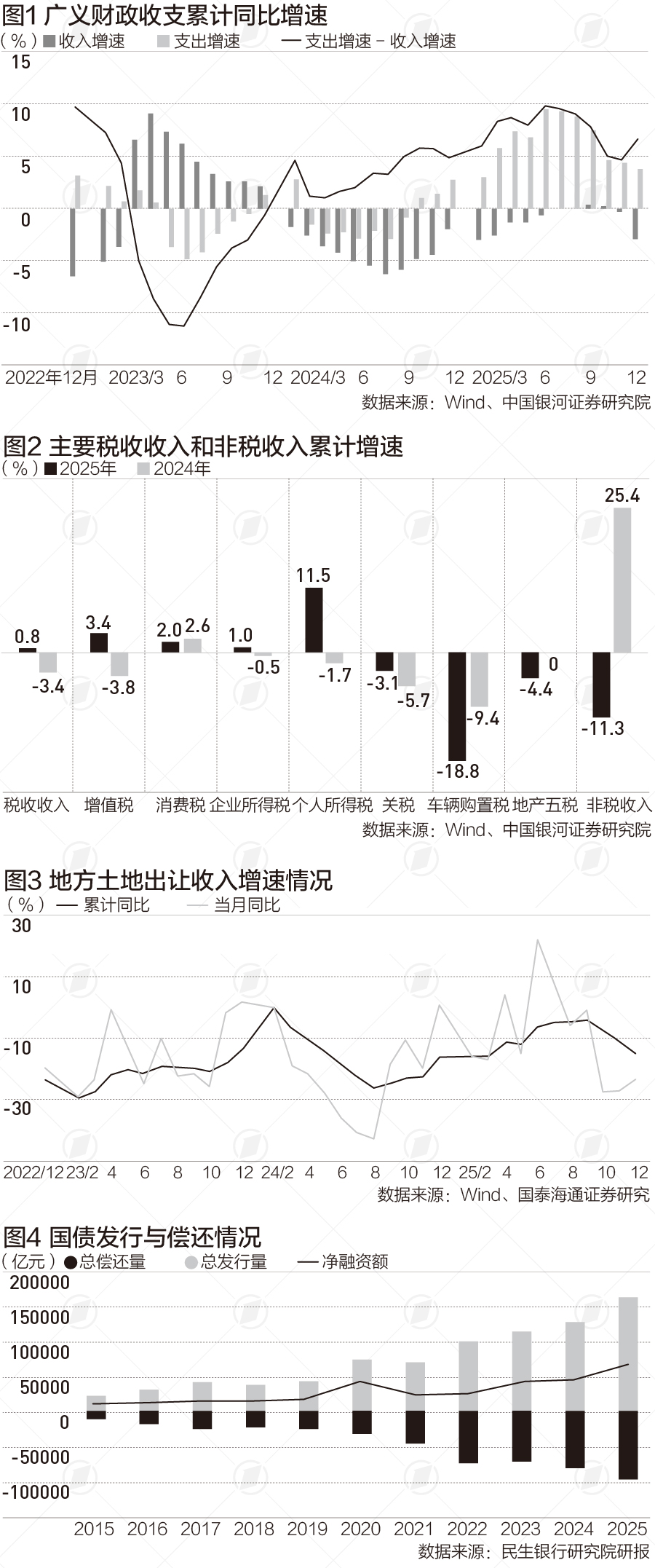
Core Viewpoint - The article discusses the expected slight growth in local fiscal revenue for 2026, driven by a more proactive fiscal policy implemented in 2025, which saw a significant increase in fiscal spending despite a decline in fiscal revenue [1][11]. Fiscal Policy and Spending - In 2025, the broad fiscal expenditure reached approximately 40.03 trillion yuan, a year-on-year increase of 3.7%, while fiscal revenue was about 27.38 trillion yuan, showing a decline of approximately 2.9% [1][3]. - The fiscal deficit exceeded revenue by about 12.65 trillion yuan, marking a year-on-year increase of 21.3% [1]. - The central economic work conference emphasized the continuation of a more proactive fiscal policy in 2026, focusing on expanding fiscal spending and ensuring necessary expenditure [10]. Revenue and Expenditure Dynamics - The 2025 national general public budget expenditure was approximately 28.74 trillion yuan, with a growth rate of 1%, while government fund expenditure was about 11.29 trillion yuan, increasing by 11.3% [2]. - The growth rate of general public budget expenditure outpaced revenue growth by 2.7 percentage points, reflecting the active role of fiscal policy in countering economic downturns [2]. - Key areas of expenditure related to social security, education, and health saw growth rates of 6.7%, 3.2%, and 5.7% respectively, indicating a focus on improving living standards [2]. Challenges in Revenue Generation - The general public budget revenue for 2025 was approximately 21.61 trillion yuan, a decrease of 1.7% from the previous year, influenced by insufficient domestic demand and ongoing adjustments in the real estate market [6]. - Tax revenue showed a slight increase of 0.8% to about 17.64 trillion yuan, while non-tax revenue fell by 11.3% to approximately 3.97 trillion yuan [6]. - The decline in land transfer income, a significant source of government fund revenue, was notable, with a drop of 14.7% to about 4.15 trillion yuan, marking the fourth consecutive year of decline [7]. Future Outlook and Recommendations - For 2026, fiscal revenue is expected to remain subdued, with projections indicating slight growth in local fiscal revenue, such as a 3% increase in Guangdong and a 2% increase in Zhejiang [11]. - Experts suggest that the government may need to increase borrowing to expand fiscal spending, with a projected deficit rate of around 4% and potential issuance of special bonds [12]. - The focus for 2026 will likely shift towards enhancing spending on social welfare and consumer support, including increased subsidies for elderly care and education [12].

2025年个税收入1.62万亿,增长11.5%
21世纪经济报道· 2026-01-31 13:19
Core Viewpoint - The article discusses the 2025 fiscal revenue and expenditure data released by the Ministry of Finance, highlighting a slight decline in overall revenue but an increase in expenditure, with a focus on supporting consumption and social welfare initiatives [1][10]. Revenue Summary - In 2025, the national general public budget revenue reached 21.6 trillion yuan, a decrease of 1.7% from the previous year. Tax revenue was approximately 17.6 trillion yuan, growing by 0.8%, while non-tax revenue fell to 3.97 trillion yuan, down 11.3% [1][4]. - The decline in overall revenue is attributed to a high base from one-time special revenue payments made by central units in 2024. However, major tax categories showed positive growth, with personal income tax increasing by 11.5% to 1.62 trillion yuan, linked to steady growth in residents' income [4][5]. Expenditure Summary - National general public budget expenditure in 2025 was 28.7 trillion yuan, an increase of 1% year-on-year. The government is committed to maintaining necessary levels of fiscal deficit and debt, ensuring that expenditure continues to grow, particularly in key areas [1][9]. - The government is focusing on enhancing support for consumption, investment in human capital, and social welfare, with significant allocations for initiatives like childcare subsidies and consumption incentives [11][12]. Regional Revenue Insights - In 2025, local fiscal revenue remained stable, with nearly 90% of provinces reporting positive growth. The central general public budget revenue was 9.4 trillion yuan, down 6.5%, while local budget revenue was 12.2 trillion yuan, up 2.4% [8][10]. - Major eastern provinces like Guangdong, Jiangsu, and Zhejiang experienced steady revenue growth, indicating a resilient economic performance in these regions [8]. Future Outlook - The Ministry of Finance plans to continue implementing proactive fiscal policies in 2026, with a focus on maintaining expenditure levels and optimizing spending structures to enhance economic recovery [13].

28.74万亿元支出保障有力 去年近九成地区财政收入实现增长
Sou Hu Cai Jing· 2026-01-30 22:24
Group 1 - In 2025, the national general public budget revenue reached 21.6 trillion yuan, a year-on-year decrease of 1.7%, while expenditure was 28.74 trillion yuan, an increase of 1% [1] - The overall fiscal revenue in China remained stable, with tax revenue steadily rebounding and key areas of expenditure being well-supported [1][2] - Tax revenue grew by 0.8% in 2025, reflecting a steady upward trend in the economy, while non-tax revenue fell by 11.3% due to a high base from 2024 [1][2] Group 2 - Major tax categories such as value-added tax, consumption tax, corporate income tax, and individual income tax grew by 3.4%, 2%, 1%, and 11.5% respectively, accounting for about 81% of total tax revenue [2] - The growth in consumption tax was primarily driven by increases in cigarette and refined oil taxes, while corporate income tax growth was supported by the manufacturing sector [2] - The securities transaction stamp duty reached 203.5 billion yuan, a significant increase of 57.8%, indicating a strong correlation with market activity [2][3] Group 3 - National general public budget expenditure increased by 1%, with social security and employment, technology, education, and health spending rising by 6.7%, 4.8%, 3.2%, and 5.7% respectively, together accounting for about 42% of total expenditure [3] - Fiscal funds showed a clear trend of investing in human capital, with over 30 million infants receiving childcare subsidies [3] - In 2025, the total expenditure on special bonds and other financial instruments reached 6.19 trillion yuan, an increase of 1.69 trillion yuan or 37.6%, enhancing economic development momentum [3][4]
财政部最新发声,2026年财政总体支出力度“只增不减”
Xin Lang Cai Jing· 2026-01-20 07:43
Core Viewpoint - The Chinese government will continue to implement a more proactive fiscal policy in 2026, focusing on increasing total expenditure, optimizing structure, improving efficiency, and enhancing momentum [1][4]. Fiscal Policy Overview - The fiscal deficit, total debt scale, and total expenditure will maintain necessary levels in 2026, ensuring that overall expenditure increases and key areas are strongly supported [1][3]. - The fiscal deficit rate for 2025 is set at around 4%, an increase of 1 percentage point from the previous year, with new government debt reaching 11.86 trillion yuan, an increase of 2.9 trillion yuan compared to the previous year [3][4]. Strategic Focus Areas - The fiscal policy will play a crucial role in boosting consumption and expanding effective investment [4]. - The 2025 National Fiscal Work Conference emphasized the need to expand the fiscal expenditure pool and ensure necessary expenditure while optimizing the expenditure structure and enhancing support for key areas [4]. Investment Direction - The fiscal expenditure structure will continue to be optimized, with a focus on supporting major national strategies and directing more resources towards people's livelihoods and key sectors [5]. - Government bond funds will prioritize improving people's livelihoods, expanding domestic demand, and enhancing future growth, particularly in areas such as urban renewal and manufacturing upgrades [5]. Expected Fiscal Metrics - The expected fiscal deficit for the current year is approximately 5.9 trillion yuan, an increase of about 200 billion yuan from the previous year, primarily borne by the central government [5]. - The issuance of special long-term government bonds is projected to be 1.5 trillion yuan, an increase of 200 billion yuan from the previous year, to support key projects [5].
央行:2025年末社会融资规模存量为442.12万亿元 同比增长8.3%
Zheng Quan Shi Bao Wang· 2026-01-15 07:08
Core Insights - The People's Bank of China reported that by the end of 2025, the total social financing scale is projected to reach 442.12 trillion yuan, reflecting a year-on-year growth of 8.3% [1] Summary by Category Loans to the Real Economy - The balance of RMB loans issued to the real economy is expected to be 268.4 trillion yuan, with a year-on-year increase of 6.3% [1] - The balance of foreign currency loans to the real economy, converted to RMB, is anticipated to be 10.5 billion yuan, showing a year-on-year decline of 18% [1] Other Financing Instruments - The balance of entrusted loans is projected to be 11.35 trillion yuan, marking a year-on-year growth of 1.3% [1] - The balance of trust loans is expected to reach 4.67 trillion yuan, with a year-on-year increase of 8.6% [1] - The balance of undiscussed bank acceptance bills is anticipated to be 2.15 trillion yuan, reflecting a year-on-year decrease of 0.3% [1] Corporate Bonds and Stocks - The balance of corporate bonds is projected to be 34.24 trillion yuan, with a year-on-year growth of 6% [1] - The balance of government bonds is expected to reach 94.92 trillion yuan, showing a year-on-year increase of 17.1% [1] - The balance of domestic stocks held by non-financial enterprises is anticipated to be 12.2 trillion yuan, reflecting a year-on-year growth of 4.1% [1]
前11个月广义财政支出超收入近10万亿
第一财经· 2025-12-26 02:25
Core Viewpoint - The article discusses the performance of China's broad fiscal revenue and expenditure in the first 11 months of the year, highlighting a slight decline in revenue and an increase in expenditure, reflecting a proactive fiscal policy aimed at stabilizing economic growth and expanding domestic demand [3][5]. Fiscal Revenue - In the first 11 months, broad fiscal revenue reached 24,079 billion yuan, showing a year-on-year decline of approximately 0.2% [3]. - The national general public budget revenue increased by 0.8% year-on-year, slightly better than the initial forecast of 0.1%, driven by stable economic performance and active capital markets [5]. - Government fund revenue decreased by 4.9% year-on-year, falling short of the initial forecast of 0.7%, primarily due to a sluggish real estate market and lower land transfer income [5]. Fiscal Expenditure - Broad fiscal expenditure amounted to 34,066 billion yuan, with a year-on-year increase of about 4.5%, which is lower than the expected growth rate of 9.3% for the year [6]. - The government allowed local governments to issue an additional 500 billion yuan in bonds in the fourth quarter to support local financial capacity and major project construction [6][7]. - The fiscal expenditure structure has been optimized, with increased focus on social welfare and public services, such as social security and education, which grew faster than average expenditure growth [9]. Government Debt - Net financing of government bonds reached 1.315 trillion yuan in the first 11 months, an increase of 361 billion yuan year-on-year [8]. - Experts anticipate that the fiscal deficit rate for 2026 will be set around 4%, with total government debt expected to exceed 12 trillion yuan, potentially reaching between 13 trillion and 16 trillion yuan [9].

前11个月广义财政支出超收入近10万亿,原因有哪些
Di Yi Cai Jing· 2025-12-25 12:25
Group 1 - The core viewpoint of the articles highlights the optimization of fiscal expenditure structure in China, with a focus on investing in people and ensuring the well-being of the population [1][8] - In the first 11 months of this year, the broad fiscal revenue reached 24,079 billion yuan, showing a year-on-year decline of approximately 0.2%, while broad fiscal expenditure was 34,066 billion yuan, reflecting a year-on-year increase of about 4.5% [1][4] - The broad fiscal expenditure exceeded revenue by 99,872 billion yuan, which is a year-on-year increase of approximately 17.9%, indicating a more proactive fiscal policy aimed at stabilizing growth and expanding domestic demand [1][6] Group 2 - The broad fiscal revenue is close to the initial official expectations for the year, with a projected growth of about 0.2% for 2025, aligning with the current year-to-date performance [4] - The general public budget revenue increased by 0.8% year-on-year in the first 11 months, slightly better than the initial forecast of 0.1%, driven by stable economic performance and increased tax revenues from a vibrant capital market [4] - However, government fund revenue remains below initial expectations, primarily due to a sluggish real estate market and lower-than-expected land transfer income, which decreased by 10.7% year-on-year [5] Group 3 - The growth rate of broad fiscal expenditure is lower than the initial official forecast, with an actual increase of 4.5% compared to an expected 9.3% for 2025, largely due to underperformance in land transfer income [6] - To maintain fiscal expenditure levels, the central government has allowed local governments to issue an additional 500 billion yuan in bonds in the fourth quarter to support local financial capacity and major project construction [6] - The total investment from new policy financial tools has reached approximately 7 trillion yuan, focusing on digital economy, artificial intelligence, and urban infrastructure projects [6][8] Group 4 - The net financing of government bonds reached 1.315 trillion yuan in the first 11 months, an increase of 361 billion yuan year-on-year [7] - The central economic work conference has called for continued implementation of a more proactive fiscal policy next year, with expectations for the fiscal deficit rate to be set around 4% for 2026 [9] - The anticipated increase in government debt issuance, including long-term special bonds and local government bonds, is expected to exceed 12 trillion yuan in 2025, potentially reaching between 13 trillion and 16 trillion yuan [9]

吉富星:加大政府债券投资于人力度
Jing Ji Ri Bao· 2025-12-23 00:03
Group 1 - The core viewpoint emphasizes the necessity of combining investments in physical assets and human capital to address external challenges, with a focus on "investing in people" as a new development direction for China's economy [1] - The government bonds are highlighted as a crucial tool for active fiscal policy, aimed at enhancing human development through investments in education, healthcare, and social welfare, which are essential for high-quality and sustainable economic growth [1][2] - The contribution of consumer spending to economic growth is projected to decrease to 44.5% in 2024, down from 2023, indicating insufficient investment in human capital as a contributing factor [1] Group 2 - The recent Central Political Bureau meeting underscored the importance of prioritizing people's livelihoods, with nearly 100 trillion yuan allocated to social welfare during the 14th Five-Year Plan, emphasizing the role of government bonds in improving living standards [2] - As of September this year, the balance of government bonds reached 93 trillion yuan, making it the largest bond category in the market, with significant allocations to both infrastructure and public service projects [2] - The government plans to allocate 150 billion yuan in special long-term bonds in 2024 to support the replacement of consumer goods, with an additional 300 billion yuan in 2025, aimed at stimulating consumption and economic growth [2] Group 3 - The current international environment remains complex, and domestic economic operations face challenges, necessitating more proactive macroeconomic policies that focus on quality and efficiency [3] - Government bond investments are primarily directed towards infrastructure projects, with 27% of special bonds in the first 11 months of this year allocated to municipal and industrial park infrastructure, and 17% to transportation infrastructure [3] - Future government bond strategies should balance supply and demand, focusing more on human capital investments while optimizing the allocation and efficiency of bond usage [3] Group 4 - There is a need to expand the quota for special bonds and national bonds in the social welfare sector, ensuring effective fund deployment to address urgent public needs and human capital development [4] - The continuation of special bonds to support consumer goods replacement is crucial for fostering a positive cycle of consumption and investment, with an emphasis on new consumption areas such as digital, green, and smart sectors [4] - Innovative government bond types, such as human capital bonds and social bonds, should be explored to specifically fund areas like childcare, education, healthcare, and elderly care, enhancing collaboration between fiscal and financial sectors [4]