
鸽派美联储

Search documents
AI支出、企业盈利、鸽派美联储!美股“四连阳”三大支柱缺一不可
Zhi Tong Cai Jing· 2026-01-02 01:56
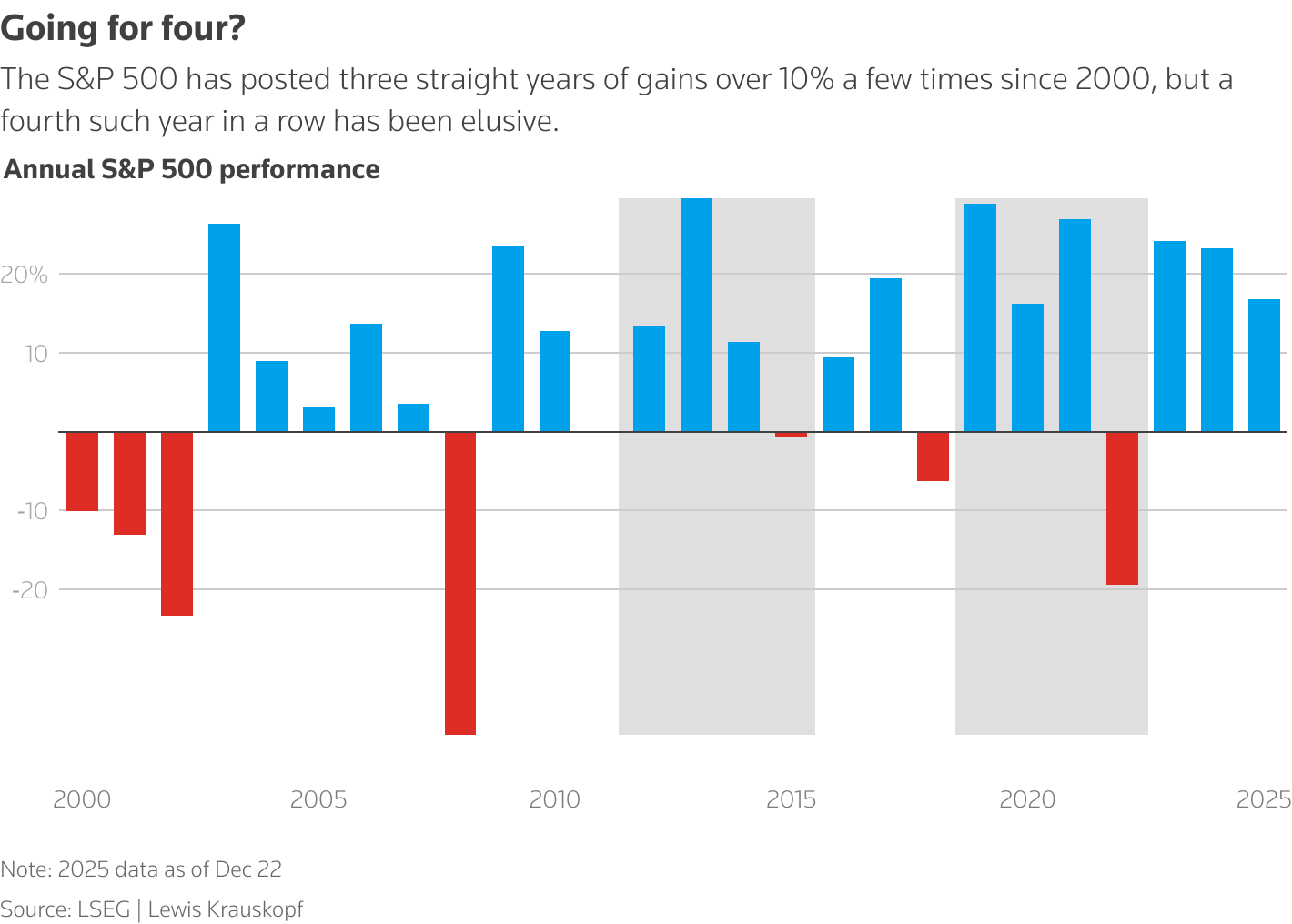
Core Viewpoint - The U.S. stock market ended 2025 with a double-digit percentage increase for the third consecutive year, driven by optimism around AI, declining interest rates, and concerns about economic recession [1] Group 1: Market Performance and Projections - The S&P 500 index rose over 16% in 2025, following increases of 23% in 2024 and 24% in 2023 [1] - Market strategists expect continued strong performance in 2026, with some projecting over 10% gains for the S&P 500 index, including a target of 8000 points from Deutsche Bank, indicating a potential increase of about 17% [1] - CFRA's Chief Investment Strategist, Sam Stovall, suggests that for another year of strong double-digit returns, "all aspects must be running at full speed," with a target price of 7400 points for the end of 2026, representing an 8% increase from current levels [1] Group 2: Corporate Earnings and AI Support - Corporate earnings growth is expected to be a key factor in market performance, with S&P 500 companies projected to grow earnings by over 15% in 2026, following a 13% increase in 2025 [4] - Earnings growth is anticipated to be driven by a broader range of companies rather than just a few tech giants, supported by fiscal stimulus and loose monetary policy [4] - The profit growth rate for the "Magnificent Seven" tech companies is expected to be 23% in 2026, compared to 13% for the remaining companies in the S&P 500 [4] Group 3: Economic Conditions and Federal Reserve Policy - A key factor for a strong market year is a moderate economic slowdown that allows inflation to decrease and paves the way for further interest rate cuts, without leading to a recession [6] - Investors expect the Federal Reserve to cut rates by a total of 175 basis points in 2024 and 2025, with at least two additional cuts of 25 basis points each in 2026 [6] - The potential appointment of a more dovish Federal Reserve Chair by President Trump in early 2026 is being closely monitored by investors [6] Group 4: Historical Context and Political Factors - Historical data shows mixed signals for potential returns in 2026, with an average increase of 12.8% in the fourth year of bull markets since 1950, although midterm election years typically see lower performance, averaging only 3.8% [7] - The U.S.-China relationship remains a significant factor that could influence market trends in 2026, with potential breakthroughs being a positive catalyst not fully priced in by the market [7]

来自华盛顿的蝴蝶效应!特朗普对美联储“动刀”反倒引爆日本市场!
Jin Shi Shu Ju· 2025-08-26 09:33
Group 1 - The yield on 30-year Japanese government bonds reached a historical high of 3.215% amid concerns over a potentially more dovish Federal Reserve following President Trump's attempt to dismiss Fed Governor Cook [1] - Japan's debt burden, approximately 250% of GDP, complicates the government's goal of managing its finances as the Finance Ministry plans to request over 32 trillion yen (approximately 217.2 billion USD) for debt servicing costs in the next fiscal year's budget, marking a record amount [1] - The sensitivity of the Japanese market to changes in global interest rates is heightened, as Japan is the world's largest creditor with some of the lowest sovereign yields [1] Group 2 - As of the end of 2023, Japan holds 2 trillion USD in U.S. assets, with rising U.S. bond yields contributing to this increase, indicating a synchronization of Japanese bond yields with U.S. yields [2] - Trump's attacks on Cook have intensified his efforts to influence monetary policy, undermining confidence in U.S. sovereign debt as a safe investment, which is particularly concerning for the Japanese bond market experiencing rising yields [2] - The ruling coalition's recent defeat in the Senate elections has empowered opposition parties advocating for consumption tax cuts, raising concerns about potential delays in discussions regarding supplementary budgets [2]
黄金牛市未完?富达看高至4000美元 押注鸽派美联储+弱美元
智通财经网· 2025-07-29 03:28
Group 1 - Fidelity International predicts gold prices may reach $4,000 per ounce by the end of next year due to the Federal Reserve's interest rate cuts, a weaker dollar, and central banks increasing gold reserves [1][2] - Ian Samson, a multi-asset fund manager, notes that the company remains bullish on gold, with some funds increasing their gold allocation from 5% to nearly 10% over the past year [1][2] - Gold prices have risen over 25% this year, driven by uncertainties from U.S. trade policies and conflicts in the Middle East and Ukraine, alongside continued central bank purchases [1][2] Group 2 - Goldman Sachs shares a similar optimistic outlook on gold prices, forecasting a potential rise to $4,000 per ounce, while Citigroup expresses a more cautious stance predicting a decline [2] - The upcoming Federal Reserve meeting is expected to maintain current interest rates, but there may be dissent among officials advocating for support of the slowing labor market [2] - Samson highlights that gold typically benefits from a weaker dollar and lower interest rates, with ongoing central bank purchases and expanding fiscal deficits enhancing gold's appeal as a hard asset [3]