黄金价格上涨逻辑

Search documents
有色ETF鹏华(159880)涨超4%,机构称短期调整不影响基本面格局
Xin Lang Cai Jing· 2026-02-03 06:17
Group 1 - The core viewpoint of the articles highlights the recovery of precious metals, particularly gold, which has seen a price increase of over 3%, returning to the $4,800 level [1] - Concerns regarding Kevin Warsh's potential interest rate cuts and the emphasis on monetary discipline by the Federal Reserve may lead to a strong dollar, impacting the long-term logic for gold price increases [1] - The market is currently pricing in two interest rate cuts by the Federal Reserve in 2026, influenced by Warsh's more dovish stance and the challenges of large-scale balance sheet reduction in the short term [1] - The demand for gold assets is increasing due to regional political instability, and despite recent price surges, liquidity easing by the Federal Reserve and escalating global conflicts are expected to support further gold price increases [1] Group 2 - The Zhongguo Securities Nonferrous Metals Industry Index (399395) has risen by 1.43%, with notable increases in stocks such as Hunan Gold (up 9.97%) and Dongyangguang (up 8.62%) [1] - The Penghua Nonferrous ETF closely tracks the Zhongguo Securities Nonferrous Metals Industry Index, which includes 50 prominent securities in the nonferrous metals sector, reflecting the overall performance of listed companies in this industry [2] - As of January 30, 2026, the top ten weighted stocks in the Zhongguo Securities Nonferrous Metals Industry Index account for 49.87% of the index, including companies like Zijin Mining and China Aluminum [2]
金价再创新高!底层逻辑是什么?
Guo Ji Jin Rong Bao· 2025-10-14 15:04
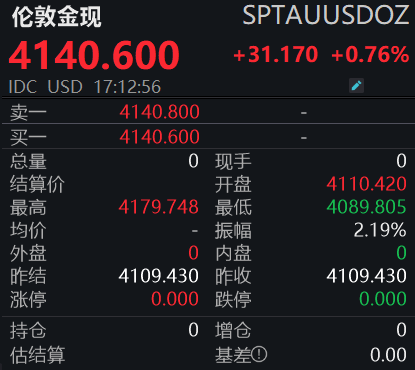
Core Viewpoint - International gold prices continue to rise, surpassing $4100 per ounce and approaching the $4200 mark, with historical highs being reached [1][3]. Gold Price Movement - As of the latest report, London gold is priced at $4140.6 per ounce, up 0.76% for the day, with an intraday high of $4179.748 per ounce [1][2]. - COMEX gold futures also saw a significant increase, rising 0.45% to $4151.7 per ounce, with a peak of $4190.9 per ounce [3][4]. Factors Driving Gold Prices - The chief economist of Nanhua Futures, Zhu Bin, identifies three main reasons for the rise in gold prices: 1. The extensive issuance of currency by the U.S. has led to severe inflation and a decline in the purchasing power of the dollar [5]. 2. The U.S. government's misuse of the dollar's hegemonic status has undermined its position as a "safe asset" [6]. 3. Pressure from former President Trump on the Federal Reserve has compromised its independence, shaking the foundation of the dollar as a global currency [6]. Investment Trends - Wang Zheng, general manager of Shangyi Investment, notes that the rise in gold prices is driven by multiple factors: 1. The onset of a Federal Reserve rate-cutting cycle typically leads to significant gains in gold [7]. 2. Global geopolitical risks and uncertainties are pushing funds towards gold as a safe-haven asset [7]. 3. Continuous gold purchases by central banks provide a solid support for gold prices, alongside a strategic demand for de-dollarization [7]. Market Dynamics - The chief asset research officer at GF Securities, Dai Kang, describes gold as a super-national sovereign credit, akin to a perpetual, non-interest-bearing bond. He suggests that the long-term investment logic for gold will be shaped by its super-national sovereign credit value [8]. - The ongoing concerns regarding U.S. debt may continue to erode the credibility of the dollar, while the trend of de-dollarization, combined with geopolitical risks and central bank demand for gold, is favorable for gold in the medium to long term [8]. Short-term Considerations - Wang Zheng cautions that gold prices may face technical pressure in the short term, suggesting a need for investors to be wary of potential pullbacks. He emphasizes that while the core value of gold remains intact, market conditions may require careful position adjustments [8].

【黄金期货收评】PCE符合预期推升降息押注 沪金日内上涨2.08%
Jin Tou Wang· 2025-09-01 09:35
Group 1 - The core viewpoint indicates that the recent increase in gold prices is influenced by geopolitical tensions, U.S. monetary policy, and rising physical gold demand in China [1][3] - As of September 1, the Shanghai gold spot price was reported at 795.38 yuan per gram, showing a discount of 5.18 yuan compared to the futures price of 800.56 yuan per gram [1] - The U.S. labor market showed unexpected weakness with non-farm employment figures falling short of market expectations, and the unemployment rate rising to 4.2% [2] Group 2 - The latest PCE and core PCE data from the U.S. met market expectations, indicating persistent inflation but limited impact from tariff shocks, which has raised market expectations for a potential Fed rate cut [3] - The demand for physical gold in China has significantly increased, with the central bank resuming gold purchases since November last year, continuing for eight consecutive months [1] - The geopolitical risks have slightly diminished, but the market's demand for safe-haven assets remains, contributing to the upward pressure on gold prices [1][3]
谁是黄金价格的推手?黄金牛市背后的深层逻辑
Sou Hu Cai Jing· 2025-04-16 01:48
Core Insights - Gold prices have become a focal point in global markets, rising from $2080 per ounce in early 2024 to over $3255 in April 2025, driven by multiple factors [1] Group 1: Safe-Haven Demand - The uncertainty in global economic recovery and frequent geopolitical conflicts have heightened safe-haven demand for gold, making it a core driver of price increases [3] - Events such as U.S. military actions in Yemen and drone attacks on Russian oil facilities have further escalated market anxiety, prompting investors to shift funds into gold [3] Group 2: Erosion of Dollar Credibility - The status of the U.S. dollar as the primary reserve currency is being challenged due to high national debt and fiscal deficits, alongside uncertainties in Federal Reserve monetary policy [4] - Rising inflation expectations and declining real interest rates pressure the returns on dollar-denominated assets, enhancing gold's appeal as a global asset [4] Group 3: Central Bank Gold Purchases - Global central banks have been increasing their gold reserves, with purchases exceeding 1000 tons from 2023 to 2024, and this trend is expected to continue into 2025 [6] - Central banks are bolstering their currencies with gold reserves, further driving demand and price increases [6] Group 4: Inflation Expectations and Fed Policy - Changes in U.S. economic inflation data and expectations of Federal Reserve rate cuts are providing support for gold prices [7] - In 2025, the Fed is in a rate-cutting cycle, with persistent high inflation contributing to a downward trend in real interest rates, which benefits gold [7] Group 5: De-Dollarization Trend - The ongoing "de-dollarization" trend, exacerbated by divisive policies, is amplifying gold's volatility and enhancing its strategic position as an alternative reserve asset [8] - Gold is increasingly viewed as a core asset for diversification in investment portfolios [8] Group 6: Future Outlook - Despite gold prices being at historical highs, the underlying logic for price increases remains intact, supported by ongoing central bank demand and short-term safe-haven needs [9] - Goldman Sachs predicts that gold prices could reach $3700 per ounce by the end of 2025, with extreme scenarios suggesting a potential rise above $4500 per ounce [9]