AI推理市场

Search documents
英伟达股价沉寂数月,今夜开幕的GTC能否力挽狂澜?
Hua Er Jie Jian Wen· 2026-03-16 10:00
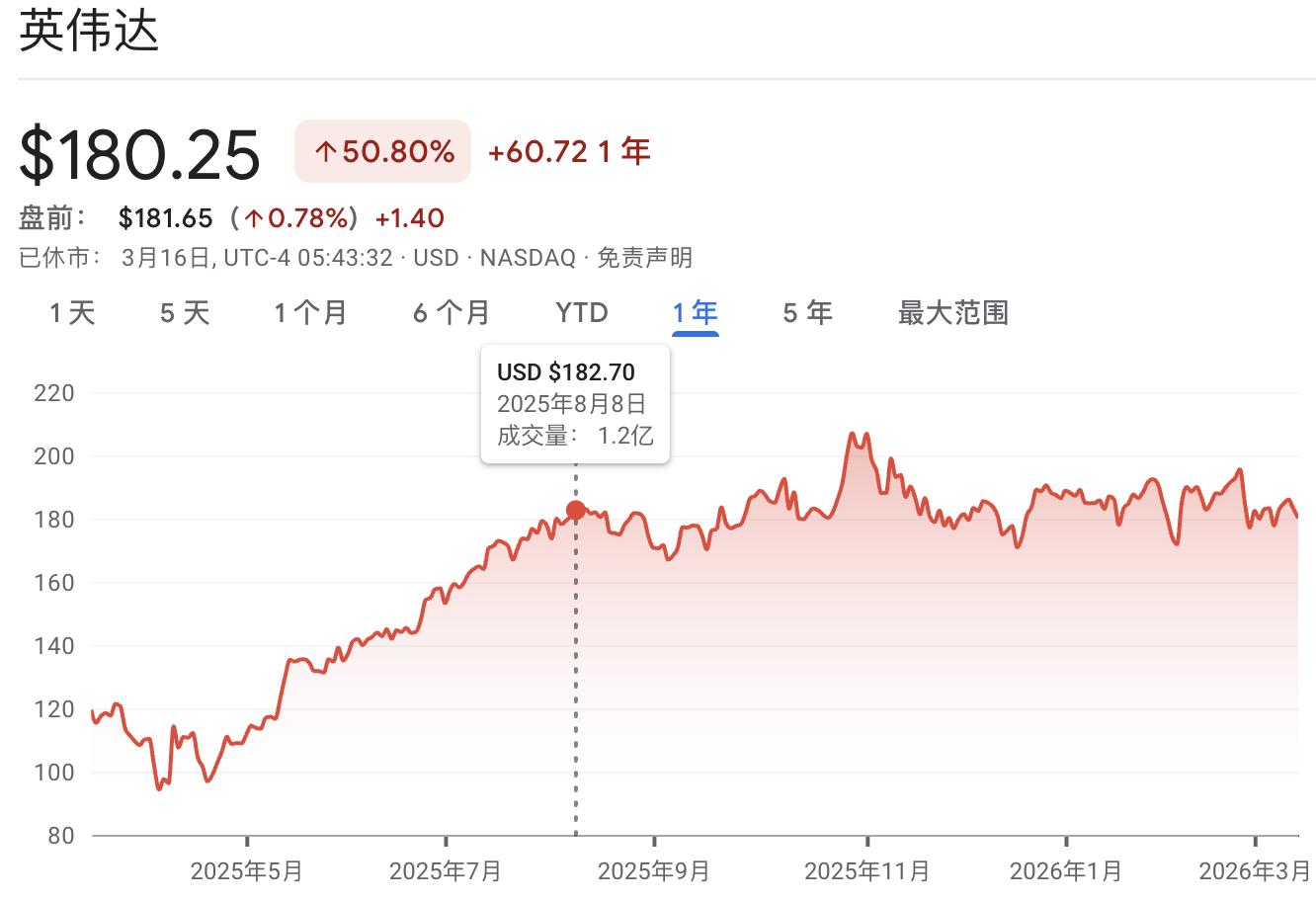
Core Viewpoint - Nvidia is at a critical juncture with most analysts optimistic about its fundamentals, yet the stock price has performed flat this year, leading to ongoing market concerns. The annual GTC conference provides an opportunity to reignite investor confidence [1] Group 1: Market Sentiment and Stock Performance - Despite a ten-year cumulative increase of 22,000%, Nvidia's stock has stagnated this year, raising doubts among investors about its ability to sustain growth [2] - Nvidia is currently trading at 17 times the expected earnings for the next fiscal year, which is below the overall valuation level of the S&P 500 index. Approximately 93% of the 70 analysts covering Nvidia have a buy rating, with an average target price of around $267 [2] - Free cash flow is expected to grow by 85% this fiscal year, reaching over $178 billion, which would set a historical record for global corporate free cash flow [2] Group 2: GTC Conference Highlights - The GTC conference is expected to showcase Nvidia's strategic shift from training to inference in AI, along with adjustments in its supply chain. There may be announcements regarding the integration of Groq technology to enter the AI inference market [3][4] - Nvidia is anticipated to present a new product lineup, including a language processing unit (LPU) rack system and a new generation of high-speed switches, potentially in collaboration with Intel on a custom x86 processor [3] Group 3: Capital Expenditure Trends - Nvidia's performance heavily relies on continued investment in AI infrastructure by major cloud providers like Amazon and Microsoft. Amazon's capital expenditure is projected to rise significantly, with an expected increase to $190 billion this year, primarily directed towards AI infrastructure [5] - Barclays forecasts that overall capital expenditure in the AI sector will peak at approximately $1 trillion by 2028, with market expectations for cloud providers' capital spending in 2028 underestimated by about $300 billion [5] Group 4: Divergent Views on GTC Impact - There is a divide on Wall Street regarding whether the GTC conference will lead to a substantial breakthrough in stock price. Concerns about the sustainability of capital expenditure from large cloud providers and geopolitical uncertainties are seen as core reasons for Nvidia's ongoing valuation pressure [6] - While UBS acknowledges Nvidia's strong fundamentals, it expresses skepticism about the potential for a "change in investment logic" that could trigger a significant stock price surge from the conference [6]


今夜,见证历史!全线暴涨!
券商中国· 2025-09-10 15:05
Core Viewpoint - The article highlights the significant surge in Oracle's stock price, driven by strong financial results and a massive increase in remaining performance obligations (RPO), which has sparked enthusiasm in the AI-driven growth narrative in the market [2][6]. Financial Performance - Oracle's stock price soared over 41% at one point, closing with a gain of 38.84%, marking the largest single-day increase since 1999 [4][6]. - The company's market capitalization rose to $941.94 billion (approximately ¥67,100 billion), with a single-day increase of $263.5 billion (approximately ¥19,000 billion) [6]. - For the first fiscal quarter of 2026, Oracle reported adjusted earnings per share of $1.47, slightly below analyst expectations of $1.48, and revenue of $14.93 billion, also below the expected $15.04 billion [6]. Remaining Performance Obligations (RPO) - Oracle's RPO surged to $455 billion, a staggering year-on-year increase of 359%, which exceeded market expectations significantly [6][10]. - This explosive growth is attributed to large-scale cloud contracts with leading AI companies such as OpenAI, xAI, and Meta, positioning Oracle as a key infrastructure provider for AI model training [6][11]. Cloud Infrastructure Growth - Oracle's cloud infrastructure revenue reached $3.3 billion in the last quarter, reflecting a year-on-year growth of 55% [7]. - The company anticipates cloud infrastructure revenue to hit $18 billion in fiscal year 2026, a nearly 77% increase from $10.3 billion in fiscal year 2025, with projections for subsequent years indicating substantial growth [8]. Analyst Reactions - Following Oracle's financial report, multiple investment banks raised their target prices for the stock, with Wolfe Research increasing its target from $300 to $400, suggesting a market cap of $1.12 trillion [10]. - Analysts noted that the reported backlog data was unprecedented, with expectations for RPO around $180 billion, making Oracle's actual figure several times higher [10]. AI Market Insights - Oracle's Chairman Larry Ellison emphasized that AI is fundamentally transforming the company, with a focus on the AI inference market, which he believes will be larger than the AI training market [11][12]. - Ellison outlined Oracle's strategy to capture the AI inference market through its new "AI database," asserting that the company's AI narrative is just beginning [11][12]. Competitive Advantage - Ellison highlighted Oracle's technological edge, claiming that its data centers are faster and more cost-effective for AI model training compared to competitors [13]. - He attributed this advantage to Oracle's underlying technology, particularly its network capabilities, which enhance data transfer speeds and reduce costs [13].

甲骨文(ORCL.US)Q1业绩会:预计2026财年云基础设施营收将增长77%至180亿美元
Zhi Tong Cai Jing· 2025-09-10 09:09
Core Insights - Oracle has reported a strong start to fiscal year 2026, becoming the preferred platform for AI workloads, with significant cloud contracts signed with major AI companies [1][2] - The company's remaining performance obligations (RPO) reached $455 billion, a year-over-year increase of 359%, indicating robust demand for cloud services [1][2] - Total revenue for the quarter was $14.9 billion, up 11% year-over-year, with operating income growing 7% to $6.2 billion [1] Group 1: Financial Performance - Oracle's RPO is expected to exceed $500 billion, with cloud infrastructure revenue projected to grow 77% to $18 billion in fiscal year 2026 [2] - The company anticipates substantial growth in cloud infrastructure revenue over the next four years, reaching $144 billion by fiscal year 2030 [2] - The first quarter's total revenue growth outpaced the previous year's growth rate of 8% [1] Group 2: AI and Cloud Infrastructure - Oracle is becoming a standard for AI training workloads, with its data centers being preferred for training AI models due to speed and cost efficiency [3][4] - The AI inference market is expected to be larger than the training market, with Oracle positioned to capitalize on this trend [3][4] - The company has developed a unique value proposition by integrating public and private data securely for AI applications [5][15] Group 3: Technological Advancements - Oracle has streamlined its cloud capabilities into a compact solution, offering a private version of its cloud for $6 million, significantly lower than competitors [6] - The company is leveraging AI application generators to enhance application development efficiency, leading to superior application quality [7][8] - Oracle's comprehensive technology stack, from infrastructure to applications, allows for seamless integration and maximized customer benefits [6][8] Group 4: Market Position and Strategy - Oracle's dual identity as both an application and infrastructure company provides a competitive edge in the market [8][9] - The company is focusing on generating applications rather than relying solely on human developers, which reduces labor costs and improves application quality [8] - Oracle's strategy includes embedding its systems within competitors' cloud platforms, enhancing its market presence and operational efficiency [12]

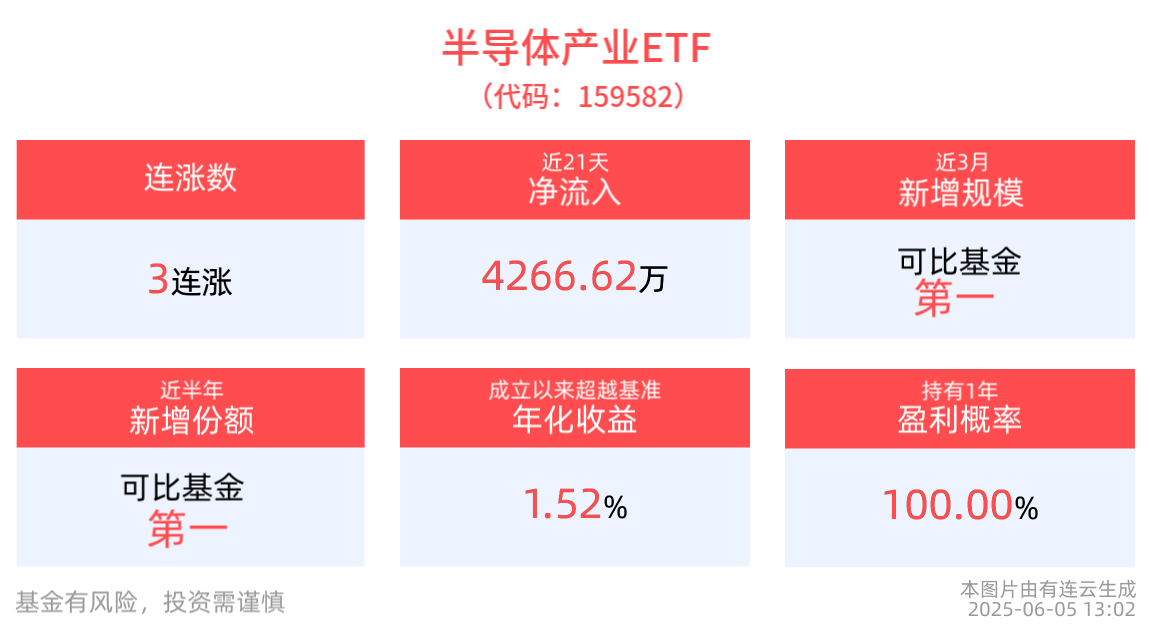
电子行业需求温和复苏,半导体产业ETF(159582)冲击3连涨,拓荆科技涨超3%
Sou Hu Cai Jing· 2025-06-05 05:24
Core Insights - The semiconductor industry is experiencing a mild recovery, with significant growth in AI-driven markets and demand for data centers, as evidenced by Nvidia's impressive Q1 performance, which saw a 73% year-over-year increase in data center revenue [3][4] - The semiconductor industry ETF (159582) has shown notable performance, with a 33.93% increase in net value over the past year, ranking in the top 8.67% among equity index funds [4][5] - Recent U.S. export restrictions on semiconductor technology to China have led to increased costs for companies like Nvidia, impacting their financials [3][4] ETF Performance - The semiconductor industry ETF has seen a significant increase in scale, growing by 30.85 million yuan over the past three months, placing it in the top half of comparable funds [4] - The ETF's share count has also increased by 30 million shares in the last six months, indicating strong investor interest [4] - The ETF's year-to-date performance shows a relative drawdown of 0.48% compared to its benchmark, with a Sharpe ratio of 1.11, indicating a favorable risk-adjusted return [5] Top Holdings - The top ten weighted stocks in the semiconductor index account for 75.47% of the index, with North Huachuang (002371) holding the largest weight at 15.51% [5][7] - Other significant holdings include Zhongwei Company (688012) at 12.80% and SMIC (688981) at 11.67%, reflecting a concentration in key players within the semiconductor sector [5][7] - The performance of these stocks varies, with some experiencing slight declines while others, like Tuojing Technology (688072), have seen increases of 3.02% [7]