AI造假退款

Search documents
围剿“仅退款”,电商告别草莽时代
Shen Zhen Shang Bao· 2026-02-05 23:01
Core Viewpoint - The recent implementation of the "Network Transaction Platform Rules Supervision Management Measures" marks a significant shift in the e-commerce landscape, aiming to combat the malicious "only refund" practices that have plagued the industry, thus signaling the end of a chaotic era in e-commerce [1][8]. Group 1: Background and Evolution of "Only Refund" Mechanism - The "only refund" mechanism was introduced in 2021 to address the high logistics costs associated with returning perishable goods, allowing consumers to receive refunds without returning items, which initially reduced costs for both consumers and merchants [2][3]. - As the e-commerce industry shifted towards a focus on user retention, platforms began to excessively promote the "only refund" policy across all categories, leading to widespread misuse and a competitive race to offer the most lenient return policies [2][3]. Group 2: Impact on Merchants - Merchants have faced significant challenges due to the lack of oversight in the "only refund" process, with some consumers exploiting the system to obtain refunds without returning products, leading to substantial financial losses for businesses [3][4]. - The misuse of the "only refund" policy has created a detrimental ecosystem where dishonest consumers profit at the expense of honest merchants, forcing the latter to either cut costs or raise prices to compensate for losses [4][6]. Group 3: Regulatory Response and Platform Adjustments - In response to the escalating issues, major e-commerce platforms began to refine their "only refund" policies in late 2024, with initiatives aimed at enhancing merchant autonomy and reducing the incidence of malicious refund requests [6][8]. - The introduction of the "Network Transaction Platform Rules Supervision Management Measures" on February 1, 2026, explicitly prohibits platforms from forcing merchants to accept "only refund" requests, marking a pivotal regulatory intervention [8]. Group 4: Future Outlook - The ongoing regulatory efforts and platform reforms are expected to restore balance in the e-commerce ecosystem, fostering a healthier environment for both consumers and merchants, as evidenced by improved merchant sentiments regarding platform policies [8]. - The application of AI technology to detect fraudulent refund claims is also being implemented, further supporting merchants in combating abuse of the refund system [7][8].

调查|当AI学会造假:实测一张“魔改图”,如何打败商家
Bei Ke Cai Jing· 2025-12-03 01:46
Core Viewpoint - The misuse of AI technology for generating fake damage images has emerged as a significant issue in e-commerce, leading to fraudulent refund requests and undermining trust in online transactions [1][11][20]. Group 1: Incidents of Fraud - A seller encountered a refund request accompanied by an AI-generated image of a damaged plush toy, which the buyer claimed was defective [2][4]. - The seller initially suspected misuse but later confirmed the image was AI-generated after using detection tools [4][10]. - Other sellers reported similar experiences, recognizing AI-generated images as fraudulent evidence for refund claims [7][9]. Group 2: Seller Responses and Strategies - Sellers have begun developing "anti-fraud" guidelines to identify AI-generated images, focusing on inconsistencies in damage representation and requesting multiple angles or videos as proof [10][18]. - Many sellers reported being able to visually identify AI-generated images due to their unrealistic characteristics [9][10]. Group 3: E-commerce Platform Reactions - Major e-commerce platforms like JD.com, Pinduoduo, and Taobao are aware of the issue and are implementing measures to combat fraudulent refund requests [20][21]. - JD.com is developing AI capabilities to identify fake images and plans to launch these features by the end of the year [20]. - Platforms are tightening refund policies and enhancing verification processes to protect sellers from fraudulent claims [21][22]. Group 4: Legal and Regulatory Context - The use of AI to create fake evidence for refunds is considered a form of fraud, potentially violating civil and criminal laws [19][23]. - New regulations are being introduced to address the misuse of AI-generated content, emphasizing the need for clear identification and penalties for fraudulent activities [19][23]. Group 5: Broader Implications for the Industry - The rise of AI-generated fraud is disrupting the balance of rights between consumers and sellers, leading to increased costs for businesses and potential price hikes for consumers [22][23]. - The ongoing challenge of distinguishing between real and AI-generated images may erode consumer trust in e-commerce platforms [18][23].



当AI学会造假:实测一张“魔改图”,如何打败商家
Xin Jing Bao· 2025-12-03 01:23
Core Viewpoint - The misuse of AI technology for generating fake damage images has emerged as a significant issue in e-commerce, leading to fraudulent refund requests and undermining trust in online transactions [1][2][16]. Group 1: Incidents of Fraud - A seller encountered a refund request accompanied by an AI-generated image of a damaged plush toy, which the buyer claimed was defective [1][2]. - Another seller identified an AI-generated image used to request a refund for a broken pet bowl, noting that the damage depicted was unrealistic [6]. - A clothing seller faced a similar situation where a buyer provided AI-generated images to claim a refund for a shirt with alleged damage [7]. Group 2: Seller Responses and Detection - Many sellers have developed strategies to identify AI-generated images, such as looking for inconsistencies in damage patterns and requesting multiple angles of evidence [8][6]. - Sellers reported that they could often recognize AI-generated images due to their unrealistic characteristics, leading to direct refusals of refund requests [6][8]. - Some sellers have successfully appealed against fraudulent refund claims, recovering funds after proving the images were manipulated [4][3]. Group 3: E-commerce Platform Responses - Major e-commerce platforms like JD, Pinduoduo, and Douyin are implementing measures to combat AI-generated fraud, including enhanced verification processes and AI detection capabilities [16][17]. - Platforms are adjusting their refund policies to limit automatic approvals for low-value claims, requiring more substantial evidence from consumers [16][19]. - The introduction of AI detection tools is expected to help platforms identify fraudulent claims more effectively by the end of the year [16][17]. Group 4: Legal and Regulatory Considerations - The use of AI to create fake evidence for refunds is considered a serious offense, potentially leading to civil and criminal liabilities under existing laws [15][19]. - Legal experts emphasize the need for clearer regulations regarding malicious refund practices and the enforcement of penalties for those who exploit AI technology for fraud [15][19]. - The recent implementation of guidelines for identifying AI-generated content aims to establish a framework for accountability in e-commerce transactions [15]. Group 5: Industry Implications - The rise of AI-generated refund fraud poses a threat to the integrity of the e-commerce ecosystem, potentially leading to increased prices and stricter return policies for consumers [18][19]. - The ongoing challenges of distinguishing between genuine and AI-manipulated images may erode consumer trust and disrupt market dynamics [18][19]. - Collaborative efforts among regulators, platforms, and sellers are essential to create a robust defense against fraudulent activities in the e-commerce sector [18].
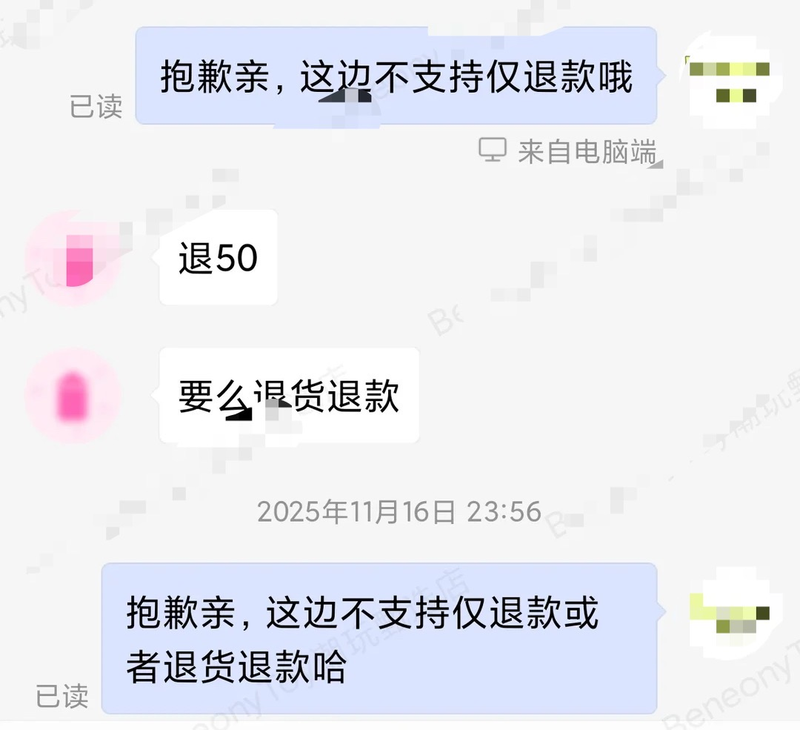
网店3个月内遭遇9起AI造假退款!强制标识背后的两难困局
Huan Qiu Wang Zi Xun· 2025-11-28 02:48
Core Viewpoint - The article highlights the challenges faced by small businesses due to organized malicious refund requests facilitated by AI-generated content manipulation, emphasizing the need for effective identification and regulation of AI-generated materials [1][3][4]. Group 1: Malicious Refunds and AI Manipulation - A small business owner experienced multiple refund requests for spoiled products, leading to suspicions of organized fraud using AI technology to alter images [1][3]. - The daughter of the business owner discovered that the refund requests were linked to AI-generated image alterations, which made it difficult to prove the legitimacy of the products [3][4]. - The current e-commerce platform lacks effective mechanisms to detect AI-generated content, leaving honest sellers vulnerable to fraudulent activities [3][4]. Group 2: Regulatory Challenges - The implementation of the "Artificial Intelligence Generated Content Identification Measures" aims to enforce mandatory labeling of AI-generated content, but many new AI contents still lack proper identification [4][6]. - The existing watermarking methods for AI-generated content are easily removable, raising concerns about the effectiveness of current regulations [6][8]. - Platforms face difficulties in managing the vast amount of AI-generated content, leading to challenges in accurately identifying and labeling such materials [11][12]. Group 3: Creator and Platform Dilemmas - Creators are facing issues with over-labeling, where their original works are incorrectly marked as AI-generated due to minor AI modifications [10][13]. - The platforms struggle to balance the need for accurate identification of AI content while maintaining a positive experience for creators and users [12][13]. - There is a call for improved appeal mechanisms for creators to contest mislabeling, as current systems are inadequate [13][14]. Group 4: Future Directions for Regulation - Experts suggest that a comprehensive governance framework is necessary to address the complexities of AI content regulation, rather than relying solely on labeling [14][16]. - Recommendations include establishing clear standards for both explicit and implicit labeling, as well as defining responsibilities for creators and platforms [14][16]. - The need for a higher-level legal framework to support AI content regulation is emphasized, as current regulations are fragmented and lack sufficient authority [16].