
GDP负增长

Search documents
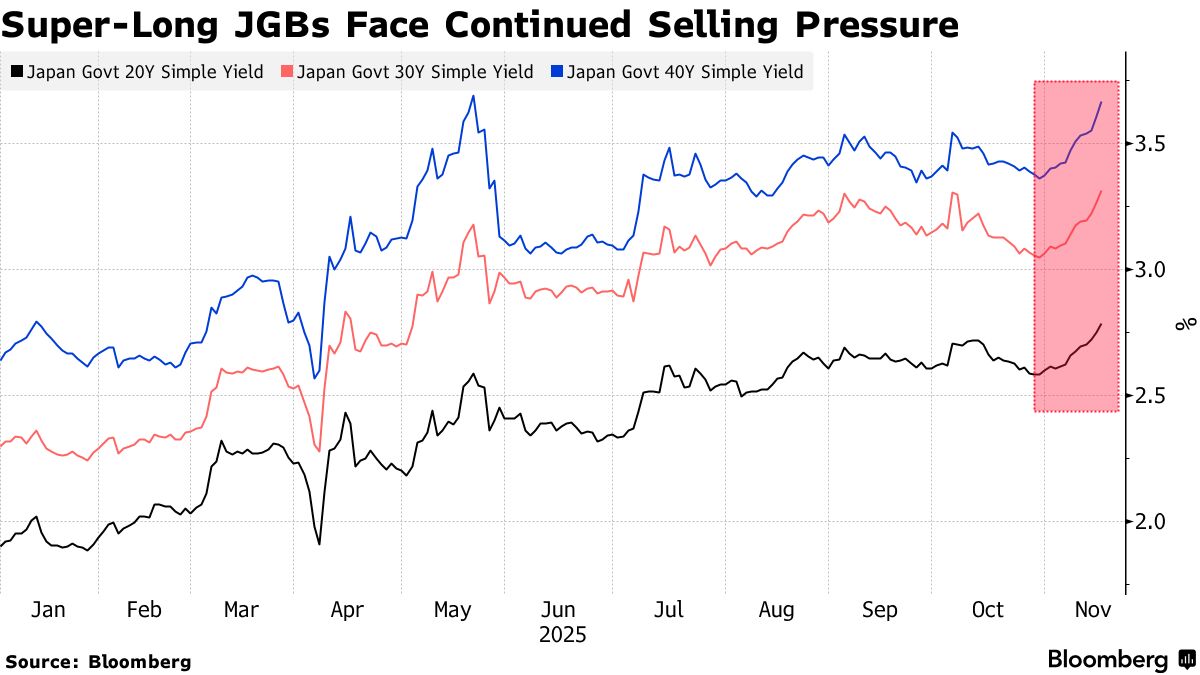
日本长期国债跌势加剧 市场日益担忧大规模经济刺激方案将冲击财政
智通财经网· 2025-11-18 06:20
Group 1 - Japanese long-term government bonds have declined further, raising concerns about the potential impact of Prime Minister Kishi's upcoming large-scale economic stimulus plan on public finances [1][4] - The yield on Japan's 40-year government bonds has surged by 8 basis points to 3.68%, the highest level since its issuance in 2007; yields on 20-year and 30-year bonds have also increased by at least 4 basis points [1][4] - The government is considering an additional budget of approximately 14 trillion yen (about 91 billion USD) for the current fiscal year, exceeding last year's 13.9 trillion yen, reflecting Kishi's commitment to a "responsible and expansionary fiscal" policy [4] Group 2 - The recent GDP data showing a 1.8% annualized decline in Japan's third quarter supports the push for a large-scale stimulus plan, marking the first negative growth in six quarters [4] - Market participants are closely monitoring the upcoming auction of 20-year government bonds, with expectations of weak demand due to the current volatility in the bond market [4] - Prime Minister Kishi is scheduled to meet with Bank of Japan Governor Ueda, with market attention focused on their statements for clues regarding the timing of the next interest rate hike [5]

日本GDP六个季度以来再现负增长
Xin Hua She· 2025-11-17 03:12
Core Points - The Japanese Cabinet Office reported a significant decline in exports due to increased tariffs imposed by the U.S. [1] - Japan's real GDP for the third quarter of this year decreased at an annualized rate of 1.8%, marking a return to negative growth since the first quarter of 2024 [1] Economic Impact - The increase in U.S. tariffs has directly impacted Japan's export performance, contributing to the overall economic contraction [1] - The negative GDP growth indicates potential challenges for the Japanese economy moving forward, as it reflects broader trade tensions [1]
日经225跳水,日本GDP六个季度以来首次负增长
2 1 Shi Ji Jing Ji Bao Dao· 2025-11-17 03:03
Group 1 - The Nikkei 225 index experienced a significant drop, falling over 1% and breaching the 50,000-point mark before narrowing its losses [1] - Japanese tourism stocks saw substantial declines, with Shiseido's stock price dropping nearly 10% and Japan Airlines falling over 5% [1] - Other consumer goods and retail stocks also faced losses, including Sanrio down 7.8%, Asics down 6.6%, and Fast Retailing down 4.83% [1] Group 2 - Isetan Mitsukoshi Holdings, a department store operator, saw its stock price drop by as much as 12% [1] - Ryohin Keikaku's stock price also fell by 12%, marking the largest decline since August 2024 [1] - The Japanese Cabinet Office reported a 1.8% year-on-year decline in real GDP for the third quarter, marking the first negative growth in six quarters [1][2] Group 3 - The actual GDP for Japan in the third quarter decreased by 0.4% compared to the previous quarter, after adjusting for price changes [2]
日本实际GDP年率6个季度来首陷负增长
日经中文网· 2025-11-17 02:58
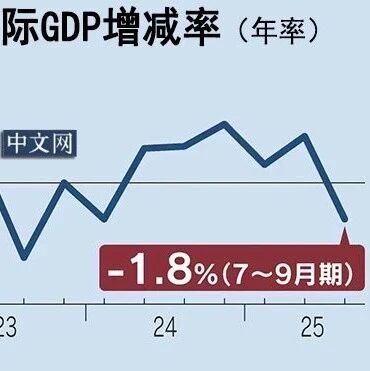
Core Viewpoint - Japan's GDP for the third quarter of 2025 shows a decline, marking the first negative growth in six quarters, with a seasonally adjusted real value down 0.4% from the previous quarter, translating to an annualized decrease of 1.8% [2][4]. Economic Performance - The actual GDP size for July to September, annualized, is 561.7 trillion yen [5]. - Exports decreased by 1.2%, marking the first negative growth in two quarters, primarily affected by U.S. tariff policies leading to reduced automobile exports [5]. - Imports fell by 0.1%, the first negative growth in three quarters, influenced by declines in oil, natural gas, and air travel-related sectors [5]. - Private residential investment saw a significant drop of 9.4%, the first negative growth in three quarters, due to stricter housing energy standards implemented in April [5]. Consumer Behavior - Personal consumption increased by 0.1%, maintaining positive growth for six consecutive quarters, although the growth rate has slowed [5]. - The hot summer contributed to increased sales in beverages, including alcoholic drinks, and growth in dining services, while autumn clothing sales and automobile consumption showed significant weakness [5]. Investment Trends - Equipment investment grew by 1.0%, marking the fourth consecutive quarter of increase, driven by labor shortages prompting automation investments and ongoing expansion in software investment [6].
日经225跳水,旅游股大幅下挫,资生堂跌近10%,日本航空跌超5%
21世纪经济报道· 2025-11-17 00:59
Market Overview - On November 17, the Nikkei 225 index opened with a significant drop, falling over 1% and briefly dipping below 50,000 points before narrowing its losses [1] - As of 9:31 AM, the index was at 50,165.30, down 211.23 points or 0.42% from the previous close [2] Stock Performance - Japanese tourism-related stocks experienced substantial declines, with Shiseido's stock price dropping nearly 10% [2] - Japan Airlines fell over 5%, while other consumer and retail stocks such as Sanrio, Asics, and Fast Retailing saw declines of 7.8%, 6.6%, and 4.83% respectively [2][3] - Isetan Mitsukoshi Holdings and Muji both saw their stock prices drop by 12%, marking the largest decline since August 2024 [2] Economic Indicators - The Japanese Cabinet Office reported a 1.8% year-on-year decline in real GDP for Q3, marking the first negative growth in six quarters [5] - The real GDP decreased by 0.4% compared to the previous quarter [5] Impact of Travel Advisories - Following safety concerns and travel advisories issued by the Chinese government, there is a notable decrease in travel to Japan, which is expected to significantly impact the Japanese tourism industry [5] - Chinese tourists account for approximately 25% of all foreign visitors to Japan, with nearly 7.5 million mainland Chinese tourists visiting Japan in the first nine months of the year [5]

日本GDP六个季度以来首次负增长
Yang Shi Xin Wen· 2025-11-17 00:31
Core Viewpoint - Japan's real GDP experienced a year-on-year decline of 1.8% in the third quarter, marking the first negative growth in six quarters [1] Economic Data Summary - The actual GDP for Japan in the third quarter decreased by 0.4% compared to the previous quarter, after adjusting for price changes [1]
美国3月贸易逆差升至纪录高位,通胀压力加剧
Xin Hua Cai Jing· 2025-05-06 14:46
Core Insights - The U.S. trade deficit reached a record high of $140.5 billion in March, increasing by 14.0% from the revised $123.2 billion in February, primarily due to increased imports before tariff hikes [1] - For the first quarter, the trade deficit expanded significantly, contributing to a negative GDP growth for the first time in three years [1] Trade Deficit and Import/Export Data - In March, the trade deficit for goods and services was $140.5 billion, up $17.3 billion from February, marking a 14.0% increase [1] - Exports in March totaled $278.5 billion, a slight increase of $0.5 billion or 0.2% from February, while imports rose to $419.0 billion, an increase of $17.8 billion or 4.4% [1] - Year-to-date through March, the trade deficit increased by $1.896 billion or 92.6% compared to the same period in 2024, with exports up by $411 million (5.2%) and imports up by $2.307 billion (23.3%) [1] Average Trade Data - For the three months ending in March, the average trade deficit rose by $14.1 billion to $131.4 billion, with average exports increasing by $4.0 billion to $275.7 billion and average imports increasing by $18.1 billion to $407.1 billion [1] Detailed Breakdown of Goods and Services - In March, goods exports increased by $1.3 billion to $183.2 billion, with notable growth in industrial supplies, natural gas, non-monetary gold, and automobiles, while capital goods saw a decline [3] - Services exports decreased by $0.9 million to $95.2 billion, with a significant drop in travel services, although transportation and financial services showed mixed results [3] - Goods imports rose by $17.8 billion to $346.8 billion, driven by increases in consumer goods and capital goods, while industrial supplies and non-monetary gold saw declines [3] - Services imports decreased slightly by $0.1 million to $72.2 billion, with varying changes in travel and transportation services [4] Actual Trade Data - In March, the actual goods trade deficit increased by $14.0 billion or 10.2% to $150.9 billion, with actual goods exports rising by $2.4 billion (1.6%) to $149.7 billion and actual goods imports increasing by $16.4 billion (5.8%) to $300.6 billion [4] Trade Partner Dynamics - In March, the U.S. had trade surpluses with countries like the Netherlands and regions in South America and Central America, while experiencing trade deficits with the EU and Ireland, with increased deficits noted with Ireland and France, and a decrease with Switzerland [4]
特朗普贸易顾问纳瓦罗:这是我见过的最好的GDP负增长数据。
news flash· 2025-04-30 14:01
Core Viewpoint - Navarro, a trade advisor to Trump, described the recent GDP negative growth data as the best he has ever seen, indicating a potentially optimistic interpretation of economic indicators despite the negative growth [1] Group 1 - The GDP data reflects a negative growth trend, which is typically viewed as a sign of economic contraction [1] - Navarro's comments suggest a divergence in perspectives regarding economic performance, highlighting a possible political narrative around economic data [1] - The characterization of the GDP data as "the best" despite being negative may indicate a focus on specific metrics or contexts that could be favorable [1]
韩国一季度GDP环比减0.2%
news flash· 2025-04-23 23:22
Core Insights - The Bank of Korea reported a preliminary verification indicating that South Korea's GDP contracted by 0.2% quarter-on-quarter and 0.1% year-on-year in the first quarter of this year, marking the first negative growth in nearly a year [1] Economic Performance - South Korea's GDP experienced a quarter-on-quarter decrease of 0.2% [1] - Year-on-year GDP also saw a decline of 0.1% [1] - This is the first instance of negative growth in the past year [1]