
住宅

Search documents
百万平供应冲击下 深圳写字楼空置率已超三成 豪宅成全年楼市“稳定器”
Hua Xia Shi Bao· 2026-01-18 00:41
Core Insights - In 2025, Shenzhen's real estate market exhibited a contrasting performance characterized by significant supply and differentiated demand, leading to a high vacancy rate of 31.4% despite a record net absorption of 664,000 square meters in the Grade A office sector [1][3][7] Group 1: Grade A Office Market - The Grade A office market in Shenzhen saw a substantial supply increase with 1.182 million square meters added, marking a 9.4% year-on-year growth in total stock to 12.843 million square meters [3] - The net absorption reached a four-year high of 664,000 square meters, exceeding the five-year average by 16.9% [3] - Despite high absorption, the vacancy rate remained elevated at 31.4%, reflecting ongoing structural challenges in the market [3][4] Group 2: Retail Property Market - The retail property market displayed a "two extremes" scenario, with premium projects thriving while secondary locations faced leasing challenges, resulting in negative net absorption in some areas [5][6] - Total retail supply reached 825,000 square meters, an 11.2% increase year-on-year, with a cautious approach from brands in opening new stores [5] - Rental trends varied significantly, with premium projects experiencing stable or rising rents, while some older projects had to reduce rents to retain tenants [6] Group 3: Residential Market - The residential market saw a decline in overall supply by 11% to 3.5 million square meters, with transaction volume dropping by 24.2% to 3.785 million square meters [7][9] - High-end luxury properties experienced a surge in demand, with average transaction prices stabilizing at 54,765 yuan per square meter, reflecting a narrowing decline of 7.3 percentage points year-on-year [7][8] - The luxury market's growth contrasted sharply with the subdued performance of the mass housing sector, which faced significant challenges in absorption and pricing [9][10][11] Group 4: Market Outlook - The outlook for 2026 suggests continued substantial supply, potentially exceeding one million square meters, with total stock expected to rise to nearly 14 million square meters [4] - The upcoming APEC conference and ongoing policy benefits are anticipated to create new opportunities for technology and high-end manufacturing sectors, supporting office demand [4]
高盛掘金日本市场“阿尔法”:未来十年豪掷8000亿日元,聚焦中型企业并购
Zhi Tong Cai Jing· 2025-12-23 03:58
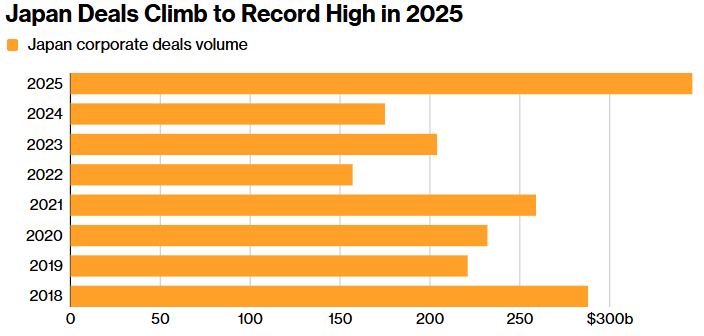
Group 1 - Goldman Sachs plans to expand its acquisition and investment scale in Japan's growing M&A market by approximately 800 billion yen (about 5.1 billion USD) over the next decade, focusing on mid-sized companies [1] - The firm is targeting companies involved in management buyouts, subsidiary sales, and succession planning, as global institutional investors show strong demand for the Japanese market [1] - The investment pace is currently two to three times faster than before, with a balanced supply-demand relationship between investors and companies seeking financing [1] Group 2 - By 2025, the transaction volume involving Japanese companies is expected to soar to a historical high of around 350 billion USD, driven by corporate governance reforms aimed at enhancing shareholder returns [1] - Goldman Sachs is primarily interested in mid-sized companies valued between 30 billion and 300 billion yen, which often lack the resources for overseas expansion or M&A [1] - The firm has already begun such investments, including a 200 billion yen acquisition of Nippo Corp. in collaboration with Eneos Holdings Inc. and a management buyout of Nihon Housing for approximately 94 billion yen [1][4] Group 3 - Healthcare is another key focus area, with Kakehashi Inc. raising about 14 billion yen from Goldman Sachs and existing shareholders to provide software data to pharmacies [4] - The industrial sector is also a priority, encompassing a wide range of industries, including Nippo and Nihon Housing, with companies like Raksul Inc. announcing a management buyout for 120 billion yen [4] - Goldman Sachs had not previously entered the consumer goods sector until acquiring Burger King Japan for about 70 billion yen from Affinity Equity Partners [4] Group 4 - Since the COVID-19 pandemic, fast-food chains like Burger King have experienced rapid growth, particularly in the hamburger segment [5] - Due to language barriers and differences in business practices and regulatory environments, overseas private equity funds require time and resources to establish teams and invest directly in Japan [5] - Many investors find it reasonable to entrust funds to firms like Goldman Sachs that have established teams and performance records in Japan [5]


日本实际GDP年率6个季度来首陷负增长
日经中文网· 2025-11-17 02:58
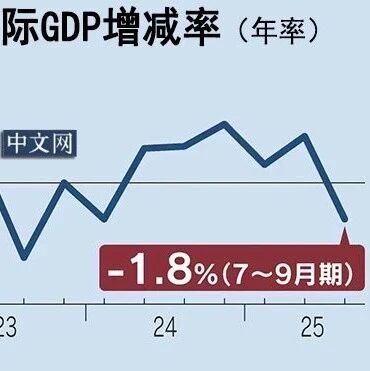
Core Viewpoint - Japan's GDP for the third quarter of 2025 shows a decline, marking the first negative growth in six quarters, with a seasonally adjusted real value down 0.4% from the previous quarter, translating to an annualized decrease of 1.8% [2][4]. Economic Performance - The actual GDP size for July to September, annualized, is 561.7 trillion yen [5]. - Exports decreased by 1.2%, marking the first negative growth in two quarters, primarily affected by U.S. tariff policies leading to reduced automobile exports [5]. - Imports fell by 0.1%, the first negative growth in three quarters, influenced by declines in oil, natural gas, and air travel-related sectors [5]. - Private residential investment saw a significant drop of 9.4%, the first negative growth in three quarters, due to stricter housing energy standards implemented in April [5]. Consumer Behavior - Personal consumption increased by 0.1%, maintaining positive growth for six consecutive quarters, although the growth rate has slowed [5]. - The hot summer contributed to increased sales in beverages, including alcoholic drinks, and growth in dining services, while autumn clothing sales and automobile consumption showed significant weakness [5]. Investment Trends - Equipment investment grew by 1.0%, marking the fourth consecutive quarter of increase, driven by labor shortages prompting automation investments and ongoing expansion in software investment [6].
分析师:美国二季度消费支出料稳定 但住宅和企业固定投资将明显疲软
news flash· 2025-07-30 12:43
Core Viewpoint - The analysis indicates that while U.S. consumer spending is expected to remain stable in the second quarter, residential and business fixed investment will show significant weakness [1] Group 1: Consumer Spending - Actual personal consumption expenditure is projected to grow at an annualized rate of 1.6% in the second quarter [1] - The strength of service spending in June remains uncertain [1] Group 2: Investment Trends - Residential and business fixed investment is anticipated to be notably weak in the second quarter [1] - Equipment investment has shown a significant slowdown, with businesses reducing spending on computers and communication equipment after a concentrated import period in the first quarter [1]
诺伟:下半年市场将面临双重压力 需重新审视资产配置策略
Zhi Tong Cai Jing· 2025-07-10 11:12
Core Viewpoint - Nuveen anticipates that the second half of 2025 will face dual pressures of economic slowdown and policy uncertainty, prompting investors to reassess asset allocation strategies focusing on robust fundamentals, defensive characteristics, and spread advantages to enhance return potential and mitigate risks [1][2] Global Economic Outlook - The global investment committee of Nuveen expects potential interest rate cuts by the Federal Reserve in September and December, but inflation driven by tariffs may lead to a pause in easing [1] - The European Central Bank is expected to pause after previous rate cuts, while the Bank of Japan is likely to raise rates once [1] Asset Allocation Strategy - Nuveen recommends focusing on assets driven by spreads and reducing reliance on risk-free rates, with municipal bonds attracting long-term investors due to a steep yield curve [1] - The real estate market is gradually recovering after two years of stagnation, with strong demand observed in medical office spaces, grocery retail properties, and affordable housing [1] Stock Market Insights - Large U.S. tech companies are benefiting from the expansion of AI, increased demand for data centers, and power generation, leading to an upgrade in market positioning [1] - Defensive sectors such as finance and infrastructure are highlighted, while European equities present long-term value; emerging markets are becoming less attractive due to trade policy impacts [1] Investment Strategies - Nuveen advises investors to adopt a broadly diversified and actively managed strategy to navigate policy changes and economic slowdowns [2] - Preferred loans and securities are favored for their attractive valuations and solid credit quality, while investment-grade corporate bonds are viewed less favorably due to narrowing spreads [2] Real Estate Sector Focus - Nuveen continues to explore opportunities arising from demographic and educational diversity, with a positive outlook on medical, industrial, and residential sectors [2] - The office market faces challenges, with vacancy rates expected to improve but recovery still requiring time; real estate bonds currently offer valuation advantages over real estate stocks [2] Infrastructure Investment Preferences - Nuveen prefers public-private projects, particularly in electricity, utilities, and energy storage investments [2] - Agricultural land assets are seen as an inflation hedge, although returns are expected to slow in 2025, especially for grain crops affected by tariff pressures [2]
国信期货:贸易摩擦实质性深化 白银期货延续震荡
Jin Tou Wang· 2025-07-10 03:23
Group 1: Silver Futures Market Performance - On July 10, the main silver futures in Shanghai reported a price of 8887 yuan per gram, with a decline of 0.13% [1] - The opening price for the day was 8880 yuan per gram, with a maximum of 8911 yuan per gram and a minimum of 8856 yuan per gram [1] Group 2: Macro News - President Trump announced that the U.S. will impose a 50% tariff on copper imports starting August 1, which will impact industries reliant on this metal, including automotive, housing, and appliances [2] - Copper is the third most consumed metal globally, with nearly half of U.S. consumption coming from imports, primarily from Chile [2] - This tariff is part of a series of tariffs aimed at promoting domestic mining and metal processing, following previous increases in steel and aluminum tariffs [2] Group 3: Institutional Perspectives - Guoxin Futures noted that precious metals are experiencing mixed fluctuations, with New York gold futures rising by 0.1% to $3321 per ounce, while Shanghai gold futures increased by 0.19% to 771.02 yuan per gram [3] - New York silver futures fell by 11.9 cents to $36.63 per ounce, and Shanghai silver dropped by 0.33% to 8870 yuan per kilogram [3] - The outlook for precious metals suggests continued fluctuations, with key support levels for gold at around $3300 per ounce and silver at $36.5 per ounce, influenced by deepening trade tensions and geopolitical disturbances [3]
交银国际:置业成本下降提供入市契机 预计今年下半年香港楼价升3%
智通财经网· 2025-06-04 08:35
Group 1: Hong Kong Real Estate Market - The Hong Kong real estate market has not shown significant improvement in the first half of the year, but key factors are beginning to turn around [1] - A rebound in population and a significant drop in interest rates, including HIBOR, are expected to restore market confidence, with property prices projected to rise by 3% in the second half of the year and by 5% in both 2026 and 2027 [1] - The decline in HIBOR directly reduces mortgage rates, alleviating payment pressure and providing a good opportunity for first-time buyers and motivating upgrade purchases in the secondary market [1] Group 2: Residential Rental Market - The trend of divergence in residential prices and rental markets has continued into 2023, driven by population inflow and government talent introduction plans, which will increase housing demand and push short-term rental growth [1] - Rental prices are expected to rise by approximately 2% to 3% this year, with areas close to major business districts and key universities projected to see rental increases of at least 5% year-on-year [1] Group 3: Retail Market - Despite changes in tourist consumption habits and average spending levels, an increase in tourist numbers and a slowdown in consumption trends from mainland China are expected to benefit the dining and grocery sectors [2] - High-end shopping centers and core shopping areas are anticipated to remain stable through 2025, although non-tourist and core retail areas may face more significant pressure due to e-commerce challenges [2] Group 4: Office Market - The office market remains cautious, with vacancy rates slightly decreasing from a high of 13.7% in July 2024 to 13.5% in March 2025, but still at elevated levels [2] - Major projects set to complete between 2025 and 2026 will limit the rebound potential of the office market, with Grade A office rents expected to decline by 3% to 5% year-on-year until economic conditions improve [2]