国有资本投资运营

Search documents
两会|谢文辉:强化国有资本投资科技创新,赋能构建现代化产业体系
券商中国· 2026-03-09 04:40
Core Viewpoint - The article emphasizes the need for systemic reforms in state-owned capital to enhance its role in supporting technological innovation and industrial upgrading, addressing issues such as risk aversion and ineffective collaboration [2]. Group 1: Challenges Faced by State-Owned Capital - State-owned capital is currently facing challenges in supporting technological innovation, characterized by a lack of willingness to invest, difficulties in converting investments, and weak collaboration [2]. - The investment share of state-owned capital in the equity investment market is projected to reach 61.5% by 2025, yet it remains conservative due to structural imbalances and a lack of effective risk management standards [4]. Group 2: Recommendations for Systemic Reform - It is suggested to implement a "risk-sharing and collaborative recognition" ecosystem for patient capital, enhancing the effectiveness of state-owned capital in the tech innovation sector [4]. - Recommendations include improving the evaluation system for state-owned enterprises' strategic missions and incorporating performance metrics for tech investments into these evaluations [4]. Group 3: Mechanisms for Technology Transfer - The article highlights the low overall technology transfer rate in China, approximately 30%, compared to 60%-70% in developed countries, indicating a need for better integration between research and industry [6]. - A proposal is made to establish a unified "industry-technology innovation element integration platform" to facilitate better connections between research and market needs, particularly in high-demand sectors like AI and biomedicine [6]. Group 4: Talent Development in Investment - There is a noted shortage of specialized talent in state-owned capital for technology innovation investments, with existing personnel primarily focused on mature industries [8]. - Recommendations include enhancing the market-oriented recruitment mechanisms for investment firms and promoting flexible compensation structures to attract and retain talent [8][9]. Group 5: Data-Driven Decision Making - The article points out the inadequacy of current evaluation methods for technology enterprises, which rely heavily on traditional financial data, neglecting deeper insights from non-structured data [10]. - Suggestions include leveraging data intelligence to improve investment decision-making capabilities and exploring collaborative data applications between government, industry, and finance [11].


恒健控股董事长唐军免职退休
21世纪经济报道· 2026-02-06 08:42
Core Viewpoint - The article discusses the recent retirement of Tang Jun, the chairman of Guangdong Hengjian Investment Holding Co., Ltd. (Hengjian Holdings), and highlights the company's strategic role in managing state-owned assets in Guangdong Province [1][4]. Company Overview - Hengjian Holdings was established in 2007 and serves as a major strategic investment platform and provincial state-owned capital operation company in Guangdong. As of the first quarter of 2025, the company reported total assets of 516.1 billion yuan and net assets of 228.2 billion yuan, ranking among the top state-owned enterprises in Guangdong [4]. - Tang Jun, born in 1965, has held various significant positions within the company and has been instrumental in positioning Hengjian Holdings as a key player in the management of state-owned assets, aiming to emulate the success of Singapore's Temasek Holdings [4][5]. Strategic Initiatives - Under Tang Jun's leadership, Hengjian Holdings has focused on supporting strategic emerging industries in Guangdong through various capital operation methods, emphasizing the importance of innovation and collaboration [5]. - The company has developed an "innovation consortium" model to address challenges in traditional collaborative innovation, aiming to enhance resource integration, improve participation motivation, and facilitate the conversion of technological achievements into practical applications [6]. Fund Management - Hengjian Holdings manages seven major fund management companies, which are responsible for various initiatives including the development of strategic emerging industries and the construction of the Guangdong-Hong Kong-Macao Greater Bay Area. The company has initiated over 70 funds with a total subscription scale exceeding 190.3 billion yuan [7]. - In the first half of 2025, Hengjian Holdings reported total operating revenue of 37.973 billion yuan, a slight decrease of 1.48% year-on-year, while net profit attributable to the parent company increased by 15.36% to 4.776 billion yuan [7].

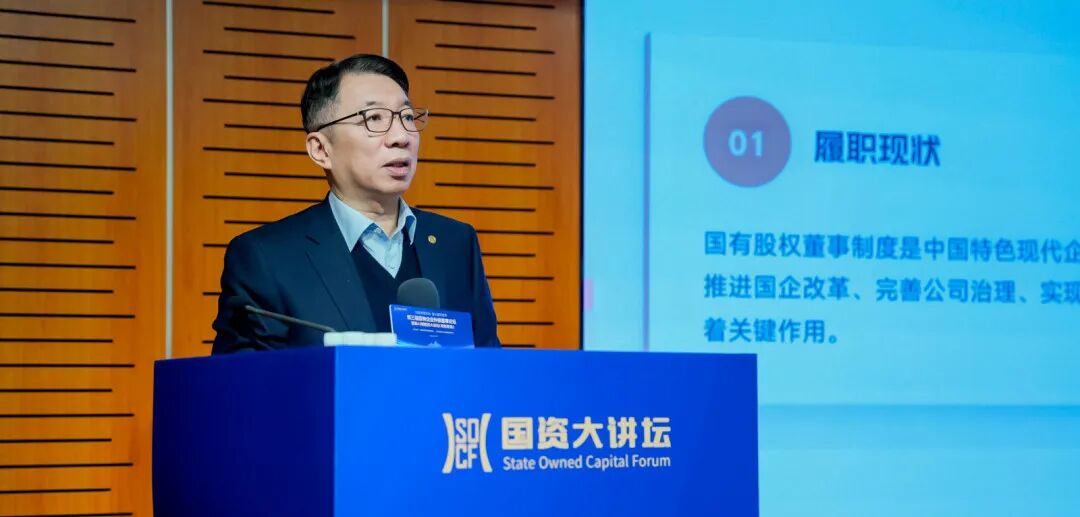
声音 | 郑杨:如何让国有股权董事“履好职”?三大挑战与四大优化对策
Xin Lang Cai Jing· 2026-02-03 12:46
Core Viewpoint - The external director system is a significant measure for deepening the reform of state-owned enterprises and improving corporate governance structures, playing a crucial role in promoting scientific decision-making within boards and enhancing modern corporate governance in state-owned enterprises [2][12]. Group 1: Role of State-Owned Equity Directors - State-owned equity directors are essential components of the modern enterprise system in China, serving three main missions: safeguarding the value of state capital, participating in corporate governance, and acting as a communication bridge between shareholders and enterprises [2][12]. - The legal status, rights, obligations, and performance requirements of state-owned equity directors have been clarified through recent amendments to laws and regulations, enhancing their role in strategic planning, major investments, and risk management [3][13]. Group 2: Challenges Faced by State-Owned Equity Directors - There are significant challenges in the performance of state-owned equity directors, particularly regarding performance norms, effectiveness, and motivation. The need for improved performance norms is highlighted, as current regulations may compel directors to act in accordance with shareholder directives, potentially conflicting with the spirit of corporate law [4][14]. - The effectiveness of state-owned equity directors needs enhancement, as the increase in their responsibilities has not been matched by adequate support mechanisms or access to critical information, which can hinder their performance [5][15]. - The motivation of state-owned equity directors is often limited due to their appointment by state shareholders and the lack of direct correlation between their compensation and company performance, leading to a conservative approach in decision-making [6][16]. Group 3: Recommendations for Improvement - Recommendations to enhance the performance of state-owned equity directors include optimizing the voting mechanism to allow for independent decision-making based on risk assessments and professional judgment [6][17]. - Strengthening the rights and protections for state-owned equity directors is essential, including establishing a daily reporting mechanism for information and ensuring their participation in key meetings to facilitate informed decision-making [7][18]. - A dual evaluation mechanism is proposed, where both the state shareholders and the companies evaluate the performance of state-owned equity directors, focusing on different aspects of their responsibilities [8][19]. - Further refinement of the duty exemption system for state-owned equity directors is suggested, shifting the focus from results to the process of decision-making, allowing for accountability only when there is a clear failure to act in the best interests of the enterprise [8][19]. Group 4: Shanghai Guotou Company's Practices - Shanghai Guotou Company, a key state-owned capital investment platform, has developed a comprehensive system to support the performance of external directors, including guidelines and communication mechanisms to enhance their effectiveness [9][20]. - The company has established standards for reviewing important proposals and has implemented a pre-communication mechanism to ensure that external directors are well-informed before board meetings [10][21]. - Ongoing efforts to improve the mechanisms supporting external directors' performance are emphasized, with a focus on innovative methods to enhance their effectiveness in governance [10][21].
海南政协委员谈打造“一流国企”:稳投资、提质效、促改革
Zhong Guo Xin Wen Wang· 2026-01-28 09:51
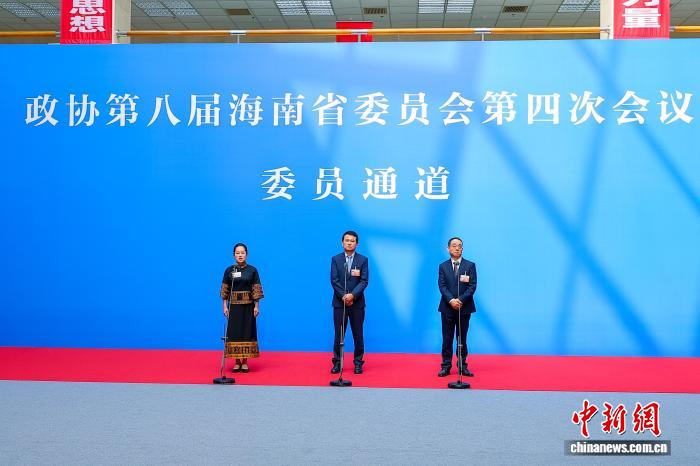
Core Viewpoint - The article discusses the development opportunities and challenges faced by state-owned enterprises (SOEs) in Hainan as the Hainan Free Trade Port begins operations, emphasizing the need for market-oriented reforms and the goal of building world-class enterprises to support economic growth [1]. Group 1: Investment Stability - Hainan Development Holding Co., Ltd. (referred to as "Hainan Holding") will focus on stabilizing investments, particularly in airport investment and operations, by advancing the construction of the Hainan Free Trade Port airport cluster [3]. - The company plans to collaborate with Singapore's Changi Airport to invest in the construction of a one-stop commercial center at Meilan Airport, aiming to establish an internationally influential transit hub [3]. Group 2: Quality and Efficiency Improvement - To ensure sustainable growth, Hainan Holding aims to adhere to the operational principles of "two profits and three fasts," which include having profitable revenue and positive cash flow, as well as ensuring that revenue growth outpaces asset growth, profit growth outpaces revenue growth, and cash flow growth outpaces profit growth [5]. - The company believes that achieving these metrics is essential for becoming a first-class enterprise [5]. Group 3: Reform Promotion - Hainan Holding will implement the "Amoeba Management Model" during the 14th Five-Year Plan period, transforming every unit and employee into a profit and cost center, with performance indicators assigned to each individual [5]. - The company will also promote the "Three Capitalizations" reform (resource assetization, asset capitalization, and capital securitization) to create a virtuous cycle among resources, assets, and capital [5]. Group 4: Future Goals - Hainan Holding aims for significant growth by 2025, targeting an asset scale of 227 billion yuan and an operating income exceeding 80 billion yuan, with a cumulative contribution to fiscal revenue of 17 billion yuan over five years [6].
杨绍华任洛阳弘义集团董事长,闫新乐任总经理
Sou Hu Cai Jing· 2025-11-19 10:43
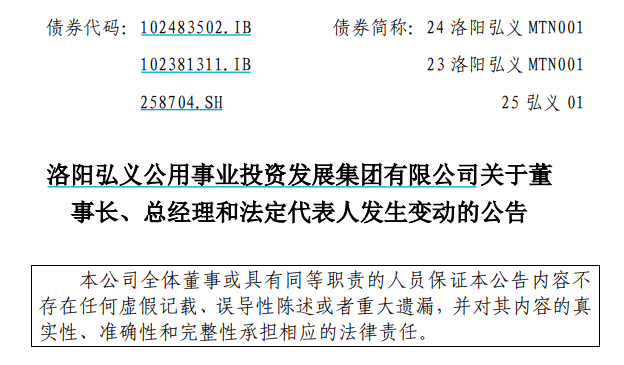
Group 1 - The announcement states that there have been changes in the leadership of Luoyang Hongyi Public Utility Investment Development Group, with Yang Shaohua appointed as the new chairman and Yan Xinle as the new general manager and legal representative [4] - Yang Shaohua has held various positions including lecturer at Henan University of Science and Technology, deputy general manager of Yidian Holdings Group Co., Ltd., and vice chairman of the supervisory board of Yidian Holdings Group Co., Ltd. [4] - Yan Xinle has served as a member of the Party Committee and deputy director of the Public Security Bureau of Yichuan County, as well as general manager of Luoyang Guosheng Trading Logistics Co., Ltd. [4] Group 2 - Luoyang Hongyi Group was established in 2013 and is a wholly-owned subsidiary of Luoyang Guosheng Group, focusing on public welfare capital investment and operation in Luoyang [4] - The company’s business scope includes investment operations in municipal public projects, joint ventures, investment attraction, and project introduction [4] - On November 15, 2024, Luoyang Hongyi Group received an AA+ credit rating from Dongfang Jincheng, with a stable rating outlook [4]
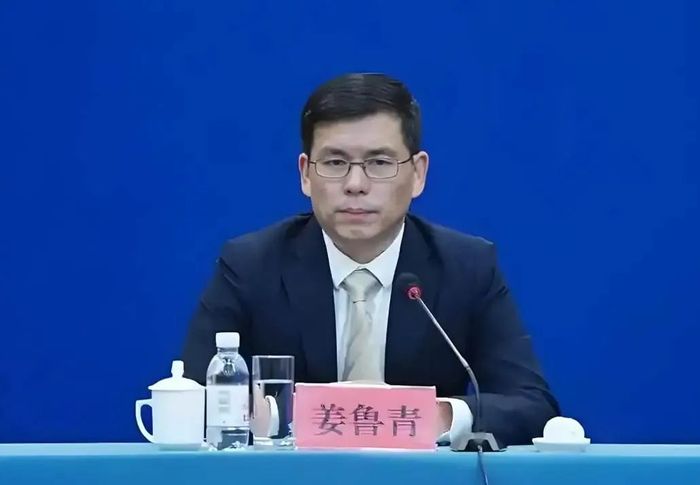
财界观察 | 青岛国企密集人事变动,姜鲁青履新华通
Xin Lang Cai Jing· 2025-07-11 03:59
Group 1 - Qingdao Guoxin Development Group Co., Ltd. announced a change in general manager, with Jiang Luqing being removed from his position as general manager and director [1] - The company stated that the position of general manager is temporarily vacant and will be filled after relevant procedures are completed [1] - Jiang Luqing has a background in various governmental roles, including positions in urban construction and airport management [1] Group 2 - Qingdao Huaton State-owned Capital Investment Operation Group Co., Ltd. also announced personnel changes, removing Wang Yongli as chairman and Zhang Wei as general manager, while appointing Jiang Luqing as chairman and Sun Mingming as general manager [3] - Sun Mingming has a long tenure at Huaton Group, previously serving as assistant to the general manager and in various leadership roles [3] - Qingdao Publishing Group Co., Ltd. announced that Liu Guang no longer serves as general manager and director due to job relocation [3] Group 3 - Guoxin Group is a state-owned enterprise authorized by the Qingdao Municipal Government, focusing on operating state-owned capital, managing state-owned equity, and engaging in investment and asset management [3] - In 2023, Guoxin Group implemented strategic restructuring and professional integration, aiming to reshape the industrial landscape and activate new economic growth drivers [4] - The group has established Qingdao Ocean Group, focusing on modern marine fisheries, marine biomedicine, and shipping logistics, and aims to become a leading enterprise in regional marine industries [4] Group 4 - Huaton Group is a pilot enterprise for the reform of state-owned capital investment and operation, focusing on intelligent advanced manufacturing, capital operation, and industrial park development [4] - The group is developing a four-in-one operational model that includes industry, parks, funds, and financial services, aiming to create a professional platform for market-oriented operation of state-owned capital [4] - Qingdao Publishing Group, established in 1987, has transformed into a wholly state-owned company with various business segments, including publishing, media, and investment [5]
珠海知名国企“换帅”!邹晖任党委书记、董事长
Sou Hu Cai Jing· 2025-06-30 15:01
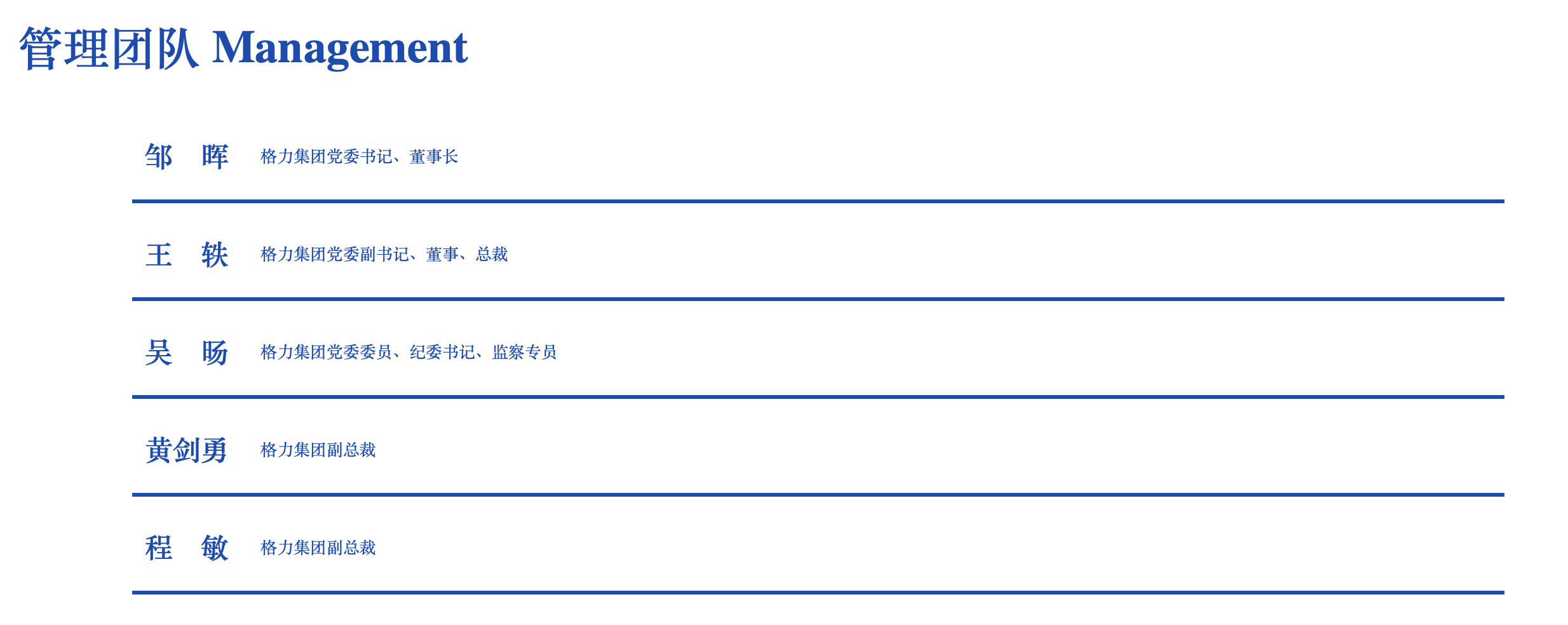
Group 1 - Zou Hui previously served as the Deputy Director of the Zhuhai Municipal State-owned Assets Supervision and Administration Commission, overseeing various departments including supervision and enterprise leadership management [3] - During his tenure, Zou Hui focused on enhancing business collaboration among state-owned enterprises, innovating regulatory models, and promoting digital transformation within state-owned enterprises [3] - In October 2020, Zou Hui proposed three principles for business collaboration: respecting market rules to enhance competitiveness, emphasizing business collaboration to improve accountability, and effectively connecting resource supply and demand [3] Group 2 - In January 2025, the Zhuhai Municipal State-owned Assets Supervision and Administration Commission held a digital transformation launch conference, where Zou Hui emphasized the provision of comprehensive digital services through a "consulting + software + data + operations" model [4] - Zhuhai Gree Group Co., Ltd., established in March 1985, is an independent legal entity funded and authorized by the Zhuhai Municipal State-owned Assets Supervision and Administration Commission, serving as the first state-owned capital investment and operation platform in Zhuhai [4] - The main business areas of Zhuhai Gree Group include industrial investment, industrial operation, park development, industrial finance, and cultural tourism [4]

重庆宣布完成市属国企战略性重组
Jing Ji Guan Cha Bao· 2025-05-28 22:30
Group 1 - Chongqing has completed a systematic restructuring of its state-owned enterprises (SOEs), reducing the number of key SOEs from 51 to 33 through five batches of strategic mergers [1] - The overall loss ratio of Chongqing's key SOEs has decreased from approximately 40% to 18.6%, with operational losses dropping to 13.7% after excluding certain reasonable losses [1] - The restructuring aims to enhance the efficiency of SOEs by integrating various sectors such as real estate, finance, construction, and port resources, achieving a synergistic effect [1] Group 2 - Chongqing's SOEs are increasing investments in sectors related to national security and new productive forces, with notable projects including collaborations with Ningde Times and Huawei [2] - After the restructuring, Chongqing Water Environment Group ranked first in net assets among China's top 50 environmental enterprises, while Chongqing Three Gorges Guarantee Group achieved the second-largest registered capital in the country [2] - Chongqing Yufu Holding Group has completed 208 investments totaling 35.059 billion yuan, with 33.6 billion yuan directed towards advanced manufacturing and strategic emerging industries, stimulating an additional 111 billion yuan in related investments [2] Group 3 - The Chongqing government plans to merge Three Gorges Guarantee with two other guarantee companies to enhance risk management and service capabilities [3] - The restructuring is characterized as a "systematic reshaping," transitioning the operational model of key financing platforms from administrative to market-oriented [3] - The reform aims to shift the industrial system from traditional to modern and to drive development through innovation rather than just resource factors [3]
国有资本投资运营公司系列研究之一:山东省级投资运营公司观察
Yuan Dong Zi Xin· 2025-05-23 12:14
1. Report Industry Investment Rating - No relevant content provided. 2. Core Viewpoints of the Report - The report analyzes Shandong provincial state - owned capital investment and operation companies from four dimensions: establishment background and process, positioning and consolidated business directions, assets and profitability, and outstanding bonds and bond valuations [2]. - Shandong provincial state - owned capital investment and operation companies' construction process can be divided into three stages: transferring state - owned capital to the provincial social security fund (2014 - 2017), introducing Shandong Guohui and transferring 20% of social security funds to it (2018 - 2020), and restructuring the social security fund council into Caixin Company and reorganizing the provincial investment and operation platforms (2020 - present) [2][8][9]. - These companies can be classified into five types according to their functions and business directions: state - owned capital operation companies, diversified industrial investment companies, focused industrial investment companies, financial investment companies, and policy - oriented investment companies [3][15]. - The asset scale of 12 provincial state - owned capital investment and operation companies in Shandong is significantly differentiated, and the asset structure varies greatly due to different functional positioning and business segments. Their profitability is good but has been under pressure in recent years [4][31][43]. - The outstanding bonds are mainly public bonds, and the scale is also significantly differentiated. Shandong Development, Shandong Guotou, Shandong Land, Shandong Steel Group, and Shandong High - speed have relatively low weighted ChinaBond valuation yields [5][52]. 3. Summary According to the Directory 3.1 Emergence: Establishment of Shandong Provincial Investment and Operation Companies - In 2013, the Third Plenary Session of the 18th Central Committee proposed to reform the state - owned capital authorization and operation system. Shandong Province launched a new round of state - owned enterprise reform [6]. - In 2014, Shandong issued the "26 Articles on Shandong State - owned Enterprise Reform", and in 2015, it passed the "1 + 5" documents, which jointly formed the top - level design for the construction of Shandong's state - owned investment and operation platforms [7]. - The construction process of Shandong provincial state - owned capital investment and operation companies has three stages: transferring state - owned capital to the social security fund, introducing Shandong Guohui, and restructuring and integrating platforms [2][8][9]. 3.2 Anchoring Direction: Company Positioning and Consolidated Business Directions - Companies are divided into five types: state - owned capital operation companies (e.g., Shandong Guotou), diversified industrial investment companies (e.g., Hualu Group, Lushang Group, Shandong Guohui), focused industrial investment companies (e.g., Shandong Energy, Shandong Gold, Shandong High - speed, Shandong Steel Group), financial investment companies (e.g., Luxin Group), and policy - oriented investment companies (e.g., Shandong Land, Shandong Development, Shandong Finance) [3][15]. - Each type of company has its own core business and development strategy. For example, Shandong Guotou focuses on IT business, Hualu Group on high - end chemical industry, and Luxin Group on financial services [19][20][23]. 3.3 Financial Perspective: Company Assets and Profitability 3.3.1 Asset Dimension - Asset scale is significantly differentiated, divided into four echelons. Shandong High - speed and Shandong Energy have over - trillion - yuan asset scales, while Shandong Development has the smallest scale [31]. - Asset composition varies. There are four types based on the consolidated statements: assets mainly formed by industrial subsidiaries' businesses, financial assets and long - term equity investments in financial subsidiaries, assets mainly formed by equity investments, and assets mainly formed by government - function infrastructure and its investment and financing services [32][34][35]. 3.3.2 Profitability Dimension - The overall profitability of 12 companies is good but has been under pressure in recent years. Since 2022, the overall revenue growth has slowed down, and the net profit has declined [43]. - In terms of revenue structure, 7 companies have more retained operating profits, 4 companies' profits mainly come from investment income, and Shandong Steel's investment income is an important source of profit due to industry downturn [44]. 3.4 Bond Market: Outstanding Bonds and Bond Valuation Overview - Outstanding bonds are mainly public bonds, and the scale is significantly differentiated. Shandong High - speed has the highest outstanding bond scale, while Shandong Development and Hualu Group have the smallest [52]. - Shandong Development, Shandong Guotou, Shandong Land, Shandong Steel Group, and Shandong High - speed have relatively low weighted ChinaBond valuation yields, less than 2% [52].


青岛城发投资集团董事长调整
Sou Hu Cai Jing· 2025-05-13 02:56
Group 1 - The announcement on May 9 indicates a leadership change at Chengfa Investment Group, with Zhang Liming appointed as the new chairman and legal representative, following the investigation of former chairman Xu Deqing for serious violations [2][3] - Zhang Liming's extensive experience in government and enterprise management is expected to stabilize operations while promoting deeper engagement in green energy and urban integration [2][5] - Chengfa Investment Group, established in 2001, has a registered capital of 3.073 billion and total assets nearing 60 billion, focusing on development operations, industrial finance, and supply chain management [5][6] Group 2 - The company has actively expanded into emerging industries, achieving progress in green energy, digital transformation, and cultural tourism integration [5][6] - The green energy initiative includes a rooftop photovoltaic project expected to generate 160,000 kWh annually, saving approximately 64 tons of standard coal and reducing CO2 emissions by about 160 tons [5] - Zhang Liming's background in cultural tourism and urban integration is anticipated to drive new breakthroughs in these sectors, enhancing the company's investment and operational strategies [7]