医疗设备

Search documents
TransMedics Group, Inc. (TMDX): A Bull Case Theory
Yahoo Finance· 2025-09-19 17:37
Core Thesis - TransMedics Group, Inc. (TMDX) is viewed as significantly undervalued with a strong growth potential, particularly in the organ transplant sector, and is projected to exceed $200 per share by 2026 from current levels around $115–$120 [4][5]. Company Performance - As of September 15th, TMDX shares were trading at $114.29, with trailing and forward P/E ratios of 57.57 and 51.55 respectively [1]. - The company has demonstrated strong profitability with a 20% net margin in its most recent quarter, indicating potential for further margin expansion [3]. Market Context - TMDX has experienced share volatility, recently dropping from $140 to $105 due to typical Q3 seasonal softness and competitor-related news that do not materially impact its operations [2]. - The acquisition of OrganOx by Terumo for $1.5 billion, reflecting a valuation of over 20x sales, underscores the premium placed on high-growth medical device companies [2]. Growth Projections - TMDX is expected to grow revenues at over 30%, significantly outpacing the typical 10–15% growth of established competitors in the MedTech sector [3]. - The company is scaling its OCS program globally, which is expected to enhance its market position and revenue growth [5]. Management Confidence - The CEO of TransMedics has expressed a highly positive outlook for the company, emphasizing long-term growth and personally investing in the stock to demonstrate confidence [2][3]. - Shareholders are encouraged to focus on long-term growth rather than short-term volatility [3].

麦科田拟港股IPO获中国证监会接收材料
Zhi Tong Cai Jing· 2025-09-19 12:22
Group 1: Macotian - Macotian plans to conduct an IPO in Hong Kong and has received material acceptance from the China Securities Regulatory Commission for its full circulation application [1] - The company offers a comprehensive product portfolio that meets clinical needs across various healthcare settings, including hospitals and community health centers [1] - As of June 30, 2025, Macotian has commercialized over 50 life support products, 80 minimally invasive products, and 210 in vitro diagnostic products, with a presence in over 140 countries and regions [1] Group 2: Shengwei Times - Shengwei Times is a provider of urban ride-hailing services and intercity passenger transport information services in China, ranking 14th in the ride-hailing market by GTV in 2024 [2] - The company has undertaken digital passenger transport projects in 17 provinces, autonomous regions, and municipalities as of June 30, 2025 [2] - Shengwei Times collaborates with various passenger transport companies to offer customized services, establishing operations in over 30 provinces and regions [2] Group 3: Zhongrun Solar Energy - Zhongrun Solar Energy specializes in the manufacturing and sales of N-type and P-type photovoltaic cells, with vertical expansion into the photovoltaic module industry [3] - The company ranks second globally in photovoltaic cell manufacturing by external shipment volume, holding a market share of 14.6% for the year 2024 [3] - Zhongrun Solar Energy has a market share of 18.3% among specialized photovoltaic cell manufacturers, serving over 1,000 customers across more than 32 countries and regions [3]
华创医药2025年重点研究成果与会议合集
华创医药组公众平台· 2025-09-19 12:00
Core Viewpoint - The Chinese innovative drug industry is gradually catching up with Europe and the United States in terms of technology, with some targets and technical pathways already leading globally. The number and value of new drugs authorized for overseas markets continue to increase, leading to world-class pricing and non-linear investment elasticity. The domestic market is experiencing strong growth in demand, with domestic new drug sales continuing to rise, and several innovative pharmaceutical companies have turned losses into profits, entering a stable growth phase [2]. Group 1: Innovative Drugs - The innovative drug sector is witnessing a significant increase in sales driven by strong domestic demand, with a number of innovative companies achieving profitability [2]. - The trend of domestic innovative drugs going overseas is accelerating, with increasing numbers and values of new drug authorizations [2]. - The pricing power of innovative drugs is improving, reflecting the global competitiveness of Chinese pharmaceutical companies [2]. Group 2: High-Value Medical Consumables - The orthopedic sector is expected to see mild price reductions due to continued domestic substitution and accelerated overseas business progress [2]. - The neurosurgery and neurointervention fields are experiencing stable growth post-collection, with new products being launched [2]. - The high-value consumables market is expected to benefit from ongoing domestic replacement and the introduction of new products [2]. Group 3: Medical Devices - The medical device sector is seeing a recovery in bidding prices, with ongoing high-speed growth in bidding data this year [2]. - Companies are entering a phase of inventory reduction, with performance expected to improve in the second half of the year [2]. - The low-value consumables sector is experiencing product upgrades and accelerated expansion into overseas markets [2]. Group 4: Blood Products - The supply side of the blood products industry is concentrating on central state-owned enterprises, gradually clearing the competitive landscape [2]. - The demand side is expected to see continuous upgrades to new products, with industry sentiment gradually improving [2]. Group 5: API (Active Pharmaceutical Ingredients) - The API sector is benefiting from the end of a capital expenditure peak, with three growth logic points driving upward trends: new high-end market products, integrated consolidation and overseas expansion, and cost-leading CDMO [2]. - Leading companies in the API sector are expected to see explosive growth in revenue and profits [2]. Group 6: CXO (Contract Research Organization) - The CXO sector is witnessing a recovery in A+H financing activity, with multiple significant business developments enhancing market confidence [2]. - The focus is on optimizing the supply-side landscape and increasing market share for leading CRO companies [2]. Group 7: Traditional Chinese Medicine and Retail Pharmacy - The traditional Chinese medicine sector is showing signs of recovery, with friendly pricing for new drugs and ongoing observation of collection progress [2]. - The retail pharmacy sector is influenced by the pace of supply-side clearing and business model upgrades, with expectations of increased store closures in the second half of 2025 [2]. Group 8: Research and Development Services - The domestic innovative drug business development is heating up, likely driving downstream demand recovery [2]. - The overseas market presents significant growth opportunities for domestic companies, leveraging cost-effectiveness and service differentiation [2].






CFOs On the Move: Week ending Sept. 19
Yahoo Finance· 2025-09-19 10:00
Executive Changes - Opendoor's CFO, Selim Freiha, has left the company effective immediately, with Christy Schwartz appointed as interim CFO [2] - OpenAI has hired Mike Liberatore as its business finance officer, overseeing AI infrastructure spending [3] - Unilever appointed Srinivas Phatak as its new finance chief, having been with the company for 26 years [4] - Market Basket's CFO, Donald Mulligan, has been named interim CEO following the removal of Arthur T. Demoulas [5] - Insulet has appointed Flavia Pease as CFO, effective September 30, transitioning from her previous role at Charles River Laboratories [6]



康泰医学股东四年套现路:王桂丽持股降至10%,高管集体减持引投资者疑虑
Xin Lang Zheng Quan· 2025-09-19 09:19
9月18日,康泰医学(300869.SZ)股价高开低走,收盘下跌1.81%,总市值停留在67.66亿元。这一市场 表现背后,是一则牵动投资者神经的公告——公司重要股东王桂丽持股比例已降至10%的整数关口。 四年减持之路 根据9月17日公告,截至9月16日,王桂丽持有康泰医学股份降至40,180,326股,占公司总股本 10.00%,触及5%整数倍变动线。这场减持马拉松始于2021年8月,当时其持股比例高达14.70%。四年来 通过连续操作,王桂丽持股数量减少近1900万股,减持原因始终标注为"自身资金需求"。2021年8月至 今,王桂丽持股从14.70%降至10.00% 高管减持潮涌动 值得关注的是,减持并非王桂丽"独角戏"。公司董事兼高管杨志山、董事高瑞斌,以及付春元、寇国治 等五位高管同步推进减持计划,八位股东清一色标注"自身资金需求"。这场自2021年开启的高管减持 潮,在资本市场投下涟漪。 投资者的尖锐质疑 在9月15日业绩说明会上,投资者直指核心:"为何高管一直在减持,是看不好公司发展吗?"这道出了 二级市场的普遍疑虑。尽管公司上半年交出了净利润1693.76万元、同比暴增107.39%的亮眼成绩单 ...
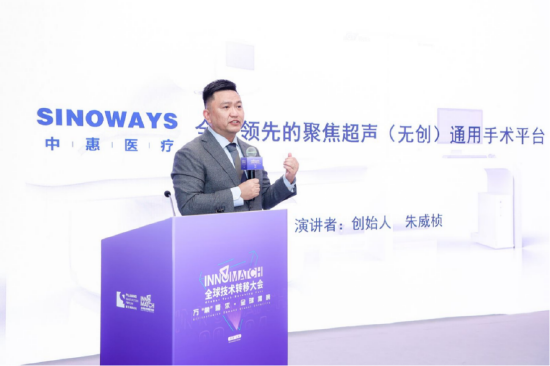
中惠医疗CEO朱威桢:从有创到无创,是医疗行业迭代必然方向
Xin Lang Ke Ji· 2025-09-19 08:15
责任编辑:刘万里 SF014 据朱威桢透露,中惠医疗当前正处于A轮融资阶段,现阶段公司已有两款成熟产品实现上市销售,正向 现金流保持稳定。公司A轮融资的核心目标,首先是将原本的串行产品开发模式、临床验证模式调整为 并行模式,以加速更多适应症产品的落地进程;其次是通过融资确认市场化价值,为未来上市奠定估值 基础。(文猛) 新浪科技讯 9月19日下午消息,中惠医疗CEO朱威桢在分享中指出:"医疗的核心一定在治疗,而从有 创到无创,是行业迭代的必然方向。"据他介绍,"中惠医疗的无创超声技术远超传统无创手段,相较于 仅能覆盖脑部疾病的伽马刀,其技术可应用于头、胸、腹、四肢等全身部位,还能通过低强度超声短暂 打开血脑屏障,辅助大分子药物治疗脑部疾病。" 据朱威桢介绍,从2014年投身聚焦超声领域时国内在该领域处于技术空白状态,到如今走出"纯原创"的 技术迭代之路,中惠医疗已实现无创超声治疗从"1.0到3.0的延续与突破"。目前,公司推进的3.0版 本"聚焦超声治疗机器人",攻克了多种超声能量同步输出难题,融合声学、热学、集成电路等多学科技 术,计划2027年上市,首攻无创治疗乳腺肿瘤这一高发疾病。 ...
医药生物行业双周报(2025、9、5-2025、9、18)-20250919
Dongguan Securities· 2025-09-19 07:40
Investment Rating - The report maintains a "Market Weight" rating for the pharmaceutical and biotechnology industry, indicating that the industry is expected to perform within ±10% of the market index over the next six months [6][29]. Core Insights - The SW pharmaceutical and biotechnology industry underperformed the Shanghai and Shenzhen 300 index, with a gain of 1.36% from September 5 to September 18, 2025, lagging behind the index by approximately 1.66 percentage points [5][13]. - Most sub-sectors within the industry recorded positive returns during the same period, with the medical research outsourcing and medical equipment sectors leading with increases of 8.17% and 5.83%, respectively, while the chemical preparations sector saw a decline of 0.96% [5][14]. - Approximately 48% of stocks in the industry achieved positive returns, with notable performers including Zhendemedical, which had a weekly increase of 62.30% [15][18]. Summary by Sections 1. Market Review - The SW pharmaceutical and biotechnology industry underperformed the Shanghai and Shenzhen 300 index, gaining 1.36% from September 5 to September 18, 2025, which is 1.66 percentage points lower than the index [5][13]. - Most sub-sectors recorded positive returns, with medical research outsourcing and medical equipment sectors leading [5][14]. - About 48% of stocks in the industry recorded positive returns, with Zhendemedical showing the highest weekly increase [15][18]. - The overall industry valuation remained stable, with a PE ratio of approximately 56.10 times as of September 18, 2025, which is 4.26 times relative to the Shanghai and Shenzhen 300 index [19][29]. 2. Industry News - The report highlights the upcoming release of the 11th batch of national drug procurement rules, with discussions held on various aspects of the procurement process [6][27]. - The National Health Commission issued a notification regarding the 2025 version of medical quality control indicators, emphasizing the importance of a scientific and standardized quality control system [23][26]. 3. Company Announcements - Changchun High-tech announced a collaboration with Denmark's ALK-Abelló A/S for the development and commercialization of specific immunotherapy products in China [28]. 4. Weekly Industry Outlook - The report suggests maintaining a focus on investment opportunities in innovative drugs and sectors with expected business development catalysts, particularly in medical devices and pharmaceutical commerce [29][30].




医药生物行业双周报(2025、9、5-2025、9、18):第十一批国采临近-20250919
Dongguan Securities· 2025-09-19 06:56
Investment Rating - The report maintains a "Market Weight" rating for the pharmaceutical and biotechnology industry, indicating that the industry is expected to perform within ±10% of the market index over the next six months [36]. Core Insights - The SW pharmaceutical and biotechnology industry underperformed the CSI 300 index, with a gain of 1.36% from September 5 to September 18, 2025, lagging behind the index by approximately 1.66 percentage points [11]. - Most sub-sectors within the industry recorded positive returns during the same period, with the medical research outsourcing and medical equipment sectors leading with increases of 8.17% and 5.83%, respectively [12]. - Approximately 48% of stocks in the industry achieved positive returns, while 52% experienced negative returns during the reporting period [13]. - The overall industry valuation remained stable, with a PE (TTM) ratio of about 56.10 times as of September 18, 2025, and a relative PE to the CSI 300 of 4.26 times [17][27]. Summary by Sections Market Review - The SW pharmaceutical and biotechnology industry underperformed the CSI 300 index, with a 1.36% increase compared to the index's performance [11]. - Most sub-sectors recorded positive returns, particularly in medical research outsourcing and medical equipment [12]. - About 48% of stocks in the industry had positive returns, with notable performers and underperformers identified [13]. Industry News - The report highlights the upcoming release of the 11th batch of national drug procurement rules, with discussions on various aspects of the procurement process [25]. - The National Health Commission issued a notification regarding the 2025 version of medical quality control indicators, emphasizing the importance of a scientific and standardized quality control system [21][24]. Company Announcements - Changchun High-tech announced a collaboration with Denmark's ALK-Abelló A/S for the development and commercialization of specific immunotherapy products in China [26]. Industry Outlook - The report suggests focusing on investment opportunities in innovative drugs and sectors with expected business development catalysts, including medical devices and pharmaceutical commerce [27][28]. - Specific companies to watch include Mindray Medical, Yifeng Pharmacy, and Aier Eye Hospital, among others, due to their strong market positions and growth potential [29].
百年医疗巨头回应出售中国业务,估值达数十亿美元
2 1 Shi Ji Jing Ji Bao Dao· 2025-09-19 05:25
Core Viewpoint - GE Healthcare is reportedly exploring options to sell its stake in the Chinese market due to declining revenues, rising tariff costs, and increasing competition from local companies [1][3]. Financial Performance - GE Healthcare's global revenue for the year reached $19.7 billion, a slight increase of 1% year-on-year, while the adjusted EBIT was $3.2 billion [3]. - In China, GE Healthcare's revenue for the year was $2.36 billion, representing a significant decline of 15%, marking the largest drop since the company became independent in 2023 [3]. - In comparison, Siemens Healthineers achieved revenue of €11.571 billion (approximately $13.39 billion) in the first half of 2025, a 7% increase, while GE Healthcare's revenue was $9.78 billion, a 3% increase [3]. Market Competition - Siemens Healthineers is the only major player to experience growth in the Chinese market, with a 2.4% increase in performance during the first half of 2025 [3]. - Local companies such as United Imaging, Mindray, and Neusoft are rapidly gaining market share, employing integrated strategies to challenge foreign giants [3][4]. Technological Advancements - Local companies have made significant strides in high-end medical equipment, with United Imaging and Neusoft both receiving approval for photon-counting CT devices, marking a shift from "catching up" to "leading" in next-generation CT technology [4][5]. - The global market for photon-counting CT is projected to reach approximately $2 billion by 2025, with the approval of these devices creating a dual-leader scenario in the market [5]. Strategic Implications - The approval of domestic photon-counting CT devices signifies a critical turning point for local high-end imaging equipment, moving from "replacement" to "leadership" in the market [5]. - The competitive landscape in China's medical device market is undergoing a transformation, posing unprecedented challenges for multinational corporations [5].

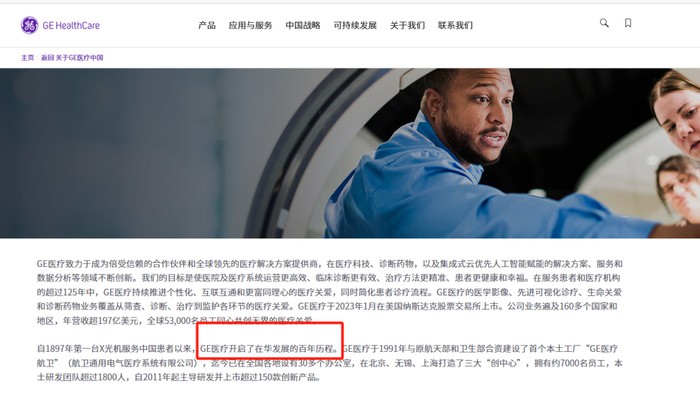
考虑出售中国业务?GE医疗回应市场传闻
2 1 Shi Ji Jing Ji Bao Dao· 2025-09-19 03:53
Core Viewpoint - GE Healthcare is reportedly exploring options to sell its stake in the Chinese market due to declining revenues, rising tariff costs, and increasing competition from local companies [1][5]. Group 1: Financial Performance - GE Healthcare's global revenue for the year reached $19.7 billion, a slight increase of 1% year-on-year, while adjusted EBIT was $3.2 billion [1]. - In China, GE Healthcare's revenue fell to $2.36 billion, marking a significant decline of 15%, the largest drop since the company became independent in 2023 [1]. Group 2: Market Competition - In the first half of 2025, Siemens Healthineers achieved revenue of €11.57 billion (approximately $13.39 billion), a 7% year-on-year increase, while GE Healthcare's revenue was $9.78 billion, up 3% [2]. - Siemens Healthineers was the only major player to see growth in the Chinese market, with a 2.4% increase, while GE Healthcare and Philips experienced declines of 2% and 11%, respectively [2]. - Local companies like United Imaging, Mindray, and Neusoft are rapidly gaining market share, employing integrated strategies to challenge foreign giants [2]. Group 3: Technological Advancements - Chinese companies are making significant strides in high-end medical equipment, with United Imaging and Neusoft receiving approval for photon-counting CT devices, marking a leap in next-generation CT technology [3][4]. - The photon-counting CT market is projected to reach approximately $2 billion globally by 2025, with local firms establishing a dual-leader position in the market [4]. Group 4: Strategic Implications - The potential sale of GE Healthcare's Chinese business could signal a significant strategic shift for multinational companies operating in China, reflecting the increasing challenges posed by local competitors [5].