
油气

Search documents
能源高质量发展专家谈丨“十四五”能源规划成绩评述及形势展望
国家能源局· 2025-08-31 03:05
Core Viewpoint - The "14th Five-Year Plan" marks a crucial period for energy transformation in China, achieving significant results despite various challenges, with a focus on optimizing industrial layout and enhancing system resilience for high-quality energy development in the "15th Five-Year Plan" [2] Group 1: Achievements in Energy Development - Energy supply capacity has been significantly enhanced, with oil production expected to reach approximately 213 million tons in 2024, and natural gas production projected to hit 246.4 billion cubic meters [3] - Coal supply security has improved, with major coal supply bases established, and over 300 million kilowatts of coal power units modified for flexibility [3] - The total installed power generation capacity reached 3.65 billion kilowatts by mid-2025, with 44 ultra-high voltage transmission lines in operation, establishing the world's largest power infrastructure system [4] Group 2: Acceleration of Green Energy Transition - Renewable energy has become the mainstay of power generation, with a total installed capacity of 2.159 billion kilowatts by mid-2025, accounting for 59.2% of total capacity [5] - Nuclear power development has progressed steadily, with operational capacity reaching 60.91 million kilowatts and a total of 113 million kilowatts in operation, approved, and under construction [5] - The ability of the power system to accommodate high proportions of renewable energy has significantly improved, with new energy storage capacity reaching 73.76 million kilowatts by the end of 2024 [5] Group 3: Optimization of Energy Layout - Key regional energy projects have been advanced, including large-scale wind and solar bases in the Sanbei region, with 90 million kilowatts completed in the first phase [7] - Cross-regional energy transmission channels have been constructed, enhancing the "West-to-East Power Transmission" capacity to over 300 million kilowatts [7] - Rural energy transformation initiatives have been implemented, with over 83,000 village-level photovoltaic assistance stations established [8] Group 4: Strengthening Energy Technology Innovation - The efficiency of clean coal utilization has improved by 40%, with successful applications of coal liquefaction technology [9] - Breakthroughs in deep-sea oil and gas resource development have been achieved, including the construction of the world's first 100,000-ton deep-water semi-submersible production platform [9] - Significant advancements in smart energy technologies have been made, integrating AI and 5G into energy sectors for improved operational efficiency [9] Group 5: International Energy Cooperation - Energy cooperation with regions such as Russia and the Middle East has been deepened, enhancing energy supply security and infrastructure connectivity [10] - China's photovoltaic products have captured approximately 85% of the global market share, with significant investments in renewable energy projects across over 100 countries [10] - Active participation in global energy governance reforms has been emphasized, strengthening international cooperation on climate change [10] Group 6: Recommendations for Future Development - The integration of source, grid, load, and storage should be promoted to address issues of renewable energy curtailment and optimize energy industry layout [11] - The role of fossil energy as a safety net should be reinforced, encouraging cross-sector collaboration and breaking down investment barriers [12] - Carbon emission intensity will replace energy consumption intensity as a key indicator, necessitating systemic adjustments in energy policies to support low-carbon development [13]

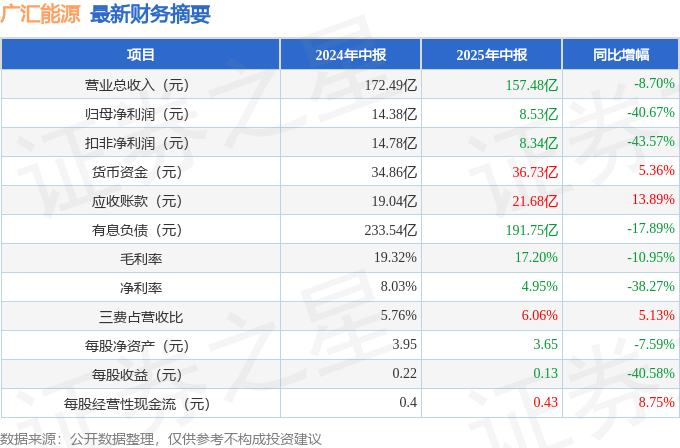
广汇能源2025年中报简析:净利润同比下降40.67%,公司应收账款体量较大
Zheng Quan Zhi Xing· 2025-08-30 23:25
据证券之星公开数据整理,近期广汇能源(600256)发布2025年中报。截至本报告期末,公司营业总收 入157.48亿元,同比下降8.7%,归母净利润8.53亿元,同比下降40.67%。按单季度数据看,第二季度营 业总收入68.46亿元,同比下降5.02%,第二季度归母净利润1.59亿元,同比下降74.73%。本报告期广汇 能源公司应收账款体量较大,当期应收账款占最新年报归母净利润比达73.22%。 建议关注公司债务状况(有息资产负债率已达32.63%) 本次财报公布的各项数据指标表现不尽如人意。其中,毛利率17.2%,同比减10.95%,净利率4.95%, 同比减38.27%,销售费用、管理费用、财务费用总计9.54亿元,三费占营收比6.06%,同比增5.13%,每 股净资产3.65元,同比减7.59%,每股经营性现金流0.43元,同比增8.75%,每股收益0.13元,同比减 40.58% | 项目 | 2024年中报 | 2025年中报 | 同比增幅 | | --- | --- | --- | --- | | 营业总收入(元) | 172.49亿 | 157.48亿 | -8.70% | | 归母净利润( ...

内蒙古多措并举兜牢能源安全底线
Zhong Guo Fa Zhan Wang· 2025-08-29 07:03
Group 1: Coal Supply - Inner Mongolia focuses on high-standard construction of coal supply bases, optimizing development layout and implementing "one mine, one policy" for coal mine resumption and stable production [1] - Six coal mines have resumed production, involving a total capacity of 126 million tons per year, supporting the region's coal production capacity to remain above 1.2 billion tons [1] - In the first half of the year, coal production reached 640 million tons, an increase of 0.7%, with approximately 60% directed to major consumption areas in Northeast, North, and East China [1] Group 2: Electricity Supply and Green Transition - The region accelerates the construction of existing power projects, strictly controls unplanned outages, and ensures full power generation [2] - In the first half of the year, new power generation capacity added was 11.91 million kilowatts, with total installed capacity reaching 270 million kilowatts and electricity generation of 4,167 billion kilowatt-hours, a growth of 4.7% [2] - The "Mont Electricity Export" reached 1,656 billion kilowatt-hours, an increase of 7.7%, accounting for over one-sixth of the national cross-province electricity export, with green electricity proportion rising to 29.6%, up 9 percentage points year-on-year [2] Group 3: Oil and Gas Production - The region promotes both conventional and unconventional resource development, increasing exploration efforts [2] - In the first half of the year, crude oil production was 1.657 million tons, an increase of 2.9%, while natural gas production remained stable at 16.88 billion cubic meters [2] - Coalbed methane production increased by 30.4% to 263.5 million cubic meters, with over 60% of natural gas supplied externally, effectively supporting local and Beijing-Tianjin-Hebei region's gas needs [2] Group 4: Grid Strengthening - Inner Mongolia is advancing the construction of a new power system, implementing strong grid projects to enhance the capacity for receiving and transmitting green electricity [3] - The approval of the ultra-high voltage electricity export channel from Inner Mongolia to Beijing-Tianjin-Hebei has been granted, with multiple 500 kV projects and smart substations put into operation [3] - The energy supply responsibility is emphasized, contributing to national energy security and stability [3]
中国的生意特朗普想截胡,普京听完美方条件,没对中方透露一个字
Sou Hu Cai Jing· 2025-08-29 06:28
Group 1 - The core issue revolves around Trump's attempts to disrupt China's energy business with Russia by offering incentives to Russia, including easing sanctions on the "Arctic LNG 2" project and encouraging Russia to procure U.S. equipment instead of collaborating with China [1][3] - The "Arctic LNG 2" project, with a total investment of $21 billion, is crucial for Russia's goal to increase its global LNG market share to 20% by 2030, and it has faced significant challenges due to U.S. sanctions [3] - China has stepped in to support the project by providing essential technology and equipment, demonstrating a strong collaborative relationship with Russia that is based on mutual respect and long-term strategic cooperation [3][5] Group 2 - Putin's silence regarding U.S. proposals indicates confidence in the stability of Sino-Russian cooperation, as he is aware of the unreliability of U.S. commitments and the potential for the U.S. to reimpose sanctions [5][6] - The energy cooperation between China and Russia has expanded beyond individual projects, with a 29.4% year-on-year increase in pipeline gas imports from Russia to China from January to May this year, indicating a deepening partnership [5][6] - The U.S. approach to cooperation is heavily influenced by geopolitical considerations, contrasting with China's non-political conditions for energy technology and equipment collaboration, making it unlikely for Russia to abandon its partnership with China [6][8]


联合能源集团上半年公司拥有人应占溢利同比下降26.7%
Zheng Quan Shi Bao Wang· 2025-08-29 05:25
联合能源集团公告,2025年上半年集团营业额约为80.8亿港元,同比下降4.2%;公司拥有人应占溢利约 为7.4亿港元,同比下降26.7%,每股基本盈利为2.88港仙。 营业额下降主要归因于原油及凝析油平均实现价格的下跌。尽管如此,贸易业务和新清洁能源业务的增 长部分抵消了这一影响。2025年上半年,布兰特原油平均价格为每桶72.03美元,较去年同期下降约 14.04%。 ...
中国石油上半年再获靓丽业绩 以创新引领价值重塑
Mei Ri Jing Ji Xin Wen· 2025-08-28 12:34
Core Viewpoint - China National Petroleum Corporation (CNPC) has demonstrated strong financial performance and resilience in the face of international oil price pressures, maintaining a stable dividend policy and showcasing significant growth in both traditional and emerging business sectors [1][2][3]. Financial Performance - In the first half of 2025, CNPC reported a revenue of 1.5 trillion RMB and a net profit attributable to shareholders of 840.1 billion RMB, which is approximately 117.6 billion USD, exceeding expectations [1][3]. - The company plans to distribute a cash dividend of 0.22 RMB per share, totaling 402.65 billion RMB, which represents 47.94% of its net profit for the period [1]. - CNPC's net profit for 2024 is projected to be 1,646.76 billion RMB, reflecting a year-on-year growth of 2.0% despite a challenging market for global oil giants [2][3]. Market Position and Valuation - CNPC ranks fifth in the Fortune Global 500 and is the second-largest in refining capacity globally, yet its price-to-book (PB) ratio of 1.03 is significantly lower than that of its peers, such as Saudi Aramco at 3.95 [2][3]. - The company has maintained a stable net asset return rate of around 11% from 2022 to 2024, contrasting with the decline seen in major international oil companies [3]. Value Management Initiatives - Recent policies have emphasized the importance of market value management for listed companies, with CNPC integrating value assessment into its management contracts [4][5]. - The company has launched a value management framework that includes both quantitative and qualitative metrics to enhance its market recognition and investor relations [5][6]. Innovation and Transformation - CNPC is focusing on innovation as a key driver for value creation, emphasizing the development of new energy and materials, as well as digital transformation initiatives [7][8]. - The company reported a 70% year-on-year increase in wind and solar power generation and a 54.9% growth in new materials production, maintaining over 50% growth for three consecutive years [7]. - The "Smart Oil" initiative aims to leverage artificial intelligence and digital technologies to enhance operational efficiency and competitiveness in the energy sector [8].
5124亿美元!中国与上合组织其他成员国贸易规模创历史新高
Yang Shi Xin Wen· 2025-08-28 00:37
Economic Cooperation and Trade - The Shanghai Cooperation Organization (SCO) summit will be held in Tianjin from August 31 to September 1, 2025, focusing on economic cooperation as a key area [1] - In 2024, trade between China and other SCO member countries is expected to reach approximately $512.4 billion, marking a historical high and a 2.7% year-on-year increase [1][2] - China imported nearly $90 billion worth of energy products from SCO member countries last year, accounting for about 20% of its total imports [1] - Exports of electromechanical products from China to SCO member countries reached $210 billion, representing 63% of total exports [1] Investment and Industrial Cooperation - Investment cooperation among SCO member countries has been expanding, with China signing upgraded investment agreements with Russia, Kazakhstan, and Tajikistan, and a service trade and investment agreement with Belarus [2] - As of July 2025, China's total investment stock in other SCO member countries exceeded $84 billion, with cooperation expanding into emerging fields such as digital economy and green development [2][4] - Over 3,000 Chinese enterprises have been established in other SCO member countries, creating over 200,000 jobs annually [4] E-commerce and Digital Cooperation - The e-commerce sector is highlighted as a significant area of economic cooperation among SCO countries, with the online retail market size exceeding $3.2 trillion in 2024 [5] - Cross-border e-commerce imports from SCO member countries to China increased by 34% year-on-year [5] - Future initiatives will focus on enhancing e-commerce supply chain cooperation and establishing more direct sourcing bases in SCO countries [5] Multilateral Trade System - The multilateral trade system faces challenges, with some members imposing tariffs that violate WTO rules, impacting global trade [3] - China, as the rotating chair of the SCO, is advocating for the strengthening of the multilateral trade system and addressing global trade disruptions [3] - A commitment to reform the WTO to better protect member interests and adapt to modern development needs is emphasized [3]
截至今年7月中国对上合组织其他成员国各类投资存量超840亿美元
Ren Min Ri Bao Hai Wai Ban· 2025-08-28 00:03
Core Insights - As of July 2025, China's investment stock in other member countries of the Shanghai Cooperation Organization (SCO) is expected to exceed 84 billion USD, with cooperation expanding from traditional sectors like oil and gas to emerging fields such as digital economy and green development [1] Investment Cooperation - The scale of investment cooperation in the SCO region is continuously expanding under the high-quality construction of the Belt and Road Initiative, with deepening supply chain collaboration [1] - China has signed investment protection agreements with all member countries, and in the past year, upgraded investment agreements with Russia, Kazakhstan, and Tajikistan to enhance mutual investment protection and improve investment access levels [1] - A service trade and investment agreement was signed with Belarus, providing a solid legal foundation and guarantee for investments between China and SCO member countries [1] Trade Growth - Trade volume between China and other member countries reached a historical high, with an estimated trade amount of approximately 512.4 billion USD in 2024, reflecting a year-on-year growth of 2.7%, which is double the amount during the Qingdao Summit in 2018 [1] - In the previous year, China imported nearly 90 billion USD worth of crude oil, natural gas, and coal from other member countries, along with agricultural products worth 13.66 billion USD, with energy products accounting for about one-fifth of total imports [1] - China exported 210 billion USD worth of electromechanical products to SCO member countries, making up 63% of its total exports, contributing to the industrialization, economic transformation, and improvement of local livelihoods in member countries [1]
截至7月中国对上合组织其他成员国 投资存量超840亿美元
Zhong Guo Zheng Quan Bao· 2025-08-27 20:39
Group 1 - The 2025 Shanghai Cooperation Organization (SCO) Summit will be held in Tianjin from August 31 to September 1, 2025, highlighting the ongoing investment cooperation between China and SCO member countries [1] - As of July 2025, China's investment stock in other SCO member countries exceeds $84 billion, with cooperation expanding from traditional sectors like oil and gas to emerging fields such as digital economy and green development [1] - China has signed investment protection agreements with all member countries, including upgraded agreements with Russia, Kazakhstan, and Tajikistan, enhancing mutual investment protection and improving investment access [1] Group 2 - Trade between China and other SCO member countries reached a record high of approximately $512.4 billion in 2024, a 2.7% increase year-on-year, doubling the trade volume since the 2018 Qingdao Summit [2] - In the previous year, China imported nearly $90 billion worth of oil, natural gas, and coal from SCO member countries, with energy products accounting for about one-fifth of China's total imports [2] - The establishment of a connectivity network among SCO countries is rapidly progressing, with significant infrastructure projects like the China-Russia Tongjiang Railway Bridge and the China-Kyrgyzstan-Uzbekistan Railway [2] Group 3 - Following the Tianjin Summit, the Ministry of Commerce will send a delegation to Russia for the 24th SCO Economic Ministers' Meeting on September 6, focusing on implementing the economic outcomes from the Tianjin Summit [2] - Future regional economic cooperation within the SCO will focus on integrated trade and investment development, deepening international supply chain cooperation, and enhancing connectivity [2]
截至7月中国对上合组织其他成员国投资存量超840亿美元
Zhong Guo Zheng Quan Bao· 2025-08-27 20:17
Group 1 - The 2025 Shanghai Cooperation Organization (SCO) Summit will be held in Tianjin from August 31 to September 1, 2025, highlighting the ongoing investment cooperation between China and SCO member countries [1] - As of July 2025, China's investment stock in other SCO member countries exceeds $84 billion, with cooperation expanding from traditional sectors like oil and gas to emerging fields such as digital economy and green development [1] - China has signed investment protection agreements with all member countries, including upgraded agreements with Russia, Kazakhstan, and Tajikistan, enhancing mutual investment protection and improving investment access [1] Group 2 - Trade between China and other SCO member countries reached a record high of approximately $512.4 billion in 2024, representing a year-on-year increase of 2.7%, and is double the trade volume during the 2018 Qingdao Summit [2] - In the previous year, China imported nearly $90 billion worth of oil, natural gas, and coal from other member countries, with energy products accounting for about one-fifth of China's total imports [2] - The connectivity network between China and SCO countries is rapidly forming, with significant infrastructure projects like the China-Russia Tongjiang Railway Bridge and the China-Kyrgyzstan-Uzbekistan Railway underway [2] Group 3 - Following the Tianjin Summit, the Ministry of Commerce will send a delegation to Russia for the 24th SCO Economic Ministers' Meeting on September 6, focusing on implementing the economic outcomes from the Tianjin Summit [3] - Future regional economic cooperation within the SCO will focus on integrated trade and investment development, deepening international supply chain cooperation, and enhancing connectivity [3] - The Ministry of Commerce aims to further improve the regional economic cooperation framework by upgrading trade and investment agreements with more member countries and promoting the coordinated development of goods, services, and digital trade [3]