
气象服务

Search documents
“国之重器”突破显著 中国方案惠及全球
Zhong Guo Qing Nian Bao· 2025-10-13 07:30
Core Insights - The Chinese Meteorological Administration has reported significant achievements in meteorological work during the 14th Five-Year Plan period, emphasizing the modernization of meteorological technology and services, with a projected 18.35% increase in the national meteorological high-quality development index by 2024 compared to 2020 [1] Group 1: Technological Advancements - The meteorological sector has made substantial progress in self-reliance and innovation, addressing critical technological challenges and achieving high-level independence in meteorological equipment and technologies such as Fengyun satellites and weather radars [2] - A comprehensive observation system has been established, featuring the world's largest and most comprehensive integration of land, sea, air, and space meteorological observation capabilities, including 9 Fengyun satellites and 842 weather radars [2][3] Group 2: Disaster Prevention and Economic Impact - The disaster monitoring rate has improved to 83%, with early warning times for severe convective weather advanced by 13%, leading to a reduction in economic losses from meteorological disasters, which now account for an average decrease of 0.12 percentage points of GDP [3] - Meteorological services have significantly supported various sectors of the economy, covering over 70 major industries, with artificial rainfall operations contributing approximately 167.7 billion tons of precipitation and reducing economic losses from hail by about 60.3 billion yuan [4][5] Group 3: Public Services and International Cooperation - The intelligent digital forecasting system can predict regional heavy rainfall and other weather events up to 15 days in advance, enhancing decision-making for government and industry [4] - The Fengyun satellites provide services to 133 countries and regions, with a notable increase in international users and a growing number of countries registered for disaster reduction emergency support mechanisms [6]
气象工作“十四五”成绩单来了!
Xin Hua She· 2025-10-12 13:43
Core Insights - The article highlights significant achievements in meteorological development during the "14th Five-Year Plan" period, emphasizing improvements in forecast accuracy and breakthroughs in key core technologies [1] - It underscores the collaborative approach in meteorological observation, focusing on "co-planning, co-building, co-sharing, and co-governing" to enhance public welfare [1] Group 1 - The meteorological sector has made notable progress under the strong leadership of the Central Committee and the State Council [1] - There is a commitment to improving forecast prediction accuracy, which is crucial for effective weather management [1] - The advancements in core technologies are pivotal for the high-quality development of meteorology [1]
“十四五”时期我国气象现代化水平快速提升 气象服务覆盖国民经济70多个行业大类
Yang Guang Wang· 2025-10-12 01:52
Core Insights - The Chinese meteorological service has significantly improved its capabilities during the "14th Five-Year Plan" period, integrating digital meteorology into urban management and covering over 70 major industries in the national economy [1][2] Group 1: Technological Advancements - The China Meteorological Administration has established 39 key open laboratories, 44 field scientific experiment bases, and 6 new research institutions, showcasing a leap from following and catching up to leading in certain areas of meteorological technology [1] - Advanced technologies such as artificial intelligence, big data, and quantum technology are increasingly integrated into meteorological applications, with models like "Fenglei," "Fengqing," "Fengshun," and "Fengyu" achieving international advanced levels [1][2] Group 2: Service Improvements - The intelligent digital forecasting system can predict regional heavy rain, high temperatures, and cold waves 3 to 7 days in advance, major national weather events 15 days ahead, global climate anomalies 6 months in advance, and climate annual forecasts 1 year ahead [2] - Economic losses due to meteorological disasters have decreased by an average of 0.12 percentage points of GDP during the "14th Five-Year Plan" period, indicating improved effectiveness in meteorological services for national economic and public welfare [2] Group 3: Future Directions - The meteorological service aims to continue modernizing its technological capabilities and social services, contributing to national strategies and improving the daily lives of citizens, thereby writing a new chapter in China's modernization [2]
气象赋能千行百业服务国计民生 2024年全国气象高质量发展指数较2020年提升18.35%
Jing Ji Ri Bao· 2025-10-11 22:11
Core Viewpoint - The Chinese Meteorological Administration aims to modernize meteorological capabilities and services during the 14th Five-Year Plan period, with a projected 18.35% increase in the national meteorological high-quality development index by 2024 compared to 2020 [1] Group 1: Meteorological Services and Economic Impact - Meteorological services cover over 70 major industries, integrating digital meteorology into urban management platforms [2] - Economic losses from meteorological disasters have decreased by an average of 0.12 percentage points of GDP during the 14th Five-Year Plan period [1] - Artificial rainfall operations have increased precipitation by approximately 167.7 billion tons, while hail prevention efforts have reduced economic losses by about 60.3 billion yuan [1] Group 2: Agricultural and Energy Support - Collaborative efforts with agricultural departments have led to agricultural meteorological disaster risk warnings, contributing to an increase in grain production by 8.3 billion jin [2] - Meteorological services support the entire energy supply chain, aiding over 2,000 new energy stations in optimizing wind and solar resource utilization [2] Group 3: Technological Advancements - The meteorological modernization includes a comprehensive observation system with 9 meteorological satellites, 842 weather radars, and over 90,000 ground observation stations, achieving an 83% monitoring rate for severe weather [4] - The development of AI meteorological forecasting models in collaboration with universities and companies has led to significant breakthroughs in meteorological services [3] Group 4: Public Engagement and Health Services - Customized meteorological services will be enhanced through big data and AI, allowing for personalized weather information based on user preferences [3] - Health-related meteorological warning products, such as those for high temperatures and pollen allergies, have gained popularity among the public [2]
“十四五”时期气象高质量发展成效显著 气象科技能力现代化和社会服务现代化加快推进(权威发布·高质量完成“十四五”规划)
Ren Min Ri Bao· 2025-10-11 22:05
Core Insights - The Chinese meteorological sector has made significant advancements in high-quality development during the "14th Five-Year Plan" period, with a projected increase of 18.35% in the national meteorological high-quality development index by 2024 compared to 2020 [1] Group 1: Technological Advancements - The meteorological technology has achieved a high level of self-reliance, with advancements in satellite, radar, and observation systems, leading to a leap from following and catching up to leading in certain areas [2] - A comprehensive meteorological observation system has been established, consisting of 9 Fengyun satellites, 842 weather radars, and over 90,000 ground observation stations, resulting in an 83% monitoring rate for severe weather [2] - The accuracy of weather forecasts has reached historical highs, with capabilities to predict regional heavy rain and other significant weather events well in advance [3] Group 2: Disaster Prevention and Mitigation - The meteorological sector has strengthened its role as the first line of defense against disasters, implementing a proactive emergency response mechanism based on meteorological warnings [4] - A progressive meteorological service model has been established, allowing for detailed and timely warnings that support local governments in disaster prevention and mitigation efforts [5][6] - The implementation of these mechanisms has proven effective, as demonstrated by the successful evacuation of 3,904 individuals during severe weather events in Yunnan province [7] Group 3: Economic and Social Impact - Meteorological services have significantly impacted over 70 sectors of the national economy, with a noted decrease of 0.12 percentage points in GDP loss due to weather-related disasters during the "14th Five-Year Plan" [9] - Artificial rainfall and snow operations have contributed to an increase of approximately 1.677 billion tons of precipitation, while hail prevention efforts have reduced economic losses by about 60.3 billion yuan [9] - Enhanced meteorological services have improved public safety and quality of life, with services covering over 50,000 tourist attractions and providing health-related weather warnings [9] Group 4: International Cooperation - The Chinese meteorological department has strengthened international cooperation, providing early warning systems to over 40 countries and expanding its global service network [10][11] - The "MAZU" early warning system aims to assist developing countries in enhancing their meteorological capabilities and climate resilience [11] - The Fengyun meteorological satellites have increased their service reach, now supporting 133 countries and regions, with a 107% growth in access to the application service platform during the "14th Five-Year Plan" [10]
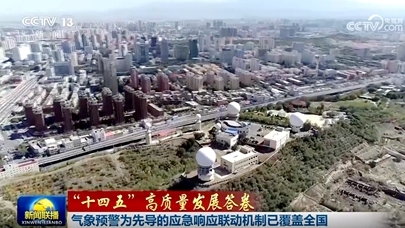
气象预警为先导的应急响应联动机制已覆盖全国
Yang Shi Wang· 2025-10-11 14:17
Core Insights - The "14th Five-Year Plan" for meteorological development in China has been successfully completed, with the national meteorological high-quality development index expected to increase by 18.35% in 2024 compared to 2020 [2] Group 1: Meteorological Services Impact - Meteorological services now cover over 70 major industries in the national economy, integrating digital meteorology into urban operation platforms [2] - Meteorological data supports 140,000 application scenarios across various sectors, including low-altitude economy, new energy industry, and financial markets [2] - Health-related meteorological warning products, such as pollen allergy forecasts and high-temperature alerts, have gained popularity among the public [2] Group 2: Disaster Response and Economic Impact - An emergency response mechanism based on meteorological warnings has been established nationwide [2] - The average economic loss due to meteorological disasters has decreased by 0.12 percentage points relative to GDP during the "14th Five-Year Plan" period [2] Group 3: Infrastructure Development - China has built a comprehensive meteorological observation system consisting of 9 Fengyun satellites, 842 weather radars, and over 90,000 ground meteorological observation stations [2] - A seamless and comprehensive intelligent digital meteorological forecasting system has been preliminarily established [2]

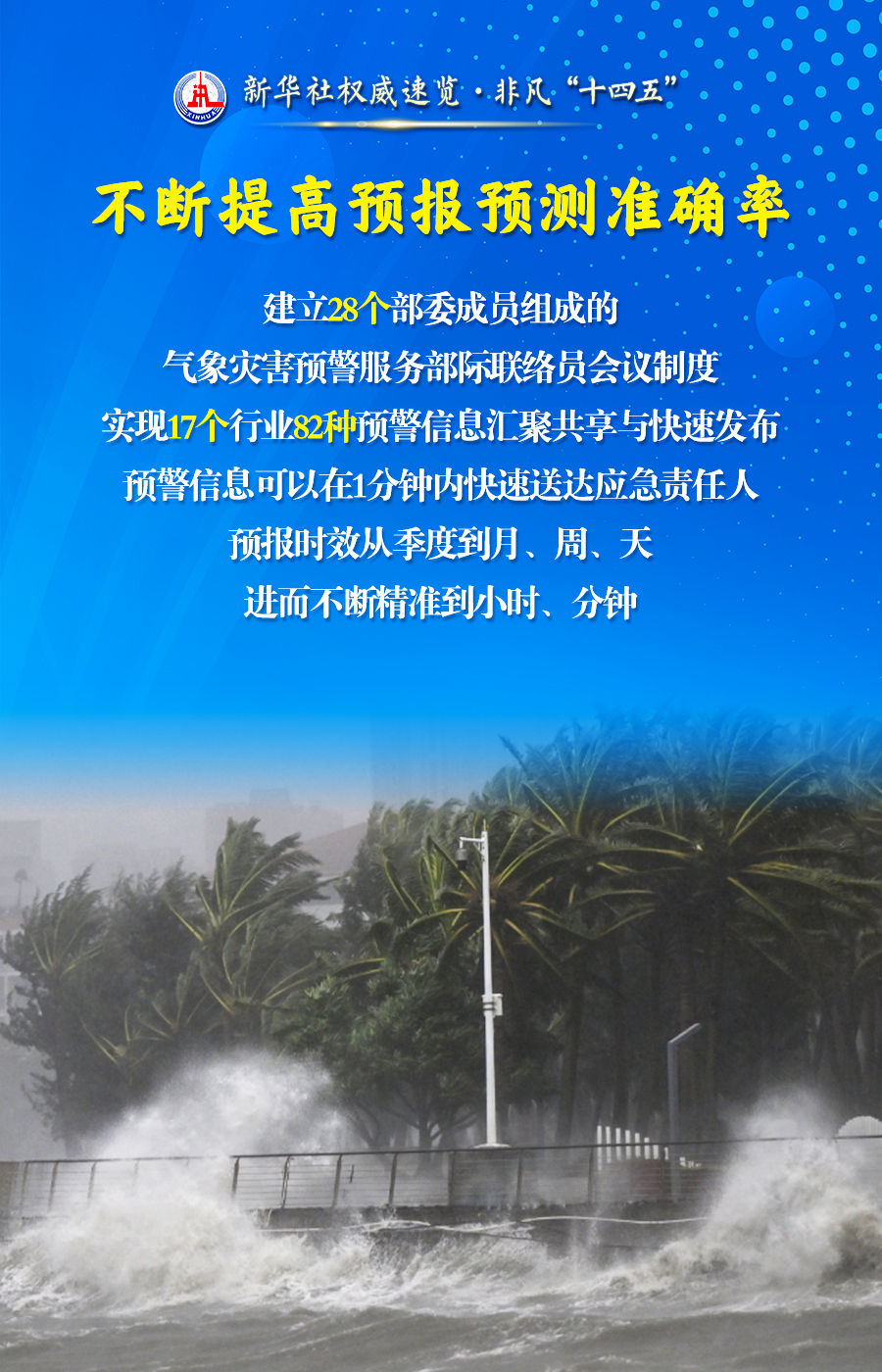
新华社权威速览·非凡“十四五”|为美好生活保驾护航,气象工作五年成绩单来了!
Xin Hua She· 2025-10-11 13:22
Core Insights - The article highlights significant advancements in meteorological services during the "14th Five-Year Plan" period, emphasizing improved forecasting accuracy and the establishment of a comprehensive meteorological observation network [1][3][19]. Group 1: Meteorological Infrastructure Development - China has launched five Fengyun meteorological satellites, achieving the world's first regional continuous imaging observation with a resolution of 250 meters per minute [3]. - A radar monitoring network consisting of 842 weather radars has been established, covering over 90% of population-dense areas [3]. - More than 90,000 ground meteorological observation stations have been built nationwide [3]. Group 2: Data Sharing and Utilization - The meteorological sector has shared over 100 types of meteorological data products, including refined intelligent grid forecasting products, with 153 countries and regions [6]. - A global ground climate dataset spanning 176 years has been released for the first time, with a spatial resolution of 10 kilometers for global atmospheric reanalysis products [6]. - Meteorological data identifiers have been issued over 980,000 times, supporting 140,000 application scenarios across various industries [6]. Group 3: Public Services and Technology Integration - The number of meteorological service indices has increased to over 70, integrating meteorological information into major media and mainstream services [9]. - New technologies such as IoT, 5G, and AI have enabled the public to access real-time meteorological information through mobile devices and wearables [9]. - The development of a seamless, all-encompassing intelligent digital meteorological forecasting system has been achieved [19]. Group 4: Agricultural Support and Risk Management - Meteorological departments are collaborating with agricultural sectors to provide disaster risk warnings and enhance agricultural resilience through insurance services [13]. - The implementation of the "Meteorological Services for Agriculture Quality Improvement and Efficiency Enhancement Action Plan" is ongoing [13]. Group 5: International Cooperation and Training - An independently developed early warning system is being utilized by over 40 countries, contributing to global early warning initiatives [15]. - The "Mazu" plan aims to provide training for 2,000 personnel and offers 100 scholarship opportunities and 50 visiting scholar positions over the next three years [16][15]. Group 6: Technological Advancements in Forecasting - Numerical forecasting capabilities have improved, with the usable forecast days for the Northern Hemisphere increasing from 7.9 to 8 days, nearing international advanced levels [19]. - The accuracy of heavy rain forecasts has improved by 10% compared to the "13th Five-Year Plan" period, with monthly and seasonal climate prediction levels increasing by 2.3% and 5.1%, respectively [20].
【“十四五”高质量发展答卷】气象预警为先导的应急响应联动机制已覆盖全国
Yang Shi Wang· 2025-10-11 11:55
Core Points - The "14th Five-Year Plan" for meteorological development in China has been successfully completed, with a projected increase of 18.35% in the national meteorological high-quality development index by 2024 compared to 2020 [1] Group 1: Meteorological Services - Meteorological services now cover over 70 major sectors of the national economy, integrating digital meteorology into urban operation platforms [1] - Meteorological data supports 14,000 application scenarios across various industries, including low-altitude economy, new energy, and financial markets [1] - The introduction of 17 types of health meteorological warning products, such as pollen allergy forecasts and high-temperature warnings, has been well received by the public [1] Group 2: Economic Impact - The average economic loss due to meteorological disasters has decreased by 0.12 percentage points relative to GDP during the "14th Five-Year Plan" period [1] Group 3: Observation Systems - China has established a comprehensive meteorological observation system consisting of 9 Fengyun satellites, 842 weather radars, and over 90,000 ground meteorological observation stations [1] - A "seamless and full coverage" intelligent digital meteorological forecasting system has been preliminarily established [1]
中国气象局:广州、深圳率先实现低空飞行气象保障职能法定化
Nan Fang Du Shi Bao· 2025-10-11 10:05
Core Viewpoint - The Chinese Meteorological Administration is focusing on high-quality development of meteorological services to support the low-altitude economy during the 14th Five-Year Plan period, emphasizing the importance of meteorological factors in ensuring the safety of low-altitude flight operations [1][2] Group 1: Meteorological Factors and Low-Altitude Flight Safety - Meteorological factors such as low-altitude wind, visibility, lightning, and severe convective weather significantly impact the safety of low-altitude flight operations [1] - The division of airspace and design of flight routes are closely linked to meteorological monitoring, forecasting, and climate condition analysis [1] Group 2: Innovations in Meteorological Services - The Chinese Meteorological Administration has developed a high-resolution three-dimensional meteorological model specifically for low-altitude applications, providing detailed wind fields and visibility data to ensure the safe operation of drones and other low-altitude vehicles [1] - Legislative support for meteorological services in low-altitude economies has been strengthened, with cities like Guangzhou and Shenzhen leading in formalizing meteorological support functions for low-altitude flight [1] Group 3: Pilot Projects and Local Initiatives - Various provincial meteorological departments are implementing pilot projects tailored to local conditions, such as Shanghai's comprehensive meteorological observation network and dedicated meteorological service centers in Chengdu and Nanchang [1] - The Guangdong-Hong Kong-Macao Meteorological Innovation Research Institute is establishing a collaborative framework that integrates industry, academia, and government to support local low-altitude economic development [1] Group 4: Future Plans and Development - The Chinese Meteorological Administration plans to issue guidance on developing meteorological services for the low-altitude economy, focusing on standardization, infrastructure development, application scenarios, and service model enhancement [2]
中国气象局部署假期后半段气象服务工作
Yang Shi Wang· 2025-10-06 05:32
Core Points - The China Meteorological Administration (CMA) has deployed meteorological services for the second half of the National Day and Mid-Autumn Festival holiday, focusing on the impact of Typhoon "Maidum" on southern regions and the expected weather changes in northern areas [1][2] - The meeting highlighted the need for continuous monitoring of the typhoon's path and its potential effects on travel and autumn harvests, emphasizing the importance of timely weather forecasts and high-level warning mechanisms [1] - There is a strong emphasis on ensuring operational stability and effective communication with various departments to provide targeted weather service alerts for different regions and travel methods [2] Group 1 - The 21st Typhoon "Maidum" has brought severe wind and rain to regions such as western Guangdong, Hainan, and southern Guangxi, increasing the risk of flooding and geological disasters [1] - Northern regions are expected to experience temperature drops and rainfall, which will significantly affect travel and autumn harvest activities [1] - Meteorological departments are required to implement a progressive meteorological service and high-level warning mechanisms to address the risks associated with the typhoon and geological disasters [1] Group 2 - The CMA emphasized the importance of strict duty management during the holiday period, ensuring that all extreme weather and service tasks are adequately supported [2] - There is a call for enhanced public awareness and proactive responses to societal concerns, aiming to create a positive atmosphere during the holiday [2] - Meteorological departments affected by adverse weather are urged to restore normal operations promptly to ensure continuous service delivery [2]