纺织服装

Search documents
纺织服装行业2025年中报综述:关税拖累制造表现,品牌业绩延续承压
Changjiang Securities· 2025-09-10 10:11
Investment Rating - The report maintains a "Positive" investment rating for the textile and apparel industry [9] Core Insights - The textile and apparel industry is experiencing pressure from tariffs, leading to a decline in manufacturing performance and continued challenges for brand performance [4][17] - In H1 2025, the A-share textile and apparel sector reported revenues of 796.9 billion and net profits of 74.4 billion, reflecting a year-on-year decline of 0.3% and 6.7% respectively [4][5] - The report highlights that the retail environment remains weak, impacting revenue growth across various segments [4][19] Revenue and Profit Analysis - Revenue growth rates for H1 2025 compared to H1 2024 are as follows: Sports (+7.9%), Mass Market (+0.7%), Textile Manufacturing (+0.5%), Mid-High End (-1.4%), Home Textiles (-2.5%) [2][6] - In Q2 2025, revenue growth rates compared to Q2 2024 are: Mass Market (+3.5%), Home Textiles (+0.8%), Mid-High End (+0.6%), Textile Manufacturing (-0.04%) [2][6] - Profitability analysis shows that in H1 2025, net profit growth rates are: Textile Manufacturing (+4.5%), Sports (-7.1%), Mid-High End (-9.4%), Home Textiles (-15.6%), Mass Market (-16.0%) [2][7] - In Q2 2025, net profit growth rates are: Textile Manufacturing (-6.4%), Home Textiles (-17.3%), Mass Market (-26.7%), Mid-High End (-36.6%) [2][7] Segment Performance - The sports segment shows resilience with a revenue of 750.6 billion in H1 2025, despite a net profit decline of 7.1% [19][20] - The mid-high end segment faces significant challenges with a revenue of 129.4 billion and a net profit decline of 9.4% in H1 2025 [36][40] - The mass market segment reported a revenue of 428.1 billion in H1 2025, with a slight decline in net profit [4][5] - Home textiles continue to struggle, with a revenue of 74.4 billion and a net profit decline of 15.6% in H1 2025 [4][5] Operational Quality - The report indicates that operational quality is declining, with inventory and accounts receivable turnover rates decreasing in a weak retail environment [4][5] - The cash flow situation remains healthy, with operating cash flow for the sports segment at 122 billion, maintaining a ratio of cash flow to net profit at 1.1 [28][33]
牛市中的主线轮动和切换
2025-09-09 14:53
Summary of Conference Call Records Industry or Company Involved - The discussion primarily revolves around the A-share market and its cyclical behavior, focusing on various sectors such as semiconductors, photovoltaics, lithium batteries, coal, and financial stocks. Core Points and Arguments 1. **Economic Cycle Impact on A-share Styles** The economic cycle influences A-share styles, with large-cap growth and value stocks performing well in an upturn, while small-cap growth or thematic growth performs better towards the end of a profit downturn [1][2][3] 2. **Investment Methodologies** The main methodologies for market style rotation are top-down and bottom-up approaches. The top-down approach categorizes macroeconomic scenarios to select investment directions, while the bottom-up approach focuses on the growth or value phase of different sectors based on ROE trends [2][4] 3. **Historical Performance of Leading Sectors** Historically, leading sectors during economic upturns include semiconductors, photovoltaics, lithium batteries, and coal. These sectors exhibit strong performance during their respective growth phases [2][5] 4. **Current Market Drivers** The primary drivers of the current market are the profit cycle and event-driven catalysts. The market is currently at the tail end of a profit downturn, favoring dividend or thematic investments, with small-cap stocks performing well [3][9] 5. **Market Environment Assessment** The current market environment can be assessed through macroeconomic scenarios. In an upturn, large-cap growth and value stocks yield excess returns, while small-cap growth performs well towards the end of a profit downturn [4][10] 6. **Lessons from Historical Market Trends** Key lessons from historical market trends indicate that sectors in a growth phase are more likely to lead the market. If a sector's financial data does not show significant improvement, any short-term market changes are likely thematic rather than systemic [5][6] 7. **Recent Style Rotations** Since 2025, the A-share market has experienced notable style rotations, shifting from growth stocks (robotics, AI) to financial stocks (banks), and then to large-cap value stocks [7][8] 8. **Indicators for Future Market Trends** Investors should monitor several key indicators, including the margin financing balance exceeding historical highs, low relative valuations of small-cap stocks, and the status of the PPI. These factors will influence the overall market style and potential investment opportunities [11][13][14] Other Important but Possibly Overlooked Content 1. **Systemic Style Change Likelihood** A systemic style change is unlikely in the short term, with the market remaining biased towards growth or technology styles until PPI turns positive [12] 2. **Sector-Specific Opportunities** Different sectors such as TMT, pharmaceuticals, and new energy may experience varying degrees of development, indicating potential investment opportunities within the growth framework [12][14]
中银量化多策略行业轮动周报–20250904-20250908
Bank of China Securities· 2025-09-08 01:41
Core Insights - The report highlights the current industry allocation of the Bank of China’s multi-strategy system, with significant positions in non-ferrous metals (15.3%), non-bank financials (12.9%), and comprehensive sectors (7.3%) [1] - The average weekly return for the CITIC primary industries was -3.0%, while the average return over the past month was 3.1% [3][10] - The report identifies the top-performing industries for the week as electric equipment and new energy (2.4%), food and beverage (0.8%), and pharmaceuticals (0.5%), while the worst performers were defense and military (-11.9%), computers (-9.8%), and electronics (-9.7%) [3][10] Industry Performance Review - The report provides a detailed performance review of CITIC primary industries, indicating that the average weekly return was -3.0% and the average monthly return was 3.1% [10] - The top three industries by weekly performance were electric equipment and new energy (2.4%), food and beverage (0.8%), and pharmaceuticals (0.5%) [11] - The bottom three industries were defense and military (-11.9%), computers (-9.8%), and electronics (-9.7%) [11] Valuation Risk Warning - The report employs a valuation warning system based on the PB ratio over the past six years, identifying industries with a PB ratio above the 95th percentile as overvalued [14][15] - Currently, the industries triggering high valuation warnings include retail, media, computers, and defense and military, all exceeding the 95th percentile in PB valuation [15][16] Strategy Performance - The report outlines the performance of various strategies, with the composite strategy yielding a cumulative return of 20.2% year-to-date, outperforming the CITIC primary industry benchmark by 2.3% [3] - The highest excess return strategy was the industry profitability tracking strategy (S1), with an excess return of 5.1% compared to the benchmark [3] - The report indicates a shift in strategy allocations, increasing positions in upstream cyclical and pharmaceutical sectors while reducing exposure to TMT, consumer, and midstream cyclical sectors [3] Current Industry Rankings - The report ranks industries based on profitability expectations, with non-ferrous metals, non-bank financials, and agriculture being the top three [18] - The implied sentiment momentum strategy ranks communication, non-ferrous metals, and electronics as the top three industries based on market sentiment indicators [22] - The macroeconomic style rotation strategy identifies comprehensive finance, computers, communication, defense and military, electronics, and media as the top six industries based on macroeconomic indicators [25]
消研所周报
Xin Lang Cai Jing· 2025-09-08 01:33
Group 1: Company Performance - Proya achieved a revenue of 5.362 billion yuan in the first half of 2025, representing a year-on-year growth of 7.21%, with a net profit of 799 million yuan, up 13.80% [2] - Nongfu Spring reported a revenue of 25.622 billion yuan for the first half of 2025, marking a 15.6% increase year-on-year, with a net profit of 7.622 billion yuan, up 22.1% [5] - Lululemon's Q2 revenue for fiscal year 2025 reached $2.5 billion, with a 7% year-on-year growth, and a 25% increase in revenue from mainland China [3] Group 2: Strategic Initiatives - Proya announced the initiation of its Hong Kong stock listing plan, aiming to enhance its capital strength and competitiveness on an international scale [2] - Lululemon plans to open approximately 15 new stores in the Americas in 2025, with a significant focus on expanding in the Chinese market [3] - Lekker Sports signed an official partnership with the Chinese National Weightlifting Team to enhance its brand image and service quality [4][5] Group 3: Product Launches and Innovations - Zdeer launched the G4 series of bone conduction hearing aids, emphasizing all-day comfort and performance for users [8] - DESCENTE held a 90th-anniversary exhibition showcasing its history and innovations in sports equipment [13] - BIRKENSTOCK introduced the 1774 Becomes Berlin collection, reinterpreting classic shoe designs with modern aesthetics [14]





A股重磅!又有两家公司筹划重大资产重组!
Zheng Quan Shi Bao· 2025-09-08 00:12
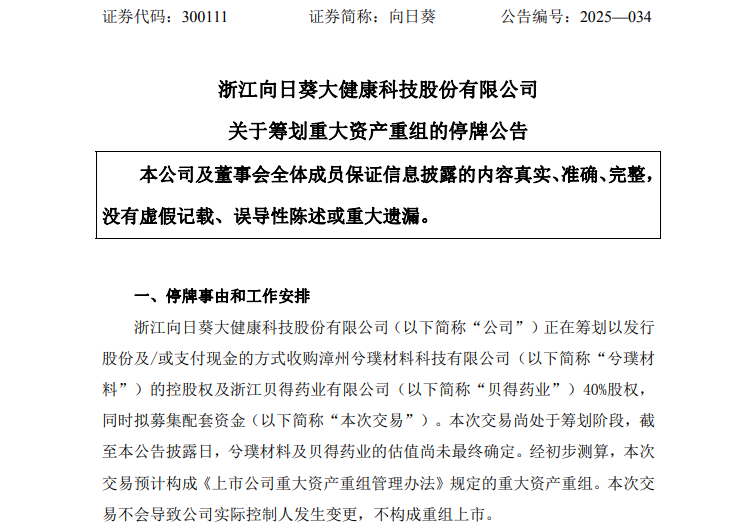
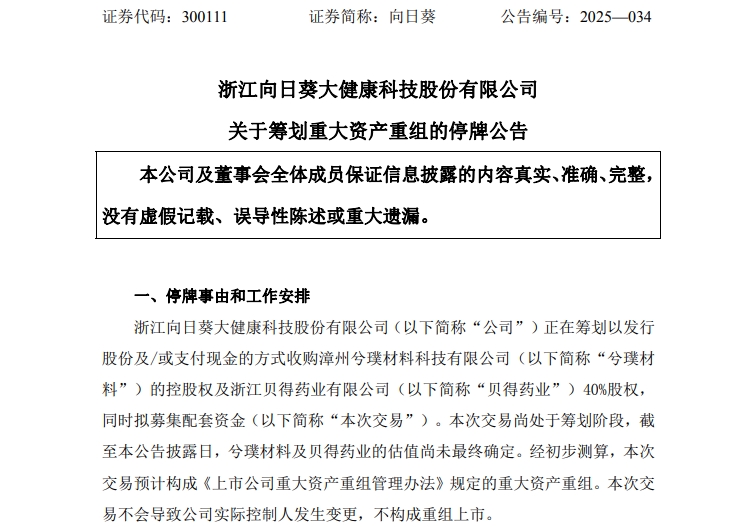
Group 1 - Xiangrikui is planning to acquire controlling stakes in Xi Pu Materials and 40% of Bei De Pharmaceutical through share issuance and/or cash payment, with the transaction expected to constitute a major asset restructuring [2][3] - The transaction is currently in the planning stage, and the valuations for Xi Pu Materials and Bei De Pharmaceutical have not been finalized yet [2] - The company has signed a letter of intent for the transaction and will disclose the transaction plan by September 22, 2023, or the stock will resume trading and terminate the restructuring plans [3] Group 2 - *ST Bosen intends to sell 35% of its stake in Shaanxi Bosen to Nantong Erfangji, which is expected to constitute a major asset restructuring [4] - This transaction does not involve share issuance and will not lead to a change in the controlling shareholder or actual controller [4] - The company reported a revenue of 51.95 million yuan and a net loss of 10.46 million yuan for the first half of 2025, with warnings of potential delisting if financial indicators trigger relevant conditions [4] Group 3 - As of September 7, over ten A-share listed companies, including *ST Bosen and Xiangrikui, have disclosed updates on merger and restructuring progress [5]
天风证券晨会集萃-20250908
Tianfeng Securities· 2025-09-07 23:41
Group 1 - The report emphasizes that in a bull market, rapid price increases often lead to short-term adjustment pressures, but do not alter the long-term trend, instead accumulating momentum for future rises [3][30] - It notes that since the end of June, the TMT sector's congestion level has risen to approximately 43% by the end of August, nearing the year's high, indicating potential structural adjustments in the market [3][30] - The report suggests that from now until the end of the year, there is likely to be a rotation in market styles, with Q4 entering a phase of policy expectation fermentation, similar to previous bull markets where new capital accelerated entry in Q4 [3][31] Group 2 - The report identifies that the bull market's main style is "stronger remains strong," but cyclical styles may perform better in the latter half of the cycle, as seen in past bull markets [5] - It highlights that the cyclical stocks have maintained a relatively stable excess return, with the potential for better performance as the fundamentals improve [5] - The report suggests focusing on sectors such as non-ferrous metals and chemicals, which have shown good revenue growth and return on equity, indicating a positive fundamental outlook [5] Group 3 - The report discusses the AI sector, particularly the end-side AI investments, which are expected to benefit from policy support and innovations from major companies like Apple [20] - It mentions that AI data centers are expected to undergo significant upgrades, with the introduction of liquid cooling technology to manage the increasing power consumption of AI chips [20] - The report also highlights the ongoing demand for AI-related technologies and the potential for substantial growth in this sector [20] Group 4 - The report indicates that the methanol industry is expected to maintain a favorable outlook due to high operating rates and low inventory levels, suggesting a sustained upward trend in industry conditions [24] - It points out that the copper smelting industry is undergoing optimization, with expectations for profitability to return as production capacities are aligned better with market demands [26] - The report recommends focusing on companies with cost advantages in the copper smelting sector, such as Zijin Mining and Jiangxi Copper [26]
A股重磅,又有两家公司,筹划重大资产重组
Zheng Quan Shi Bao· 2025-09-07 22:27
Group 1 - Company Xiangrikui is planning to acquire controlling stakes in Zhangzhou Xipu Materials Technology Co., Ltd. and 40% of Zhejiang Beid Pharmaceutical Co., Ltd. through share issuance and/or cash payment [2] - The transaction is expected to constitute a major asset restructuring, but it will not lead to a change in the actual controller of the company and does not constitute a restructuring listing [2][4] - A transaction intention agreement has been signed by all parties involved, and the company's stock was suspended from trading starting September 8 [4] Group 2 - Company *ST Bosen plans to sell 35% of its stake in Shaanxi Bosen Apparel Intelligent Manufacturing Co., Ltd. to Nantong Erfang Machine, which is expected to constitute a major asset restructuring [6] - This transaction does not involve share issuance, will not lead to a change in the controlling shareholder or actual controller, and is still in the preliminary planning stage [6] - The company reported a significant decline in operating performance, with a revenue of 51.95 million yuan and a net loss of 10.46 million yuan for the first half of 2025 [7]


从GDP到GNP:产能出海新机遇
2025-09-07 16:19
Summary of Key Points from Conference Call Records Industry Overview - The discussion revolves around the **Chinese manufacturing industry** and its strategic shift towards **capacity relocation** in response to rising trade tensions and geopolitical challenges [1][2][5][6][8]. Core Insights and Arguments - **Trade Surplus and Capacity Relocation**: China faces a high trade surplus, prompting the need for capacity relocation to mitigate trade friction and adjust the domestic economic structure. Industries with higher overseas revenue ratios tend to have better Return on Equity (ROE) [1][2][8]. - **Impact of Globalization Trends**: The increasing trend of de-globalization, characterized by rising tariffs and geopolitical conflicts, necessitates a shift in supply chain strategies towards regionalization and localization. Chinese companies must optimize their supply chains and expand overseas to maintain competitiveness [1][6][8]. - **Labor Cost Dynamics**: The diminishing labor cost advantage in China and intense domestic competition make capacity relocation a viable solution. Foreign markets show higher tolerance for Chinese capacity relocation compared to product exports [1][8][9]. - **Lessons from Japan**: Japan's historical experience in the 1980s, where it successfully addressed trade issues through overseas direct investment (OFDI), serves as a model for China. Japanese companies improved profitability and supported technological advancements through profit repatriation from overseas subsidiaries [1][10][11]. - **Industry Selection for Capacity Relocation**: A scoring model was developed to evaluate industries suitable for capacity relocation based on urgency, overseas demand potential, and industry lifecycle. Key sectors identified include high-tech electronics, renewable energy equipment, and certain consumer goods [4][17]. Additional Important Insights - **Challenges of Exporting vs. Relocating Capacity**: The current tariff landscape poses significant challenges for Chinese exports, with countries like the U.S. imposing average tariffs of approximately 40% since 2018. This has led to an increase in anti-dumping investigations against Chinese products [5][6]. - **Employment Implications**: Capacity relocation can alleviate domestic employment pressures, as seen in Japan, where overseas employment has significantly increased. This trend indicates a need for more long-term expatriate staff to manage overseas operations [13][15]. - **Service Industry Growth**: The shift from manufacturing to production-related services is emerging as a trend, with increased demand for technical services and support as companies invest abroad. This transition highlights the importance of service sectors in offsetting manufacturing job losses [16]. Conclusion - The strategic shift towards capacity relocation is essential for Chinese companies to navigate the current global trade environment. By learning from Japan's experiences and focusing on high-potential industries, China can enhance its competitiveness and adapt to the evolving economic landscape [1][11][17].
A股重磅!又有两家公司,筹划重大资产重组!
Zheng Quan Shi Bao· 2025-09-07 15:10
Core Viewpoint - Sunflower is planning to acquire controlling stakes in Xi Pu Materials and 40% of Bei De Pharmaceutical through share issuance and/or cash payment, with the transaction expected to constitute a major asset restructuring [2][5] Group 1: Transaction Details - The acquisition involves Xi Pu Materials Technology Co., Ltd. and Zhejiang Bei De Pharmaceutical Co., Ltd. [2] - The valuation of both companies has not been finalized as the transaction is still in the planning stage [2] - The company anticipates that the transaction will not lead to a change in actual control and will not constitute a restructuring listing [2] Group 2: Regulatory and Market Impact - A transaction intention agreement has been signed by all parties involved, leading to a suspension of Sunflower's stock trading starting September 8 [5] - The company is expected to disclose the transaction plan within 10 trading days, by September 22, or the stock will resume trading and the planning will be terminated [5] Group 3: Industry Context - The announcement comes amid a wave of merger and acquisition activities, with over ten A-share listed companies, including Sunflower, disclosing their restructuring progress recently [8]
外出打工的湖北人,正纷纷往回走
21世纪经济报道· 2025-09-07 12:14
Core Viewpoint - The article highlights the trend of returning workers in Hubei province, showcasing how individuals who previously sought employment in other regions are now returning to their hometowns to start businesses or find jobs, driven by local policies, industry foundations, and emotional ties to their roots [1][2][4]. Group 1: Return of Workers - Hubei province is experiencing a "returning geese" trend, with many former migrant workers coming back to their hometowns for employment and entrepreneurship [1][2]. - In 2024, Yichang is expected to see an increase of 15,400 returning workers, a year-on-year growth of 20.3% [1]. - The total number of new returning entrepreneurial entities in Hubei in the first half of 2025 exceeded 12,000, directly creating 83,000 jobs, with project revenues growing by 23% year-on-year [1]. Group 2: Employment Opportunities - Returning workers are engaging in various sectors, including manufacturing (automobiles, machinery, clothing) and agriculture (crawfish, mushrooms, livestock), as well as modern services like e-commerce and hospitality [2][5]. - The textile and clothing industry in Tianmen has attracted around 100,000 people back to employment and entrepreneurship over the past three years, creating 160,000 jobs [5]. - In the crawfish industry in Qianjiang, workers can earn over 100,000 yuan annually, while seasonal jobs in processing can yield around 40,000 yuan [6]. Group 3: Supportive Policies - Hubei has introduced a "six subsidies and one benefit" policy package to support returning entrepreneurs, covering rent, loans, social security, and entrepreneurship [10]. - The province aims to cultivate 100 "Jingchu Returning Geese" projects, each receiving 100,000 yuan in funding support [10]. - Local governments are also implementing measures to facilitate returning workers, such as job fairs and skills training programs to match local industry needs [11][12]. Group 4: Economic Impact - The return of workers is expected to create a multiplier effect, with 67.7% of returning entrepreneurs engaging in agriculture, tourism, and textile industries [7][8]. - The article emphasizes the need for Hubei to develop a long-term mechanism to sustain economic growth driven by returning workers, focusing on enhancing public services and creating a supportive environment for entrepreneurship [12][13].