医疗

Search documents
上海两会|上海持续打造国际一流营商环境,变企业“需求清单”为“服务清单”
Sou Hu Cai Jing· 2026-02-07 07:53
Core Viewpoint - Shanghai is committed to enhancing its attractiveness for foreign investment through targeted measures and aims to maintain its status as a key destination for foreign capital in China [1][2]. Group 1: Characteristics of Foreign Investment in Shanghai - The scale of foreign investment in Shanghai remains stable, with actual foreign investment expected to reach $16.06 billion by 2025, accounting for 15.3% of the national total, ranking second among all provinces and cities in China [2]. - The quality of foreign investment is improving, with high-tech industries expected to account for 33% of actual foreign investment during the 14th Five-Year Plan period, a 10 percentage point increase from the previous period [2]. - The momentum for foreign investment is strong, with 6,300 new foreign enterprises projected to be established by 2025, representing a growth of 6.8%, and contracted foreign investment expected to reach $18 billion, an increase of nearly 20% [2]. Group 2: Future Strategies for Attracting Foreign Investment - Shanghai plans to expand high-level opening-up by aligning with international trade rules and steadily increasing institutional openness, particularly in key sectors such as telecommunications, healthcare, education, and finance [3]. - The city will support the transformation and upgrading of foreign investment by implementing a new encouraged foreign investment industry catalog, guiding foreign enterprises towards advanced manufacturing, modern services, high-tech, and energy-saving industries [3]. - Shanghai aims to continuously create a world-class business environment by enhancing service guarantees for foreign enterprises and transforming the "demand list" of companies into a "service list" to improve the experience of foreign investors [3].
上海将采取哪些更具针对性的稳外资举措?市商务委回应
Xin Lang Cai Jing· 2026-02-07 07:23
Core Insights - Shanghai has prioritized stabilizing foreign investment for two consecutive years, yet actual foreign investment has not shown improvement, prompting the government to consider more targeted measures [1][2] Group 1: Foreign Investment Characteristics - The scale of foreign investment in Shanghai is stable, with a projected actual foreign investment of $16.06 billion by 2025, a single-digit decline, and an increase in the national share to 15.3%, ranking second in the country [1] - The quality of foreign investment has improved, with high-tech industries accounting for 33% of actual foreign investment during the 14th Five-Year Plan, a 10 percentage point increase from the previous plan [2] - The momentum for foreign investment remains strong, with over 6,300 new foreign enterprises expected to be established by 2025, representing a growth of 6.8%, and contracted foreign investment exceeding $18 billion, a nearly 20% increase [2] Group 2: Future Measures for Stabilizing Foreign Investment - Shanghai aims to expand high-level opening-up by aligning with international trade rules, gradually increasing institutional openness, and promoting key pilot projects in telecommunications, healthcare, education, and finance [2] - The city will support the transformation and upgrading of foreign investment by implementing a new encouraged foreign investment industry catalog, guiding investments towards advanced manufacturing, modern services, high-tech, and energy-saving industries [2] - Continuous efforts will be made to create a world-class business environment, enhancing service guarantees for foreign enterprises and transforming their needs into a service checklist [2]
上海今年千方百计稳外资外贸,计划一季度推出新一轮政策
Di Yi Cai Jing· 2026-02-07 07:20
Core Insights - Shanghai has shown resilience in attracting foreign investment despite global economic challenges, with actual foreign investment reaching $16.06 billion, ranking second among Chinese cities and accounting for 15.3% of the national total [1] - The quality of foreign investment in Shanghai is improving, with high-tech industries accounting for 33% of actual foreign investment during the 14th Five-Year Plan, a 10 percentage point increase from the previous plan [1] - The number of regional headquarters and foreign R&D centers in Shanghai has increased, with a total of 1,076 regional headquarters and 636 foreign R&D centers recognized by the end of last year [1] Group 1 - Shanghai aims to stabilize foreign investment by enhancing its business environment and supporting the transformation and upgrading of foreign enterprises [2] - The city plans to align with international trade rules and expand institutional openness, particularly in key sectors such as telecommunications, healthcare, education, and finance [2] - New foreign investment policies will guide investments towards advanced manufacturing, modern services, high-tech, and energy-saving industries [2] Group 2 - Shanghai's foreign trade is projected to exceed 4.5 trillion yuan by 2025, with growth rates in import and export values surpassing national averages [3] - The city will implement new policies to stabilize foreign trade, focusing on maintaining the basic trade framework and boosting confidence among foreign trade enterprises [3] - A new round of foreign investment policies is expected to be launched in the first quarter of this year [3] Group 3 - Shanghai will enhance cross-border trade facilitation by collaborating with customs, foreign exchange, and tax departments to improve processes such as customs clearance and export tax rebates [4] - The city aims to foster new business models in foreign trade, including the development of cross-border e-commerce and optimizing overseas warehouse services [4] - Initiatives will also focus on service trade and digital trade, with plans to establish a national service trade innovation development demonstration zone [4]
东胜向暖 暖向民生
Xin Lang Cai Jing· 2026-02-06 19:58
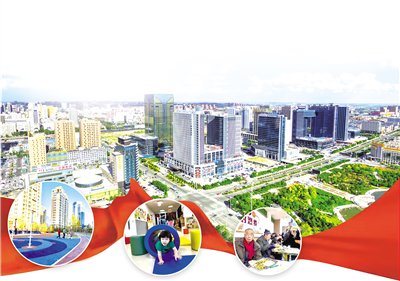
Core Viewpoint - The focus of the news is on the development and improvement of public welfare in Dongsheng District, Inner Mongolia, with significant investments in education, healthcare, elderly care, employment, and urban living conditions to enhance the quality of life for residents by 2025 [5][10]. Public Welfare Investment - Dongsheng District plans to allocate 79.6% of its general public budget expenditure towards education, healthcare, elderly care, employment, and livability to respond to public expectations and improve basic public services [5]. Education Development - By 2025, Dongsheng District aims to establish 50 childcare institutions, enhancing the "15-minute" childcare service circle [6]. - The district has been recognized as a "Quality Balanced Development Area" for compulsory education, with plans to build or expand 4 schools, adding 2,880 new student places and attracting 195 excellent teachers [6]. - AI education will cover 47 primary and secondary schools, with a college entrance examination admission rate reaching 84%, a historical high [6]. Elderly Care and Healthcare - Dongsheng District will establish 30 elderly care restaurants and 8 community elderly service stations by 2025, enhancing social interaction and meal accessibility for seniors [7][8]. - The district has passed the national chronic disease comprehensive prevention and control demonstration area assessment, with 12 grassroots medical institutions upgraded to improve healthcare access [8]. Employment and Economic Growth - The district will host 46 recruitment events and implement "10+N" employment service initiatives, aiming for 8,868 new urban jobs in 2025, with 5,667 jobs for key groups [9]. - Skills training programs will be provided for rural laborers and unemployed individuals to enhance employment opportunities [9]. Urban Living Conditions - Dongsheng District will implement 44 old residential area renovation projects and 18 energy-saving renovations, benefiting 7,076 households and covering 773,600 square meters [9]. - The district's property management coverage has reached 81%, ensuring better maintenance of residential areas [9]. Infrastructure and Environmental Improvements - By 2025, the district will complete 4 rural water supply projects, benefiting over 6,800 residents, and enhance green spaces with a green coverage rate of 44.1% [10]. - Smart traffic management upgrades will improve traffic efficiency by 18% at major intersections [10].

成都推出“预付保”!如遇商家“跑路”,消费者能拿回一定比例的消费余额赔付
Sou Hu Cai Jing· 2026-02-06 14:03
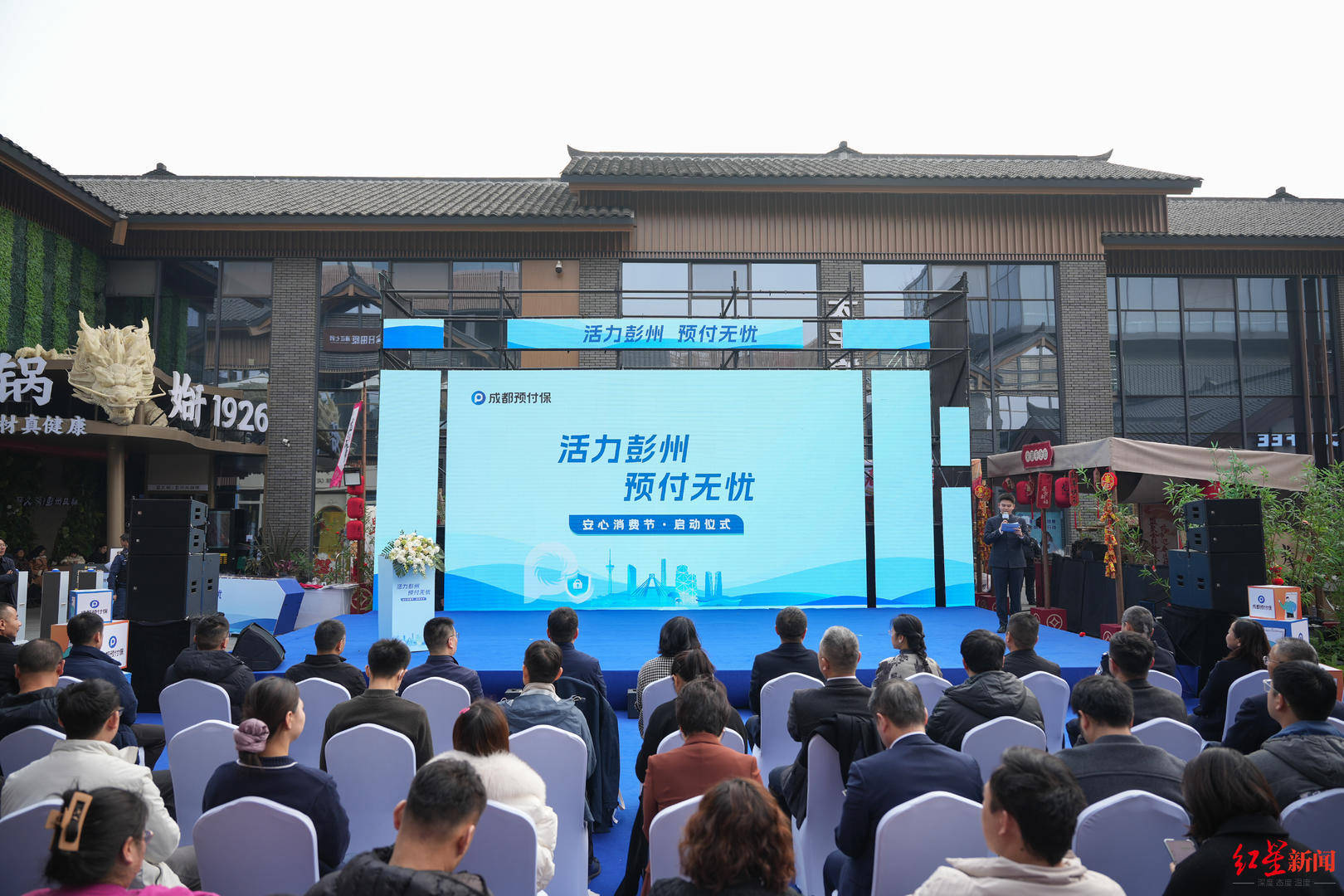
Group 1 - The core initiative "Prepaid Worry-Free" aims to enhance consumer confidence in prepaid services through the "Chengdu Prepaid Consumption Comprehensive Service Platform" (referred to as "Prepaid Protection") [2][3] - The platform is developed by the Chengdu Municipal Financial Management Bureau in collaboration with relevant industry authorities, utilizing smart technology and an innovative "differential supervision" model to ensure consumer protection and risk mitigation [2] - The platform has been piloted in several areas including Sichuan Tianfu New Area, Chengdu Jinjiang District, Pengzhou, and Dujiangyan, with plans for future expansion across more industries and regions [3] Group 2 - The "Prepaid Protection" platform addresses common issues in prepaid consumption such as financial security risks, contract traps, and merchant dishonesty, which have been significant sources of consumer complaints [3] - For merchants, the platform serves as a credibility endorsement, enhancing consumer trust and potentially increasing transaction rates [3] - The "Prepaid Worry-Free" themed market event showcased various businesses in sectors like healthcare, sports training, arts education, childcare services, and elder care, creating immersive consumer experiences [4]
业绩提振,港股医药回暖!诺诚健华领涨创新药,520880摸高2%!港股通医疗ETF华宝底部四连阳
Xin Lang Cai Jing· 2026-02-06 09:49
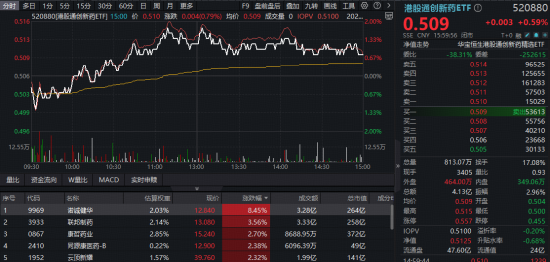
Core Viewpoint - The Hong Kong pharmaceutical sector is experiencing a significant rebound, particularly in innovative drugs, with several companies reporting strong earnings forecasts and positive growth trends [1][8]. Group 1: Innovative Drug Sector - The Hong Kong Stock Connect Innovative Drug ETF (520880) saw a rise of nearly 2% after opening lower, indicating strong investor interest [1][8]. - Innovent Biologics (诺诚健华) led the gains with a rise of over 12%, projecting revenues of 2.37 billion yuan for 2025, a year-on-year increase of approximately 134%, and an expected net profit of around 630 million yuan, marking its first profit [1][8]. - Other companies like Rongchang Biopharmaceutical and CanSino Biologics also reported profitability, with net profit growth exceeding 100% year-on-year [1][8]. Group 2: Medical Sector - The medical sector is also showing positive momentum, with AI healthcare and CXO-related stocks active; Ark Health (方舟健客) led with a 4.71% increase [3][10]. - Ark Health forecasts a profit of 7 to 10 million yuan for 2025, indicating a turnaround from previous losses, and raised approximately 144.3 million HKD to accelerate the development of its AI-driven chronic disease management platform [3][10]. - Among the 10 component stocks of the Hong Kong Stock Connect Medical ETF (159137) that disclosed earnings forecasts, 9 are expected to be profitable, with several companies anticipating net profit growth of over 100% [3][10]. Group 3: Market Trends and Investment Opportunities - Despite the positive earnings outlook, the recent performance of the pharmaceutical sector has diverged from these fundamentals, with the Hong Kong Stock Connect Innovative Drug ETF (520880) experiencing four consecutive weeks of declines [5][12]. - The current market conditions may present a favorable opportunity for accumulation in the Hong Kong pharmaceutical sector, particularly through ETFs, which offer higher efficiency and flexibility [5][12]. - Investors are encouraged to consider the Hong Kong Stock Connect Innovative Drug ETF (520880) and its associated funds for a comprehensive exposure to innovative drug companies, with the top ten holdings accounting for over 73% of the portfolio [6][12].

四川省政协委员胡裕华:建议提升服务消费 深化成都国际消费中心城市建设
Zhong Guo Jing Ying Bao· 2026-02-06 07:55
Core Viewpoint - The Sichuan provincial government is focusing on boosting consumption as a key topic during the "Two Sessions," with specific actions outlined in the 2026 government work report to enhance traditional and new consumption, as well as service consumption [1] Group 1: Consumption Boosting Initiatives - The Sichuan government plans to implement special actions to stimulate consumption and increase urban and rural residents' income [1] - Chengdu aims to deepen its construction as an international consumption center city, with discussions on enhancing consumption scenarios including landmark shopping districts and unique cultural experiences [1] - Chengdu's retail sales of consumer goods exceeded 1 trillion yuan in 2023, making it the sixth city in China to reach this milestone, with a target of 1.1 trillion yuan by 2025 [2] Group 2: Service Consumption Development - The government report emphasizes the need to expand service consumption by tapping into potential areas such as transportation, housekeeping, and online audio-visual services [2] - Chengdu is accelerating the development of service consumption, focusing on integrating cultural, commercial, and tourism experiences, and promoting nighttime economy [2][3] Group 3: Enhancing the Value Chain - Recommendations include enhancing the service consumption value chain by focusing on high-value, experiential services, particularly in healthcare and professional services [3] - The development of "low-altitude economy" is suggested, with plans for low-altitude tourism and drone performances to create new consumption scenarios [3] Group 4: Optimizing Existing Commercial Spaces - There is a need to shift from "incremental construction" to "stock optimization" in Chengdu's commercial landscape, addressing the vitality of existing commercial entities [4] - Suggestions include transforming traditional commercial spaces into multi-functional areas that incorporate cultural and social experiences [4] Group 5: Global Consumption Hub - Chengdu is encouraged to transition from "buying globally" to "selling globally," aiming to establish itself as a global hub for consumer goods distribution and innovation [5] - The city should strengthen its role in promoting local products internationally and attract regional headquarters and R&D centers for brands [5][6] Group 6: New Retail Experiences - The promotion of a "front store, back warehouse" retail model is suggested to enhance consumer convenience and create a new benchmark for offline shopping [6] - Recommendations include establishing night markets featuring local cuisine to enrich the nighttime economy and enhance tourism appeal [6]
理响中国|创意图解:供需“双向奔赴”,激活消费增长主引擎
Huan Qiu Wang· 2026-02-06 02:58
Core Viewpoint - The article emphasizes the importance of boosting consumption as a key strategy for building a strong domestic market, highlighting various initiatives proposed in the "14th Five-Year Plan" to enhance consumer spending and supply of quality goods and services [2][13]. Group 1: Consumption Boosting Strategies - The "14th Five-Year Plan" suggests implementing special actions to boost consumption, expanding the supply of quality consumer goods and services, and promoting the upgrade of commodity consumption [2][13]. - The Central Economic Work Conference has also prioritized boosting consumption as a crucial element in constructing a robust domestic market [2]. Group 2: Supply and Demand Adaptation - Supply and demand adaptation is defined as a mutual effort where the supply side provides products and services that accurately match consumer needs, while also innovating to lead and create demand [4]. - The article notes that the capability of the supply side has significantly improved, allowing for a wider range of traditional products to be available [5][6]. Group 3: Changing Consumer Characteristics - Current consumer characteristics are evolving, with service consumption expenditure as a percentage of per capita consumption rising from 39.7% in 2013 to an expected 46.1% by 2025 [9]. - Consumption is shifting from merely meeting basic needs to pursuing quality, experience, and self-actualization [9]. Group 4: Emerging Consumer Markets - The article highlights the emergence of new consumer markets such as RV camping, cruise tourism, and the silver economy, which are expected to grow steadily [11]. - It also mentions the importance of developing the "first launch economy" and the "ice and snow economy" to stimulate consumption [11]. Group 5: Infrastructure and Regulatory Enhancements - Strengthening urban and rural logistics infrastructure is essential to address rural logistics shortcomings and build an efficient logistics network covering both urban and rural areas [12]. - The article calls for increased regulation of e-commerce platforms and live-streaming sales to enhance immediate consumption [11].

深圳上市公司达600家,截至1月末总市值超19万亿元稳居全国大中城市第二位
Jin Rong Jie· 2026-02-06 02:46
Core Viewpoint - Shenzhen's listing companies have officially surpassed 600, marking a significant milestone in the city's financial landscape and showcasing its strong innovation and manufacturing capabilities [1] Group 1: Company Listings - On February 6, Zhuozheng Medical and Dazhu CNC were listed on the Hong Kong Stock Exchange, contributing to Shenzhen's total of 600 listed companies [1] - Among these, there are 426 domestic listed companies and 174 overseas listed companies [1] Group 2: Market Capitalization - As of the end of January 2026, the total market capitalization of Shenzhen's listed companies exceeds 19 trillion yuan, ranking second among major cities in China [1] Group 3: Growth and Innovation - During the "14th Five-Year Plan" period, the number of domestic listed companies in Shenzhen has grown by over 35% [1] - Notable new entrants include Beixin Life and Dapu Micro, along with industry leaders in niche sectors such as Yingshi Innovation and Woan Robotics, illustrating Shenzhen's high-tech and innovative industrial landscape [1] Group 4: Overseas Listings - In the past three years, 38 new companies have been added to the overseas market, with the Hong Kong market performing particularly well [1] - 27 newly listed companies in Hong Kong raised a total of 29.573 billion HKD, with over 70% of these companies experiencing stock price increases on their first trading day, averaging a rise of 26.22% [1] Group 5: Financing Performance - The Hong Kong market has shown strong refinancing performance, with a total refinancing amount of 55.466 billion HKD in 2025, a significant year-on-year increase of 4710.58% [1] - BYD alone accounted for over 43.509 billion HKD in refinancing, representing more than 78.44% of the total, marking it as the largest equity refinancing in the global automotive industry in nearly a decade [1] Group 6: Innovation and Financial Ecosystem - The increase in the number and quality of listed companies reflects the competition between urban innovation dynamics and financial ecosystems [1] - The achievement of 600 listed companies in Shenzhen is not just a numerical milestone but also a vivid practice of the efficient cycle among technology, industry, and finance, providing a valuable model for urban development in China [1]
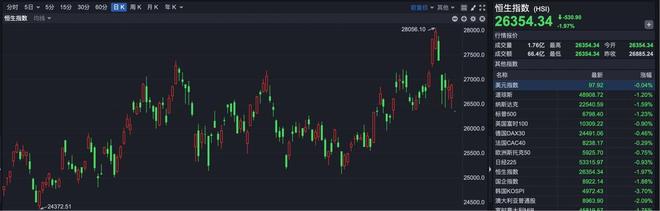
港股速报|开盘再遭冲击 恒指跌近2% 三只新股上市集体走高
Mei Ri Jing Ji Xin Wen· 2026-02-06 02:38
Market Overview - The Hong Kong stock market opened lower today, with the Hang Seng Index starting at 26,354.34 points, down 530.90 points, a decline of 1.97% [1] - The Hang Seng Tech Index opened at 5,275.12 points, decreasing by 131.01 points, a drop of 2.42% [2] New Listings - Three new stocks were listed today, with Muyuan Foods (HK02714) slightly opening lower but rising nearly 2%, Dazhong CNC (HK03200) opening over 10% higher, and Zhuozheng Medical (HK02677) opening over 35% higher, later peaking at over 40% [4] Company Performance - NIO Inc. (HK09866) saw its stock rise over 6% after announcing an earnings forecast, expecting adjusted operating profit of approximately 700 million to 1.2 billion yuan for Q4 2025, marking the first time the company anticipates quarterly adjusted operating profit in its 11-year history [4] Sector Performance - The technology sector experienced widespread declines, with Baidu Group falling over 4%, and Kuaishou and Alibaba both dropping over 3% [6] - Gold stocks also faced declines, with Zijin Mining falling over 5%, and semiconductor stocks weakened, with Huahong Semiconductor down over 3% [6] Market Outlook - Analysts believe the recent adjustments in the Hong Kong market are primarily technical corrections rather than a trend reversal, attributing the decline to overly optimistic market sentiment and external factors such as liquidity concerns from the U.S. Federal Reserve's chair nomination [7] - Mid-term support for the market is expected from low valuations and continued inflow of southbound capital [7] - A notable shift in capital is observed, moving from recently high-performing tech stocks to more defensive sectors like consumer and dividend stocks, which are favored for their lower valuations and stable performance [7]