
厨房电器

Search documents
老板电器(002508):Q3经营保持韧性
Guotou Securities· 2025-10-30 09:04
Investment Rating - The investment rating for the company is maintained at "Buy-A" with a 12-month target price of 23.79 CNY, corresponding to a 14 times dynamic price-to-earnings ratio for 2026 [4][3]. Core Insights - The company reported a revenue of 7.31 billion CNY for the first three quarters of 2025, a year-on-year decrease of 1.1%, and a net profit attributable to shareholders of 1.16 billion CNY, down 3.7% year-on-year. In Q3 alone, the revenue was 2.7 billion CNY, showing a year-on-year increase of 1.4%, while the net profit was 450 million CNY, up 0.6% year-on-year. The company is expected to see marginal improvements driven by the old-for-new policy [2][3]. Financial Performance Summary - Q3 revenue growth was stable, with online sales of range hoods and gas stoves increasing by 8% year-on-year. The company is focusing on the old-for-new activities in retail channels, which are expected to yield positive results. However, the engineering channel revenue is anticipated to decline due to a decrease in residential construction area [2]. - The gross profit margin in Q3 increased by 0.9 percentage points year-on-year, attributed to a lower proportion of revenue from the engineering channel and cost reduction measures. The net profit margin decreased by 0.1 percentage points year-on-year due to increased sales expenses, which rose by 2.0 percentage points [3]. - The operating cash flow in Q3 increased by 110 million CNY year-on-year, primarily due to revenue growth. Cash received from sales and services increased by 240 million CNY [3]. Financial Forecasts - The company is projected to achieve revenues of 11.39 billion CNY in 2025, with net profits of 1.58 billion CNY. The expected earnings per share (EPS) for 2025 is 1.67 CNY, with a gradual increase to 1.77 CNY by 2027 [4][10].

爱仕达发布前三季度业绩,归母净亏损5898.56万元
Zhi Tong Cai Jing· 2025-10-30 08:22
Core Viewpoint - Aishida (002403.SZ) reported a decline in revenue and incurred net losses in the first three quarters of 2025 compared to the previous year [1] Financial Performance - The company's operating revenue for the first three quarters was 1.954 billion yuan, representing a year-on-year decrease of 7.57% [1] - The net loss attributable to shareholders of the listed company was 58.986 million yuan [1] - The net loss attributable to shareholders after deducting non-recurring gains and losses was 75.133 million yuan [1] - The basic loss per share was 0.17 yuan [1]

比依股份(603215):新品类带来增量,放量后有望带动盈利改善
Shenwan Hongyuan Securities· 2025-10-30 03:46
Investment Rating - The investment rating for the company is "Outperform" (maintained) [1]. Core Insights - The company reported a revenue of 1.756 billion yuan for the first three quarters of 2025, representing a year-on-year growth of 19%. However, the net profit attributable to shareholders decreased by 29% to 72 million yuan, and the net profit after deducting non-recurring items fell by 33% to 66 million yuan [4][7]. - The decline in profit is attributed to significant investments in new product molds and the initial costs associated with the startup phase of subsidiaries. Despite this, the company is expanding its product categories, particularly in air fryers and coffee machines, which are expected to contribute to revenue growth in the future [7]. - The company has successfully established itself as a key supplier for several well-known domestic and international brands, enhancing its market position [7]. Financial Data and Profit Forecast - The company is projected to achieve total revenue of 2.441 billion yuan in 2025, with a year-on-year growth rate of 18.6%. The net profit attributable to shareholders is expected to be 153 million yuan, reflecting a growth of 9.9% [6][9]. - The gross margin is forecasted to improve gradually as new products ramp up production, with an estimated gross margin of 14.3% in 2025 [6]. - The company’s earnings per share (EPS) is projected to be 0.82 yuan in 2025, with a price-to-earnings (P/E) ratio of 24 times [6][9].

华帝股份的前世今生:营收41.58亿行业第二,净利润3.55亿居次席,资产负债率高于行业平均
Xin Lang Cai Jing· 2025-10-29 12:48
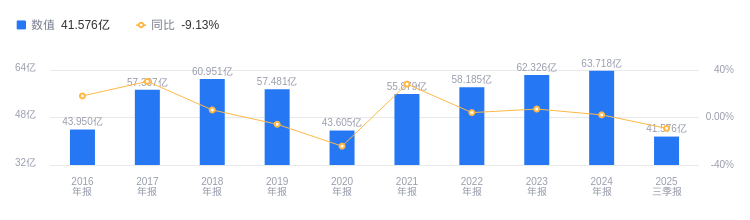
Core Viewpoint - Huadi Co., Ltd. is a well-known kitchen and bathroom appliance company in China, recognized for its high quality, innovative technology, and comprehensive after-sales service, with a strong market competitiveness and cost-effectiveness [1] Group 1: Business Performance - In Q3 2025, Huadi's revenue reached 4.158 billion yuan, ranking second in the industry, while the industry leader, Boss Electric, reported 7.312 billion yuan [2] - The main business revenue breakdown shows that range hoods generated 1.169 billion yuan (41.76% of total revenue) and stoves generated 734 million yuan (26.21% of total revenue) [2] - The net profit for the same period was 355 million yuan, also ranking second in the industry, with Boss Electric leading at 1.145 billion yuan [2] Group 2: Financial Ratios - As of Q3 2025, Huadi's debt-to-asset ratio was 43.81%, down from 46.49% year-on-year, which is higher than the industry average of 29.86% [3] - The gross profit margin for the same period was 43.29%, an increase from 40.50% year-on-year, exceeding the industry average of 35.95% [3] Group 3: Shareholder Information - As of September 30, 2025, the number of A-share shareholders decreased by 2.61% to 35,500, while the average number of circulating A-shares held per shareholder increased by 2.68% to 22,000 [5] - Among the top ten circulating shareholders, Hong Kong Central Clearing Limited held 52.7199 million shares, a decrease of 9.1954 million shares from the previous period [5] Group 4: Management Compensation - The chairman and president, Pan Yejiang, received a salary of 911,100 yuan in 2024, an increase of 180,000 yuan from 731,100 yuan in 2023 [4] Group 5: Market Outlook - Huadi's revenue and net profit showed a year-on-year decline in Q3 2025, primarily due to the impact of real estate pressures and reduced government subsidies [5] - The company has been expanding its new retail channel, opening over 1,000 new stores in the first half of 2025, with a gross margin of 41.5% for this channel [5] - Analysts maintain profit forecasts for 2025-2027, expecting net profits of 453 million, 466 million, and 502 million yuan respectively, with a target price of 7.42 yuan based on a 14x PE ratio [5]


亿田智能前三季度营收净利双降
Bei Jing Shang Bao· 2025-10-29 12:05
Core Insights - Zhejiang Yitian Intelligent Kitchen Appliances Co., Ltd. reported a significant decline in revenue and net profit for the first three quarters of 2025, indicating financial distress [1] Financial Performance - The company achieved a revenue of 245 million yuan for the first three quarters, representing a year-on-year decrease of 45.51% [1] - The net profit for the same period was a loss of 111 million yuan, marking a staggering year-on-year decline of 904.67% [1] - In the third quarter alone, the revenue was 70.05 million yuan, down 33.95% year-on-year [1] - The net profit for the third quarter was a loss of 39.19 million yuan, which is a 36.79% decrease compared to the previous year [1]

火星人(300894):经营承压明显 盈利能力下滑
Xin Lang Cai Jing· 2025-10-29 08:41
Core Insights - The company reported a significant decline in revenue and net profit for Q1-Q3 2025, with total revenue of 577 million yuan, down 43.03% year-on-year, and a net profit attributable to shareholders of -218 million yuan, a staggering decrease of 1546.12% [1] - In Q3 2025, the company achieved a total revenue of 203 million yuan, representing a year-on-year decline of 35.81%, and a net profit of -95 million yuan, down 265.08% year-on-year [1] Financial Performance - The company's gross margin improved slightly in Q3 2025, increasing by 0.36 percentage points to 39.44% [1] - The expense ratios for sales, management, R&D, and financial costs in Q3 2025 were 44.69%, 14.09%, 9.74%, and 4.43%, respectively, showing increases of 13.88 percentage points, 3.78 percentage points, 1.14 percentage points, and 4.68 percentage points year-on-year [1] - The net profit margin for Q3 2025 decreased by 38.54 percentage points to -46.76% [1] Cash Flow - In Q3 2025, cash received from sales was 199 million yuan, down 41.87% year-on-year, with a net operating cash flow of -58 million yuan [2] Profit Forecast and Investment Recommendation - Based on the performance in Q3 2025 and the overall industry environment, the company is expected to achieve net profits attributable to shareholders of -155 million yuan, 28 million yuan, and 30 million yuan for the years 2025-2027, respectively, maintaining a "buy" investment rating [2]

火星人前三季度营收同比下滑43.03%
Bei Jing Shang Bao· 2025-10-29 05:36
Core Insights - Marsman Kitchenware Co., Ltd. reported a significant decline in revenue and net profit for the first three quarters of 2025, indicating financial distress [1] Financial Performance - The company achieved a revenue of 577 million yuan for the first three quarters, representing a year-on-year decrease of 43.03% [1] - The net profit for the same period was a loss of 218 million yuan, reflecting a staggering year-on-year decline of 1546.12% [1] - In the third quarter alone, the company generated a revenue of 203 million yuan, down 35.81% year-on-year [1] - The net profit for the third quarter was a loss of 94.73 million yuan, which is a year-on-year decrease of 265.08% [1]
火星人:2025年前三季度净利润约-2.18亿元
Mei Ri Jing Ji Xin Wen· 2025-10-28 11:02
Group 1 - The core viewpoint of the news is that Mars Man (SZ 300894) reported a significant decline in its third-quarter performance for 2023, with revenue dropping by 43.03% year-on-year to approximately 577 million yuan, and a net loss attributable to shareholders of about 218 million yuan [1] - The basic earnings per share for the company is reported as a loss of 0.54 yuan [1] - As of the report date, the market capitalization of Mars Man is 5.1 billion yuan [2] Group 2 - The A-share market has surpassed 4000 points, marking a significant resurgence after a decade of stagnation, with technology stocks leading the market's transformation into a "slow bull" new pattern [2]
老板电器10月23日获融资买入276.08万元,融资余额2.08亿元
Xin Lang Cai Jing· 2025-10-24 01:45
Core Viewpoint - The performance of Boss Electric Appliances shows a mixed trend in financing activities and stock performance, with a notable decrease in net buying and a high level of margin trading [1][2]. Financing Activities - On October 23, Boss Electric had a financing buy amount of 2.76 million yuan, with a net financing buy of -4.69 million yuan, indicating more repayments than new purchases [1]. - The total margin trading balance for Boss Electric as of October 23 is 212 million yuan, with the financing balance at 208 million yuan, accounting for 1.16% of the circulating market value [1]. - The margin trading activities are at a high level, with the financing balance exceeding the 50th percentile of the past year [1]. Stock Performance - On October 23, Boss Electric's stock price increased by 0.63%, with a trading volume of 77.77 million yuan [1]. - The stock's margin selling activity included a repayment of 34,100 shares and a sale of 2,900 shares, with a selling amount of 55,200 yuan [1]. - The margin balance for short selling is 3.43 million yuan, which is above the 80th percentile of the past year, indicating a high level of short selling activity [1]. Company Overview - Boss Electric, established on November 7, 2000, specializes in kitchen appliances, with major products including range hoods (47.86% of revenue), gas stoves (25.10%), and dishwashers (7.33%) [2]. - As of June 30, 2025, the company reported a revenue of 4.608 billion yuan, a year-on-year decrease of 2.58%, and a net profit of 712 million yuan, down 6.28% year-on-year [2]. Shareholder Information - The total number of shareholders for Boss Electric as of June 30, 2025, is 61,600, an increase of 45.19% from the previous period [3]. - The average circulating shares per person decreased by 31.12% to 15,149 shares [3]. - The second-largest circulating shareholder is Hong Kong Central Clearing Limited, holding 90.89 million shares, a decrease of 27.10 million shares from the previous period [3].
亿田智能股价跌5.01%,中邮基金旗下1只基金重仓,持有8800股浮亏损失1.84万元
Xin Lang Cai Jing· 2025-10-23 03:04
Group 1 - Yitian Intelligent experienced a decline of 5.01%, with a current stock price of 39.61 yuan per share and a trading volume of 1.10 billion yuan, resulting in a total market capitalization of 7.262 billion yuan [1] - The company, Zhejiang Yitian Intelligent Kitchen Appliances Co., Ltd., was established on September 25, 2003, and went public on December 3, 2020. Its main business involves the research, production, and sales of integrated stoves and other modern kitchen appliances [1] - The revenue composition of Yitian Intelligent is as follows: integrated stoves account for 58.38%, other products 33.32%, and computing power business 8.30% [1] Group 2 - Zhongyou Fund holds a significant position in Yitian Intelligent, with its fund "Zhongyou Consumption Upgrade Flexible Allocation Mixed A" (003513) owning 8,800 shares, representing 2.19% of the fund's net value, making it the seventh-largest holding [2] - The fund has a total scale of 16.9033 million yuan and has achieved a year-to-date return of 18.98%, ranking 4,330 out of 8,159 in its category [2] - The fund manager, Qi Zheng, has been in charge for 1 year and 181 days, with the best fund return during this period being 22.84% and the worst being 16.05% [3]