
基金

Search documents
圣湘生物等在湖南新设股权投资基金,出资额8.2亿
Sou Hu Cai Jing· 2026-02-11 01:46
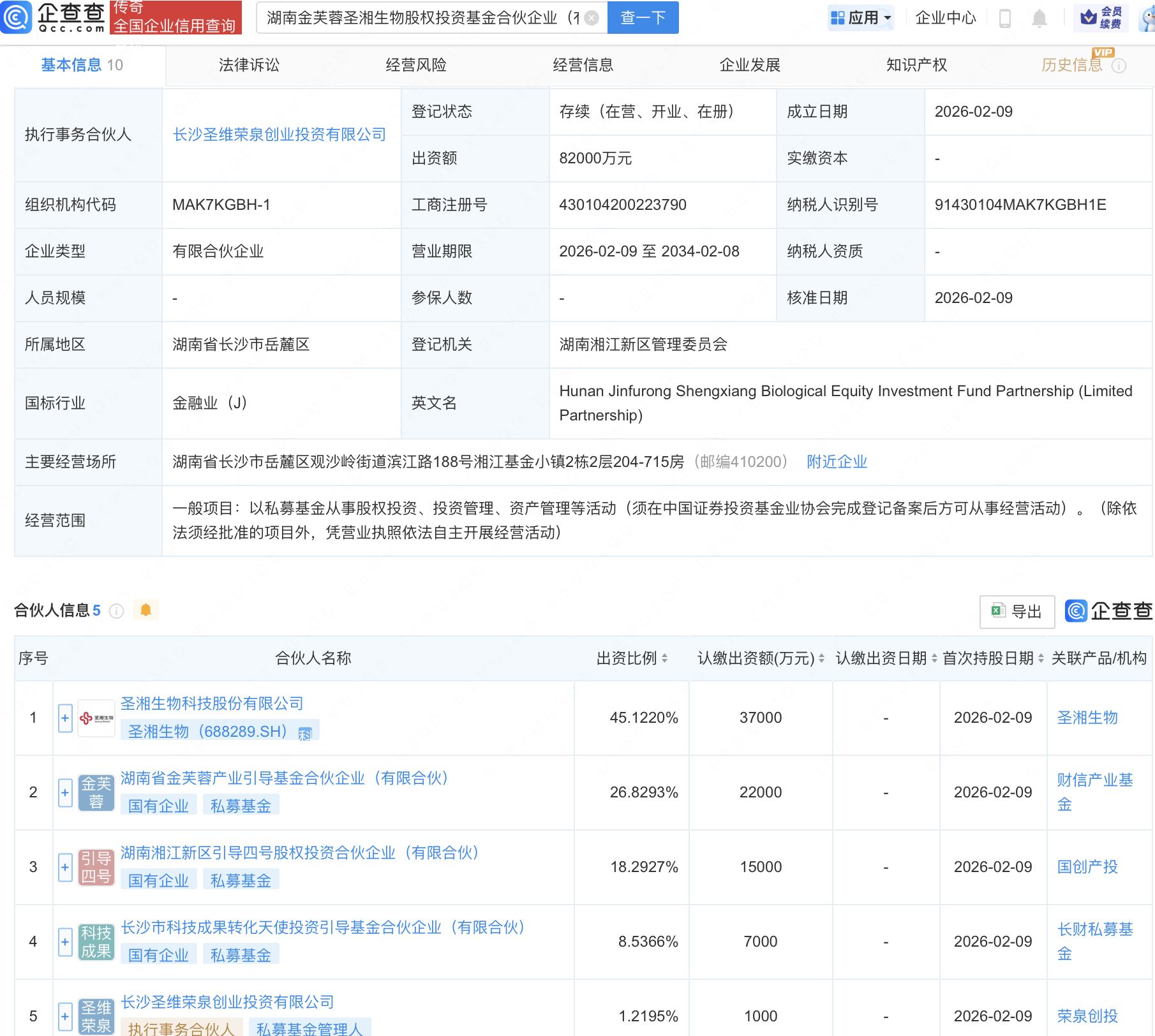
Core Insights - Hunan Jinfurong Shengxiang Biological Equity Investment Fund Partnership has been established with a total investment of 820 million yuan, focusing on private equity investment, investment management, and asset management activities [1][2]. Group 1: Company Overview - The fund is a limited partnership and is registered in Changsha, Hunan Province, with a business duration from February 9, 2026, to 2034 [2]. - The main operating location is at Jiangjiang Fund Town, Changsha, Hunan Province [2]. Group 2: Investment Structure - The fund's major partners include: - Shengxiang Biological Technology Co., Ltd. with a contribution ratio of 45.12% [3]. - Hunan Jinmeirong Industrial Guidance Fund Partnership with a contribution ratio of 26.83% [3]. - Hunan Xiangjiang New Area Guidance No. 4 Equity Investment Partnership with a contribution ratio of 18.29% [3]. - Changsha Technology Achievement Transformation Angel Investment Guidance Fund Partnership with a contribution ratio of 8.54% [3].


上证180指数上涨0.26%,上证180ETF指数基金(530280)备受关注
Sou Hu Cai Jing· 2026-02-11 01:41
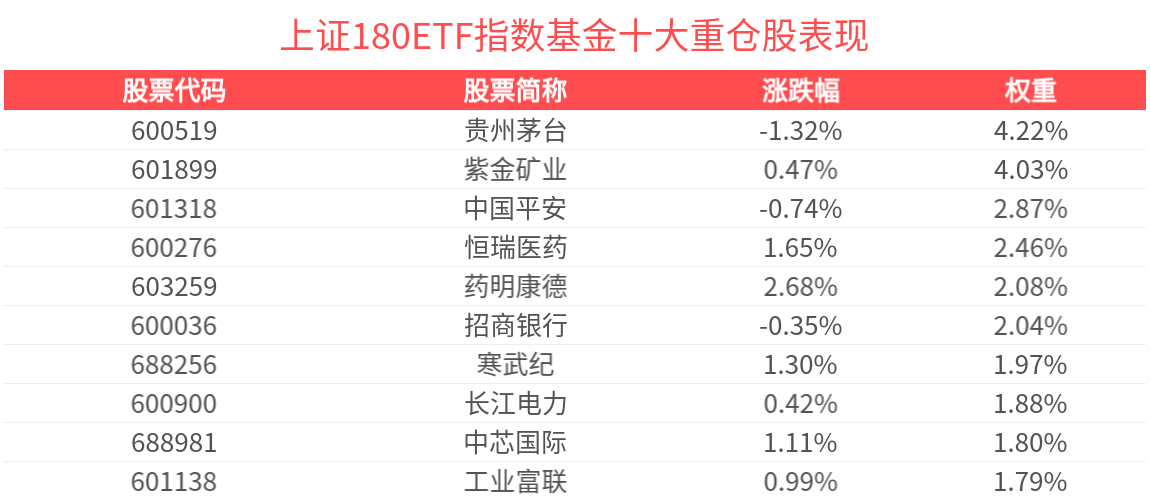
Core Viewpoint - The Shanghai 180 ETF Index Fund closely tracks the Shanghai 180 Index, which reflects the overall performance of 180 large-cap and liquid securities in the Shanghai stock market, showing a recent upward trend in both the index and the fund itself [1][2]. Performance Summary - As of February 10, 2026, the Shanghai 180 Index increased by 0.26%, with notable gains from stocks such as China Power (+9.99%) and Dongfang Electric (+8.34%) [1]. - The Shanghai 180 ETF Index Fund rose by 0.24%, with a latest price of 1.26 yuan, and has accumulated a 1.37% increase over the past week [1]. - The fund's trading volume was 23.03 thousand yuan on February 10, with an average daily trading volume of 65.87 thousand yuan over the past week [1]. Fund Size and Growth - The Shanghai 180 ETF Index Fund experienced a significant growth of 622.11 thousand yuan in size over the past year [1]. - The fund has a Sharpe ratio of 1.91 since its inception, indicating a favorable risk-adjusted return [1]. Fee Structure - The management fee for the Shanghai 180 ETF Index Fund is set at 0.15%, while the custody fee is 0.05% [1]. Tracking Accuracy - As of February 10, 2026, the tracking error of the Shanghai 180 ETF Index Fund over the past three months is 0.019%, demonstrating its effectiveness in tracking the underlying index [1]. Top Holdings - As of January 30, 2026, the top ten weighted stocks in the Shanghai 180 Index account for 24.85% of the index, including major companies like Zijin Mining and Kweichow Moutai [2]. - The top ten stocks by weight are: - Zijin Mining (4.03%) - Kweichow Moutai (4.22%) - China Ping An (2.87%) - Hengrui Medicine (2.46%) - WuXi AppTec (2.08%) - Cambricon (1.97%) - China Merchants Bank (2.04%) - Yangtze Power (1.88%) - SMIC (1.80%) - Industrial Fulian (1.79%) [3].
300亿基金经理辞职
Sou Hu Cai Jing· 2026-02-11 01:40
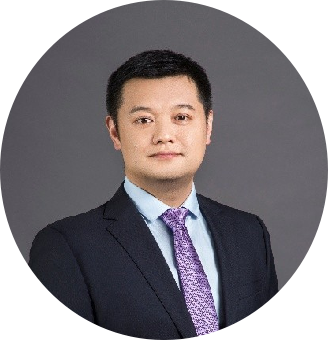
Core Viewpoint - Tianhong Fund announced the resignation of fund manager Jiang Xiaoli due to personal reasons, emphasizing the company's commitment to maintaining stable operations of its products despite her departure [1][3]. Group 1: Resignation Announcement - Jiang Xiaoli has resigned from all public fund products she managed, citing personal reasons and a desire to take a break while balancing family commitments [1]. - The company expressed respect for her decision and gratitude for her long-term professional contributions [1]. - Jiang Xiaoli managed a total of 10 funds with an aggregate scale of 35 billion yuan, all of which reported positive returns during her tenure [1]. Group 2: Background and Experience - Jiang Xiaoli has 16 years of experience in the securities industry, having worked at Tianhong Fund in various roles since 2009, including as a bond researcher and trader [1]. - She returned to Tianhong Fund in 2011 after a brief period at Everbright Sun Life Insurance, where she also served as a bond trader and researcher [1]. Group 3: Investor Communication - In her farewell letter to investors, Jiang Xiaoli reflected on her 14 years as the fund manager of Tianhong Yongli, emphasizing the responsibility of managing funds that include retirement savings and salaries of working individuals [3]. - She expressed the desire for a break after years of intense work, highlighting the lack of personal time and the need to focus on her health and family [3]. - Jiang Xiaoli aims to return in a better state for the next phase of her life after taking this much-needed break [3].

基金分红:富国国有企业债债券基金2月24日分红
Sou Hu Cai Jing· 2026-02-11 01:37
以上内容为证券之星据公开信息整理,由AI算法生成(网信算备310104345710301240019号),不构成 投资建议。 本次分红对象为权益登记日在本基金注册登记机构登记在册的本基金基金份额持有人。,权益登记日为 2月12日,现金红利发放日为2月24日。选择红利再投资方式的投资者所得再投资基金份额的计算基准为 2026年02月12日的基金份额净值,自2026年02月24日起投资者可以办理该部分基金份额的查询、赎回等 业务。根据财政部、国家税务总局相关规定,基金向投资者分配的基金收益,暂免征收所得税。本基金 本次分红免收分红手续费。选择红利再投资方式的投资者其红利所转换的基金份额免收申购费用。 证券之星消息,2月11日发布《富国国有企业债债券型证券投资基金2026年第一次收益分配公告》。本 次分红为2026年度的第一次分红。公告显示,本次分红的收益分配基准日为1月1日,详细分红方案如 下: ...

基金分红:华泰柏瑞中证中央企业红利ETF发起式联接基金2月13日分红
Sou Hu Cai Jing· 2026-02-11 01:37
本次分红对象为权益登记日在本基金注册登记机构登记在册的本基金全体基金份额持有人,权益登记日 为2月12日,现金红利发放日为2月13日。选择现金红利再投资的投资者将其现金红利转基金份额的基金 份额净值确定日为:2026年2月12日,红利再投资所得份额的持有期限自份额确认日开始计算。选择现 金红利再投资方式的投资者其红利再投资的基金份额将于2026年2月13日直接计入其基金账户,2026年2 月24日起可以查询、赎回。根据财政部、国家税务总局的相关规定,基金向投资者分配的基金收益暂免 征收所得税。本次分红免收分红手续费;选择现金红利再投资方式的投资者其现金红利再投资的基金份 额免收申购费用。 以上内容为证券之星据公开信息整理,由AI算法生成(网信算备310104345710301240019号),不构成 投资建议。 证券之星消息,2月11日发布《华泰柏瑞中证中央企业红利交易型开放式指数证券投资基金发起式联接 基金分红公告》。2026年度第2次分红。公告显示,本次分红的收益分配基准日为1月1日,详细分红方 案如下: ...
数字经济ETF工银(561220)开盘跌0.26%,重仓股中芯国际跌1.89%,海光信息跌1.54%
Xin Lang Cai Jing· 2026-02-11 01:37
Group 1 - The Digital Economy ETF ICBC (561220) opened at a decline of 0.26%, priced at 1.535 yuan [1] - Major holdings in the Digital Economy ETF include companies like SMIC, which fell by 1.89%, and Haiguang Information, which dropped by 1.54% [1] - The fund's performance benchmark is the China Securities Index for State-Owned Enterprises in the Digital Economy, managed by ICBC Credit Suisse Asset Management [1] Group 2 - Since its inception on May 21, 2025, the fund has achieved a return of 54.05%, while its return over the past month has been -0.65% [1] - The fund manager is Shi Baojiao, indicating a specific leadership in managing the ETF [1]





盘前资讯|影视主题ETF大涨 吸引超13亿元资金布局
Sou Hu Cai Jing· 2026-02-11 01:31
Group 1 - The AI application-related sectors experienced a significant surge on February 10, with the film ETFs (159855) hitting the daily limit and another film ETF (516620) rising over 9%, collectively attracting more than 1.3 billion yuan in net inflows [1] - In addition to film-themed ETFs, various other thematic ETFs, including those focused on gold, robotics, media, satellites, chemicals, and rare earths, also saw substantial capital allocation, while leading broad-based ETFs like the HuShen 300 ETF (510300) and the CSI 500 ETF (510500) experienced net outflows exceeding 1.4 billion yuan each [1] - The People's Bank of China released its monetary policy execution report for the fourth quarter of 2025, emphasizing the continuation of a moderately accommodative monetary policy aimed at stabilizing economic growth and ensuring reasonable price recovery, while carefully managing the implementation of policies based on domestic and international economic conditions [1]
华商基金陈恒:2026年A股主线或趋于多元 关注有色电力化工航空等板块
Xin Lang Cai Jing· 2026-02-11 01:31
Core Insights - The article features insights from Chen Heng, a fund manager with 17.4 years of experience in the securities industry, focusing on his investment philosophy and market outlook as the new year approaches [1][5]. Investment Philosophy - Chen Heng aims to balance between "optimal decision-making" and "satisficing decision-making," seeking to avoid both perfectionism and mediocrity while focusing on long-term growth potential, reasonable valuations, and controllable risks [3][9]. - The investment approach emphasizes the importance of deep cognitive understanding over mere speed of information acquisition, advocating for a stable mindset throughout market cycles [3][9]. Industry Selection Framework - Chen Heng's investment methodology is based on a five-dimensional framework derived from traditional Chinese wisdom: - "Dao" focuses on quality factors, targeting leading companies with competitive advantages rather than short-term speculative themes [4][10]. - "Tian" involves observing industry cycles, avoiding sectors that lack favorable conditions regardless of their price [4][10]. - "Di" emphasizes reasonable valuation positions to prevent over-investment in overheated sectors [4][10]. - "Jiang" is about selecting true leaders within niche markets [4][10]. - "Fa" refers to the flexible use of various financial instruments for dynamic adjustments and risk management [4][10]. Market Outlook - For 2025, Chen Heng identifies two main themes: non-ferrous metals and AI, predicting that these sectors will perform prominently throughout the year [4][10]. - As market valuations adjust and industry logic evolves, other sectors are expected to reveal improved cost-effectiveness, leading to a more balanced and diverse A-share market [4][10]. Sector Focus - Chen Heng finds the risk-reward ratio in the non-ferrous metals sector attractive due to global demand and value reassessment [5][11]. - Additional sectors of interest include: - Power equipment, which represents a new core competitiveness for Chinese manufacturing and is essential for AI [5][11]. - Chemicals, which may benefit from a dual boost in profitability and valuation due to commodity reassessment [5][11]. - Aviation, which is experiencing improvements in supply-demand dynamics and overall industry recovery [5][11].
停牌!“红利一哥”中证红利质量ETF(159209)本月分红启动,今日10:30起复牌交易
Sou Hu Cai Jing· 2026-02-11 01:27
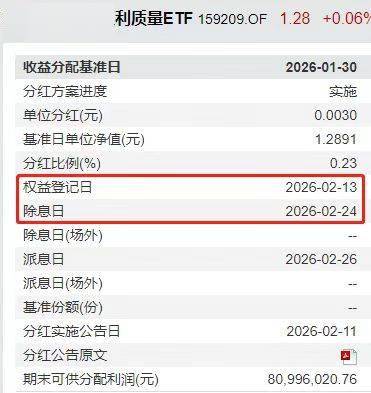
Group 1 - The core point of the news is that the China Securities Red Chip Quality ETF (fund code: 159209) will distribute its first dividend for the year 2026, with a cash dividend of 0.003 yuan per share [1][2] - The fund will suspend trading on February 11, 2026, and will resume trading at 10:30 AM on the same day, advising investors to manage their trading and funds accordingly [1] - The fund is noted as the only dividend ETF in the A-share market that has increased by over 20% in 2025 [1] Group 2 - The dividend distribution benchmark date is set for January 30, 2026, with a dividend ratio of 0.23% based on a benchmark net asset value of 1.2891 yuan per unit [2] - The fund's total distributable profit at the end of the period is reported to be 80,996,020.76 yuan [2] - The fund maintains a low fee structure of "0.15% + 0.05%", which is the lowest in the market, providing significant cost advantages for long-term holders [3] Group 3 - The China Securities Red Chip Quality Index combines "high dividend" and "high quality" strategies, demonstrating good allocation value in a rising risk appetite environment [2] - The index focuses on companies with stable dividend capabilities while emphasizing profitability, financial health, and growth potential, making it more attractive in positive market conditions [2] - The fund has implemented a monthly dividend assessment mechanism to enhance cash flow experience for investors and increase holding willingness [3]
公告速递:调整华富天益货币基金申购、定投及转换转入业务金额限制
Sou Hu Cai Jing· 2026-02-11 01:20
证券之星消息,2月11日华富基金管理有限公司发布《关于调整华富天益货币市场基金申购、定投及转 换转入业务金额限制的公告》。公告中提示,为了保证基金的平稳运作,保护基金持有人的利益,自 2026年2月12日起调整华富天益货币市场基金申购、定投及转换转入业务金额限制,申购、转换转入上 限金额为1.0万元,下属分级基金调整明细如下: 以上内容为证券之星据公开信息整理,由AI算法生成(网信算备310104345710301240019号),不构成 投资建议。 ...