可转债市场

Search documents
如何寻找债市的结构性亮点
2026-03-18 02:31
Summary of Conference Call Records Industry Overview - The records primarily discuss the bond market dynamics, focusing on the differentiation between short-term and long-term interest rates, influenced by various macroeconomic factors and regulatory changes [1][2][6]. Key Points and Arguments Bond Market Dynamics - Short-term interest rates are supported by a stable funding environment and favorable regulatory policies, while long-term rates are pressured by inflation expectations and concerns over demand stabilization [1][2]. - The 30-year government bond yield is referenced to be capped at approximately 2.3%, which is 75% of the new mortgage rate [1][10]. - The market for convertible bonds is currently in a weak oscillation phase, with unexpected strong redemptions and external risks suppressing valuations [1][13]. Economic Performance and Drivers - Economic data for early 2026 exceeded expectations, primarily driven by emerging industries such as technology and grid investment, while traditional construction sectors showed lackluster performance [1][5]. - Local governments are prioritizing growth over debt resolution, with special refinancing bond issuance at 650 billion, significantly lower than the previous year's 950 billion [1][5][6]. - The net financing of government bonds in 2025 increased by nearly 2.8 trillion, contributing at least 100 basis points to the 5% GDP growth [5][6]. Interest Rate Trends - The long-term interest rates are expected to fluctuate within a range of 1.78% to 1.85% for 10-year bonds and 2.22% to 2.3% for 30-year bonds [2][6]. - The divergence in short and long-term rates is attributed to changes in market behavior and a lack of "herding" towards long-duration bonds [6][7]. Regulatory Impact - The impact of interbank deposit regulation has largely been realized, with a significant portion of funds (14.8 trillion) affected, leading to a limited release of net interest margin for banks [8][10]. - The short-term interest rates have already reflected the regulatory benefits, with a decline of about 6-7 basis points since the Lunar New Year [8][10]. Investment Strategies - In the current market environment, banks are advised to focus on stable asset allocation strategies, particularly in 5-7 year government bonds and 2-3 year corporate credit bonds [9][12]. - The convertible bond market is experiencing a shift, with a cautious outlook due to external uncertainties and the end of the "double innovation" market trend [13][18]. Market Sentiment and Future Outlook - The sentiment in the convertible bond market remains weak, with a notable shift in pricing logic for new bonds, moving away from high premiums based solely on novelty and scarcity [16][17]. - The overall outlook for the convertible bond market is cautious, with expectations of continued oscillation rather than a strong trend, emphasizing the importance of selecting specific securities over managing positions [18]. Additional Important Insights - The market is currently facing a complex interplay of internal and external factors, including inflation concerns and geopolitical tensions, which are influencing investor behavior and market dynamics [2][16]. - The need for a clear understanding of macroeconomic indicators and regulatory changes is critical for navigating the current investment landscape [6][8].
【固收】本周继续下跌——可转债周报(2026年3月2日至2026年3月6日)(张旭/杨欣怡)
光大证券研究· 2026-03-08 00:08
Market Overview - The China convertible bond index decreased by 2.07% during the week of March 2 to March 6, 2026, compared to a decrease of 0.23% the previous week. The overall index fell by 2.28%, contrasting with a rise of 2.74% the prior week. Year-to-date, the convertible bond index has increased by 4.56%, while the overall index has risen by 5.63% [4][5]. Rating Analysis - The performance of convertible bonds by rating shows that high-rated bonds (AAA) fell by 1.05%, while medium-high rated bonds (AA+) decreased by 1.44%. Medium-rated bonds (AA) experienced the largest drop of 3.66%, followed by medium-low rated bonds (AA-) at 2.37% and low-rated bonds (AA- and below) at 2.90% [4]. Size Classification - In terms of bond size, large-scale convertible bonds (over 2 billion) decreased by 1.02%, medium-large bonds (1.5 to 2 billion) fell by 1.88%, medium-sized bonds (1 to 1.5 billion) saw a significant drop of 5.47%, medium-small bonds (0.5 to 1 billion) decreased by 2.43%, and small-scale bonds (under 0.5 billion) fell by 2.67%. The medium-sized bonds had the largest decline [5]. Price and Valuation Metrics - The average price of convertible bonds is 139.31 yuan, down from 142.60 yuan the previous week. The average conversion price is 106.74 yuan, down from 111.01 yuan, and the average conversion premium rate is 31.15%, slightly down from 31.83% [5]. Market Sentiment and Strategy - The convertible bond market has seen a downturn this week. Investors are advised to monitor market supply, policy trends, and geopolitical disturbances, and to make informed decisions based on bond terms and underlying stock conditions [6].


可转债周报20260228:地缘冲突后转债市场如何演进?-20260304
Changjiang Securities· 2026-03-04 10:30
1. Report Industry Investment Rating - No industry investment rating is provided in the report. 2. Core Views of the Report - After reviewing the two high - intensity geopolitical conflicts in the past five years, the short - to - medium - term performance of convertible bonds may be weak. In the current situation, it is recommended to focus on pro - cyclical sectors such as petroleum and petrochemicals. Considering the convergence of the stock index futures basis, convertible bonds may face short - term correction risks. [2][4][7] - The A - share market strengthened during the week, with the small - and medium - cap and pro - cyclical manufacturing sectors outperforming, and the trading volume slightly expanding. [2][4][7] - The convertible bond market oscillated weakly, the medium - cap convertible bonds were relatively strong, and the trading volume converged. The overall valuation was compressed, especially in the high - parity and high - market - value ranges. The implied volatility declined but remained at a high level, and the median market value slightly increased. [2][4][7] - Structurally, cyclical sectors such as steel and non - ferrous metals were relatively good, and some of the top - performing targets showed negative premiums. The primary issuance was stable. In terms of terms, the willingness to downward - revise was weak, while the probability of non - call increased. It is recommended to pay attention to the performance of new bonds and the disturbances of term games. [2][4][7] 3. Summary According to the Directory 3.1 Geopolitical Conflicts and the Convertible Bond Market - In the two high - intensity geopolitical conflicts in the past five years (the Russia - Ukraine conflict in late February 2022 and the escalation of the Palestine - Israel conflict in early October 2023), the short - to - medium - term performance of CSI Convertible Bond Index was weak. The Wande Convertible Bond Equal - Weighted Index performed relatively well in the short term after the Russia - Ukraine conflict. [11] - In the Russia - Ukraine conflict, the petroleum and petrochemical industry performed well in the short term, while in the Palestine - Israel conflict, the social service industry performed well in the short term. Given the current situation is more similar to the energy - power game during the Russia - Ukraine conflict, attention can be paid to energy and cyclical industries such as petroleum and petrochemicals. [11][12] - From a futures perspective, there may be short - term correction risks. When the annualized yield of the next - month continuous basis of CSI 500 futures approaches zero, the convertible bond market often faces short - term correction pressure. The high correlation between the CSI Convertible Bond Index and the CSI 500 Index (97.9% from the beginning of 2025 to the current Friday) indicates that this futures sentiment indicator can also reflect the sentiment changes of convertible bond market investors. [12] 3.2 Market Theme Weekly Review - From February 24 to February 28, 2026, the equity market strengthened overall, and the pro - cyclical direction performed well. Among them, metal zinc, metal lead, phosphate chemicals, small - metal concepts, and metal copper in the non - ferrous metal direction were good, while AI corpus, Xiaohongshu concept, Kuaishou concept, short - drama games, and Sora concept (text - to - video) in the AI Internet direction were under pressure. [16] 3.3 Market Weekly Tracking 3.3.1 Main Stock Indexes Strengthened, with Medium - and Small - Cap Indexes Performing Strongly - The main A - share stock indexes strengthened overall during the week. The Shenzhen Component Index performed well, while the ChiNext Index was relatively weak. In terms of style, medium - and small - cap indexes were relatively strong, while the science - innovation and large - cap indexes were relatively weak. [16] - In terms of funds, the net outflow of market main funds converged during the week. The average daily trading volume expanded, and the net outflow of main funds slightly decreased. [17] - The cyclical manufacturing sectors in the A - share market were strong during the week. Sectors such as metal materials and mining, environmental protection, national defense and military industry, and chemicals led the gains, while sectors such as social services, insurance, and media Internet were relatively weak. [21] - In terms of trading volume, the electronics, metal materials and mining, and power and new energy equipment sectors were the focus of trading during the week. The trading volume of most sectors rebounded compared with last week, and the average daily trading volume of the public utilities sector increased by more than 62% week - on - week. [22] - The congestion degree of market sectors still differed significantly during the week. The congestion degree of cyclical directions such as petroleum and petrochemicals, basic chemicals, and steel increased, while that of sectors such as commercial retail, media, and transportation decreased. [24] 3.3.2 Convertible Bond Market Oscillated Weakly, with the Large - Cap Index Performing Weakly - From February 24 to February 28, 2026, the convertible bond market oscillated slightly weakly. The CSI Convertible Bond Index oscillated weakly, with the large - cap convertible bond index performing relatively weakly and the medium - cap convertible bond index performing relatively strongly. The trading volume converged slightly. [28] - In terms of valuation, when divided by the parity range, the overall valuation of the convertible bond market was compressed, except for a slight increase in the 120 - 130 yuan parity range, and the conversion premium rate in the 140 - yuan - and - above parity range was significantly compressed. When divided by the market value range, the overall valuation was also compressed, except for a slight increase in the 110 - 120 yuan market value range, and the conversion premium rate in the 150 - yuan - and - above market value range was significantly compressed. [32] - The weighted implied volatility of the convertible bond market balance oscillated weakly during the week, still at a historical high. The median market value of convertible bonds oscillated and slightly increased, remaining higher than the high point in August 2025. [36] - Convertible bonds in cyclical sectors performed relatively well. Sectors such as steel, non - ferrous metals, public utilities, and basic chemicals led the gains. In terms of trading volume, the trading was mainly concentrated in the power equipment, basic chemicals, and electronics sectors, with the combined trading volume of these three sectors accounting for more than 35%. [39] - Most individual convertible bonds weakened during the week. Only 143 convertible bonds had a range increase greater than or equal to 0, accounting for 37.0% of the total number of outstanding convertible bonds in the market. Among the convertible bonds in the conversion period, the top five in terms of weekly increase were Youcai Convertible Bond, Dazhong Convertible Bond, Guanglian Convertible Bond, Yitian Convertible Bond, and Huaya Convertible Bond, while the top five in terms of weekly decrease were Fuxin Convertible Bond, Hengshuai Convertible Bond, Ruichuang Convertible Bond, Huicheng Convertible Bond, and Xinfu Convertible Bond. Some of the top - five - increasing individual bonds had negative premiums. [44] 3.4 Convertible Bond Issuance and Term Tracking 3.4.1 Primary - Market Pre - issuance Situation - One convertible bond, Aiwei Convertible Bond, was listed during the week from February 24 to February 28, 2026. [47] - Five listed companies updated their convertible bond issuance plans in the primary market during the week, with two in the exchange - acceptance stage and three having passed the general meeting of shareholders. [48] - The total disclosed scale of ongoing projects at the exchange - acceptance stage and later was 8.302 billion yuan. There were 5 companies approved by the CSRC with a planned issuance scale of 439 million yuan, 7 companies having passed the listing committee meeting with a planned issuance scale of 697 million yuan, and 44 companies in the exchange - acceptance stage with a planned issuance scale of 6.989 billion yuan. [49][52] 3.4.2 Downward - Revision - Related Announcement Summary - No convertible bonds were expected to trigger downward revision during the week. Three convertible bonds announced not to downward - revise, with a market - value - weighted average PB of the underlying stocks of 2.5. Two convertible bonds proposed downward revision, with a market - value - weighted average PB of the underlying stocks of 1.6. [53][58] 3.4.3 Redemption - Related Announcement Summary - Two convertible bonds were expected to trigger redemption during the week. Seven convertible bonds announced not to redeem in advance, and four convertible bonds announced early redemption. [59]
资金进场!单日净流入超百亿
Zhong Guo Zheng Quan Bao· 2026-02-25 13:09
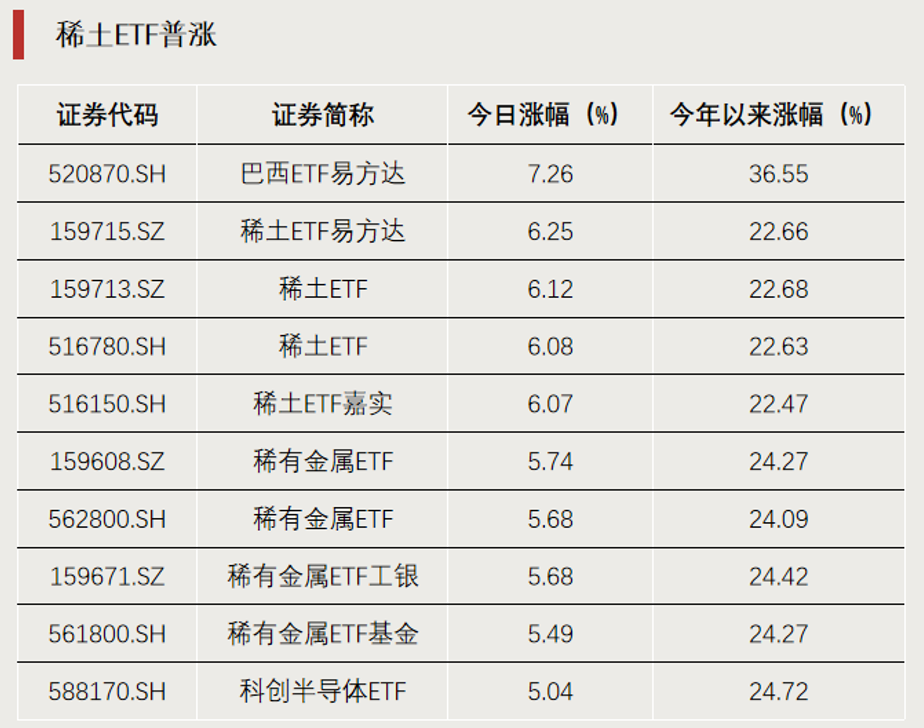
Market Overview - On February 25, major A-share indices collectively rose, with the ChiNext Index increasing by over 1.4%. More than 1,000 out of over 1,400 ETFs in the market saw gains [1] ETF Performance - The rare earth and rare metal sector ETFs performed notably well, with 8 related ETFs ranking among the top ten for daily gains, all exceeding 5%. Year-to-date, these 8 ETFs have accumulated gains of over 20% [2] - On February 24, the ETF market experienced a net inflow of over 11 billion yuan, marking the highest single-day net inflow in the past six trading days. ETFs focused on the Hong Kong stock market showed strong capital attraction, with over half of the top ten ETFs by net inflow being Hong Kong ETFs [3][8] Rare Earth and Rare Metal ETFs - On February 25, all 8 ETFs focused on rare earth and rare metals closed higher, with gains leading the ETF market. Four products linked to the CSI Rare Earth Industry Index rose over 6%, while four linked to the CSI Rare Metal Theme Index rose over 5%. The CSI Rare Earth Industry Index includes 43 constituent stocks related to rare earth mining, processing, trading, and applications, with only one stock declining by the close [4] - During the trading session, four rare earth ETFs reached new highs since their inception, with some funds doubling in value since launch. The CSI Rare Metal Theme Index includes up to 50 constituent stocks involved in rare metal mining, smelting, and processing, with all 50 stocks rising by the close [5] Specific ETF Gains - The following ETFs showed significant daily and year-to-date gains: - Brazil ETF E Fund: 7.26% daily gain, 36.55% YTD - Rare Earth ETF E Fund: 6.25% daily gain, 22.66% YTD - Rare Earth ETF: 6.12% daily gain, 22.68% YTD - Rare Earth ETF: 6.08% daily gain, 22.63% YTD - Rare Earth ETF Jiashi: 6.07% daily gain, 22.47% YTD - Rare Metal ETF: 5.74% daily gain, 24.27% YTD - Rare Metal ETF: 5.68% daily gain, 24.09% YTD - Rare Metal ETF ICBC: 5.68% daily gain, 24.42% YTD - Rare Metal ETF Fund: 5.49% daily gain, 24.27% YTD - Sci-Tech Semiconductor ETF: 5.04% daily gain, 24.72% YTD [6] Declining ETFs - Energy sector ETFs experienced some pullback, with two S&P Oil & Gas ETFs showing the largest declines in the market, both of which had risen over 9% the previous day. Additionally, some media sector ETFs also saw significant declines [6] Hong Kong ETFs - On February 24, Hong Kong market-focused ETFs attracted significant capital, with the top ten ETFs by net inflow including seven Hong Kong ETFs that collectively saw over 7 billion yuan in net inflows. Since the beginning of February, these seven ETFs have accumulated over 28 billion yuan in net inflows [8][9] New ETF Issuances - On February 25, several ETFs began issuance, including the Huatai-PB Hang Seng Technology ETF and the Huaxia CSI Battery Theme ETF, with the issuance period for the Huatai-PB CSI Animal Husbandry Industry ETF ending on March 6 [11] Investment Outlook - Looking ahead, the technology and resource sectors are expected to remain key investment themes. Emerging technologies, including internet, media, computing, robotics, electronics, and military sectors, are highlighted as potential areas of focus. Value stocks in consumer services, food and beverage, and building materials are also anticipated to present investment opportunities [12]
泰康基金总经理金志刚:骏马踏春开新局,骐骥凌云启华章
Sou Hu Cai Jing· 2026-02-17 00:27
Core Viewpoint - The company expresses optimism about the Chinese economy's resilience and the capital market's potential for growth in 2026, emphasizing a commitment to client-centric investment management and wealth creation [3][4]. Group 1: Economic Outlook - By the end of 2025, China's GDP is projected to achieve a growth target of 5%, with exports exceeding expectations, contributing to global economic recovery [3]. - The A-share market has shown significant recovery, with major indices rebounding over 15 months and the Shanghai Composite Index surpassing 4000 points, marking a ten-year high [3]. Group 2: Investment Strategy - The company plans to leverage a combination of fiscal leadership, stable exchange rates, and supportive monetary policies to navigate the economic landscape [4]. - Investment opportunities are anticipated in the equity market, shifting from valuation recovery to profit-driven growth, particularly in sectors like AI and cyclical industries [4]. - The fixed income market is expected to maintain a stable interest rate environment, with convertible bonds likely benefiting from equity market trends [4]. Group 3: Company Initiatives - The company aims to enhance its research and investment capabilities to provide sustainable returns across various market conditions [5]. - A comprehensive product service system will be developed to meet market trends and client needs, focusing on pension solutions and lifecycle investment products [5]. - A robust risk management framework will be established to protect investors' interests, ensuring transparency and compliance [5]. - The company will upgrade investor engagement services through diverse channels, promoting long-term and value-based investment philosophies [5].

股债双轮驱动 民生加银鑫享债券A近一年、三年同类排名Top 1
Jiang Nan Shi Bao· 2026-02-06 05:57
Group 1 - The capital market in early 2026 shows a diverse pattern with a seesaw effect between stocks and bonds, while convertible bonds stand out as a major highlight [1] - The bond market has strengthened under the central bank's liquidity support, with yields declining by approximately 2 basis points, except for the ultra-long end which saw a slight increase of 1 basis point due to supply concerns [1] - The convertible bond market has experienced significant enthusiasm, with new bonds seeing substantial first-day gains, such as a 57.3% increase for the Nipei Convertible Bond and over 126% cumulative gain for the Lianrui Convertible Bond within three days [1] Group 2 - The net inflow into convertible bond ETFs reached 13.193 billion yuan in 2026, with the total scale of convertible bond ETFs surpassing 61 billion yuan by the end of 2025, marking a shift towards index-based investment as the mainstream for convertible bond allocation [1] - The strong performance of the convertible bond market is attributed to ample macro liquidity, the expansion of "fixed income +" products, and a balanced supply-demand dynamic, making convertible bonds an attractive option for risk-averse investors seeking value [1] - The director of fixed income investment at Minsheng Jianyin Fund, Xie Zhihua, notes that while the stock market is rising sharply, it has not reached bubble levels, suggesting a healthier market environment where stocks with matching valuations and fundamentals deserve attention [2]
可转债市场周观察:转债波动不弱正股,把握估值深水区交易节奏
Orient Securities· 2026-01-26 12:45
Group 1: Report Industry Investment Rating - No information provided on the report industry investment rating Group 2: Core Viewpoints of the Report - The convertible bond market had a good performance last week except for a significant valuation correction on Tuesday. The high sentiment in the equity market remains the biggest support for convertible bonds, and there was a behavior of bargain - hunting allocation on Tuesday [6][9]. - As the number of convertible bonds below 130 yuan decreases, convertible bonds enter the deep - water area. High valuations are expected to continue in an equity bull market, but potential losses from valuation fluctuations should be watched out for. If there was under - allocation before, it is recommended to wait for a correction to make allocations. Attention should be paid to newly issued convertible bonds, those whose redemption is waived, and those whose shareholders have not yet reduced their holdings [6][9]. - The sentiment in the equity market remained high last week. Although the proportion of margin trading purchases declined significantly under the margin policy, the central bank's targeted interest rate cut and a net MLF injection of 70 billion yuan in January supplemented market liquidity. The overall performance was similar to the past two weeks, with small - and medium - cap stocks remaining strong and heavy - weight stocks facing significant selling pressure. External events suppressed overseas markets, increasing the attractiveness of RMB assets. A - shares rose against the trend in the global market last week. In the medium - to - long term, the upward logic remains unchanged, but in the short term, there is a continuous game between regulators and the market regarding heavy - weight value and growth themes. A sideways shock with a slight upward trend is expected, and the two - end market of technology + dividends will shift to mid - cap blue - chips [6][9]. Group 3: Summary According to the Directory 1. Convertible Bond Views: Convertible Bond Fluctuations Are Not Weaker Than Underlying Stocks, Grasp the Trading Rhythm in the Valuation Deep - Water Area - The convertible bond market had a good performance last week except on Tuesday when the valuation corrected sharply. The valuation shows a trend of rapid decline and slow rise. The high - sentiment equity market supports convertible bonds, and there was bargain - hunting on Tuesday [9]. - With fewer convertible bonds below 130 yuan, they enter the deep - water area. High valuations may continue in a bull market, but valuation risks should be noted. Wait for a correction to allocate if under - allocated before. Focus on newly issued, redemption - waived, and non - shareholder - reduced convertible bonds [9]. - The equity market was high - spirited last week. Despite the drop in margin trading purchases, central bank policies supplemented liquidity. Small - and medium - cap stocks were strong, heavy - weight stocks faced selling pressure. A - shares rose against the global trend. In the short term, there is a game between regulators and the market, and the market is expected to shift to mid - cap blue - chips [9]. 2. Convertible Bond Review: Slight Decline in Trading Volume, Valuation Continues to Rise 2.1 Market Overall Performance: Most Equity Indexes Closed Higher, Trading Volume Declined - The equity market cooled slightly last week. Most broad - based indexes rose, such as the CSI 500 (up 4.34%), CSI 2000 (up 4.04%), etc., while the ChiNext Index (down 0.34%), CSI 300 (down 0.62%), and SSE 50 (down 1.54%) fell. Construction materials, petroleum and petrochemicals, and steel led the rise in industries, while banking, communication, and non - bank finance led the decline. The average daily trading volume decreased significantly from 3.46227 trillion yuan to 2.8 trillion yuan [12]. - The top ten rising convertible bonds last week were Jiamei Convertible Bond, Fuxin Convertible Bond, etc. In terms of trading volume, Jiamei Convertible Bond, Fuxin Convertible Bond, etc. were more active [12]. 2.2 Slight Decline in Convertible Bond Trading Volume, Good Performance of Medium - and Low - Rated, High - Price Convertible Bonds - Convertible bonds rose significantly last week. The 100 - yuan premium rate decreased and then reached a new high, and the average daily trading volume decreased to 87.919 billion yuan. The CSI Convertible Bond Index rose 2.92%, the median conversion price increased 4.5% to 110.8 yuan, and the median conversion premium rate decreased 0.9% to 32.2%. Medium - and low - rated, high - price convertible bonds led the rise, while high - rated, large - cap convertible bonds performed weakly [18].
市场环境因子跟踪周报(2026.01.16):市场降温整固,成长优势延续-20260122
HWABAO SECURITIES· 2026-01-22 11:17
- The report tracks quantitative factors in the equity market, highlighting that the market style remains tilted towards small-cap and growth-oriented stocks, with increased volatility in style performance and widened return differences between styles[10][11] - In terms of market structure, the dispersion of excess returns across industries has risen, while industry rotation speed has decreased. The proportion of rising constituent stocks in indices like CSI 300 and CSI 500 has declined. Additionally, the concentration of trading in the top 100 stocks remained stable, while the top 5 industries saw a slight increase in trading concentration[10][11] - Market activity indicators show a decline in market volatility across most indices except CSI 1000, while turnover rates have continued to rise[10][11] - In the commodity market, the trend strength of precious metals and energy chemicals has increased, while other sectors have seen a decline. Basis momentum for precious metals and agricultural products has risen, whereas other sectors have declined. Volatility remains high for precious metals and base metals, with slight decreases in energy chemicals and black metals. Liquidity has decreased for precious metals and energy chemicals but increased for other sectors[23][28] - In the options market, implied volatility for SSE 50 and CSI 1000 has decreased from previous highs. The skewness of call options has declined, while that of put options has increased. Despite this, the skewness of CSI 1000 put options remains negative, indicating that market participants perceive a low risk of significant declines in small-cap stocks in the short term[31][32] - In the convertible bond market, the market experienced wide fluctuations. The premium rate for bonds convertible at par value has stabilized with slight adjustments, while the pure bond premium rate for debt-oriented groups has continued to rise. The proportion of low-conversion-premium bonds has also increased. However, trading volume in the market remains high and has not weakened[33][39]
固收-1月债市展望
2025-12-29 15:50
Summary of Key Points from the Conference Call Industry Overview - The conference call primarily discusses the bond market outlook for early 2026, focusing on government bonds and credit bonds, with specific attention to the impact of monetary policy and market dynamics on these instruments [1][3][9]. Core Insights and Arguments - **Monetary Policy and Market Sentiment**: The expectation for monetary policy easing is limited, with concerns about increased government bond supply, particularly from Shandong province, which is set to issue nearly 100 billion in a single day [1][2]. - **Interest Rate Projections**: The forecast for the 10-year government bond yield is between 1.75% and 1.85%, while the 30-year yield is expected to be around 2.3% [1][3][9]. - **Social Financing Growth**: A slight increase in social financing growth is anticipated, projected to rise by 0.1%, but overall, significant upward movement is not expected [1][4]. - **Inflation Expectations**: The impact of rising prices of small and precious metals on the Producer Price Index (PPI) is expected to be limited due to their low weight in the PPI calculation. The CPI is projected to reach 1.5% year-on-year in February 2026, influenced by seasonal factors and technical issues [1][5]. - **Market Stability**: The central bank is expected to maintain market stability through liquidity easing and purchasing operations, with large banks and insurance companies actively participating in the market [1][7][8]. Investment Strategy - **Focus on Space Selection**: The current investment strategy should prioritize space selection over timing, given the stability of interest rate ceilings [1][8]. - **Credit Bond Recommendations**: The most secure investments are expected to be in three-year perpetual bonds, followed by AA- to AA+ rated city investment bonds, and then five-year perpetual bonds and two-year general credit bonds [1][10]. - **Convertible Bonds**: There is a notable demand for convertible bonds at the beginning of the year, although the current low holding levels of insurance and pension funds may affect this trend [1][11]. Additional Insights - **Market Dynamics**: The bond market is expected to experience fluctuations, but significant declines are not anticipated. The market consensus suggests that the peak for the 10-year government bond yield will be around 2.0% [1][9]. - **Sector Performance**: In the convertible bond market, sectors such as AI and robotics are performing well, while previous strong sectors like non-ferrous metals are adjusting [1][14]. - **New Issuances**: There has been an increase in the issuance of new bonds, particularly in the technology sector, with promising opportunities expected in January 2026 [1][15]. Conclusion - The bond market outlook for early 2026 suggests a stable yet cautious environment, with specific strategies recommended for navigating the anticipated fluctuations and opportunities in various sectors. The focus remains on maintaining a balanced approach to investment, considering both the macroeconomic indicators and sector-specific trends.
A股调整稳固,商品趋势度提升——市场环境因子跟踪周报(2025.12.12)
华宝财富魔方· 2025-12-18 09:10
Market Overview - The A-share market is experiencing limited incremental growth, characterized by stockholder competition as year-end approaches, leading to a seasonal tightening of market liquidity and a tendency for investors to lock in profits, resulting in a potential lack of new funds [3][5] - The overall market is entering a phase of adjustment and consolidation, although it remains in a bull market, suggesting that any temporary corrections may present good investment opportunities [5][6] Equity Market Factors - Last week, market style shifted towards small-cap stocks, while the growth style was favored over value [7][9] - The volatility of small-cap stocks decreased, while the volatility of growth stocks increased [9] - The dispersion of excess returns among industries decreased, and the speed of industry rotation slowed down, with a lower proportion of rising constituent stocks [7][9] - The trading concentration increased, with the top 100 stocks accounting for a higher proportion of trading volume, while the top 5 industries saw a decrease in their trading volume share [7][9] - Market activity decreased, as indicated by lower market volatility and turnover rates [8][9] Commodity Market Factors - In the commodity market, the trend strength of various sectors increased, particularly in precious metals and non-ferrous sectors [25][26] - The basis momentum in the energy and chemical sector increased, while it decreased in other sectors [26] - Volatility levels rose in all sectors except for energy and chemicals, with precious metals maintaining high volatility [25][26] - Liquidity in the black sector decreased, while other sectors saw a slight increase [25][26] Options Market Factors - The implied volatility of the SSE 50 and CSI 1000 indices further declined, reaching historical low levels, closely approaching historical volatility [28] - The skewness of put options for the SSE 50 decreased, while it increased for the CSI 1000, indicating that market adjustments may begin with a divergence in market capitalization styles [28] Convertible Bond Market Factors - The convertible bond market exhibited low volatility and oscillation last week [33] - The premium rate for bonds convertible at 100 remained high with little change, while the premium rate for debt-type bonds decreased [33] - The proportion of low premium convertible bonds declined again, remaining at a low level, with trading volume maintaining near the historical median for the past year [33]