
低空经济

Search documents
张永伟:聚合智能“三大件”将成拉动出海和经济增长的重要引擎
Bei Ke Cai Jing· 2025-09-18 12:37
Core Viewpoint - The integration of smart electric vehicles, humanoid robots, and low-altitude travel is accelerating, with the potential to form a "converged intelligent industry" that will drive economic growth and international expansion [1][2]. Group 1: Market Size and Growth - The market size for China's converged intelligent "three major components" is expected to exceed $50 billion this year, with projections of nearly $240 billion globally and over $120 billion in China by 2030 [1]. - The "new three items" for overseas expansion, including new energy vehicles, power batteries, and photovoltaic technology, have significantly contributed to China's outward-oriented economic development [1]. Group 2: Strategic Recommendations - To promote the integrated development of smart vehicles, humanoid robots, and low-altitude economy, it is recommended to reduce costs and increase efficiency in manufacturing to achieve scale advantages [2]. - Companies should expand from single-component production to the converged field, collaborating across supply chains and developing common technology platforms [2]. - There is a need to accelerate the expansion into international markets, treating them as a "second starting line" to seize global opportunities [2]. - The industry should shift from a single-industry development mindset to a coordinated development approach, enhancing planning for application scenarios, infrastructure, and computing power systems [2].
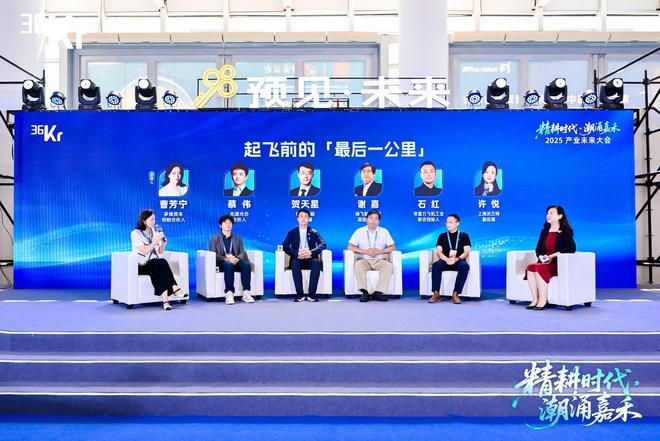
圆桌对话:起飞前的「最后一公里」 | 2025年36氪产业未来大会
3 6 Ke· 2025-09-18 11:58
Core Viewpoint - The 2025 36Kr Industry Future Conference, co-hosted with the Ministry of Commerce, focuses on key sectors such as artificial intelligence, low-altitude economy, advanced manufacturing, new energy, and large consumption, aiming to discuss development paths and industry future [1] Group 1: Industry Overview - The conference emphasizes the importance of collaboration among government, capital, and industry to address challenges in the low-altitude economy [1] - The low-altitude economy has been recognized in national strategic reports, indicating its growing significance [3] - The industry is transitioning from niche innovation to a more widely recognized economic model, with a focus on public understanding and acceptance [7] Group 2: Company Insights - EHang is a pioneer in the eVTOL sector, with its EH216-S being the only eVTOL product globally with all necessary certifications, aiming to transform urban air mobility [4] - PeakFly has achieved significant milestones in eVTOL development, including successful test flights and regulatory approvals, focusing on logistics and human mobility [5][8] - Zero Gravity Aircraft is advancing its eVTOL products and aims to establish a comprehensive supply chain through market activation [9][17] - Volant is developing high-capacity eVTOLs and has recently completed its first flight, marking a significant step in its engineering development [6] Group 3: Investment Landscape - Investment in the low-altitude economy has surged, with a 50% increase in financing activities compared to the previous year, totaling over 7.5 billion RMB [12] - Investment trends show a shift towards early-stage funding and a focus on core technologies and key components within the industry [12][14] - The long-term potential of the low-altitude economy is emphasized, with expectations for significant growth over the next decade [13] Group 4: Future Outlook - The low-altitude economy is expected to become a major contributor to economic growth, with a focus on creating a safe, efficient, and environmentally friendly transportation network [15] - Companies are actively working on establishing operational ecosystems and addressing regulatory challenges to facilitate market entry and growth [18] - The industry anticipates a shift in consumer behavior towards embracing low-altitude transportation solutions, which will be crucial for its maturation [15]


张永伟:智能汽车和具身机器人、飞行汽车供应链重合度超过60%
Jing Ji Guan Cha Bao· 2025-09-18 11:14
Core Insights - The three emerging industries of smart vehicles, embodied robots, and low-altitude economy (including flying cars) are deeply interconnected in technology, supply chains, and applications, with over 60% overlap in their supply chains [1] - The integration of artificial intelligence technology is fundamental to these industries, which share a common technological architecture of "perception-decision-execution" [1] - By 2030, the global market for the "three major components" of aggregated intelligence is expected to reach nearly $240 billion, with China's market exceeding $120 billion [2] Industry Overview - The automotive supply chain can be closely linked with the supply chains of embodied robots and low-altitude flying vehicles, with shared components such as perception devices [1] - The mass production benefits from the automotive industry, particularly in batteries, thermal management, and chips, can accelerate the maturity of the robotics and low-altitude flying vehicle sectors [1] - Companies like Tesla are leading in the humanoid robot field, sourcing over 70% of their suppliers from the existing automotive supply chain, while domestic companies are also diversifying into multiple categories [2] Market Trends - The competition in the future will focus on the collaborative efficiency of aggregated ecosystems rather than individual products, positioning the "three major components" as key drivers for high-quality economic development and global expansion [2] - The Wuhan Optics Valley has emerged as a significant base for the aggregated intelligence industry, housing the largest and most diverse humanoid robot innovation center in the country [2]

(活力中国调研行)“苏超”后签约 老牌工业城常州的“新玩法”
Zhong Guo Xin Wen Wang· 2025-09-18 09:12
Core Viewpoint - The article highlights the innovative "soft investment" strategies employed by Changzhou, an established industrial city in China, to attract foreign enterprises and enhance local economic collaboration through cultural and sporting events [1][2]. Group 1: Soft Investment Strategies - Changzhou has organized multiple events, such as "Foreign Friends Watching Su Chao," inviting over 540 foreign executives from 20 countries to foster international business cooperation [1][2]. - The city emphasizes the importance of a favorable "soft" environment, including comprehensive support systems, as a key factor for enterprises deciding to settle in the area [1]. Group 2: Industrial Strength and Transformation - Changzhou covers 37 out of 41 industrial categories defined by the national classification, with a stable manufacturing value-added ratio of approximately 42% [2]. - The city has transitioned from being an "industrial star city" to an "innovation and intelligent manufacturing city," with over 5,400 high-tech enterprises and a high-tech industry output ratio of 59.1% [2]. - Changzhou is focusing on strengthening its advantageous industries while also preparing for future sectors such as synthetic biology, hydrogen energy storage, low-altitude economy, and artificial intelligence [2].
广汽高域世界智博会收获500架意向订单,美国政府宣布启动新的低空试点项目 | 投研报告
Zhong Guo Neng Yuan Wang· 2025-09-18 06:45
Core Insights - The low-altitude economy index increased by 1.01% this week, with a daily average transaction amount of 34.308 billion yuan and a TTM price-to-earnings ratio of 114.66 times, while the net inflow of main funds was -330 million yuan [1][2] Market Performance - The daily average transaction amount decreased compared to last week, while the valuation remained high and the net outflow of main funds narrowed [2] Industry Developments - The U.S. government announced the launch of a new low-altitude pilot project [4] - GAC High Domain World Smart Expo received 500 intent orders [5] - The first urban-level low-altitude intelligent system was launched in Wuhu, Anhui [5] - XPeng Huaitian's "land aircraft carrier" (X3-F) received a special flight certificate in the UAE [5] - The first low-altitude economic internet platform in Hunan was launched [6] Policy Developments - Wenchang City Development and Reform Commission publicly solicited opinions on the "Wenchang City Low Altitude Economic Industry Development Plan (Draft for Comments)" [7] Company News - Nocoda Technology's subsidiary signed a cooperation agreement with AlphaAI Technology Limited to establish a strategic partnership in the field of drone AI technology and low-altitude economic smart facilities [8] - Joby signed a memorandum with Miami-Dade County to plan short-distance shuttle services in the Biscayne Bay area starting in Q1 2026, initially deploying 10 S4 models [8]
广西北海全域低空经济发展公司登记成立
Qi Cha Cha· 2025-09-18 06:03
Group 1 - The establishment of Guangxi Beihai Low-altitude Economic Development Co., Ltd. has been officially registered with a capital of 20 million yuan [1] - The company's business scope includes operations of private large aircraft operators, aircraft management services, artificial intelligence general application systems, and technical consulting services for AI public service platforms [1] - The company is wholly owned by Beihai Rural Construction Investment Group Co., Ltd. [1]
上交所:加快推进新一轮资本市场改革 不断增强市场吸引力和包容性
Zheng Quan Ri Bao· 2025-09-18 00:12
Group 1 - The Shanghai Stock Exchange (SSE) is actively promoting the implementation of policies such as the "1+6" reform framework for the Sci-Tech Innovation Board, aimed at enhancing the high-quality development of listed companies [1] - Since the introduction of the fifth set of listing standards, the SSE has received 15 IPO applications, including 4 from unprofitable companies, indicating a growing acceptance of diverse business models [1][2] - The SSE has organized outreach activities covering over 1,000 enterprises and market institutions, with more than 2,000 participants, to promote the policies supporting technological innovation [1] Group 2 - The SSE has initiated pre-communication with various commercial aerospace, artificial intelligence, and low-altitude economy companies to expand the fifth set of standards to relevant industries [2] - As of September 11, the SSE has launched 13 ETFs related to Sci-Tech innovation, with a total scale of approximately 280 billion, making it the highest proportion of index investment in A-shares [2] - The SSE is enhancing investor services, with 4.75 million investors having opened trading permissions for the Sci-Tech growth tier, indicating a significant influx of market liquidity [2] Group 3 - The SSE is fostering a new industrial system characterized by "hard technology," with significant growth in strategic emerging industries such as artificial intelligence and quantum information [3] - In the first half of the year, R&D investment by entities in the Shanghai market reached 432.6 billion, with Sci-Tech Innovation Board companies investing 84.1 billion, which is 2.8 times their net profit [3] - Traditional industries are also transforming and upgrading, with notable profit growth in sectors like steel and machinery, driven by technological innovation [3]
聚合智能融合发展 成新能源产业壮大关键路径
Xin Lang Cai Jing· 2025-09-17 22:42
Core Insights - The rapid development and application of artificial intelligence technologies have positioned smart vehicles, low-altitude travel, and embodied robots as key carriers of AI applications, with a consensus emerging on the importance of scaling smart vehicle components to empower these sectors [1][2] - The concept of "aggregated intelligence" is characterized by the deep coupling of technology, industry chains, and application scenarios, which is seen as a new direction for the renewable energy industry to break through single development bottlenecks and unlock trillion-yuan market potential [1][4] Technology and Industry Chain Interconnectivity - There is significant "homogeneity" among smart vehicles, embodied robots, and low-altitude economy, with AI as the core support for underlying technologies, forming an AI-based terminal industry chain [2][3] - The supply chain overlap exceeds 60%, with some companies estimating it to be as high as 70%, allowing components from smart vehicles to directly support robots and low-altitude aircraft [2][3] - The cost of laser radar has dramatically decreased from 100,000 yuan in 2019 to 800 yuan today, showcasing the potential for cost reduction in robotics and low-altitude economies through supply chain integration [2][3] Practical Applications and Industry Initiatives - Companies like Beijing Horizon Robotics have successfully integrated smart vehicle technology into robotics, with over 10 million units of their chips deployed in vehicles and applications in various robotic platforms [3] - Zhixing Technology has entered the robotics field through acquisitions, developing the world's first domestic mid-to-high computing power robot controller based on intelligent driving technology [3] Scene Integration and Ecosystem Development - The shift from a single product mindset to an ecosystem approach is gaining traction in the renewable energy sector, exemplified by initiatives like the "robot soccer league" that fosters a developer ecosystem [4][5] - The low-altitude economy is being redefined through innovative transportation solutions, with electric flying cars expected to reduce costs significantly from millions to around 200,000 yuan [5][6] - Companies like Sichuan Wofei Chang Kong are actively developing electric flying vehicles and have secured substantial orders, indicating strong market demand for low-altitude travel solutions [5][6] Strategic Collaborations and Future Outlook - Jianghuai Automobile Group is pursuing an "all-chain" ecosystem strategy by collaborating with universities and leading companies in robotics and low-altitude economies to extend the automotive industry chain into new fields [6] - The aggregation of smart vehicles, embodied robots, and low-altitude economies is projected to form a trillion-yuan export force in the next five years, with integrated development being the key to seizing this opportunity [6]
如何看待低空经济“成长的烦恼”?
Shang Hai Zheng Quan Bao· 2025-09-17 19:28
Group 1 - The low-altitude economy is facing scrutiny after a collision incident involving eVTOL aircraft, highlighting that safety is the absolute prerequisite for the industry's development [1][2] - The collision occurred during a rehearsal at the Changchun Airshow, where two Xiaopeng Huaitian eVTOLs collided due to insufficient flight spacing, resulting in one aircraft catching fire upon landing [1] - The incident raises questions about the readiness of the eVTOL industry for public demonstrations, with concerns about pilot proficiency and the current inadequacies in the flight support system and infrastructure [1][2] Group 2 - The low-altitude economy is still in its infancy, facing challenges in airspace management, safety regulation, technical standards, and infrastructure development [2] - Following the incident, it is anticipated that regulatory bodies may implement stricter low-altitude flight management regulations, including mandatory collision warning systems, which could temporarily limit the commercial operation of flying vehicles [2] - Despite the accidents, there is a belief that low-altitude flying can be safe and that the industry should maintain a balanced perspective, recognizing the importance of safety while fostering development [2][3] Group 3 - Recommendations for the development of the low-altitude economy include enhancing flight safety measures, improving infrastructure and support services, and establishing comprehensive management and industry standards [3] - There is a call for strengthening certification management for low-altitude flying vehicles and enhancing training and management for pilots [3] - Emphasizing that safety is crucial for the low-altitude economy to thrive and become a new engine for economic growth [4]
聚合智能融合发展成新能源产业壮大关键路径
Zheng Quan Ri Bao· 2025-09-17 16:09
Core Insights - The rapid development and application of artificial intelligence technologies have made smart vehicles, low-altitude travel, and embodied robots key carriers of AI applications, with a consensus emerging on the importance of scaling smart vehicle components to empower these sectors [1][2] - The concept of "aggregated intelligence" is characterized by deep coupling of technology, industry chains, and application scenarios, which is seen as a new direction for the new energy industry to break through single development bottlenecks and unlock trillion-yuan market potential [1][7] Group 1: Technological Synergy and Industry Chain Interconnectivity - Smart vehicles, embodied robots, and low-altitude economy share significant "homogeneity" in their underlying technologies, all supported by artificial intelligence, leading to a unified terminal industry chain [2][3] - The supply chain overlap exceeds 60%, with some companies estimating it to be as high as 70%, allowing components from smart vehicles to directly support robots and low-altitude vehicles [2][3] - The cost reduction in components, such as LiDAR, has been significant, with prices dropping from 100,000 yuan in 2019 to 800 yuan today, demonstrating the potential for cost-effective solutions in robotics and low-altitude travel [3] Group 2: Scene Integration and Ecological Co-construction - The shift from a single product mindset to an ecological thinking is becoming a consensus among professionals in the new energy sector, with examples like the "robot football league" showcasing developer ecosystems [5] - The low-altitude economy is showing great potential in reconstructing transportation scenarios, with electric flying cars expected to reduce costs significantly from millions to around 200,000 yuan [6] - Companies like Sichuan Wofei Chang Kong Technology are actively developing electric flying vehicles and have plans for commercial operations by 2026, indicating a growing market for low-altitude travel solutions [6][7] Group 3: Strategic Collaborations and Future Outlook - Companies like Jianghuai Automobile Group are exploring collaborative ecosystems by sharing technologies and resources across smart vehicles, robots, and low-altitude travel [7] - The integration of smart vehicles, embodied robots, and low-altitude economy is expected to form a trillion-yuan "new trio" export force in the next five years, emphasizing the importance of fusion development [7]