投资银行

Search documents
华兴资本成为首家将BNB纳入专项配置数字资产的香港上市公司
Ge Long Hui· 2025-08-22 13:15
Core Viewpoint - Huaxing Capital has announced a strategic partnership with YZi Labs to support the development of the BNB and BNB Chain ecosystem, marking a significant step in its Web3 strategy and traditional financial infrastructure transformation [1][2]. Group 1: Strategic Initiatives - Huaxing Capital plans to invest approximately $100 million in BNB, recognizing the value and potential of the BNB Chain ecosystem, which is one of the most widely used public chains globally [2]. - The company will collaborate with Huaxia Fund (Hong Kong) to develop fund products and other Web3-related offerings, ensuring compliance with the Hong Kong Securities and Futures Commission (SFC) [2]. - A Real World Assets (RWA) fund, targeting several hundred million dollars, will be established to focus on the tokenization and on-chain circulation of traditional assets such as real estate, bonds, and commodities [2]. Group 2: Market Position and Future Outlook - This partnership positions Huaxing Capital as the first Hong Kong-listed company to include BNB in its digital asset allocation, aiming to drive the adoption of blockchain technology among TMT companies listed in Hong Kong [3]. - The collaboration is expected to create synergies, enhancing Huaxing Capital's financial services and investment banking capabilities while integrating digital assets into its core operations [3]. - The partnership is seen as a strategic choice that combines Huaxing's financial expertise with YZi Labs' leadership in the Web3 space, aiming to bridge traditional economies with the digital future [3].
华兴资本与YZi Labs达成深度战略合作 共同推动金融科技创新与RWA生态建设
Ge Long Hui· 2025-08-22 13:05
Core Viewpoint - Huaxing Capital has announced a strategic partnership with YZi Labs to support the development of the BNB and BNB Chain ecosystem, marking a significant step in its Web3 strategy and traditional financial infrastructure transformation [1][2]. Group 1: Strategic Initiatives - Huaxing Capital plans to allocate approximately $100 million for BNB asset configuration, recognizing the value and potential of the BNB Chain ecosystem [2]. - The company will collaborate with Huaxia Fund (Hong Kong) to develop fund products and other Web3-related offerings, ensuring compliance with the Hong Kong Securities and Futures Commission [2]. - A Real World Assets (RWA) fund, targeting several hundred million dollars, will be established to focus on the tokenization and on-chain circulation of traditional assets [2]. Group 2: Market Positioning - Huaxing Capital becomes the first Hong Kong-listed company to include BNB in its digital asset allocation, aiming to drive the adoption of blockchain technology among TMT companies [3]. - The partnership is expected to create synergies, enhancing Huaxing Capital's position in financial innovation and Web3, while leveraging YZi Labs' extensive ecosystem resources [3]. - The collaboration is seen as a strategic choice to bridge traditional finance and the digital future, positioning Huaxing Capital to lead industry transformation and embrace the global digital economy [3].
华兴资本控股(01911)拟与YZi Labs建立战略合作框架,以支持币安币及BNB Chain生态系统的应用,并建立互相赋能的合作关系
智通财经网· 2025-08-22 13:01
Core Viewpoint - The company has entered into a strategic cooperation memorandum with YZi Labs to support the application of Binance Coin (BNB) and the BNB Chain ecosystem, aiming to establish a mutually empowering partnership [1] Group 1: Strategic Initiatives by the Company - The company plans to invest approximately $100 million in a special allocation of BNB assets, aiming to become the first Hong Kong-listed company to include BNB in its digital asset allocation [2] - The company will collaborate with Huaxia Fund (Hong Kong) and other ecosystem partners to develop fund products related to Web3 and promote the listing of BNB on licensed virtual asset exchanges in Hong Kong [2] - The company aims to establish a Real World Asset (RWA) fund with a target size of several hundred million dollars, promoting the adoption of BNB blockchain in stablecoin and RWA application scenarios among Hong Kong-listed companies [2] Group 2: Strategic Support from YZi Labs - YZi Labs will provide strategic, commercial, and ecological support for the development and promotion of the BNB ecosystem, including connecting the company with relevant third-party service providers and potential strategic partners [3] - YZi Labs will assist in promoting the company's initiatives related to the BNB ecosystem and help disseminate the company's announcements through its official channels, in compliance with applicable laws [3] - The two parties will jointly agree on other strategic initiatives or collaborative projects to achieve better development goals for the BNB Chain ecosystem [3] Group 3: Additional Collaboration Opportunities - YZi Labs and the company may engage in other collaborative models, such as joint branding and promotional activities, within legal frameworks [4] - The deep strategic cooperation between the company and YZi Labs aims to promote the widespread adoption of the BNB ecosystem while helping the company seize core development opportunities within the BNB Chain ecosystem [4] - The collaboration aligns with the company's strategic direction to actively expand into digital assets within its core business areas of investment banking and financial services [5]
华兴资本控股(01911) - 自愿性公告 - 关於与YZi Labs订立战略合作备忘录
2025-08-22 12:45
香港交易及結算所有限公司和香港聯合交易所有限公司對本公告的內容概不負責,對其準確性或完整 性亦不發表任何聲明,並明確表示,概不對因本公告全部或任何部分內容而產生或因依賴該等內容而 引致的任何損失承擔任何責任。 CHINA RENAISSANCE HOLDINGS LIMITED 華興資本控股有限公司 (於開曼群島註冊成立的有限公司) (股份代號:1911) 自願性公告 關於與YZi Labs訂立戰略合作備忘錄 本公告乃由華興資本控股有限公司(「本公司」)董事(「董事」)會(「董事會」)自願性發出。 繼本公司於2025年6月26日就加密貨幣資產投資計劃發佈公告後,董事會欣然宣佈,於 2025年8月22日交易時段後,本公司與YZILabs Management Ltd(「YZi Labs」)訂立戰略合 作備忘錄(「備忘錄」),擬與YZi Labs建立戰略合作框架,以支持幣安幣(「BNB」)及BNB Chain生態系統的應用,並建立互相賦能的合作關係:本公司通過其金融專業能力賦能 BNB Chain生態,同時在BNB Chain生態的優質項目中獲得投行、金融服務與更佳的投資 機會,以及將該等機會應用於我們的核心業務 ...
高盛:中国股市仍有上涨空间 仍有大量“存量资金”尚未入市
Zhi Tong Cai Jing· 2025-08-22 05:53
Core Insights - The current rally in the Chinese stock market is primarily driven by retail investor funds, with a significant amount of "existing funds" yet to enter the market, providing further upward momentum, particularly for small and mid-cap stocks [1] Group 1: Market Dynamics - Only 22% of household financial assets are currently allocated to stocks and related products, indicating a potential inflow of over 10 trillion yuan, which supports the market with ample incremental funds [1] - The trend suggests that the Chinese stock market, especially small and mid-cap stocks, has considerable room for growth, with indices like the CSI 1000 and CSI 500 being highlighted for attention [1] Group 2: Market Performance Indicators - Recently, A-shares have become the most net bought market, with a buying ratio of 1.1 times [1] - Technical indicators show that the upward trend in the Chinese stock market is broadening, with approximately 10% of the Shanghai Composite Index and 8% of the Shenzhen Component Index stocks reaching 52-week highs [1] - About 90% of the stocks in the Shanghai Composite Index and Shenzhen Component Index are trading above their 50-day moving average, indicating strong market momentum and a reduction in concentration risk, enhancing confidence across a wider range of sectors [1]

中金公司股价小幅回落 新设绿色股权投资合伙企业
Jin Rong Jie· 2025-08-21 13:23
作者:A股君 截至8月21日收盘,中金公司股价报37.96元,较前一交易日下跌0.63%。当日成交量为242037手,成交 金额达9.26亿元。 中金公司是中国领先的投资银行,业务范围涵盖投资银行、股票业务、固定收益、财富管理和投资管理 等。公司总部位于北京,在上海、深圳等主要城市设有分支机构。 消息面上,中金公司全资子公司中金资本运营有限公司近日参与设立了四川省成眉环投金瑞绿色股权投 资合伙企业,出资额达10亿元。此外,中金公司近期作为牵头保荐人助力天岳先进完成港股IPO,发行 规模达23.5亿港元。 风险提示:股市有风险,投资需谨慎。 资金流向方面,8月21日主力资金净流出5383.31万元,近五日累计净流出2.15亿元。 本文源自:金融界 ...

摩根士丹利重磅!亚洲宏观展望十大关键问题之答案
Zhi Tong Cai Jing· 2025-08-21 12:06
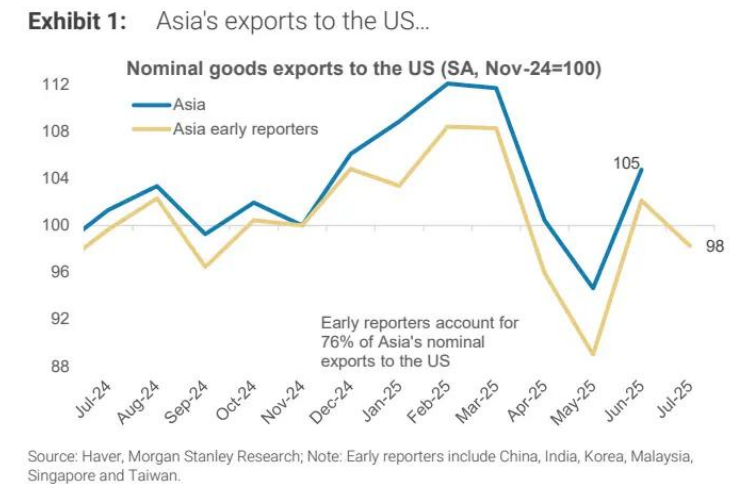
Group 1 - Investors are focusing on the impacts of tariffs, the effectiveness of China's antitrust policies, US-India trade tensions, and whether the Bank of Japan is lagging behind [1] - Morgan Stanley's latest report indicates that investors are more optimistic about the macro outlook for the US and Asia compared to the bank's baseline scenario [1] Group 2 - The current tariff on Asian goods has increased significantly to 25% from 5% at the beginning of the year, with expectations of a notable slowdown in exports by the second half of 2025 [2] - Despite the tariff increases, investors believe that growth in the US and Asia will not show significant deceleration in the latter half of 2025 [2][4] - Non-tech exports from Asia have stabilized after a decline in April and May, with a focus on non-tech exports due to tech products being largely exempt from tariffs [2][5] Group 3 - Exporters have not borne much of the tariff burden, as the prices of goods imported from Asia to the US remain higher than levels seen in February 2025 [7] - The effective tariff rate on Asian imports has risen by 20 percentage points, yet the prices of these goods are only slightly lower than in February 2025 [10] Group 4 - Capital expenditure momentum in Asia appears to be stabilizing, with evidence suggesting a slowdown in capital goods imports since May 2025 [12] - South Korea has committed $350 billion in investments, with actual equity commitments expected to be lower than $17.5 billion, while Japan has announced $550 billion in loans and guarantees, with only 12% expected to be actual investments [13] Group 5 - The increase in tariffs is expected to enhance the transmission of price increases to core goods, with indications that tariffs are driving prices higher in categories such as automobiles and household goods [16] - The US core PCE is projected to peak at 0.39% monthly by August 2025, with core CPI expected to reach a higher peak of 0.45% [16] Group 6 - Asian central banks are currently in a wait-and-see mode, with expectations of further rate cuts as trade policy uncertainties decrease [17] - The report anticipates additional rate cuts in the remaining months of 2025 and into 2026 across various Asian central banks [17] Group 7 - The effectiveness of China's antitrust efforts faces challenges, with recent signals from policymakers indicating potential follow-up actions to address deflationary pressures [18] - The current macroeconomic environment is less favorable for addressing deflation compared to previous years, with a need for a rebalancing from investment to consumption [18][24] Group 8 - The impact of tariffs on India's growth is expected to be mitigated, with only 2% of India's GDP affected by direct and indirect channels from tariffs [19] - The Indian government estimates that only 55% of its exports to the US will be impacted by tariffs, allowing for some exemptions [19] Group 9 - There is a growing divergence between macroeconomic indicators and micro-level data in India, with corporate revenue growth slowing while nominal GDP growth remains high [21] - Factors such as recent monetary easing by the Reserve Bank of India are expected to support economic re-inflation in the coming quarters [21] Group 10 - The Bank of Japan maintains a dovish stance due to moderate demand-side inflation pressures, with expectations of no rate hikes in the near term [22] - The Japanese economy is still recovering from the pandemic, with private consumption and capital expenditure below pre-COVID levels [22] Group 11 - Asian investors are reducing net purchases of US stocks, indicating a shift in focus towards European equities and increased foreign exchange hedging on US positions [23] - The ongoing concerns about the US macro outlook are prompting Asian investors to reconsider their asset allocations [23]


高盛:大量“存量资金”尚未入市,中国股市仍有上涨空间,看好中小盘股表现
Hua Er Jie Jian Wen· 2025-08-21 06:50
Core Viewpoint - The recent report from Goldman Sachs indicates that the current rally in the Chinese stock market is primarily driven by retail investor funds, with a significant amount of "idle funds" yet to enter the market, providing further upward momentum, particularly for small and mid-cap stocks [1][2]. Group 1: Market Dynamics - Goldman Sachs estimates that Chinese households hold approximately 55 trillion RMB in "excess deposits," with only 22% of household financial assets allocated to funds and stocks, suggesting a potential inflow of over 10 trillion RMB into the market [2][3]. - The report highlights that the ratio of household deposits to the total market capitalization of A-shares indicates substantial room for capital allocation [2]. - Recent data shows that the monthly change in household deposits has turned negative, suggesting a shift of savings from bank deposits to financial assets like stocks [2][3]. Group 2: Small and Mid-Cap Stocks - Goldman Sachs emphasizes the long-term growth potential of small-cap indices, particularly the CSI 1000 index, which has a retail ownership ratio of 61% and foreign ownership of only 2.5% [2][3]. - The CSI 500 index also shows a high retail ownership ratio of 51% and a low foreign ownership ratio of 1.4%, indicating a strong domestic investor base [2]. - The CSI 1000 index has the largest exposure in margin trading, amounting to 62 billion USD, which is 3.5% of its market capitalization, making it more sensitive to market performance and liquidity conditions [2][3]. Group 3: Sector Performance - From an industry allocation perspective, the CSI 1000 index has a more balanced weight distribution, with only about 10% allocated to traditional sectors like finance and real estate, while technology and healthcare sectors account for 25% and 12%, respectively, aligning with national strategic policies [3]. - Recent trading data indicates that A-shares have become the most net-bought market, with a buying ratio of 1.1, led by long-term investors in the information technology, industrial, and consumer sectors, while financial and materials sectors faced net selling [4]. - Technical indicators show that approximately 10% of the Shanghai Composite Index and 8% of the Shenzhen Component Index constituents have reached 52-week highs, reflecting strong market momentum [4]. Group 4: Market Trends - The trading volume of the CSI 500 index (mid-cap stocks) is on the rise, while the trading volume of the CSI 2000 index (micro-cap stocks) is declining, indicating a reduction in speculative behavior in the market [5].
证券公司投资银行业务,在产业企业绿色低碳转型中的创新模式研究
Zhong Guo Zheng Quan Bao· 2025-08-21 04:33
Group 1 - The article emphasizes the importance of financial support in achieving the "dual carbon" goals, highlighting the role of financial institutions in directing resources towards low-carbon technologies and innovative models [1][2] - The investment market for zero-carbon energy transition is expected to emerge in seven key areas: renewable resource utilization, energy efficiency improvement, electrification of end-use consumption, zero-carbon power generation technology, energy storage, hydrogen energy, and digitalization [1][2] - The broad definition of investment banking is expanding beyond traditional roles to include comprehensive services such as policy research, market analysis, strategic planning, and risk management, particularly in the context of green finance and sustainable development [3][4] Group 2 - The carbon market in China is in a rapid expansion phase, with new regulations being introduced to include more industries in carbon emissions reporting and verification, marking a significant step towards a more comprehensive carbon trading system [6][7] - Investment banks can provide carbon asset management services, including carbon emission assessments, reduction strategy design, and trading optimization, thereby helping companies navigate the complexities of carbon trading [9] - Green electricity trading is a system that integrates the trading of electricity value with renewable energy attributes, allowing for a more efficient connection between supply and demand in the renewable energy sector [12][13] Group 3 - Carbon asset development is crucial for converting carbon emissions rights into economically valuable assets, with various projects such as forestry carbon sinks and renewable energy generation being key avenues for generating carbon credits [14][15] - Investment banks are positioned to offer comprehensive solutions for companies facing new compliance requirements due to policies like the EU carbon border tax, including building carbon footprint management systems and providing ESG consulting services [16][20][24] - The transition to zero-carbon energy presents significant opportunities for investment banks to support renewable energy companies through equity investments, underwriting, and mergers and acquisitions, thereby enhancing their market presence and value [25]
美财长与高盛齐看好稳定币,但瑞银警告:恐非真实需求
贝塔投资智库· 2025-08-21 04:01
Core Viewpoint - The stablecoin market is entering a new expansion cycle, with potential scale reaching trillions of dollars, driven primarily by the payments sector [1][3]. Market Size and Growth Potential - The global stablecoin market currently stands at $271 billion, with Circle's USDC expected to benefit from legislative advancements and ecosystem expansion [1]. - By the end of 2027, USDC's market size is projected to grow by $77 billion, achieving a compound annual growth rate (CAGR) of 40% [1]. Payment Sector Insights - The global payments market is approximately $240 trillion annually, with consumer payments accounting for $40 trillion and B2B payments around $600 billion [3]. - The penetration of stablecoins in payment scenarios is seen as a core growth driver, despite current applications being dominated by cryptocurrency trading and offshore dollar demand [3]. Regulatory Environment and Market Dynamics - The issuance of stablecoins requires a 1:1 reserve of dollars or government bonds, which could structurally impact the bond market, particularly short-term low-interest government bonds [4]. - The recent passage of the GENIUS Act by the U.S. White House provides crucial institutional support for the stablecoin market [4]. - Tether's USDT remains the leading stablecoin, but regulatory limitations prevent it from directly serving U.S. users, while Circle aims to leverage new legislative benefits to expand USDC's adoption [4]. Competitive Landscape - Traditional financial institutions, such as U.S. banks, are planning to issue their own dollar-backed stablecoins, which may intensify competition for USDC's growth [4]. - Tether's CEO has indicated plans to strategize entry into the U.S. market, aiming to overcome current regulatory barriers [4]. Market Outlook and Diverging Opinions - U.S. Treasury Secretary Scott Basset expresses optimism about the stablecoin market, suggesting a $2 trillion market size is a "very reasonable target," potentially exceeding this figure [5]. - However, some analysts, including those from UBS, caution that stablecoins may represent a conversion of funds rather than net demand growth, highlighting a divergence in market perspectives on the actual impact of stablecoins [5].