
电力

Search documents
申能股份:公司主要从事国内电力、石油天然气的开发建设和经营管理
Zheng Quan Ri Bao· 2026-02-10 13:12
Core Viewpoint - Sheneng Co., Ltd. primarily engages in the development and management of domestic electricity, oil, and natural gas projects, providing a range of services including exploration, investment construction, operation maintenance, energy-saving technology, and fuel trading [2]. Company Overview - The company operates as an energy project developer, focusing on domestic markets without any overseas export or sales activities [2].


申能股份:公司正处在快速发展期
Zheng Quan Ri Bao· 2026-02-10 13:12
Core Viewpoint - Sheneng Co., Ltd. is in a rapid development phase, focusing on its new energy power generation strategy to strengthen its market position and competitiveness while seizing opportunities during the green transition [2] Group 1: Company Strategy - The company is actively responding to policy calls and emphasizes stable and sustainable cash dividends for investors [2] - In its future dividend strategy, the company will balance investor returns, corporate development, and financial governance, continuously optimizing profit distribution levels and forms [2] Group 2: Market Position - The company aims to enhance its market position and competitiveness by capitalizing on the opportunities presented by the green transition [2]
华电国际:已获核准及在建机组均已在最新定期报告相关章节中完整披露
Zheng Quan Ri Bao Zhi Sheng· 2026-02-10 13:12
Core Viewpoint - The company has received approval for its ongoing projects and has fully disclosed its construction units in the latest periodic report [1] Group 1: Business Operations - The company's main business involves the construction and operation of power plants, with profits primarily derived from thermal and hydropower sectors [1] - The company aims to continuously strengthen its core business and enhance value [1]

华电国际:公司始终坚持依法合规,以高质量发展推动市值管理工作
Zheng Quan Ri Bao Zhi Sheng· 2026-02-10 12:44
证券日报网讯 2月10日,华电国际在互动平台回答投资者提问时表示,公司严格贯彻落实国务院国资委 关于市值管理的有关要求,聚焦主责主业,持续提升经营质量与核心竞争力;全面提高信息披露质量, 主动开展业绩说明会、投资者调研等沟通活动;开展中期分红,健全市值管理长效机制。公司始终坚持 依法合规,以高质量发展推动市值管理工作,切实维护全体股东权益。 (编辑 楚丽君) ...
山西11名评标专家被暂停资格,评标公正性再引关注
Xin Lang Cai Jing· 2026-02-10 12:40
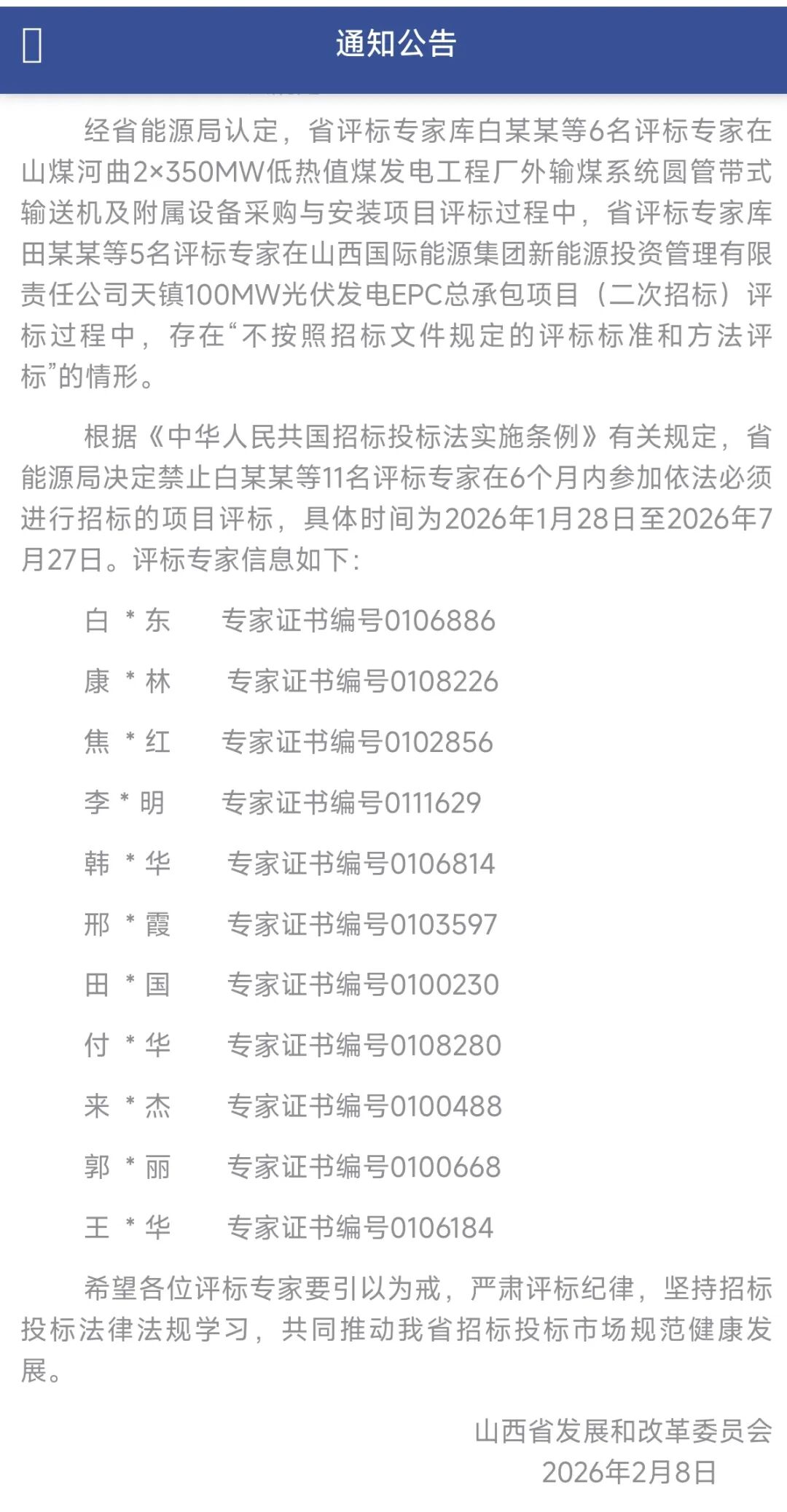
Core Viewpoint - The recent suspension of 11 bidding experts in Shanxi Province highlights ongoing issues of corruption and misconduct in the evaluation process of major energy projects, which poses risks to project quality and public safety [1][4][11]. Group 1: Violations and Involved Projects - The suspended experts were involved in significant projects, including the Shanmei Hequ low calorific value coal power project and the Tianzhen 100MW photovoltaic EPC project, both of which are critical to Shanxi's energy sector [4][17]. - The experts failed to adhere to the evaluation standards and methods outlined in the bidding documents, undermining their role as gatekeepers of project quality [5][17]. Group 2: Common Forms of Evaluation Misconduct - The misconduct of bidding experts is not an isolated incident, with multiple cases reported in recent months, indicating a systemic issue within the evaluation process [6][10]. - Previous reports have identified experts who neglected to reject bids that should have been disqualified, further illustrating the prevalence of evaluation irregularities [6][18]. Group 3: Underlying Issues and Regulatory Gaps - The familiarity among experts, often referred to as "familiarity bidding," contributes to corruption, as experts can easily collude if they know each other [9][20]. - The regional consolidation of expert pools and challenges in implementing cross-province evaluation mechanisms exacerbate the problem, making it difficult to enforce fair practices [9][22]. Group 4: Consequences of Misconduct - The failure to evaluate bids according to standards leads to resource misallocation and undermines public interest, as compliant companies may exit the market or resort to bribery to compete [23]. - Companies that win contracts through bribery may compromise on project quality, posing risks to public safety and ultimately burdening taxpayers with increased costs [23]. Group 5: Remedial Measures and Future Outlook - Shanxi Province has initiated a series of corrective measures, including the announcement of multiple batches of suspended experts, reflecting a zero-tolerance approach to violations [11][24]. - Experts suggest systemic reforms, such as establishing a national shared expert database and enhancing evaluation methods, to reduce opportunities for collusion and improve the integrity of the bidding process [11][24].
国家能源局赴12398能源监管热线中心召开春节期间民生用能保障等工作座谈会
国家能源局· 2026-02-10 12:37
宋宏坤一行实地查看了12398热线中心工作现场,听取了 12398热线投诉举报 新制度 实施一年来 投诉举报处理情况的汇报, 就做好春节期间民 生用能保障、 12398热线投诉举报等工作,与国家能源局相关司、部分派出机构和电网企业有关负责同志进行深入座谈交流。 宋宏坤指出, 12398热线是国家能源局联系群众、服务民生的 重要 窗口 。 12398热线 新制度 运行 一年以来,总体运转 平稳有效 ,投诉举报办 理 效能显著提 升 , 民生纽带 作用 有效巩固 , 热线的公信力和社会认可度 进一步增强。 下一步,各单位 要深入研究制度运行中的堵点难点 , 不断健全投诉处理机制,优化投诉工作流程,推动制度运行更加规范;要坚持和发展新时代 "枫桥经验",不断提升基层治理水平,着力强化投诉处 理质效;要强化科技赋能,积极推进大数据、人工智能等技术应用,提升热线服务智能化水平。 宋宏坤强调,各单位要 充分认识春节期间做好保暖保供工作的重要意义,对于人民群众的用能诉求,要 加强服务引导,优化人员配置, 提高处理 效率,提升工作质量, 着力解决好人民群众用能急难愁盼问题 ; 要进一步完善应急预案,提高应急处置能力 , 加强 ...
股票行情快报:申能股份(600642)2月10日主力资金净卖出408.65万元
Sou Hu Cai Jing· 2026-02-10 12:25
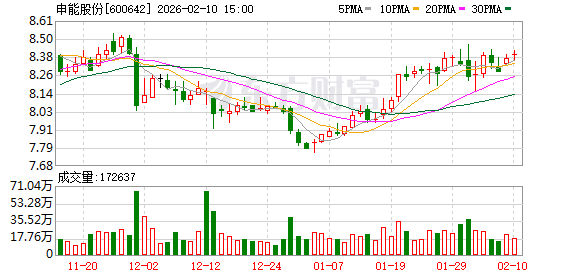
Group 1 - The core viewpoint of the news is that Sheneng Co., Ltd. (600642) has shown mixed financial performance, with a decline in revenue but an increase in net profit for the first three quarters of 2025 [2] - As of February 10, 2026, Sheneng's stock closed at 8.4 yuan, with a slight increase of 0.36% and a trading volume of 172,600 hands, amounting to a total transaction value of 145 million yuan [1] - The company's main business includes the development and management of electricity, oil, and natural gas projects, providing various services such as exploration, investment, construction, operation maintenance, and energy-saving technologies [2] Group 2 - For the first three quarters of 2025, Sheneng reported a total revenue of 20.932 billion yuan, a year-on-year decrease of 6.44%, while the net profit attributable to shareholders was 3.315 billion yuan, an increase of 1.04% [2] - In Q3 2025, the company recorded a single-quarter revenue of 7.974 billion yuan, down 8.27% year-on-year, but the net profit attributable to shareholders rose by 13.64% to 1.238 billion yuan [2] - The company's debt ratio stands at 54.23%, with investment income of 1.518 billion yuan and financial expenses of 718 million yuan, resulting in a gross profit margin of 22.84% [2]

江苏新能拟发行可转债募资不超12.4亿元
Zhi Tong Cai Jing· 2026-02-10 12:20
Group 1 - The company Jiangsu Xinneng (603693.SH) announced its plan to issue convertible bonds to unspecified investors, with a total fundraising amount not exceeding 1.24 billion yuan [1] - The net proceeds from the fundraising, after deducting issuance costs, will be used for the Lianyungang Qingkou Salt Field integrated fishing and solar power generation project and to supplement working capital [1]

江苏新能(603693.SH)拟发行可转债募资不超12.4亿元
智通财经网· 2026-02-10 12:16
Core Viewpoint - Jiangsu New Energy (603693.SH) plans to issue convertible bonds to raise up to 1.24 billion yuan, with net proceeds intended for a power generation project and working capital [1] Group 1 - The company intends to issue convertible bonds to unspecified investors [1] - The total amount to be raised is not more than 1.24 billion yuan [1] - The net proceeds, after deducting issuance costs, will be used for the Lianyungang Qingkou Salt Field integrated fishery and solar power generation project and to supplement working capital [1]
电投绿能(000875):电投集团唯一绿色氢基能源平台,项目陆续落地发展前景广阔
Guoxin Securities· 2026-02-10 12:15
Investment Rating - The report assigns an "Outperform" rating to the company, marking its first coverage [5]. Core Insights - The company is positioned as the only green hydrogen energy platform under the State Power Investment Corporation, with a dual-track development strategy focusing on "New Energy +" and "Green Hydrogen Energy" [1][13]. - The company has a total installed capacity of 14.44 million kilowatts as of 2024, with a significant portion (76.9%) coming from wind and solar energy [1][17]. - The profitability of coal-fired power is expected to stabilize due to improvements in the pricing mechanism, transitioning from a single pricing model to a two-part pricing model, which will reduce revenue volatility [1][38]. - The company is actively developing its green hydrogen business, leveraging abundant wind and solar resources to produce green hydrogen and ammonia, with several projects already in operation or under construction [2][14]. Financial Projections - The projected net profits for the company from 2025 to 2027 are estimated at 533 million, 809 million, and 907 million yuan, respectively, with a significant year-on-year growth rate expected in 2026 [3][4]. - The earnings per share (EPS) for the same period are forecasted to be 0.15, 0.22, and 0.25 yuan, with corresponding price-to-earnings (PE) ratios of 47.1, 31.0, and 27.7 [3][4]. - The absolute valuation of the company's stock is estimated to be between 7.89 and 8.24 yuan, indicating a premium of 14% to 19% over the current stock price of 6.92 yuan [3][5]. Revenue and Profitability - The company's revenue is projected to decline slightly in the coming years, with a forecasted revenue of 12.69 billion yuan in 2025, reflecting a decrease of 7.6% from the previous year [4]. - The net profit margin is expected to experience fluctuations, with a significant drop in 2025 due to various market factors, but is anticipated to recover in subsequent years [3][24]. - The company’s operating cash flow is showing signs of improvement, with a net cash flow of 5.16 billion yuan in the first three quarters of 2025, indicating a positive trend in cash management [30][32]. Market Trends - The renewable energy market is advancing towards a more market-oriented pricing mechanism, which is expected to enhance the profitability of new energy projects [2][60]. - The company is well-positioned to benefit from the increasing demand for green hydrogen and ammonia, driven by international regulations and market trends favoring low-carbon solutions [2][54].
