
高等教育

Search documents
我国首艘海洋级智能综合科考船“同济”号交付
news flash· 2025-07-13 01:06
Core Viewpoint - The delivery of China's first ocean-class intelligent comprehensive scientific research vessel "Tongji" marks a significant advancement in marine research capabilities, emphasizing its multifunctional design and intelligent features [1]. Group 1: Vessel Specifications - "Tongji" is a 2000-ton new generation green, silent, and intelligent comprehensive scientific research vessel [1]. - The vessel integrates various scientific investigation capabilities, including marine geology, marine chemistry, and marine biology [1]. Group 2: Educational and Cultural Aspects - "Tongji" serves multiple purposes, including scientific research, talent training, popular science education, and cultural heritage [1]. - The vessel is part of Tongji University's initiative to create a "marine campus" [1]. Group 3: Technological Advancements - Compared to previous research vessels, "Tongji" features enhanced intelligence, indicating a shift towards more advanced technological integration in marine research [1].
警校和海关学院,突然成了“性价比之选”?
Hu Xiu· 2025-07-13 00:00
Group 1 - The article discusses the significant differences in college admission scores across different provinces in China, highlighting the inherent flaws in relying solely on score lines for evaluating employment quality [4][6][11] - It emphasizes that students from economically developed regions, such as Jiangsu and Zhejiang, tend to have a better understanding of college admissions and job prospects compared to those from less developed areas [4][5][12] - The rising admission scores for police academies in Jiangsu are noted, with reports indicating that scores above 600 are now common, surpassing many prestigious universities [6][7] Group 2 - The article mentions that the highest reported score for the Jiangsu Police Academy is 663, which places students within the top 1800-1900 range for science subjects in the province [7] - It raises questions about the employability of graduates from police academies compared to those from top-tier universities, suggesting that the job security offered by police positions may be more appealing in certain contexts [8][12] - The discussion includes the increasing pressure on graduates to secure employment, leading to a higher volume of applications and potentially lower quality of academic work [9][10]

哈尔滨工业大学发表最新Nature论文
生物世界· 2025-07-12 23:36
Core Viewpoint - The article discusses the development of a new type of laser called "metalaser," which enhances the understanding and performance of lasers in various optical and photonic applications [2][5]. Group 1: Introduction to Metalasers - The research team from Harbin Institute of Technology (Shenzhen) has proposed and realized the metalaser, utilizing the interaction between local and non-local responses of dielectric resonant metasurfaces [3][4]. - Traditional lasers require additional optical components to modify laser characteristics, leading to larger systems and limitations due to speckle noise [2]. Group 2: Features and Advantages of Metalasers - The non-local interactions between meta-atoms in planar structures limit laser modes, while local variations in dipole moments precisely shape the beam wavefront [4]. - Metalasers can emit with any desired profile, including focal points, focal lines, vector beams, vortex beams, and even holograms [4]. - The scattering waves from metalasers do not experience resonant amplification like traditional laser modes, resulting in significantly weaker intensity, which minimizes speckle noise issues found in conventional laser holography [4].

从课堂知识到强农本领(在一线)
Ren Min Ri Bao· 2025-07-12 22:10
Core Viewpoint - The articles highlight the integration of agricultural education with practical experience, emphasizing the importance of hands-on learning for students in agricultural fields, particularly in the context of rural revitalization and industry development [1][2][3]. Group 1: Agricultural Education and Practical Experience - Students from Shandong Agricultural University are actively participating in hands-on agricultural activities, such as potato harvesting, which enhances their practical skills and understanding of the agricultural sector [1]. - The university has initiated the construction of rural revitalization stations, encouraging students and faculty to engage in rural service during breaks, resulting in approximately 10,000 stations established in Shandong [1]. - The innovative graduation project design encourages students to conduct field research in agricultural production areas, fostering a deeper connection between academic learning and real-world agricultural practices [2]. Group 2: Research and Development in Agriculture - Students are proposing industry chain enhancement plans based on their research into local agricultural sectors, such as tea production, demonstrating a focus on high-quality development in agriculture [2]. - The university collaborates with local governments and enterprises to establish multiple research institutes, facilitating student internships and contributing to rural development [2]. - Research projects, such as the development of new bio-based controlled-release fertilizers, showcase the application of scientific research to practical agricultural challenges, with a focus on environmental sustainability [3].
上海海关学院录取位次超上海交大,不必大惊小怪
Nan Fang Du Shi Bao· 2025-07-12 05:46
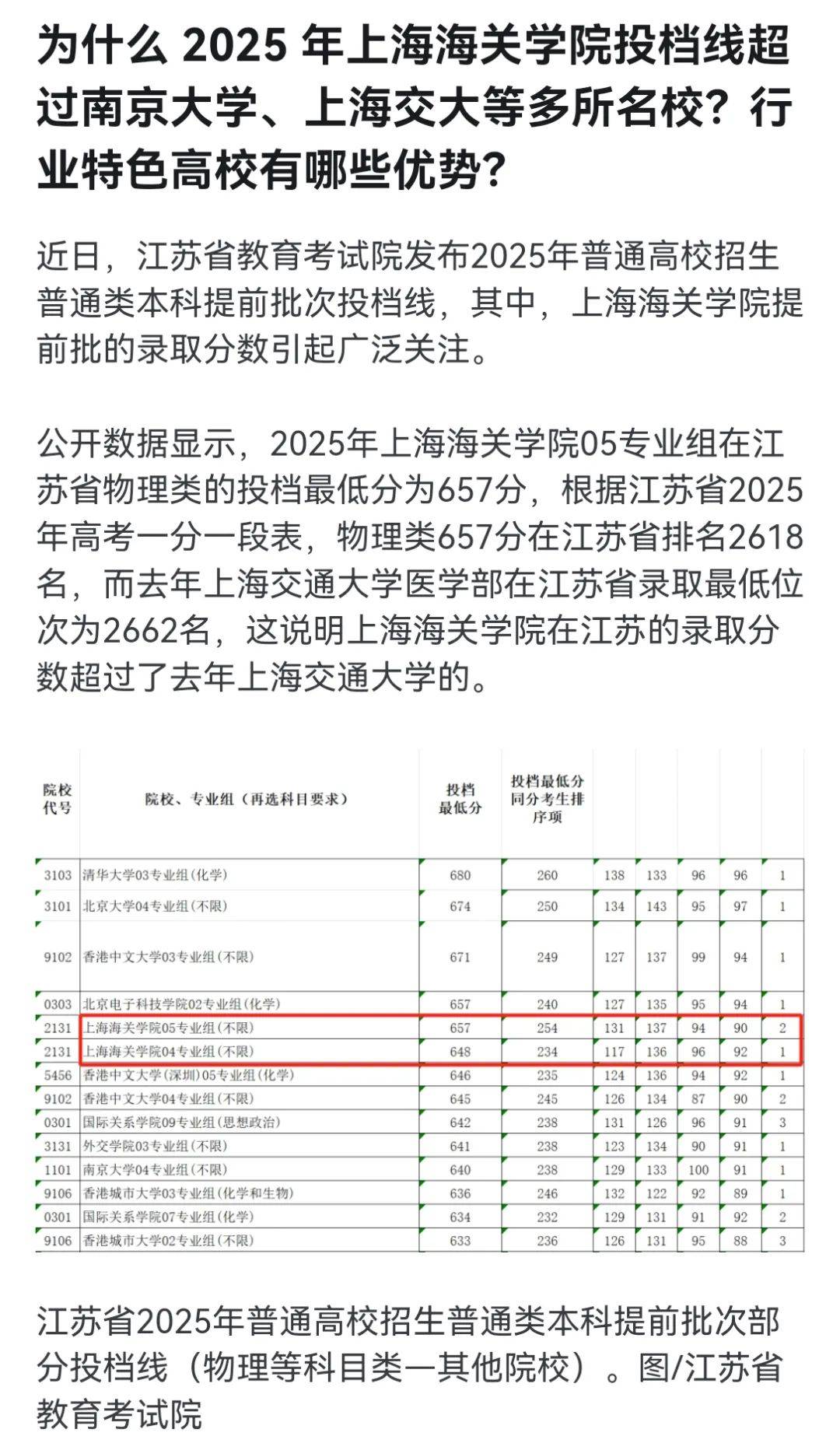
Group 1 - The minimum admission score for the Shanghai Customs College in the physics category in Jiangsu Province for the 2025 college entrance examination is 657, ranking 2618th, which is higher than the 2024 Shanghai Jiao Tong University Medical School's admission rank of 2662, attracting social attention [1] - The Shanghai Customs College has a high probability of students successfully passing civil service examinations, with the admission rate for civil servants significantly exceeding the social average [1] - The choice of candidates to pursue ordinary undergraduate colleges with good employment prospects over prestigious universities is seen as a rational decision, emphasizing the importance of aligning choices with personal interests, abilities, and long-term career development plans [1][2] Group 2 - There is a debate on whether students' choices are pragmatic or overly utilitarian, highlighting the need for students to make their own decisions rather than being influenced by parental expectations [2] - The misalignment of students' educational choices with their career aspirations is noted, with many students pursuing general education when they aim for employment, leading to structural employment difficulties in the job market [3] - A clear understanding of career goals is essential for students when selecting universities and majors, as focusing solely on civil service examinations may limit broader employment opportunities [3]
第五届“智荟中欧·北京论坛” 举行,中外政商看全球经贸格局重构
Zhong Guo Xin Wen Wang· 2025-07-12 03:21
Group 1 - The global economic and trade landscape is undergoing significant structural adjustments, with challenges arising from geopolitical factors, trade barriers, financial volatility, and technological changes [1] - The "Global Economic Landscape Reconstruction and Corporate Strategy" forum was held to discuss strategies for navigating these changes, featuring experts in international investment, currency, and trade systems [1] - Companies need to build safer global supply chains, strengthen local operations, enhance digital capabilities, and seize opportunities in regional cooperation and emerging markets to maintain value and influence in uncertain international markets [1] Group 2 - There is a systemic decline in investment returns globally, raising questions about the long-term reliance on growth-promoting policies and their impact on efficiency [2] - The rise of stablecoins presents a new form of currency that requires international institutional involvement for effective management and transparency [2] - China's strong production, logistics, and human resources capabilities position it favorably in the global supply chain, but companies must align more precisely with overseas market demands [2] Group 3 - The acceleration of global regulation on cryptocurrencies, particularly stablecoins, is influenced by the U.S. government's support for these assets, which may undermine their decentralized nature [3] - The forum aims to facilitate dialogue among political, business, and academic leaders to help companies make strategic decisions and innovate in the globalization process [3] - There is a notable difference between China and the EU, highlighting the need for both parties to demonstrate sincerity and respect in their interactions [3]
白宫重击高校波及华尔街
Jing Ji Ri Bao· 2025-07-11 22:22
Core Viewpoint - The conflict between the U.S. government and prestigious universities like Harvard has escalated, leading to significant funding cuts and legal battles, which could have broader implications for the higher education sector and its financial stability [1][2][3]. Group 1: Government Actions and University Responses - The U.S. government has threatened to cut federal funding to Harvard University, amounting to $2.2 billion, unless the university implements governance reforms [1]. - Harvard has filed lawsuits against the government in response to funding freezes and the revocation of its SEVP certification, which affects its ability to enroll international students [1][2]. - Other universities, including Columbia, Princeton, and Stanford, have also faced funding cuts and threats, indicating a wider trend affecting elite institutions [2]. Group 2: Financial Implications for Universities - Federal funding is crucial for U.S. universities, with Harvard's operational income projected at $6.5 billion for 2024, where a $2.2 billion cut represents a one-third reduction in revenue [3]. - Columbia University relies on federal funding for approximately 12% of its annual budget, highlighting the financial vulnerability of these institutions [3]. - The Moody's credit rating agency has downgraded the outlook for the entire U.S. higher education sector to "negative" due to these funding challenges [3]. Group 3: Impact on Revenue Sources - The four main revenue sources for U.S. universities include government funding, tuition and fees (especially from international students), donations, and research funding [3][4]. - The ongoing legal issues and funding cuts threaten three of these revenue sources, particularly affecting international student enrollment and government research grants [4]. - As a potential short-term solution, universities may rely more heavily on their endowment funds, which have historically been a significant source of income [4]. Group 4: Endowment Fund Dynamics - As of the end of 2024, U.S. university endowment funds exceed $870 billion, with Harvard's endowment at $52 billion, the largest in the country [5]. - The investment strategies of these endowments, particularly the "Yale model," have shifted towards higher-risk assets like private equity, which could be impacted by the current financial pressures [6]. - Universities are considering adjusting their investment portfolios in response to potential funding crises, with some institutions already evaluating the sale of private equity assets [7]. Group 5: Broader Economic Implications - The potential sell-off of private equity assets by universities could lead to a ripple effect in the financial markets, particularly affecting valuations in the private equity sector [7][8]. - The interconnectedness of universities with various sectors, including technology, means that disruptions in funding could adversely affect innovation and project development in these areas [8]. - The situation reflects a broader trend where actions against universities could destabilize multiple sectors, akin to a domino effect [8].
激活教育综合改革新动能 教育专家解码“一融双高”深化路径
Zheng Quan Shi Bao Wang· 2025-07-11 14:01
Group 1 - The core concept of "integrating party building with high-level education" is emphasized as a crucial path for the development of higher education and party building in universities [1][2] - The Central University of Finance and Economics highlights the need to strengthen the party's comprehensive leadership in educational institutions, focusing on strategic support and system construction [1] - There is a call to enhance the core driving force for comprehensive educational reform, aiming to cultivate a high-quality teacher workforce and develop a distinctive talent cultivation system [1] Group 2 - The Ministry of Education stresses the importance of improving grassroots party building in universities, aligning it with the strategic goal of building a strong educational nation [2] - Key areas of focus include the deep integration of party building with business operations to ensure high-quality development in education [2] - The promotion of exemplary party building practices and quality improvement initiatives is essential for implementing the "integrating party building with high-level education" strategy [2]
去深圳上大学
经济观察报· 2025-07-11 12:17
Core Viewpoint - Shenzhen has rapidly developed its higher education system over the past decade, transforming from a "university desert" to a city with a growing number of high-quality universities, driven by its economic growth and demand for skilled talent [2][4][22]. Summary by Sections Historical Development - Shenzhen's first university, Shenzhen University, was established in 1983, but the city lagged behind other major cities in higher education resources [5][4]. - Since 2014, Shenzhen has built eight new universities, bringing the total to 17 by 2024, with plans for further expansion [5][20]. Phases of University Development - The development of universities in Shenzhen can be divided into three phases: the initial establishment of Shenzhen University in the 1980s, the cooperative education model in the 2000s, and the recent surge in new universities since 2010 [8][14][20]. - The establishment of Southern University of Science and Technology (SUSTech) in 2010 marked a significant shift towards creating high-level research universities [17][19]. Financial Support and Investment - Shenzhen's education expenditure has seen substantial growth, with 2023 spending exceeding 100 billion yuan, and projections for 2025 to reach 102.06 billion yuan [26][28]. - The city's higher education spending has increased from 1.14 billion yuan in 2012 to an expected 17.81 billion yuan in 2025, reflecting a compound annual growth rate of 21.69% [28][30]. Talent Retention and Economic Alignment - Shenzhen has one of the highest university graduate retention rates in China, with 73.2% of graduates remaining in the city in 2024 [35]. - The universities in Shenzhen focus on aligning their programs with local industry needs, particularly in STEM fields, to ensure that graduates meet the demands of the local economy [36][46]. Future Prospects - The city plans to continue expanding its higher education system, with expectations to establish at least 10 more universities during the 14th and 15th Five-Year Plans, potentially reaching over 30 institutions [44][45]. - Future developments will likely focus on emerging industries such as artificial intelligence, robotics, and renewable energy, ensuring that academic programs support these sectors [46][47].
中国农业大学启动国际暑期学校
Xin Jing Bao· 2025-07-11 10:30
Core Insights - China Agricultural University has launched the 2025 International Summer School, attracting nearly 200 students from 38 countries to experience Chinese agricultural education [1][2] - The initiative aims to address global challenges such as climate change and food security by integrating agriculture with cutting-edge technology [1] - The "Youxue CAU" project is designed to create a new high ground for global agricultural graduate education and promote the "Study in China" brand [1] Group 1 - The summer school includes four specific activities: International Summer School on Agricultural Green Development, Overseas Graduate Summer School on "Statistical Genetics," A5+N International Summer School on Artificial Intelligence and Agricultural Remote Sensing, and Asian Young Scholars "Sustainable Food Systems Writing Camp" [1] - The project encourages students to integrate knowledge across disciplines, maintain a spirit of inquiry, and build connections to tackle future uncertainties [1] - Students from the University of California, Berkeley, highlighted the project as a bridge to future agriculture, emphasizing the importance of international collaboration in addressing global challenges [2] Group 2 - The launch ceremony featured tours of the university's campus, including the Animal Medicine Specimen Museum, Feed Museum, and Insect Museum, showcasing advancements in agricultural development and innovative applications [2] - The initiative reflects a commitment to fostering knowledge sharing and collaboration among students from diverse backgrounds [2] - The focus on "green technology and smart innovation" aligns with global efforts to combat climate change and ensure food security [2]