就业质量

Search documents
中国人工作时长结束9年连涨,但还远远不够
经济观察报· 2026-01-22 12:38
Core Viewpoint - The long working hours in China's labor market reflect low employment quality, and there is a need to adjust the minimum wage standards for full-time workers to an hourly basis to address this issue [1][4][28]. Group 1: Working Hours Trends - After nine consecutive years of growth, the average weekly working hours for employees in China have shown a slight decline in 2025, with all months except January reporting lower hours compared to the same period in 2024 [2][21]. - The average weekly working hours in China remain high, exceeding the legal standards of 8 hours per day and 44 hours per week, indicating a significant issue in the labor market [4][8]. - The proportion of urban employed individuals working over 48 hours per week increased from 50.2% in 2018 to 44.6% in 2022, highlighting the persistent issue of excessive working hours [14]. Group 2: Factors Influencing Working Hours - The increase in average working hours since 2016 is not solely explained by economic cycles, as China's GDP growth has been declining while working hours have continued to rise [8][9]. - Rising fixed costs for companies, including social insurance expenses, have led businesses to extend working hours instead of hiring more employees to maximize profits [9][10]. - The mismatch between actual working hours and workers' desired hours contributes to job dissatisfaction and reflects the low quality of employment [12]. Group 3: Structural Issues in Employment - The coexistence of long working hours and insufficient working hours in different sectors indicates structural contradictions in labor allocation in China [16]. - Competitive industries, such as hospitality and construction, tend to have longer working hours, while government sectors and individual businesses often experience insufficient working hours [17][19]. - The issue of insufficient working hours is particularly pronounced among women, low-educated individuals, and those in informal employment, leading to increased income inequality [19]. Group 4: Recommendations for Improvement - To address the issue of excessive working hours, it is essential to enhance macroeconomic demand by increasing the income of low- and middle-income groups, thereby boosting their consumption capacity [22]. - Reducing the social insurance burden on companies is crucial, as China's social insurance costs are among the highest globally [22]. - Adjusting the wage determination mechanism for full-time workers to an hourly basis, similar to non-full-time workers, is recommended to improve employment quality [23][24].


国际劳工组织报告指出——全球就业质量改善明显放缓
Jing Ji Ri Bao· 2026-01-18 22:17
Core Insights - The International Labour Organization's report indicates that while the global economy shows resilience, progress towards "decent work" has significantly stalled [1] Economic Outlook - Global GDP growth is expected to remain consistent from 2025 to 2027, with no significant recession anticipated [1] - The global unemployment rate is projected to stabilize at 4.9% in 2026, with approximately 186 million unemployed individuals [2] Employment Quality and Participation - Employment quality improvements have slowed, with a notable increase in informal employment, projected to reach 2.1 billion people, or 57.7% of the global workforce by 2026 [2] - The labor force participation rate is expected to decline to 60.5% by 2027, primarily due to aging populations in high-income countries [2] Inequality in Employment - Gender inequality remains a significant issue, with women making up only 40% of the global workforce and facing lower participation rates compared to men [3] - Youth unemployment is worsening, with a global youth unemployment rate of 12.4% in 2025, and 2.6 billion young people neither employed nor in education or training [3] Trade and Technological Impact - Trade continues to support global employment, providing jobs for 465 million workers, but trade uncertainties are suppressing wages and high-quality job growth [3] - The rapid development of artificial intelligence is creating complex impacts on the job market [3] Structural Challenges in Low-Income Countries - Low-income countries are experiencing a 3.1% employment growth, but slow productivity growth and a lack of quality jobs are leading to increased informal employment and in-work poverty [4] - Labor income as a share of GDP is declining, with a projected labor income share of 52.6% in 2025, down from 53.0% in 2019 [4] Government Debt and Employment Policies - Global public debt is expected to exceed 100% of GDP, limiting governments' ability to improve employment quality due to fiscal pressures [4]
加纳前三季度就业人数增加33万人
Shang Wu Bu Wang Zhan· 2025-12-20 15:58
Core Insights - The employment figures in Ghana show an increase of over 330,000 jobs in the first three quarters of 2025, with the labor force population exceeding 15 million and an average unemployment rate of 12.8% [1] Employment Quality Challenges - Employment quality remains a significant challenge, with over two-thirds of individuals engaged in vulnerable sectors, particularly affecting women, rural workers, and those in agriculture [1] - Self-employment continues to dominate, with limited opportunities for stable wage employment, indicating that job growth alone does not ensure economic resilience for households [1] Gender and Regional Disparities - There are notable gender and regional disparities in employment, with more women employed than men, yet the unemployment rate is higher for women [1] - Urban areas consistently show higher employment levels and unemployment rates compared to rural areas [1] Youth Unemployment - The youth unemployment rate is above the national average, with an average unemployment rate of 32.5% for individuals aged 15 to 24, and a staggering 49.3% in the Greater Accra region for the same age group in the second quarter [1] Labor Utilization and Skills Mismatch - The underutilization rate of the labor force has risen to 23.4%, with significant skill mismatches between urban and rural areas [1] - Nearly half of the employed individuals express interest in shift work [1] Recommendations for Employment Improvement - The statistical office calls for prioritizing youth employment, enhancing apprenticeship programs, promoting formal employment, improving financing channels, and strengthening labor protections to reduce vulnerable employment [1] - There is a need to align skill development with labor market demands [1]
“月入3万元不稀奇”!外卖小哥成意外赢家?
21世纪经济报道· 2025-07-15 12:24
Group 1 - The core viewpoint of the article highlights the intense competition among food delivery platforms, which has unexpectedly benefited delivery workers, leading to increased earnings and job opportunities [2][4]. - Promotions such as "25 off 24" and "0 yuan milk tea" have driven daily order volumes to new highs, with figures reaching 80 million, 120 million, and 150 million [2]. - Delivery workers report hourly wages exceeding 100 yuan, with potential monthly earnings surpassing 10,000 yuan, and some even reaching 20,000 to 30,000 yuan [2][4]. Group 2 - The article discusses the concept of high-quality employment, defining it as the realization of workers' rights throughout the employment process [4]. - Experts emphasize that improving employment quality is essential for social stability, fairness, and sustainable development in the context of China's transition from a manufacturing powerhouse to an innovation-driven economy [4][5]. - There is a recognized trade-off between employment quality and quantity, with the need to prioritize job creation while enhancing job quality [5][6]. Group 3 - The discussion on employment quality particularly focuses on flexible employment groups, such as delivery workers, who often lack adequate legal protections [7][8]. - It is suggested that platform workers should be recognized as employees rather than independent contractors to ensure their rights are protected under labor laws [8]. - Collective bargaining mechanisms are proposed as a means to safeguard the rights of flexible workers, although challenges remain regarding representation and membership in labor unions [8].

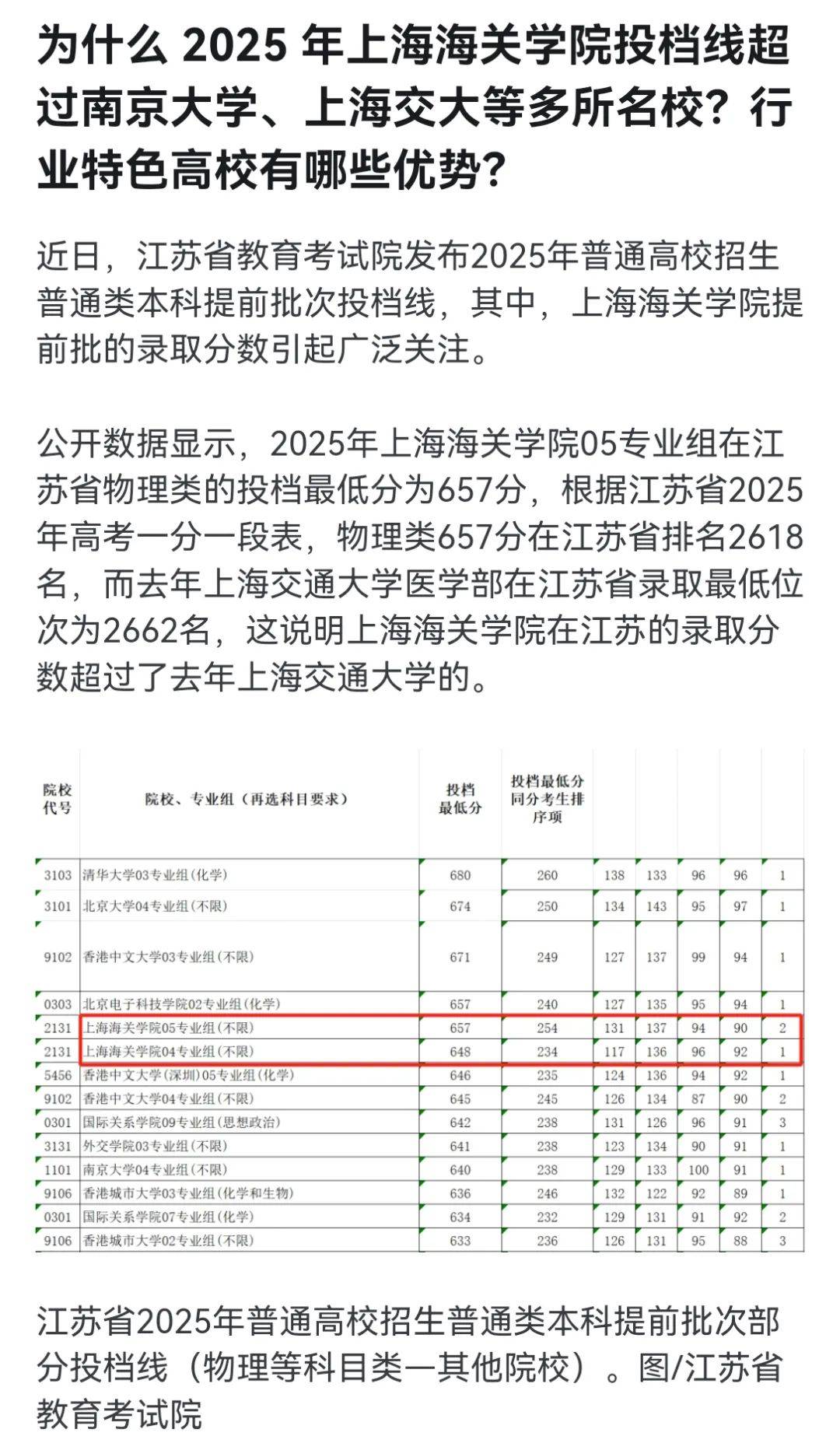
警校和海关学院,突然成了“性价比之选”?
Hu Xiu· 2025-07-13 00:00
Group 1 - The article discusses the significant differences in college admission scores across different provinces in China, highlighting the inherent flaws in relying solely on score lines for evaluating employment quality [4][6][11] - It emphasizes that students from economically developed regions, such as Jiangsu and Zhejiang, tend to have a better understanding of college admissions and job prospects compared to those from less developed areas [4][5][12] - The rising admission scores for police academies in Jiangsu are noted, with reports indicating that scores above 600 are now common, surpassing many prestigious universities [6][7] Group 2 - The article mentions that the highest reported score for the Jiangsu Police Academy is 663, which places students within the top 1800-1900 range for science subjects in the province [7] - It raises questions about the employability of graduates from police academies compared to those from top-tier universities, suggesting that the job security offered by police positions may be more appealing in certain contexts [8][12] - The discussion includes the increasing pressure on graduates to secure employment, leading to a higher volume of applications and potentially lower quality of academic work [9][10]