
纺织业

Search documents
2025年全国纺织业出口货值为2595.2亿元,累计下滑0.9%
Chan Ye Xin Xi Wang· 2026-01-24 02:42
Core Viewpoint - The textile industry in China is experiencing a decline in export value, with a reported decrease in both monthly and cumulative export figures for 2025 compared to the previous year [1]. Industry Summary - As of December 2025, the total export value of the textile industry in China reached 24.86 billion, reflecting a year-on-year decrease of 1% [1]. - The cumulative export value for the entire year of 2025 was 259.52 billion, showing a slight decline of 0.9% year-on-year [1]. - A statistical chart detailing the export value of the textile industry from 2019 to 2025 has been compiled based on data from the National Bureau of Statistics [1]. Company Summary - Listed companies in the textile sector include Fengzhu Textile (600493), Jiangnan High Fiber (600527), Hangmin Co., Ltd. (600987), Bailong Oriental (601339), and others [1]. - The report by Zhiyan Consulting provides an in-depth analysis of the market landscape and future prospects for the industrial textile sector in China, indicating a focus on comprehensive industry solutions for investment decisions [1].


鲁泰纺织股份有限公司 2025年度业绩预告
Zhong Guo Zheng Quan Bao - Zhong Zheng Wang· 2026-01-24 00:51
登录新浪财经APP 搜索【信披】查看更多考评等级 证券代码:000726 200726 证券简称:鲁泰A 鲁泰B 公告编号:2026-002 债券代码:127016 债券简称:鲁泰转债 鲁泰纺织股份有限公司 2025年度业绩预告 本公司及董事会全体成员保证信息披露的内容真实、准确、完整,没有虚假记载、误导性陈述或重大遗 漏。 一、本期业绩预计情况 1.业绩预告期间:2025年1月1日至2025年12月31日 ■ 二、与会计师事务所沟通情况 本次业绩预告相关数据是公司财务部门初步测算的结果,未经会计师事务所审计。 三、业绩变动原因说明 公司2025年度实现归属于上市公司股东的净利润增加,主要原因是出售交易性金融资产获得投资收益及 所持有交易性金融资产产生公允价值变动等收益,上述收益计入非经常性损益,增加净利润约17,000万 元。 四、其他相关说明 1.本次业绩预告是公司财务部门的初步测算结果,未经审计机构审计。2025年度具体数据,将在公司 2025年度报告中详细披露。 2.公司将严格按照有关法律法规的规定和要求,及时做好信息披露工作,敬请广大投资者注意投资风 险。 2.业绩预告情况:预计净利润为正值且属于同 ...

中国纺织稳步迈向全球产业中高端(向新向优的中国产业)
Ren Min Ri Bao· 2026-01-24 00:47
Core Viewpoint - The Chinese economy is set to focus on developing a modern industrial system by 2025, emphasizing the importance of the real economy, technological innovation, and the integration of traditional industries with new technologies [1]. Group 1: Industry Development - The modern industrial system is seen as the material and technical foundation for Chinese-style modernization, with a focus on advanced manufacturing as the backbone [1]. - The textile industry, a traditional sector, is experiencing revitalization through innovation and new applications, such as the use of ultra-high molecular weight polyethylene fibers in robotics [2][3]. - Despite external pressures and insufficient domestic demand, the textile industry is showing resilience, with significant production and export capabilities, including over 700 billion garments produced annually [3]. Group 2: Brand Strength - The textile sector is enhancing its competitiveness through strong branding, with companies like Zhejiang Yizhong Clothing achieving a 20% increase in revenue in 2025 [5]. - The establishment of a quality grading system in the local industry has improved product competitiveness, with sales in the local down jacket industry expected to exceed 50 billion yuan in 2025 [5]. - A report indicates that 60% of consumers prefer domestic brands in the apparel and footwear categories by 2025 [5]. Group 3: Innovation - The integration of AI technology in clothing customization is revolutionizing the industry, allowing for rapid and accurate size generation from photographs [6][7]. - The digitalization of textile enterprises has reached a tool adoption rate of 84.9% by September 2025, significantly improving production efficiency [7]. Group 4: Export Growth - The silk export sector is expanding, with a reported 20% increase in export volume for Jiangsu Huajia Silk Co. in 2025 [8]. - The overall export value from the Shengze Town, a key fabric export base, is projected to grow by 5.1% in 2025, reflecting a more diversified export structure [8]. - The Chinese textile industry is leveraging a global supply chain network to enhance market reach and frequency of transactions [8].
实力更强 技术更新 市场更多元 中国纺织稳步迈向全球产业中高端(向新向优的中国产业)
Ren Min Ri Bao· 2026-01-23 21:53
Core Viewpoint - The Chinese economy is set to focus on developing a modern industrial system by 2025, emphasizing the importance of the real economy, technological innovation, and the integration of traditional industries with new technologies [1]. Group 1: Industry Development - The textile industry is a vital pillar of China's economy, contributing significantly to employment, innovation, and consumption [3]. - China has the most complete textile industrial system globally, producing over 70 billion garments annually and accounting for over 30% of global textile and apparel trade [3]. - Despite external pressures and insufficient domestic demand, the textile industry continues to thrive, with new trends like "Guochao" (national trend) gaining international attention [3][4]. Group 2: Brand Strength - In Pinghu, Zhejiang, the local down jacket industry has shifted from OEM to building strong regional brands, with a projected sales scale exceeding 50 billion yuan by 2025 [5]. - The World Brand Lab's ranking shows that several textile companies, including Hengli and Weiqiao, have improved their positions, reflecting a growing preference for domestic brands among consumers [5]. Group 3: Innovation - Companies are leveraging AI technology for custom clothing, significantly improving production efficiency by over 70% through digital modeling [6][7]. - As of September 2025, the penetration rate of digital R&D design tools in the textile sector has reached 84.9%, indicating rapid growth in digital transformation [7]. Group 4: Resilience - Jiangsu Huajia Silk Co., Ltd. reported a more than 20% year-on-year increase in export volume, actively expanding into new markets like Australia and Turkey [8]. - The export volume from Shengze Town, a key fabric export base, increased by 5.1% year-on-year, showcasing the industry's ability to adapt and grow through a global supply chain network [8].
降本加量扩围 结构性货币政策增强企业获得感
Zhong Guo Zheng Quan Bao· 2026-01-23 21:02
Group 1: Financial Support and Policy Impact - The issuance of a 150 million yuan loan has addressed the urgent funding needs for technological transformation at Guangdong Rifa Cable Co., which plans to build an automated production project with an expected production efficiency increase of 20%-50% [1] - The People's Bank of China has introduced a series of structural monetary policy measures, including a 0.25 percentage point reduction in various policy tool rates and an expansion of the re-lending quota for technological innovation and transformation to 1.2 trillion yuan [1][4] - The Agricultural Bank of China provided a tailored financial service plan for Huafei Textile, including a 150 million yuan project loan, leveraging the favorable policy environment created by the recent interest rate cuts [2] Group 2: Bank Lending and Economic Support - The Transportation Bank of Guangdong has supported nearly 200 technology enterprises and 25 technological transformation projects, with a total credit investment exceeding 6.5 billion yuan, significantly reducing interest expenses for enterprises [3] - The recent reduction in structural monetary policy tool rates has enabled banks to obtain funds at lower costs from the central bank, enhancing their ability to issue loans to qualifying enterprises [3] - The People's Bank of China has already disbursed 5.036 billion yuan in re-lending and rediscount funds to financial institutions following the rate cuts, effectively transmitting policy benefits to agricultural, small, and private enterprises [2][3] Group 3: Future Expectations and Industry Focus - The optimization of structural monetary policy tools is expected to guide financial resources towards technology innovation, green development, and support for small and micro enterprises, with a specific focus on a 1 trillion yuan re-lending quota for private enterprises [4][5] - Analysts believe that the enhancements in structural monetary policy tools reflect the government's commitment to supporting specific industries, which will help stabilize market expectations and attract more social capital into these sectors [5] - The central bank aims to utilize various structural monetary policy tools to support key areas of the national economy, including technology innovation, manufacturing transformation, and consumption stimulation, ensuring a foundation for long-term high-quality development [5]
鲁泰A:2025年度业绩预盈公告
Zheng Quan Ri Bao Zhi Sheng· 2026-01-23 13:16
(编辑 丛可心) 证券日报网讯 1月23日,鲁泰A发布公告称,公司预计2025年度归属于上市公司股东的净利润为57,000 万元至63,000万元,比上年同期41,032.14万元增长38.92%至53.54%。 ...
鲁泰A发预增,预计2025年度归母净利润5.7亿元至6.3亿元,同比增长38.92%至53.54%
Zhi Tong Cai Jing· 2026-01-23 13:05
鲁泰A(000726.SZ)披露2025年度业绩预告,公司预计归属于上市公司股东的净利润5.7亿元至6.3亿元, 同比增长38.92%至53.54%;扣除非经常性损益后的净利润3.7亿元至4.3亿元。 ...
华升股份(600156.SH):目前暂未建立财务共享中心
Ge Long Hui· 2026-01-23 10:01
格隆汇1月23日丨华升股份(600156.SH)公布,公司目前暂未建立财务共享中心。未来,公司将顺应数字 化趋势,推动搭建财务共享中心,实现财务数智化转型。 ...

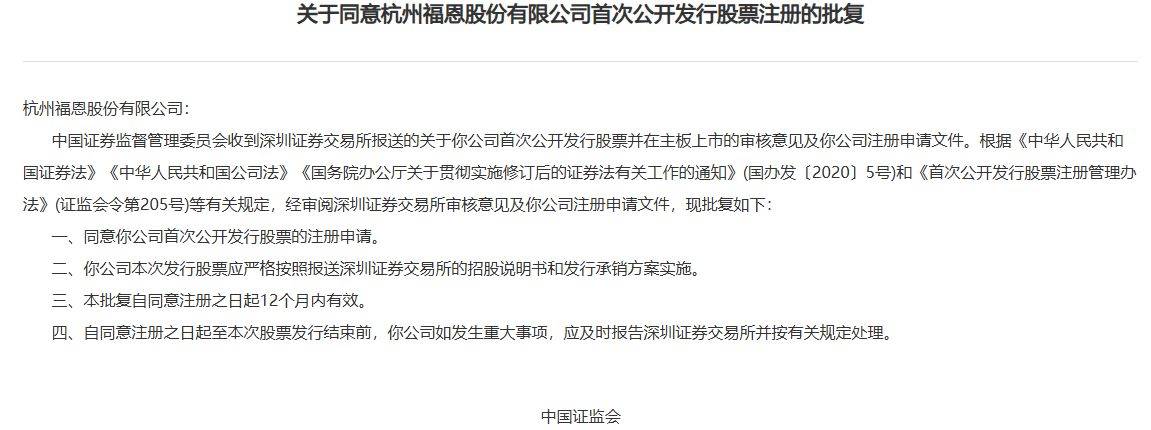
福恩股份IPO获注册:深耕全球生态环保再生面料市场
Sou Hu Cai Jing· 2026-01-23 02:17
Core Viewpoint - The approval of Hangzhou Fuen Co., Ltd.'s initial public offering (IPO) by the China Securities Regulatory Commission marks a significant step for the company, which specializes in sustainable eco-friendly fabrics and is a leader in the domestic recycled fabric market [1]. Company Overview - Hangzhou Fuen Co., Ltd. is a global supplier of eco-friendly fabrics, focusing on the research, production, and sales of sustainable materials. The company has established itself as a large enterprise integrating fabric design, research, spinning, weaving, dyeing, finishing, and sales [4]. - The main products are eco-friendly fabrics, primarily made from recycled materials, positioning the company as a leader in the domestic market for recycled fabrics. The materials used include recycled plastics and textiles, aligning with the growing global recognition of sustainable development [4]. - Fuen has been recognized by the China National Textile and Apparel Council as a "Development Base for Recycled Fiber Fashion Fabric Products," highlighting its role in the textile industry's transformation towards sustainability [4]. Industry Trends - The global recycled fabric industry is experiencing rapid growth driven by policies and brand commitments. For instance, the EU's Sustainable Product Ecodesign Regulation sets clear targets for the use of recycled materials in textiles, prompting brands like H&M and Fast Retailing to commit to increasing the proportion of recycled materials in their products to 50% in the coming years [5]. - In China, the goal is to achieve a 25% recycling rate for waste textiles by 2025, supported by various government initiatives. The global sustainable recycled fiber market is expected to grow at a compound annual growth rate (CAGR) of approximately 6.7% [5]. - China, as the largest textile and apparel producer and consumer, is projected to exceed 3 million tons of annual recycled fiber usage by 2024, with a 12% annual growth rate in the recycling of waste textiles [5]. Challenges in the Industry - Despite the industry's growth, challenges remain, including a low overall recycling rate of less than 30% for waste textiles in China. Key issues include technological bottlenecks and high costs associated with recycling processes [6]. - Most recycling currently relies on physical methods, which produce low-value products. Although chemical recycling methods can achieve high-quality circularity, they face challenges in cost and complexity, hindering large-scale industrialization [6]. - The recycling system is also underdeveloped, with challenges in sourcing and sorting diverse and complex materials, which complicates efficient recycling and stable raw material supply [6]. Future Outlook - China is a crucial production center for recycled fibers, particularly recycled polyester, holding over 65% of the global market share in the Asia-Pacific region. Fuen Co., Ltd. has established a vertically integrated system from research to production and has successfully embedded itself in the green supply chains of global fast fashion brands [7]. - Domestic companies are making technological advancements, such as effectively separating polyester and cotton blends, addressing significant technical challenges in recycling [7]. - However, the high-end market and technological leadership in global recycled fibers are still dominated by international companies. Most of China's recycled fiber production remains at the primary product stage, facing structural challenges in transitioning to high-value fabrics [7]. - The future of China's recycled fabric industry requires continued investment in research and development to build technological barriers and the establishment of a digital lifecycle management system for raw material recycling and product traceability to meet increasingly complex international green trade regulations [7].
江西玉山:厚植发展沃土,让企业安心发展
Xin Lang Cai Jing· 2026-01-21 21:34
(来源:中华工商时报) 玉山县工商联联合司法局建立"律师轮班"制度,在企业服务中心常态化为企业提供法治体检、纠纷化解 等法律服务。针对大福科技等企业的需求,联合人社部门举办专场招聘会,帮助企业快速补齐用工缺 口。 玉山县把优化营商环境作为"一把手工程",创新推出"亲清恳谈日"机制,县委、县政府领导带队上门倾 听企业诉求。县高新区企业服务中心为企业提供全周期帮办代办服务,2025年为263家企业办结事项511 件。"财园信贷通""科创贷"等金融产品精准发力,2025年为220余家企业解决融资超9.6亿元。税务部门 更是主动上门,为大福科技等新落地企业开展纳税信用复评辅导、研发费用加计扣除政策解读,助力企 业纾困解难。 作为连续10次入选"浙商最佳投资目的地"的县区,玉山已吸引近7500名浙商投资超400亿元,浙资企业 工业税收占全县七成以上。2025年1至11月,玉山县签约亿元以上项目60个,总投资146.736亿元。规上 工业增加值增长10%,高新技术产业投资增长146.2%。截至目前,玉山县在册经营主体已有4.9万余 户。 转自:中华工商时报 地处浙赣边界的江西省玉山县凭借"办事不用求人、办事便捷高效"的优 ...