
金融科技

Search documents
新大陆(000997):Q3利润增速实现反弹,首发支付行业专属大模型
Haitong Securities International· 2025-10-30 05:29
Investment Rating - The report maintains an "Outperform" rating for the company, expecting a relative performance exceeding the benchmark index by over 10% in the next 12-18 months [4][9]. Core Insights - The company is projected to have a net profit attributable to shareholders of RMB 1.28 billion for 2025, with adjustments to RMB 1.57 billion and RMB 1.91 billion for 2026 and 2027 respectively. The EPS forecasts for 2025-2027 are RMB 1.26, RMB 1.55, and RMB 1.89 [4][9]. - The target price is set at RMB 38.71, based on a 25x PE ratio for 2026, referencing comparable companies [4][9]. - In Q3 2025, the company reported a revenue increase of 14.86% year-on-year, with a net profit attributable to shareholders rising by 29.77% year-on-year [4][9]. - For the first three quarters of 2025, total revenue reached RMB 62.44 billion, up 12.04% year-on-year, while net profit attributable to shareholders was RMB 9.18 billion, an increase of 12.15% year-on-year [4][9]. - The gross profit margin (GPM) for Q3 was 35.71%, a slight decrease of 0.25 percentage points year-on-year, but showed recovery from Q2 due to improved market conditions [4][9]. Financial Summary - The company’s total revenue is projected to grow from RMB 8.25 billion in 2023 to RMB 11.705 billion by 2027, reflecting a compound annual growth rate (CAGR) of 18.3% [3][4]. - The net profit attributable to shareholders is expected to increase significantly from RMB 1.004 billion in 2023 to RMB 1.913 billion in 2027, indicating a CAGR of 22% [3][4]. - The sales gross margin is expected to improve from 35.2% in 2023 to 42.5% by 2027, demonstrating operational efficiency [3][4]. Business Performance - The merchant operation services segment recorded a transaction volume of RMB 16.2 trillion in the first three quarters, with Q3 alone contributing nearly RMB 570 billion, marking an over 18% year-on-year growth [4][9]. - The smart terminal sector achieved over 26% year-on-year growth in overseas payment equipment revenue in Q3, indicating strong market penetration in emerging markets [4][9]. - The company launched an industry-specific AI model and has seen over 150,000 merchants trialing its AI marketing products, showcasing innovation in technology integration [4][9].

香港金管局:数码货币及数据基建共同构建香港未来金融体系的核心支柱
Zhi Tong Cai Jing· 2025-10-30 03:49
Core Viewpoint - The Hong Kong Monetary Authority (HKMA) emphasizes the importance of digital currency and data infrastructure as core pillars for the future financial system of Hong Kong [1] Group 1: Financial Infrastructure - The HKMA's "Fintech 2025" initiative aims to promote the adoption of financial technology and cultivate talent and enterprises in the fintech sector [1] - A robust financial infrastructure is likened to a highway that facilitates the safe and efficient flow of funds and financial assets within the economy [1] - The exploration of Central Bank Digital Currency (CBDC) and the development of next-generation data infrastructure are highlighted as key components of the financial system [1][2] Group 2: Digital Currency Development - Hong Kong has been researching CBDC since 2017, with the "Digital Hong Kong Dollar" being a focus for international trade payments [2] - The mBridge project connects the "Digital Hong Kong Dollar" with CBDCs from mainland China, Thailand, and the UAE, significantly reducing cross-border transaction processing time from days to seconds [2] - The project is expected to enter the Minimum Viable Product (MVP) stage in 2024, enhancing the efficiency of cross-border payments for businesses [2] Group 3: Tokenization Initiatives - The HKMA is exploring how tokenization can improve the financial system, with the Ensemble project launched to develop a tokenization ecosystem [3] - The project has gained international attention, collaborating with central banks from Brazil, France, and Thailand on cross-border tokenization use cases [3] - The use of tokenized deposits for digital asset trading settlements is being researched, with the "Digital Hong Kong Dollar" serving as the currency backbone [3] Group 4: Data Infrastructure Development - The establishment of the Commercial Data Interchange (CDI) aims to facilitate data flow between banks and data providers, enhancing connectivity [4] - Since its launch in 2022, CDI has formed partnerships with 26 banks and 17 data providers, facilitating over 71,000 loan applications with a total credit approval amount exceeding HKD 58.1 billion [4] - The CDI also supports small and medium-sized enterprises in overcoming challenges when applying for bank loans [4] Group 5: API and Interconnectivity - The opening of the API framework and the implementation of the Interbank Account Data Sharing (IADS) service allow customers to securely share data across different banks and platforms [5] - Over 1,200 APIs have been launched, with a monthly usage exceeding 96 million times, while IADS has attracted over 70,000 users [5] - The CDI has automated over 1.5 million record verifications monthly, enhancing the efficiency of financial services [5] Group 6: Recognition and Future Plans - The achievements of the "Fintech 2025" initiative have led to Hong Kong being ranked first in the fintech category among major international financial centers [6] - The HKMA plans to announce the next phase of its fintech development blueprint to ensure Hong Kong remains at the forefront of financial technology [6]
我国量子科技取得重大突破!金融科技ETF(516860)近一周累计上涨超5%,神州信息涨停
Xin Lang Cai Jing· 2025-10-30 03:33
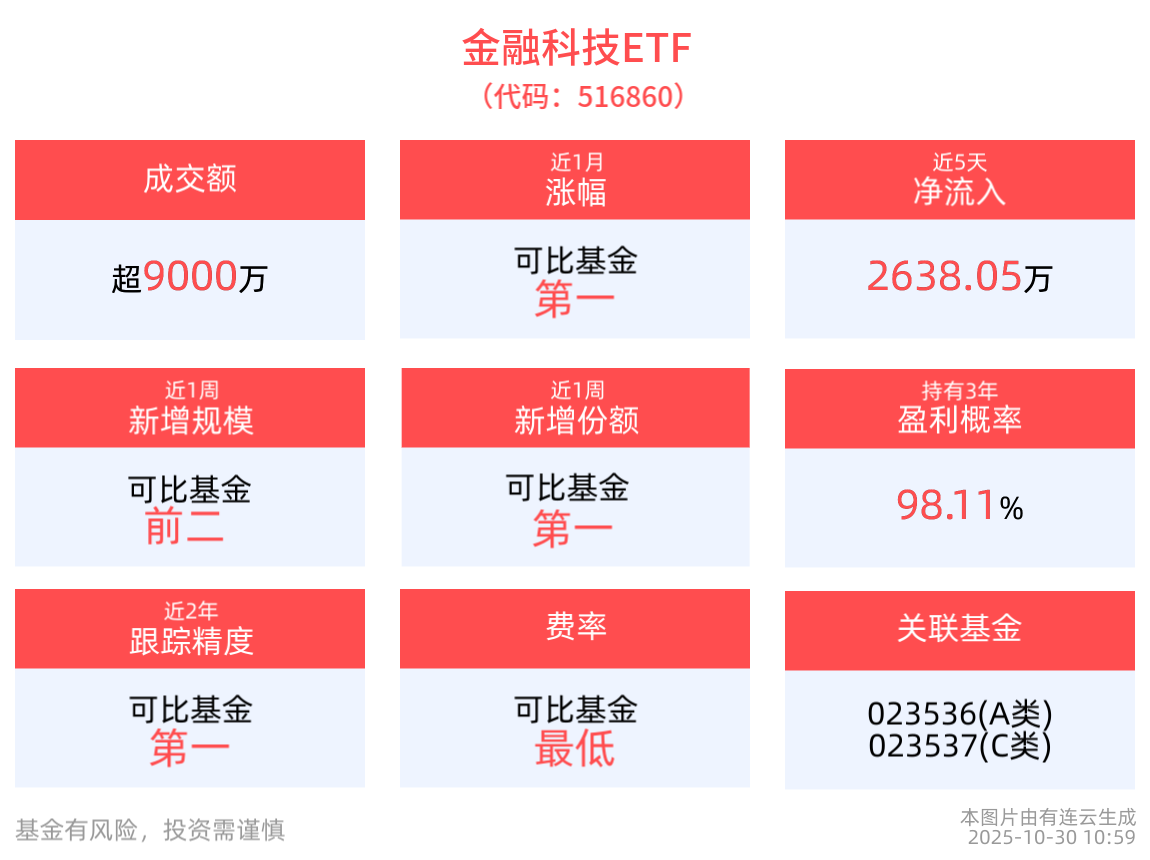
Group 1 - The China Securities Financial Technology Theme Index decreased by 1.26% as of October 30, 2025, with mixed performance among constituent stocks [3] - The Financial Technology ETF (516860) fell by 1.42%, with a latest price of 1.53 yuan, but has seen a 5.50% increase over the past week, ranking 1 out of 7 among comparable funds [3] - The trading volume for the Financial Technology ETF reached 93.84 million yuan, with a turnover rate of 3.78% [3] Group 2 - Quantum technology is becoming a key focus for research and development, with significant breakthroughs transitioning from theoretical research to practical applications [4] - A quantum computing company in Beijing reported that its latest product has a computing capacity of 1000 qubits, enabling the control of 1000 variables in a single calculation [4] - The first domestic optical quantum computer manufacturing plant is set to open in Shenzhen next month, entering small-scale production [4] Group 3 - The Vice Chairman of the China Securities Regulatory Commission emphasized the need to regulate the application of artificial intelligence in capital markets to mitigate risks [4] - Quantum computing is identified as a core driver of next-generation information technology, with its applications expanding from specialized to general computing, impacting sectors like finance, pharmaceuticals, and energy [4] - The quantum computing industry is at a critical turning point, with the period from 2025 to 2030 expected to be a golden window for commercialization, potentially reaching a market size of hundreds of billions [4] Group 4 - The Financial Technology ETF saw a significant increase in scale, growing by 116 million yuan over the past week, ranking 2 out of 7 among comparable funds [4] - The ETF's share count increased by 7 million shares in the past week, also ranking 1 out of 7 among comparable funds [4] - The latest net outflow for the Financial Technology ETF was 6.18 million yuan, but there were net inflows on 3 out of the last 5 trading days, totaling 26.38 million yuan [4] Group 5 - The China Securities Financial Technology Theme Index tracks companies involved in financial technology, reflecting the overall performance of these securities [5] - As of September 30, 2025, the top ten weighted stocks in the index accounted for 55.55% of the total index weight [5]


Fiserv's former CEO left the fintech company in crisis. Trump put him in charge of Social Security.
MarketWatch· 2025-10-29 20:59
Core Insights - Social Security Commissioner Frank Bisignano sold his Fiserv stock for at least $500 million prior to the stock's decline [1] Company Summary - Frank Bisignano's sale of Fiserv stock occurred before a significant drop in the stock's value, indicating potential insider knowledge or market timing [1]


2025全球金融科技中心城市榜单:北京排名第一
Bei Jing Shang Bao· 2025-10-29 16:40
Core Insights - The report released by the Beijing Frontier Financial Regulatory Technology Research Institute highlights five core trends in the development of fintech globally, emphasizing the need for innovation and competitive advantage amidst significant global changes [1][3] Summary by Sections Global Fintech City Rankings - The 2025 Global Fintech Hub Report ranks Beijing as the top city for fintech development, followed by San Francisco, New York, London, Shanghai, Shenzhen, Hangzhou, Singapore, Hong Kong, and Paris [2] - The rankings show minimal changes from 2024, with Hong Kong rising one position and Paris replacing Sydney in the top ten [2] Factors Contributing to Rankings - The report attributes Beijing's top position to strong policy guidance and market vitality, supported by its status as a national financial management and technology innovation center [3][4] - China's large economy and active digital economy, which accounts for over 40% of GDP, provide a rich landscape for fintech, particularly in the consumer sector [3] Regional Analysis - Asia leads the global fintech competition with 25 cities in the top 50, while the Americas and Europe account for 28% and 20% respectively [4] - Among the top 50 cities, 70% experienced ranking changes, indicating fierce competition [2][4] Emerging Centers - The report notes that 14 cities in the top 50 have improved their rankings, with a significant presence from emerging markets, highlighting the dual role of industry/technology and ecosystem/rules in driving fintech development [6] - New emerging cities are showing differentiated advantages in the competitive landscape, with a focus on creating a conducive environment for fintech innovation [6] Importance of Fintech Development - The advancement of fintech is crucial for the modernization of financial systems, driving innovation, economic growth, and job creation [7] - To enhance competitiveness, cities need to focus on diverse and inclusive fintech market innovations, maintain high levels of research investment, and foster open ecosystems [7]
全球金融科技中心城市报告发布,北京蝉联榜首
Bei Jing Ri Bao Ke Hu Duan· 2025-10-29 15:12
Group 1 - The core theme of the 2025 Financial Street Forum focuses on "Building a Financial Digital Intelligence Ecosystem under Artificial Intelligence" [1] - Beijing ranks first in the "2025 Global Financial Technology Center Cities" report, leading in financial technology industry scale, R&D investment, and information technology industry scale [1][3] - The top 10 cities in the global financial technology ranking include Beijing, San Francisco, New York, London, Shanghai, Shenzhen, Hangzhou, Singapore, Hong Kong, and Paris [1] Group 2 - The report indicates that global competition in financial technology is intensifying, with cities innovating and competing more fiercely [3] - The gap between the top 10 cities has been narrowing for six consecutive years, highlighting the growing strength of these cities in the financial technology arena [3] - In 2025, Asian cities continue to lead in the global financial technology landscape, with 60% representation in the top 10 cities [3] Group 3 - The Beijing Frontier Financial Regulatory Technology Research Institute is a non-profit research organization guided by the Beijing Municipal Financial Supervision and Administration Bureau [4] - The "Global Financial Technology Center Network" was launched to create an international and branded world-class financial technology ecosystem [4] Group 4 - The 2025 Financial Street Forum includes discussions on empowering financial digitalization and intelligent transformation through financial technology [5] - The event features contributions from government departments, financial institutions, and academia, focusing on the latest developments and research in financial technology and green innovation [5]
2025金融街论坛|2025全球金融科技中心城市榜单:北京排名第一,新兴中心崛起
Bei Jing Shang Bao· 2025-10-29 14:42
Core Insights - The report highlights the competitive landscape of global fintech cities, with a focus on the top 50 cities selected from over 80 worldwide, showcasing their fintech ecosystems and industry development status [1][3] Ranking Overview - Beijing ranks first globally in the 2025 fintech city rankings, followed by San Francisco, New York, London, Shanghai, Shenzhen, Hangzhou, Singapore, Hong Kong, and Paris [3] - The rankings show minimal changes compared to 2024, with Hong Kong rising one position and Paris replacing Sydney in the top 10 [3] Trends in Fintech Development - The report identifies five core trends in fintech development, emphasizing the need for innovation and competitive advantage amidst a rapidly evolving global landscape [1] - The gap in fintech development index scores between the top-ranked city and the tenth has decreased from 29.7 points in 2020 to 22.8 points in 2025, indicating a more competitive environment [4] Regional Analysis - Asia leads the global fintech competition, with 25 cities in the top 50, representing 50% of the total [6][7] - Among the top 10 cities, 60% are from Asia, with five cities from China, highlighting the region's dominance in fintech [6] Emerging Market Dynamics - The report notes that 14 cities in the top 50 have improved their rankings, with a significant presence from emerging markets, which account for 50% of the cities showing upward movement [9] - The rise of new fintech centers is attributed to both industry/technology-driven and ecosystem/rules-driven development models [9] Importance of Fintech Development - Fintech is crucial for modern financial system innovation, driving economic growth and creating job opportunities [10] - The report emphasizes the need for diverse and inclusive market innovation, high research investment, and international collaboration to enhance the competitiveness of cities in fintech [10]


美股三大指数高开,纳指再创新高
第一财经· 2025-10-29 13:56
Market Performance - On October 29, US stock indices opened higher, with the Dow Jones up 0.30%, Nasdaq up 0.66% reaching a new historical high, and S&P 500 up 0.28% [1] - The current price of the Dow Jones Industrial Average is 47849.41, with an increase of 143.04 points [2] - The Nasdaq index is at 23985.31, rising by 157.82 points [2] - The S&P 500 index stands at 6910.01, up by 19.12 points [2] Notable Company Movements - Nvidia's stock increased by over 3%, with its market capitalization surpassing $5 trillion, making it the first company globally to achieve this milestone [2] - Caterpillar's stock rose by over 6% [3] - Fiserv's stock experienced a significant decline of 44% [3] Other Indices - The Nasdaq China Golden Dragon Index increased by 0.6% [4]



美股三大指数集体高开,纳指涨0.65%,英伟达涨超3%
Feng Huang Wang Cai Jing· 2025-10-29 13:42
Group 1 - The three major U.S. stock indices opened higher, with the Dow Jones up 0.29%, the Nasdaq up 0.65%, and the S&P 500 up 0.26% [1] - Nvidia shares rose over 3% as the company projected a business scale of $500 billion over the next six quarters [1] - Caterpillar's stock increased by more than 6% [1] Group 2 - Futu Holdings saw its shares rise over 3% [1] - Kingsoft Cloud's stock increased by more than 2% [1]
道指开盘涨0.3%,标普500涨0.3%,纳指涨0.7%
Xin Lang Cai Jing· 2025-10-29 13:40
Group 1 - Caterpillar's stock increased by 5.9% after Q3 adjusted EPS exceeded expectations [1] - GlaxoSmithKline's stock rose by 5.3% due to a Q3 revenue increase and a return to profitability [1] - Bloom Energy's stock surged by 13% with a year-over-year growth of 57.1% in Q3 [1] Group 2 - FIS's stock plummeted by 42.1% after lowering its full-year adjusted EPS guidance [1]

