
集成电路

Search documents
积塔半导体增资至179亿元,增幅约6%
Sou Hu Cai Jing· 2025-12-11 06:11
天眼查工商信息显示,12月9日,上海积塔半导体有限公司发生工商变更,新增中电金投控股有限公 司、中电中金(厦门)智能产业股权投资基金合伙企业(有限合伙)、重庆中金科元私募股权投资基金 合伙企业(有限合伙)等为股东,注册资本由约169亿人民币增至约179亿人民币,增幅约6%,同时, 多位主要人员发生变更。 上海积塔半导体有限公司成立于2017年11月,法定代表人为孙劼,经营范围含集成电路芯片及产品制 造、集成电路芯片设计及服务、电子元器件批发、电子产品销售、计算机软硬件及辅助设备批发、计算 机系统服务、信息系统集成服务等。股东信息显示,该公司现由华大半导体有限公司、上海集成电路产 业投资基金股份有限公司、中国互联网投资基金(有限合伙)及上述新增股东等共同持股。 ...
甬矽电子(688362):消费类订单持续饱满,2.5D封装加速验证
China Post Securities· 2025-12-11 06:08
| 最新收盘价(元) | 31.98 | | --- | --- | | 总股本/流通股本(亿股)4.10 | / 4.10 | | 总市值/流通市值(亿元)131 | / 131 | | 52 周内最高/最低价 | 40.79 / 24.06 | | 资产负债率(%) | 70.4% | | 市盈率 | 199.88 | | 第一大股东 | 浙江甬顺芯电子有限公 | | 司 | | 研究所 分析师:吴文吉 SAC 登记编号:S1340523050004 Email:wuwenji@cnpsec.com 分析师:翟一梦 SAC 登记编号:S1340525040003 Email:zhaiyimeng@cnpsec.com 甬矽电子(688362) 证券研究报告:电子 | 公司点评报告 股票投资评级 资料来源:聚源,中邮证券研究所 公司基本情况 消费类订单持续饱满,2.5D 封装加速验证 l 投资要点 消费类订单持续饱满。2025 年前三季度,随着全球终端消费 市场持续回暖,产业链去库存周期基本结束,叠加 AI 应用场景不 断涌现,集成电路行业整体景气度维持在较高水平。2025 年前三 季度,得益于海外大客户的 ...

上海高质量孵化器增至18家
Jie Fang Ri Bao· 2025-12-11 05:27
Core Insights - Shanghai has added 6 new high-quality incubators, bringing the total to 18, focusing on emerging industries such as synthetic biology, brain-machine intelligence, and integrated circuits [1][2]. Group 1: New Incubators - The newly added incubators include: - Nest Shanghai Innovation Incubator, focusing on synthetic biology and gene therapy [1] - Sinan Brain-Machine Intelligence Incubator, concentrating on brain-machine interfaces and cognitive disorder interventions [2] - Shanghai Aimi Sanjiang New Materials Innovation Center, targeting new materials and membrane materials [2] - "Shutong Chain Valley" Blockchain Application Innovation Incubator, focusing on blockchain core technologies [2] - "Zero Bay" Science and Technology Innovation Incubator, emphasizing electronic information and advanced equipment [2] - Zhangjiang Gaoke 895 Incubator, serving the integrated circuit design industry [3] Group 2: Focus Areas and Objectives - The high-quality incubators aim to accelerate the construction of local technology enterprises and nurture future industries, with a focus on areas such as large models, quantum optics, intelligent sensing, humanoid robots, and cell and gene therapy [1]. - The Nest Shanghai Innovation Incubator aims to support the biopharmaceutical industry by exploring disruptive life science technologies and establishing a mechanism for technology transfer [1]. - The Sinan Brain-Machine Intelligence Incubator collaborates with academic and medical institutions to create a comprehensive incubation model [2]. - The Shanghai Aimi Sanjiang New Materials Innovation Center has established a full-cycle incubation chain for technology commercialization [2]. - The "Shutong Chain Valley" incubator integrates various application scenarios for blockchain technology to empower startups [2]. - The "Zero Bay" incubator focuses on identifying commercially valuable technologies and projects through collaboration with universities [2].
湖南向伟创见科技有限公司成立 注册资本200万人民币
Sou Hu Cai Jing· 2025-12-11 04:57
Core Viewpoint - Hunan Xiangwei Chuangjian Technology Co., Ltd. has been established with a registered capital of 2 million RMB, focusing on various technology sectors including smart robotics and integrated circuit design [1] Group 1: Company Overview - The company is legally represented by Gao Wei [1] - The registered capital of the company is 2 million RMB [1] Group 2: Business Scope - The business scope includes research and development of smart robots, integration of smart control systems, and sales of smart robots [1] - The company also engages in integrated circuit chip design and services, as well as sales of integrated circuit chips and products [1] - Additional services include quantum computing technology services, sales of optical instruments and glass, and electronic measurement instruments [1] - The company is involved in the retail of electronic components, specialized materials, and various types of machinery and equipment [1] - It offers technology services, development, consulting, and software sales, along with new materials technology research [1]
中国IC独角兽、安徽制造EDA龙头,启动IPO!
Sou Hu Cai Jing· 2025-12-11 03:08
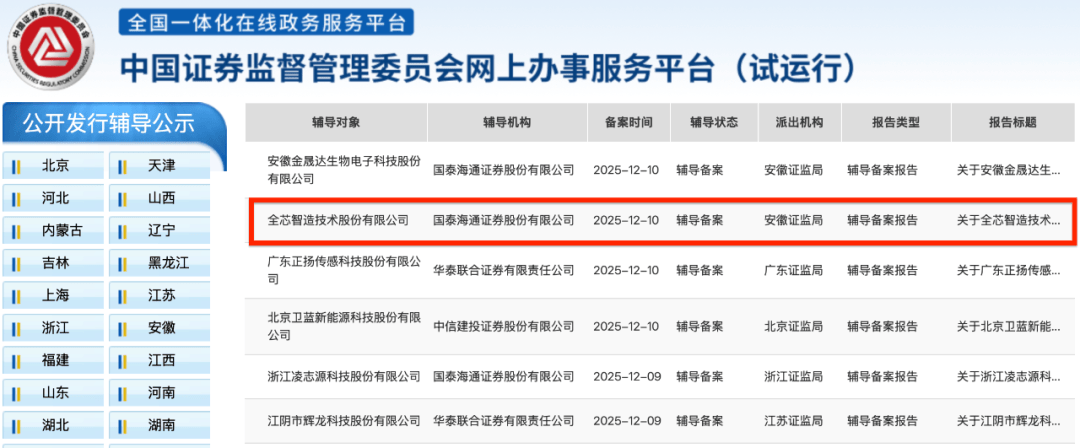
今年9月,全芯智造刚刚完成规模达10亿元的C轮融资,农银资本、中国人保等金融资本的加入,为其技术研发和市场拓展注入新的资金活力。据浑璞投 资公众号披露,作为国内制造EDA的领军者,全芯智造已构建起四大核心技术平台——国产计算光刻平台、设计制造协同优化平台、智能制造平台及全 流程工艺器件仿真设计平台,形成覆盖半导体制造关键环节的技术矩阵。 12月10日,证监会官网披露信息显示,总部位于安徽合肥的全芯智造技术有限公司(下称"全芯智造")已在安徽证监局完成辅导备案登记,正式启动IPO 进程,国泰海通担任本次发行的辅导机构。 | | | 公开发行辅导公示 | 辅导对象 | 辅导机构 | 备案时间 | 辅导状态 | 派出机构 | 报告类型 | 报告标题 | | --- | --- | --- | --- | --- | --- | --- | --- | --- | --- | | = | 北京 | 天津 | 安徽金晟达生物电子科技股份 有限公司 | 国泰海通证券股份有限公司 | 2025-12-10 | 辅导备案 | 安徽证监局 | 辅导备案报告 | 关于安徽金晟达生 ... | | - | 河北 | 山西 - | ...

从交往“有度”到服务“有为”——广州出台第二批政商交往指引助力全周期护航企业高质量发展
Guang Zhou Ri Bao· 2025-12-11 01:38
Core Points - The article emphasizes the importance of effective governance in promoting economic and social development, as highlighted by the 20th Central Committee's Fourth Plenary Session [1] - The "Guidelines (Second Batch)" aim to clarify and standardize the "three distinctions" principle, fostering a supportive environment for enterprise development and optimizing the business environment [1][7] - The guidelines address 15 typical scenarios across six areas, providing answers and case studies to assist officials in better serving enterprises [1][4] Group 1: Investment and Financing - The guidelines identify issues faced by state-owned capital investment funds, such as reluctance and lack of expertise in making investments, which hinder industrial upgrades and economic growth [2] - Two scenarios and one case are set in the investment and financing section to encourage market-oriented investment decisions within legal frameworks [2][3] Group 2: Approval Processes - The guidelines include specific cases related to approval processes, such as expedited approvals for drone companies and automatic qualification for autonomous taxi operations, to alleviate concerns among officials [4] - The content covers the entire enterprise development cycle, addressing high-frequency and ambiguous service scenarios to enhance efficiency and support for new industries [4][6] Group 3: Learning from Advanced Practices - The guidelines introduce a "learning from others" section, compiling nine best practices from cities like Beijing and Shanghai to improve the business environment and government-enterprise relationships [6] - By comparing local practices with those of advanced regions, the guidelines aim to identify strengths and weaknesses, fostering a culture of improvement and competitiveness [6] Group 4: Governance and Accountability - The guidelines promote a shift in government-business interactions from superficial engagements to substantive support for enterprises, addressing both excessive familiarity and lack of action [7] - The guidelines serve as a reference for supervision and accountability, signaling support for innovation and tolerance for mistakes to create a favorable political and developmental environment [7]
激发“中国制造+中国市场”澎湃动力
Jing Ji Ri Bao· 2025-12-11 00:59
Group 1 - The core argument emphasizes the importance of a modernized industrial system as a foundation for a country's international market influence and its impact on people's livelihoods [1] - The super-large market in China is a significant advantage, providing a robust support system for the modern industrial framework through large-scale production and innovation cost reduction [2] - The open nature of the super-large market enhances the resilience and capability of the industrial supply chain, allowing domestic companies to engage in global competition effectively [2] Group 2 - China's industrial system has evolved into a structure that supports diverse consumption needs, showcasing capabilities in high-end manufacturing and meeting consumer demands [3] - The combination of strong supply capabilities from Chinese manufacturing and the vast demand potential of the Chinese market creates a significant economic scale advantage [3] - Future economic growth will increasingly rely on the dynamic balance between supply and demand, necessitating continued market reforms and the creation of a fair business environment [3]
金观平:激发“中国制造+中国市场”澎湃动力
Jing Ji Ri Bao· 2025-12-11 00:10
Group 1 - The modernization of the industrial system is crucial for a country's international market influence and the well-being of its citizens, with China's large-scale market being a significant advantage [1] - A large-scale market empowers the modern industrial system by enabling mass production, which reduces innovation costs and creates a positive cycle of research, production, and iteration [1] - The strong siphoning effect of a large-scale market attracts global talent and capital, providing robust support for industrial innovation and transforming factor advantages into industrial advantages [1] Group 2 - China's automotive and integrated circuit exports have shown impressive growth rates of 25.6% and 17.6% respectively over the past 11 months, highlighting the open nature of the large-scale market [2] - The dual focus on domestic market cultivation and global market expansion enhances the resilience and capability of the industrial supply chain against external risks [2] - China's industrial system has developed a structure of "high-end leadership, mid-end support, and basic guarantee," capable of supporting a diverse consumption structure [2] Group 3 - To fully unleash the potential of "Chinese manufacturing + Chinese market," a dynamic balance between demand-driven supply and supply-driven demand must be achieved [3] - Continuous market reform is necessary to eliminate institutional barriers and release the domestic demand potential of the large-scale market [3] - Creating a fair and compliant business environment will promote the industrial system's advancement towards higher quality, efficiency, and flexibility, laying a solid foundation for Chinese-style modernization [3]
江苏经济总量今年将突破14万亿元巨轮破浪,经济高质量发展成色足
Xin Hua Ri Bao· 2025-12-10 23:15
Economic Growth and Development - Jiangsu's economic total is projected to rise from 10.5 trillion yuan in 2020 to 13.7 trillion yuan in 2024, marking the crossing of the fourth trillion yuan milestone during the "14th Five-Year Plan" period [1][2] - The province's labor productivity increased from 213,000 yuan per person in 2020 to 284,000 yuan per person in 2024, with an average annual growth rate exceeding GDP growth by 0.5 percentage points from 2021 to 2024 [2] Structural Optimization and Innovation - Economic growth is increasingly driven by structural optimization, technological advancement, and efficiency improvements, with Jiangsu's social retail sales remaining among the top in the country [3] - Jiangsu has implemented over 1,600 major provincial projects in five years, enhancing its regional innovation capabilities to rank second nationally, with R&D investment intensity reaching the average level of innovative countries and regions [3] Environmental Sustainability and Quality of Life - Jiangsu has made significant strides in carbon neutrality initiatives, with renewable energy capacity surpassing coal power, and has maintained PM2.5 levels within national standards for four consecutive years [4] - The income disparity between urban and rural residents has narrowed to a ratio of 2.04:1, with urban employment growth consistently above 10% nationally [4] Consumer Market and Domestic Demand - Jiangsu has hosted over 12,000 consumer promotion events during the "14th Five-Year Plan," distributing approximately 2.54 billion yuan in consumption vouchers and digital currency [5][6] - The province has established a comprehensive network of commercial infrastructure, including 918 "quarter-hour" convenience living circles and 15 national e-commerce demonstration bases, leading the nation in these initiatives [6] Manufacturing and Industrial Strength - Jiangsu has maintained its position as the leading manufacturing province in China for four consecutive years, with manufacturing value added reaching 4.63 trillion yuan in 2024, accounting for 33.8% of GDP [8] - The province has developed a modern industrial system focused on advanced manufacturing, with 14 national-level advanced manufacturing clusters, the highest in the country [8][9] Future Industry and Technological Advancement - Jiangsu's strategic emerging industries have seen a 5 percentage point increase in their share of industrial output over four years, with sectors like new energy and high-end equipment exceeding one trillion yuan in revenue [9] - The province's artificial intelligence industry is estimated to be worth nearly 400 billion yuan, with significant advancements in technology innovation and application across various sectors [9]
经济日报金观平:激发“中国制造+中国市场”澎湃动力
Jing Ji Ri Bao· 2025-12-10 22:23
Group 1 - The modernization of the industrial system is crucial for a country's international market influence and the well-being of its citizens, with China's large-scale market being a significant advantage [1] - A large-scale market empowers the modern industrial system by enabling mass production, which reduces innovation costs and fosters a positive cycle of research, production, and iteration [1] - The strong siphoning effect of a large market attracts global talent and capital, providing robust support for industrial innovation and transforming factor advantages into industrial advantages [1] Group 2 - The open nature of the large-scale market is a key strength in building a modern industrial system, with impressive export growth in sectors like automobiles (25.6%) and integrated circuits (17.6%) [2] - The dual focus on domestic market cultivation and global market expansion enhances the resilience and capability of the industrial supply chain against external risks [2] - China's industrial system has evolved into a structure that supports diverse consumption scenarios, showcasing capabilities in high-end manufacturing with products like the C919 aircraft and luxury cruise ships [2] Group 3 - To fully unleash the potential of "Chinese manufacturing + Chinese market," a dynamic balance between demand-driven supply and supply-driven demand must be established [3] - Continuous market reform is necessary to eliminate systemic barriers and release the internal demand potential of the large-scale market [3] - Creating a fair and compliant business environment will promote the industrial system's advancement towards higher quality, efficiency, and flexibility, laying a solid foundation for modernization [3]