
纺织服装

Search documents
富安娜:拟5585万元-1.04亿元回购公司股份
news flash· 2025-07-31 11:04
智通财经7月31日电,富安娜(002327.SZ)公告称,公司计划以集中竞价交易方式回购公司股份,回购资 金总额不低于5585万元且不超过1.04亿元,回购价格不超过11元/股。回购的股份将用于实施员工持股计 划或股权激励计划。 富安娜:拟5585万元-1.04亿元回购公司股份 ...

盛泰集团(605138)7月31日主力资金净流出1038.10万元
Sou Hu Cai Jing· 2025-07-31 09:56
金融界消息 截至2025年7月31日收盘,盛泰集团(605138)报收于7.67元,下跌2.17%,换手率5.7%, 成交量31.66万手,成交金额2.58亿元。 资金流向方面,今日主力资金净流出1038.10万元,占比成交额4.03%。其中,超大单净流出697.30万 元、占成交额2.71%,大单净流出340.80万元、占成交额1.32%,中单净流出流入1547.17万元、占成交 额6.01%,小单净流出509.08万元、占成交额1.98%。 通过天眼查大数据分析,盛泰智造集团股份有限公司共对外投资了8家企业,参与招投标项目31次,知 识产权方面有商标信息57条,专利信息41条,此外企业还拥有行政许可19个。 来源:金融界 盛泰集团最新一期业绩显示,截至2025一季报,公司营业总收入9.03亿元、同比减少10.03%,归属净利 润2037.42万元,同比增长200.14%,扣非净利润2616.38万元,同比增长319.27%,流动比率0.948、速动 比率0.607、资产负债率61.03%。 天眼查商业履历信息显示,盛泰智造集团股份有限公司,成立于2007年,位于绍兴市,是一家以从事纺 织服装、服饰业为主的 ...

嘉曼服饰(301276)7月31日主力资金净流入3183.93万元
Sou Hu Cai Jing· 2025-07-31 08:27
嘉曼服饰最新一期业绩显示,截至2025一季报,公司营业总收入2.95亿元、同比增长2.71%,归属净利 润4460.22万元,同比减少16.09%,扣非净利润3797.77万元,同比减少15.37%,流动比率4.306、速动比 率3.184、资产负债率19.46%。 金融界消息 截至2025年7月31日收盘,嘉曼服饰(301276)报收于24.96元,上涨6.99%,换手率 22.27%,成交量10.26万手,成交金额2.51亿元。 资金流向方面,今日主力资金净流入3183.93万元,占比成交额12.68%。其中,超大单净流入1137.31万 元、占成交额4.53%,大单净流入2046.62万元、占成交额8.15%,中单净流出流出1349.86万元、占成交 额5.38%,小单净流出1834.07万元、占成交额7.3%。 通过天眼查大数据分析,北京嘉曼服饰股份有限公司共对外投资了17家企业,参与招投标项目2次,知 识产权方面有商标信息255条,专利信息4条,此外企业还拥有行政许可6个。 来源:金融界 天眼查商业履历信息显示,北京嘉曼服饰股份有限公司,成立于1992年,位于北京市,是一家以从事纺 织服装、服饰业为 ...
东兴证券晨报-20250731
Dongxing Securities· 2025-07-31 08:03
Economic News - The National Development and Reform Commission is soliciting public opinions on the "Guidelines for the Layout and Investment Direction of Government Investment Funds" and the "Management Measures for Strengthening the Guidance and Evaluation of Government Investment Fund Investment Direction," emphasizing the role of government investment funds in supporting strategic initiatives and attracting social capital [1] - In June 2025, the Ministry of Finance issued new bonds totaling 628.1 billion yuan, including 101 billion yuan in general bonds and 527.1 billion yuan in special bonds, with a total of 1,175.3 billion yuan in local government bonds issued [1] - The State Administration for Market Regulation has initiated a pilot program for product carbon footprint labeling, aiming to enhance collaboration among regulatory departments and promote the application of certification results [1] - In July, the Manufacturing Purchasing Managers' Index (PMI) was reported at 49.3%, indicating a slight decline in manufacturing activity, with large enterprises maintaining a PMI above the critical point [1] - Beijing has issued measures to improve the fertility support policy system, including optimizing childcare support policies and establishing a dynamic adjustment mechanism for childcare service prices [1] - The National Health Commission held a meeting to strengthen the prevention and control of the Chikungunya virus, emphasizing the need for effective measures to maintain public health and economic stability [1] - The U.S. has suspended the minimum tax exemption for low-value goods, effective August 29, impacting goods valued at or below $800 [5] - The Federal Reserve has decided to maintain the federal funds rate target range at 4.25% to 4.50%, indicating a cautious approach to future rate changes amid economic uncertainties [5] - The China Council for the Promotion of International Trade reported a 37.8% month-on-month decrease in the global trade friction index in May, reflecting a reduction in trade tensions [5] - Guangdong Province is intensifying efforts to regulate the live e-commerce industry, focusing on protecting consumer rights and enhancing regulatory enforcement [5] Company News - Yonghui Supermarket plans to issue A-shares to no more than 35 specific investors, raising up to 3.992 billion yuan for store upgrades, logistics improvements, and working capital [6] - Hehua Co., Ltd. has suspended trading of its stock due to potential changes in its controlling shareholder, with discussions ongoing [6] - Changjiang Electric Power reported a total revenue of 36.587 billion yuan for the first half of 2025, a year-on-year increase of 5.02%, driven by increased electricity generation [6] - Jinchengzi is planning to acquire a 55% stake in Changchun Samit Optoelectronics through a combination of stock issuance and cash payment, with trading suspended for up to 10 days [6] - CATL's revenue for the first half of the year reached 178.886 billion yuan, a year-on-year increase of 7.27%, with net profit growing by 33.02% [7] Industry Insights - The implementation of the child-rearing subsidy policy is expected to benefit the entire fertility industry chain, particularly in the demand for baby products and children's clothing [8] - The textile manufacturing sector is showing positive performance, with Baolong Oriental expecting a net profit increase of 50.2% to 76.0% in the first half of the year due to strong order volumes [9] - The home furnishing sector is experiencing pressure from declining real estate data, but retail sales remain strong, supported by government subsidies [9] - The toy industry, particularly for brands like Pop Mart, is seeing stable second-hand prices, indicating strong demand and a healthy market environment [10] - The textile and apparel industry has shown growth, with significant increases in various sectors, including beauty and personal care [11]
中大李善民:广东兼具机电和数智双优势,能助力传统产业升级
2 1 Shi Ji Jing Ji Bao Dao· 2025-07-31 07:27
Core Insights - Guangdong Province is accelerating the construction of a modern industrial system, focusing on the integration of traditional industries with digitalization and intelligence [1] - The province leads the nation in the number of national-level green factories, green supply chain enterprises, and national green industrial parks, but faces challenges in the digital transformation of small and medium-sized enterprises (SMEs) [1] - There is a need for increased policy support to foster service providers that assist SMEs in their digital transformation [2] Industry Overview - The digital and intelligent transformation of industries is an inevitable trend for future development, with Guangdong possessing advantages in electromechanical and digital technologies [1] - The province has a complete industrial chain for artificial intelligence and robotics, which can enhance production capacity and efficiency in traditional industries [1] - As of April 2025, the core industry scale of artificial intelligence in Guangdong exceeded 77 billion yuan, with cumulative production of industrial robots reaching 96,200 units and service robots at 2.67 million units, marking growth rates of 31.1% and 10.8% respectively [1] Challenges and Recommendations - SMEs are hesitant to invest in digital transformation due to high costs, long cycles, and significant risks, with a lack of service providers like Guangzhou Zhijing Technology's "Find Fabric Artifact" [2] - Recommendations include increasing policy support for service providers that assist SMEs, such as "Find Fabric Network," to address transformation challenges in traditional textile and apparel industries [2] - There is a call to optimize the business environment to support the ongoing high-end, intelligent, and green transformation of traditional industries, including enhancing policy precision and facilitating collaboration among government, enterprises, and academic institutions [2]
广东多个行业产值产量全国第一
news flash· 2025-07-31 05:24
Core Insights - The competitiveness of traditional industries in Guangdong Province is continuously improving, with significant production in sectors such as food and beverage, refined edible oils, and beverages, all ranking first nationally [1] - The textile and apparel industries also maintain a strong position, with output and value ranking among the top in the country [1] - The home appliance industry remains the largest in the nation, with production of air conditioners, electric fans, microwave ovens, range hoods, and gas appliances all leading nationally [1] - In the first half of this year, Guangdong Province produced 1.3134 million vehicles, ranking second in the country [1] - The establishment of five integrated refining and chemical bases has led to an annual crude oil processing capacity exceeding 80 million tons, with paint, synthetic detergent, and plastic products also ranking first nationally [1]
经济大省新亮点丨聚焦19条标志性产业链 山东塑造工业发展新动能
Xin Hua She· 2025-07-31 03:21
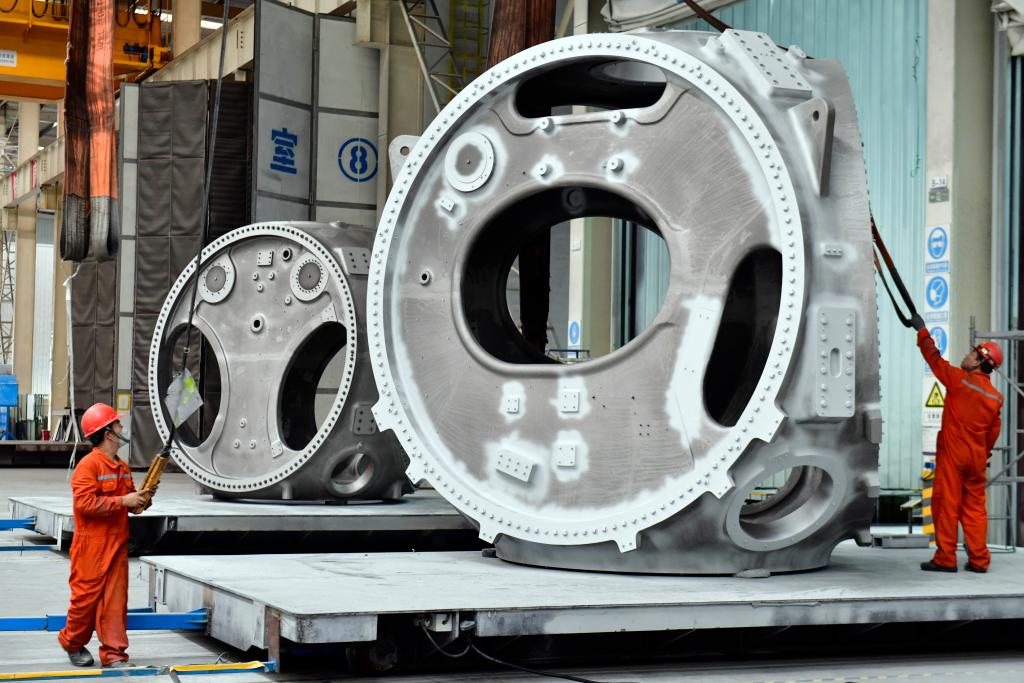
Group 1 - Shandong is implementing a "chain leader system" focusing on 19 key industrial chains to promote the deep integration of industrial, supply, and innovation chains, resulting in significant growth in sectors such as automotive (16.2%), railway and shipbuilding (21.1%), and electronics (21.9%) in the first half of the year [1][4] - The number of enterprises involved in these key industrial chains exceeds 36,000, accounting for over 90% of the province's total [4] - Shandong has introduced over 20 supportive policies across various industries, including artificial intelligence and modern medicine, to enhance the development of these industrial chains [4][6] Group 2 - The "chain leader" enterprises, such as Shandong Guochuang Precision Machinery Co., are attracting upstream and downstream companies to establish a renewable energy equipment manufacturing base, producing over 85% of wind power products locally [2][4] - Shandong plans to hold 30 provincial-level industrial chain matching events this year, aiming to serve over 100,000 small and medium-sized enterprises [5] Group 3 - The textile industry chain, led by Lutai Textile Co., is innovating with self-cleaning fabrics and cross-border knitting, creating a full-cycle innovation chain from fiber to finished garments [6][7] - Shandong has initiated 1,762 provincial-level technology innovation projects, resulting in the development of 7,074 new technologies, products, and processes [8] Group 4 - The robotics industry in Shandong is experiencing rapid growth, with industrial robot production increasing by 72.4% from January to May [10] - The lithium battery industry cluster in Zaozhuang has achieved significant production capacities, including 160,000 tons of positive materials and 32 GWh of battery cells [13] Group 5 - Shandong's industrial value added increased by 7.7% in the first half of the year, with industrial investment growing by 13.4%, contributing 5.2 percentage points to overall investment growth [14]

盛泰集团涨停封单超1.1亿元 纺织服装板块活跃度提升
Jin Rong Jie· 2025-07-31 01:37
Group 1 - The core point of the article highlights that Shengtai Group reached a limit-up price of 7.84 yuan, with a total order value of 1.11 billion yuan and a turnover rate of 0.77% as of the market close on July 30 [1] - The stock experienced a significant increase in trading volume, with a 328.14% increase in the average transaction size, ranking first in the market for trading activity [1] - In the textile and apparel sector, two stocks reached the limit-up price on the same day, indicating a positive trend in the industry [1]
梁丹媚:遭越南“背刺”,印尼和美国谈判关税时陷入两难
Sou Hu Cai Jing· 2025-07-31 00:16
Core Viewpoint - The article discusses a significant shift in the U.S. geopolitical economic strategy under the Trump administration, characterized by unprecedented tariffs aimed at reshaping global supply chains, curbing China's influence, and re-establishing U.S. economic dominance [1][5]. Tariff Impact - The scale of the tariff measures is alarming, with proposed tariffs of 46% on Vietnamese exports, 49% on Cambodian goods, 36% on Thai products, 32% on Indonesian items, and 24% on Malaysian exports [2][4]. - Following the announcement, Southeast Asian currencies such as the Thai baht and Malaysian ringgit experienced sharp declines, leading to significant market volatility [4]. Trade Balance and Strategy - The U.S. claims these tariffs are a response to "unfair trade practices," yet many ASEAN countries are sources of substantial U.S. trade surpluses, with a total trade volume of $476.8 billion in 2024, including $352.3 billion in exports from ASEAN to the U.S. [4][5]. - Analysts suggest that the true aim of the tariffs is to economically compel Southeast Asian nations to decouple from China, making their ties with China less economically viable [5][6]. Political Leverage - The U.S. strategy is described as using international trade as a tool for political coercion, effectively weaponizing trade to achieve its geopolitical objectives [6]. - The uncertainty surrounding the implementation of these tariffs serves as a strategic weapon, creating confusion and anxiety among targeted nations and businesses, thereby maximizing U.S. leverage in negotiations [7]. ASEAN's Response - ASEAN's collective response to the U.S. tariffs has been weak, with member states unable to form a unified front against U.S. unilateralism, leading to a situation where individual countries seek bilateral negotiations with the U.S. [10][11]. - The establishment of a "Vietnam precedent," where Vietnam negotiated a reduction in tariffs from 46% to 20%, has shifted the focus of other ASEAN countries from collective resistance to individual negotiations, fostering competition among them [13][14].
安正时尚集团股份有限公司股票交易异常波动的公告
Shang Hai Zheng Quan Bao· 2025-07-30 17:50
重要内容提示: 证券代码:603839 证券简称:安正时尚 公告编号:2025-032 安正时尚集团股份有限公司股票交易异常波动的公告 本公司董事会及全体董事保证本公告内容不存在任何虚假记载、误导性陈述或者重大遗漏,并对其内容 的真实性、准确性和完整性承担法律责任。 ●安正时尚集团股份有限公司(以下简称"公司")股票连续两个交易日(2025年7月29日、7月30日)收 盘价格涨幅偏离值累计超过20%,根据《上海证券交易所交易规则》的有关规定,属于股票交易异常波 动情形。 登录新浪财经APP 搜索【信披】查看更多考评等级 (一)生产经营情况 ●经公司自查并向控股股东、实际控制人书面征询核实、确认,截至本公告披露日,公司及控股股东、 实际控制人不存在应披露而未披露的重大事项。 一、股票交易异常波动的具体情况 经公司自查,公司目前生产经营情况正常,内外部经营环境未发生重大变化,不存在应披露而未披露的 重大信息。 (二)重大事项情况 经公司自查并向控股股东、实际控制人书面征询核实,截至本公告披露日,公司、控股股东及实际控制 人不存在影响公司股票交易价格异常波动的重大事项,不存在涉及公司应披露而未披露的重大信息,包 括 ...
