
环保工程及服务

Search documents
通源环境(688679.SH)发布半年度业绩,归母净亏损999万元
智通财经网· 2025-08-25 10:15
智通财经APP讯,通源环境(688679.SH)披露2025年半年度报告,报告期公司实现营收6.42亿元,同比下 降2.63%;归母净利润亏损999万元,同比由盈转亏;扣非净利润亏损1046万元,同比由盈转亏;基本每股收 益-0.08元。 ...

光大环境(00257) - 2025 H1 - 电话会议演示
2025-08-25 10:00
2025 Interim Results Presentation August 2025 China Everbright Environment Group Limited Forward-looking Statement This presentation may contain forward-looking statements. Any such forward-looking statements are based on a number of assumptions about the operations of China Everbright Environment (Group) Limited ("Everbright Environment" or the "Company", together with its subsidiaries, collectively the "Group") and factors beyond the Company's control and are subject to significant risks and uncertainties ...
菲达环保(600526.SH):上半年净利润1.27亿元,同比增长8.68%
Ge Long Hui A P P· 2025-08-25 09:28
格隆汇8月25日丨菲达环保(600526.SH)公布2025年半年度报告,报告期实现营业收入15.9亿元,同比增 长5.13%;归属于上市公司股东的净利润1.27亿元,同比增长8.68%;归属于上市公司股东的扣除非经常 性损益的净利润1.17亿元,同比增长28.04%;基本每股收益0.14元。 ...

通源环境(688679.SH):上半年净亏损999.18万元
Ge Long Hui A P P· 2025-08-25 08:52
Core Insights - Tongyuan Environment (688679.SH) reported a revenue of 642 million yuan for the first half of 2025, representing a year-on-year decrease of 2.63% [1] - The net profit attributable to shareholders was -9.99 million yuan, indicating a significant decline of 443.81% compared to the same period last year [1] - The basic earnings per share were -0.08 yuan, reflecting a decrease due to the drop in net profit and attributable net profit [1] Financial Performance - Revenue for the reporting period was 642 million yuan, down 2.63% year-on-year [1] - Net profit attributable to shareholders was -9.99 million yuan, a decline of 443.81% year-on-year [1] - Basic earnings per share were -0.08 yuan, a decrease attributed to the decline in net profit [1] Profitability Metrics - The decline in net profit was primarily due to a decrease in gross profit margin [1] - The significant drop in net profit and earnings per share indicates challenges in maintaining profitability [1]
一周安徽上市公司要闻回顾(8.18-8.24)
Xin Lang Cai Jing· 2025-08-25 06:44
Group 1: Huangshan Capsule - The company reported a net profit of 35.55 million yuan for the first half of 2025, representing a year-on-year increase of 19.78% [1] - The operating revenue for the same period was 244 million yuan, showing a growth of 3.66% year-on-year [1] - The revenue proportion from enteric-coated gelatin capsules and plant-based hollow capsules increased from 26.17% in the previous year to 35.46% [1] Group 2: iFlytek - iFlytek plans to raise no more than 4 billion yuan through a private placement of A-shares, with the issuance subject to approval from the China Securities Regulatory Commission [2] - The company will issue no more than 100 million shares, accounting for 4.33% of the total share capital before the issuance [2] - For the first half of 2025, software and information technology services accounted for 98.16% of the company's revenue [2] Group 3: Anke Bio - Anke Bio announced the resignation of supervisor Li Chenghua due to personal reasons [3] - For the first half of 2025, the revenue composition was 73.51% from genetic engineering drugs, 16.77% from other businesses, and 9.72% from external patches [3] Group 4: Yingliu Co. - Yingliu Co. disclosed that after the release and re-pledging of shares, a total of 90 million shares have been pledged, accounting for 48.43% of the shares held by the controlling shareholder [3] - The revenue composition for the first half of 2025 included 60.84% from high-temperature alloy products and precision cast steel parts, and 23.55% from nuclear power and other large cast steel parts [3] Group 5: Wantong Technology - Wantong Technology reported a net loss of approximately 37.44 million yuan for the first half of 2025, with operating revenue of about 324 million yuan, a decrease of 5.66% year-on-year [4] - The net loss for the same period in 2024 was approximately 734,000 yuan [4] Group 6: Hefei Urban Construction - Hefei Urban Construction plans to apply for a loan of 2.1 billion yuan by mortgaging its own assets [5] - The mortgaged asset is a commercial property located in Hefei, with an assessed value of approximately 3.01 billion yuan [5] Group 7: Zhonghuan Environmental Protection - Zhonghuan Environmental Protection announced that a specific shareholder plans to reduce its holdings by no more than 15.06 million shares, which is 3.55% of the total share capital [6] Group 8: Kouzi Jiao - Kouzi Jiao reported a net profit of approximately 71.5 million yuan for the first half of 2025, with operating revenue of about 2.53 billion yuan, a decrease of 20.07% year-on-year [7] - The net profit decreased by 24.63% compared to the same period last year [7]
光大环境(00257.HK):运营收入占比超70% 中期派息比例提升7PCT
Ge Long Hui· 2025-08-25 04:04
Core Insights - The company experienced a decline in both revenue and profit, with a significant optimization in revenue structure [1][2] - The operating income increased while construction revenue saw a substantial decrease, indicating a shift towards higher-margin operations [1][2] Revenue and Profit Analysis - In H1 2025, the company reported operating revenue of HKD 14.304 billion, a year-on-year decrease of 8% due to reduced new projects [1] - The net profit attributable to shareholders was HKD 2.07 billion, down 10% year-on-year, primarily due to decreased construction profits and increased foreign exchange losses [1] - The operating income, which has a higher gross margin, was HKD 9.943 billion, up 5% year-on-year, while construction revenue fell to HKD 1.844 billion, down 49% [1] Margin Improvement - The sales gross margin improved to 44.26%, an increase of 5.53 percentage points year-on-year [1] - The net profit margin rose to 19.4%, up 0.8 percentage points year-on-year [1] - Management expenses increased to 11.7%, up 4.6 percentage points, mainly due to expanded foreign exchange losses [1] Segment Performance - The environmental energy segment achieved operating revenue of HKD 5.142 billion, a 5.8% increase, while construction revenue dropped by 69.9% [2] - The green environmental segment reported operating revenue of HKD 3.189 billion, up 1%, with construction revenue declining by 74.3% [2] - The environmental water segment saw operating revenue of HKD 1.477 billion, a 13.5% increase, while construction revenue decreased by 16.7% [2] Shareholder Returns - The company increased its interim dividend payout ratio to 42%, reflecting improved cash flow from operating income [2] - The dividend per share was set at HKD 0.15, with the total dividend amount rising from HKD 860 million to HKD 920 million [2] Investment Outlook - The profit forecast has been slightly adjusted downwards, maintaining an "outperform" rating [2] - Expected net profits for 2025-2027 are projected at HKD 3.532 billion, HKD 3.715 billion, and HKD 3.887 billion, with year-on-year growth rates of 4.6%, 5.2%, and 4.6% respectively [2] - The current stock price corresponds to a PE ratio of 7.4, 7.1, and 6.8 for the respective years [2]
光大环境(0257.HK):H1发电量同比增长9% 中期股息提升1港仙
Ge Long Hui· 2025-08-25 04:04
Core Viewpoint - The company reported a decline in revenue and net profit for H1 2025, but continues to show operational growth and positive cash flow, indicating potential for value reassessment [1][2] Financial Performance - H1 2025 revenue was HKD 14.304 billion, down 8.4% year-on-year - Net profit attributable to shareholders was HKD 2.207 billion, a decrease of 10.1% year-on-year, slightly below expectations of HKD 2.258 billion [1] - The company declared an interim dividend of HKD 921 million, corresponding to a DPS of HKD 0.15, up from HKD 0.14 in H1 2024, with a payout ratio of 41.8% [1] Operational Highlights - Power generation and heating volumes increased by 9% and 32% year-on-year, respectively - Waste treatment volume reached nearly 29 million tons, a 2% increase year-on-year, with power generation of 14.8 billion kWh (up 9%) and heating volume of 3.8 million tons (up 32%) [1] - The company effectively reduced costs through precise management, with a decrease in the purchase price of biomass fuel by 8% year-on-year [1][2] Market Expansion - The company is expanding into Central Asia's solid waste and water markets, with two waste-to-energy projects in Uzbekistan, involving a total investment of approximately RMB 2.2 billion [2] - It has secured contracts for equipment supply in Thailand and Malaysia, indicating a strategic move towards light asset services in overseas markets [2] Cash Flow and Shareholder Returns - The company achieved a positive free cash flow of RMB 4.04 billion in 2024, marking the first time since 2003 that it has turned positive in its environmental business [2] - H1 2025 free cash flow was approximately RMB 2 billion, with expectations for continued improvement in shareholder returns [2] Earnings Forecast - The profit forecast for 2025-2027 has been adjusted, with expected net profits of HKD 3.392 billion, HKD 3.539 billion, and HKD 3.687 billion, reflecting a downward adjustment of 3%, 4%, and 2% respectively [2] - The target price has been set at HKD 5.34, based on a PE ratio of 9.7 for 2025, an increase from the previous target of HKD 4.79 [2]
京源环保(688096.SH):2025年中报净利润为232.31万元,同比扭亏为盈
Xin Lang Cai Jing· 2025-08-25 03:08
Financial Performance - The company reported a total revenue of 210 million yuan, an increase of 39.32 million yuan compared to the same period last year, representing a year-on-year growth of 23.03% [1] - The net profit attributable to shareholders was 2.32 million yuan, an increase of 6.38 million yuan compared to the same period last year [1] - The net cash inflow from operating activities was 5.24 million yuan, an increase of 12.77 million yuan compared to the same period last year, achieving two consecutive years of growth [1] Financial Ratios - The latest debt-to-asset ratio is 51.88%, a decrease of 1.47 percentage points from the previous quarter and a decrease of 5.62 percentage points from the same period last year [3] - The latest gross profit margin is 27.68%, an increase of 0.27 percentage points from the previous quarter and an increase of 0.46 percentage points from the same period last year [3] - The latest return on equity (ROE) is 0.25%, an increase of 0.76 percentage points from the same period last year [3] Earnings and Efficiency - The diluted earnings per share are 0.02 yuan, an increase of 0.05 yuan compared to the same period last year [4] - The total asset turnover ratio is 0.11 times, an increase of 0.02 times compared to the same period last year, representing a year-on-year increase of 24.06% [4] - The inventory turnover ratio is 0.88 times, an increase of 0.24 times compared to the same period last year, representing a year-on-year increase of 37.75% [4] Shareholder Structure - The number of shareholders is 4,161, with the top ten shareholders holding a total of 64.49 million shares, accounting for 38.87% of the total share capital [4] - The largest shareholder is Li Wulin, holding 10.97% of the shares [4]


伟明环保(603568.SH):2025年中报净利润为14.25亿元、较去年同期上涨0.13%
Xin Lang Cai Jing· 2025-08-25 02:30
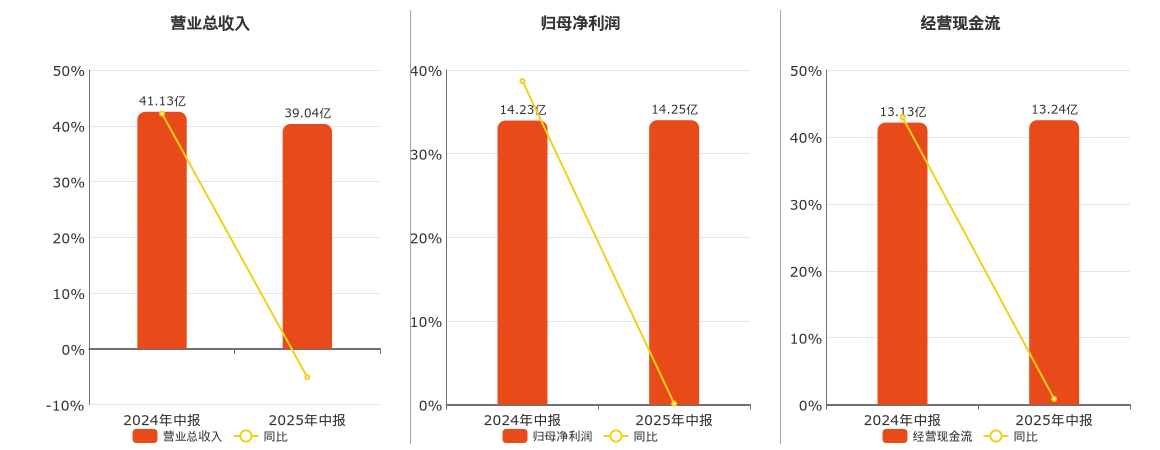
公司最新毛利率为49.05%,较上季度毛利率增加2.08个百分点,较去年同期毛利率增加3.30个百分点。最新ROE为10.23%。 公司摊薄每股收益为0.84元。 公司最新总资产周转率为0.14次。最新存货周转率为4.32次。 公司股东户数为2.90万户,前十大股东持股数量为12.33亿股,占总股本比例为72.35%,前十大股东持股情况如下: 2025年8月23日,伟明环保(603568.SH)发布2025年中报。 公司营业总收入为39.04亿元。归母净利润为14.25亿元,较去年同报告期归母净利润增加185.10万元,实现5年连续上涨,同比较去年同期上涨0.13%。经营 活动现金净流入为13.24亿元,较去年同报告期经营活动现金净流入增加1130.26万元,实现5年连续上涨,同比较去年同期上涨0.86%。 公司最新资产负债率为46.23%,较去年同期资产负债率减少1.59个百分点。 | 序号 | 股东名称 | 持股 | | --- | --- | --- | | l | 伟明集团有限公司 | 40.8 | | 2 | 项光明 | 10.0 | | 3 | 温州市嘉伟实业有限公司 | 7.12 | | ব | ...

公用环保202508第4期:7月全社会用电量同比+8.6%,1-7月新增电力装机32505万千瓦
Guoxin Securities· 2025-08-24 13:24
Investment Rating - The report maintains an "Outperform" rating for the public utility and environmental sectors [6][9]. Core Views - The report highlights a significant increase in electricity consumption, with a year-on-year growth of 8.6% in July 2025, reaching 1,022.6 billion kWh [3][16]. - The total installed power generation capacity in China reached 367.367 million kW by July 2025, with an increase of 32.505 million kW compared to the end of 2024 [3][17]. - The new energy storage capacity has seen substantial growth, with a cumulative installed capacity of 101.3 GW by mid-2025, marking a 110% increase year-on-year [16][18]. Summary by Sections Market Review - The Shanghai Composite Index rose by 4.18%, while the public utility index increased by 1.89% and the environmental index by 1.33% [15][29]. - Within the electricity sector, thermal power increased by 3.38%, hydropower by 1.05%, and new energy generation by 1.91% [15][32]. Important Events - In July 2025, the total electricity consumption reached 1,022.6 billion kWh, with the first industry showing a 20.2% increase, the second industry a 4.7% increase, and the third industry a 10.7% increase [3][16]. - The installed capacity for various power sources as of July 2025 includes hydropower at 44.161 million kW, thermal power at 148.66 million kW, nuclear power at 6.094 million kW, wind power at 57.487 million kW, and solar power at 110.96 million kW [3][17]. Investment Strategy - Recommendations include major thermal power companies like Huadian International and Shanghai Electric, as well as leading new energy firms such as Longyuan Power and Three Gorges Energy [5][26]. - The report suggests that the nuclear power sector will maintain stable profitability, recommending companies like China Nuclear Power and China General Nuclear Power [5][26]. - In the environmental sector, it highlights opportunities in water and waste incineration industries, recommending companies like China Everbright Environment and Zhongshan Public Utilities [5][27]. Key Company Earnings Forecasts - Huadian International is rated "Outperform" with an expected EPS of 0.46 for 2024 and 0.62 for 2025 [9]. - Longyuan Power is also rated "Outperform" with an expected EPS of 0.75 for 2024 and 0.85 for 2025 [9]. - China Nuclear Power is rated "Outperform" with an expected EPS of 0.46 for 2024 and 0.50 for 2025 [9].