
Computers

Search documents
计算机ETF(159998)、云计算ETF沪港深(517390)涨超3%,机构:算力基础设施投资保持强劲
2 1 Shi Ji Jing Ji Bao Dao· 2025-09-25 02:59
Group 1: ETF Performance - The Computer ETF (159998) rose by 3% and recorded a trading volume exceeding 99 million yuan, ranking first among similar products [1] - The Computer ETF has seen a net inflow of nearly 40 million yuan over the past two days [2] - The Cloud Computing ETF (517390) increased by 4.32% with a trading volume over 26 million yuan [3] Group 2: ETF Composition and Strategy - The Computer ETF tracks the CSI Computer Theme Index, which includes stocks from companies involved in information technology services, application software, system software, and computer hardware [4] - The Cloud Computing ETF closely follows the CSI Hong Kong-Shanghai Cloud Computing Industry Index and includes internet companies from Hong Kong and computing leaders from A-shares [4] Group 3: Policy and Market Developments - The Ministry of Commerce and other departments issued policies to promote service exports, supporting the establishment of international data service businesses in specific regions [5] - Alibaba Cloud announced a global infrastructure expansion plan, establishing new cloud computing nodes in Brazil, France, and the Netherlands, and expanding data centers in several countries [5] - Hubei Province is developing a multi-layered computing infrastructure system by 2027, integrating space-based computing services [5] Group 4: Industry Outlook - The computer industry is expected to continue its development under a "soft and hard" framework, with strong investment in AI hardware and benefits for domestic AI chip and server manufacturers [6] - The acceleration of enterprise-level AI applications is driving commercialization, although there are concerns about the variability in performance realization [6] - Focus is recommended on hardware infrastructure with strong performance certainty and software applications with practical scenarios, balancing innovation and profitability [6]
联想“全栈AI”亮相2025云栖大会
Zhong Zheng Wang· 2025-09-24 12:16
Core Insights - Lenovo showcased its "full-stack AI" solutions at the 2025 Cloud Summit, highlighting a comprehensive range of AI terminal, infrastructure, and service offerings [1] - The company emphasized advancements in AI infrastructure, particularly in intelligent computing, scientific computing, and universal computing scenarios [1][2] Group 1: AI Infrastructure - Lenovo's intelligent computing platform has been upgraded to version 3.0, introducing four new technologies aimed at enhancing AI infrastructure stability and integration [1] - The ThinkSystem SC750V4 server, a next-generation fully liquid-cooled high-density server, was presented, achieving a 40% reduction in power consumption compared to traditional air cooling [1] Group 2: Scientific Computing - Lenovo's new liquid cooling technology, "Sea God," allows for a PUE value below 1.1, addressing both computing power and energy efficiency challenges [1] Group 3: Universal Computing - The ThinkSystem DG series all-flash storage products provide high effective capacity and IOPS performance, ensuring rapid access to massive data sets [2] - Lenovo's NE8770-64QC switch meets stringent requirements for 400G ultra-high-speed rates and 99.999% reliability through advanced technologies [2] - The innovative "dual-loop" phase change immersion cooling system achieves a PUE value of 1.035, allowing enterprises to allocate 96.6% of their electricity costs to AI training and inference [2]

终端应用掀AI投资第二波行情,预期兑现度决定“胜者为王”
Cai Fu Zai Xian· 2025-09-23 09:28
Group 1 - The core viewpoint is that AI is experiencing a new wave of investment opportunities similar to the "Internet+" era, driven by policy and corporate innovation [1][8] - East Wu Securities suggests focusing on relatively underperforming segments in the AI industry chain, particularly in mid-to-upstream storage and AIDC fields, as well as downstream AI applications like AI in healthcare, humanoid robots, and smart driving [1][5] - The current AI market is primarily centered around upstream computing infrastructure, with companies like Lenovo showing significant growth in their ISG business group, which increased by 63% year-on-year [4][11] Group 2 - The downstream application sector is lagging behind upstream hardware, presenting a potential configuration direction with better risk-reward ratios [5][11] - Lenovo has established a strong position in the AI PC market, with AI PC shipments accounting for over 30% of total PC shipments, indicating user acceptance [7][10] - The AI application market is expected to experience a significant explosion, supported by favorable policies and a large user base, which will enhance the investment value of companies like Lenovo [9][10] Group 3 - The AI application market is anticipated to have a longer duration and greater elasticity compared to the previous infrastructure-driven phase, as seen in the "Internet+" era [8][12] - The market is transitioning from a broad-based rally to a "winner takes all" scenario, where leading companies like Lenovo are expected to gain more market share and investment value [12][13] - Lenovo's strong performance in various sectors, including a 24.6% global market share in PCs and significant growth in the smartphone segment, highlights its competitive advantage in the AI landscape [12][13]

周六这场招聘会供岗9000余个
Zheng Zhou Ri Bao· 2025-09-23 00:54
Core Points - The event "2025 'Ten Thousand Jobs for Ten Thousand Families'" job fair will be held on September 27 in Zhengzhou, organized by the Jinshui District Human Resources and Social Security Bureau and the Fengqing Road Street Office [1] - The job fair targets various urgent employment groups, including young talents, high-level talents, recent graduates, unemployed individuals, and veterans [1] - Over 9,300 job positions will be available across multiple industries, including computer science, environmental technology, mechanical manufacturing, education, finance, and more [1] Industry Summary - The job fair will feature key enterprises from diverse sectors such as technology, education, food, tourism, finance, and healthcare, indicating a broad demand for talent across industries [1] - Job positions will cover a wide range of professional categories, including roles in new media, project management, e-commerce, engineering, and legal services, reflecting the evolving job market needs [1] - The event will provide various service areas for job seekers, including recruitment zones and registration areas, enhancing the job matching process [1]
2025年全球笔电出货量预计将突破1.8亿台
WitsView睿智显示· 2025-09-18 14:47
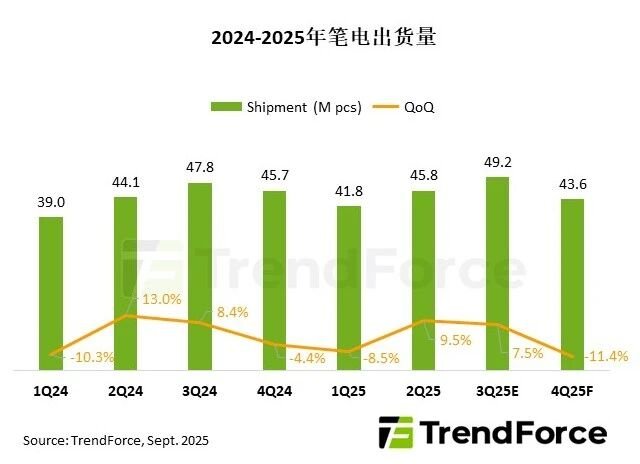
Core Insights - The global laptop market is showing signs of recovery despite geopolitical factors and tariff uncertainties, with a projected annual shipment increase of approximately 2.2% in 2023, surpassing 180 million units [2][6]. - Southeast Asia is emerging as a key manufacturing base for laptops, driven by investments from major brands like Dell and Apple, with Vietnam's production capacity expected to reach 13.5% of the global share by 2025 [5][6]. Group 1: Market Trends - The laptop market is benefiting from zero tariffs on Southeast Asian imports to the U.S., leading brands to increase shipments in anticipation of demand [2]. - The second quarter of 2023 saw a significant shipment increase of 9.5% due to factors such as U.S. tariff exemptions and a surge in demand from the Chinese market driven by subsidy policies [2]. - The third quarter is expected to maintain positive growth, with a projected quarter-on-quarter increase of 7.5% as brands and suppliers continue to support the market through subsidies [2]. Group 2: Regional Manufacturing Developments - Southeast Asia has become a primary production base outside of China, with Vietnam and Thailand leading the way in laptop manufacturing due to favorable policies and investments [5]. - Vietnam's laptop production capacity is anticipated to grow rapidly, reaching 13.5% of the global market share by 2025, supported by major manufacturers like Compal and Wistron [5]. - Thailand is also expanding its production capabilities, with a projected capacity share of 6.7% by 2025, driven by HP's initiatives and local government incentives [5]. - Other regions such as India, Indonesia, and Brazil are also seeing increased local manufacturing efforts, with an expected global capacity share of 3.7% by 2025 due to local production requirements [5].

集邦咨询:预估2025年全球笔电出货年增2.2% 东南亚产能持续扩张
智通财经网· 2025-09-17 09:21
Group 1 - The global laptop market is showing signs of recovery despite geopolitical factors and tariff uncertainties, with a projected annual shipment increase of approximately 2.2%, surpassing 180 million units in 2025 [1] - The second quarter of this year saw significant shipment momentum, with a quarter-on-quarter increase of 9.5%, driven by zero tariffs on laptops imported from Southeast Asia and a surge in demand from the Chinese market due to subsidy policies [3] - The third quarter is expected to maintain positive growth, with a projected quarter-on-quarter increase of 7.5%, as brands and suppliers continue to support channels through subsidies [3] Group 2 - Southeast Asia is emerging as a key production base for laptops outside of China, with major investments from companies like Dell and Apple in Vietnam, leading to a projected global production capacity share of 13.5% by 2025 [4] - Thailand is also becoming a significant player in laptop manufacturing, with HP driving new production lines, and an expected production capacity share of 6.7% by 2025 [4] - Other regions such as India, Indonesia, and Brazil are being prioritized for localized production due to government requirements, with an anticipated global production capacity share of 3.7% by 2025 [4] Group 3 - The demand side of the global laptop market is benefiting from moderate replacement cycles and educational projects, while the supply side is diversifying due to capacity relocation and geopolitical factors, positioning Southeast Asia as a critical manufacturing hub [5]
研报 | 预估2025年全球笔电出货年增2.2%,东南亚产能持续扩张
TrendForce集邦· 2025-09-17 09:01
Core Insights - The global laptop market is showing signs of recovery in 2025 despite geopolitical factors and tariff uncertainties, with an expected annual shipment increase of approximately 2.2%, surpassing 180 million units [2][7] Group 1: Market Dynamics - The second quarter of 2025 saw particularly strong shipment momentum, driven by zero tariffs on laptops imported from Southeast Asia and proactive inventory management by brands [4] - The education sector continues to stimulate demand, contributing to a 9.5% quarter-on-quarter increase in shipments, with expectations of a 7.5% growth in the third quarter [5] Group 2: Southeast Asia's Role - Southeast Asia is emerging as a key production base outside of China, with significant investments from companies like Dell and Apple in Vietnam, leading to a projected 13.5% share of global laptop production capacity by 2025 [6] - Thailand is also becoming a notable production hub, with HP's initiatives leading to new production lines, and an expected capacity share of 6.7% by 2025 [6] - Other regions such as India, Indonesia, and Brazil are being prioritized for localized production due to government requirements, with an anticipated global capacity share of 3.7% by 2025 [6] Group 3: Demand and Supply Factors - The demand side of the global laptop market is benefiting from moderate replacement cycles and educational projects, while the supply side is diversifying due to capacity relocation and geopolitical factors [7]
Apple vs. HP: Which Stock Has an Edge as AI PC Sales Accelerate?
ZACKS· 2025-09-16 17:31
Core Insights - The personal computer market is projected to grow by over 4.1% year-over-year in 2025, with U.S. shipments expected to reach 70.4 million, reflecting a growth of 1.7% [1][2] - The demand for AI-powered PCs and the end-of-service for Microsoft Windows 10 in October 2025 are significant catalysts for this growth [1] Group 1: Apple - Apple's Mac business is experiencing strong demand for its M4 chip series, including M4, M4 Pro, and M4 Max, with the new MacBook Air offering up to 18 hours of battery life [2] - The latest macOS Tahoe 26 introduces new design features and capabilities, enhancing user experience with personalized options [3] - In Q2 2025, Apple gained market share, reaching 9.1%, a 110 basis point increase year-over-year, with shipments growing 21.4% to 6.2 million [4] - The Zacks Consensus Estimate for Apple's Q4 fiscal Mac sales is projected at $8.43 billion, indicating a 9% growth from the previous year [5] - Apple's earnings per share are expected to rise by 9% year-over-year in fiscal 2025, with a consistent track record of beating earnings estimates [9][12] Group 2: HP - HP is positioned to benefit from the growing interest in Generative AI-enabled PCs, with forecasts suggesting that 40-60% of all PCs will be AI PCs in the next three years [6] - In Q3 fiscal 2025, HP's AI PC revenues grew significantly, with AI PC shipments surpassing 25% of its mix, ahead of the company's target [7] - HP's market share in Q2 2025 was 20.7%, down 60 basis points year-over-year, with shipments growing 3.2% to 14.1 million [10] - The Zacks Consensus Estimate for HP's fiscal 2026 earnings is projected at $3.10 per share, reflecting an 8.3% decrease from fiscal 2025 [11] - HP shares are trading at a lower valuation compared to Apple, with a Price/Sales ratio of 0.47X versus Apple's 8.21X, indicating a more attractive valuation [17] Group 3: Comparative Performance - Year-to-date, Apple shares have decreased by 5.4%, while HP shares have dropped by 14.9%, indicating relative outperformance by Apple [14] - Both companies hold a Zacks Rank of 3 (Hold), but the growing demand for Macs is seen as a positive indicator for Apple's stock prospects [20]


Tariffs Have Slowed Some Imports, But This Category Is Up Sharply
Yahoo Finance· 2025-09-16 12:02
Core Insights - Tariffs are negatively impacting imports across various industries, but the computer equipment sector is experiencing significant growth due to the AI boom [2][5] - Total U.S. imports increased by 6% in July, largely driven by investments in data centers to support AI [2][3] - The overall U.S. trade deficit rose by nearly 33% to $78.3 billion, influenced by a surge in computer imports [3] Import Trends - High-tech imports have risen by 34% year-over-year through July, with computer shipments increasing by 65% and computer accessories by 50% in July alone [4][5] - Capital goods imports related to AI and data centers are resilient, while imports of other products subject to tariffs have declined significantly [3][6] - Civilian aircraft imports fell by 30%, machinery by 21%, trucks by 13%, and cars by 11% year-over-year in July [7] Economic Projections - Goldman Sachs forecasts that the five largest U.S. tech companies will spend $736 billion on capital goods, including computer equipment, in 2025 and 2026 [6] - Overall capital goods imports have increased by 15% this year, contrasting with an 11% decline in all other imports [6]
1 Reason Wall Street Is Obsessed With IBM Stock
Yahoo Finance· 2025-09-15 19:33
Core Insights - IBM has successfully transformed its business model over the years, adapting to new technological trends such as quantum computing, cloud computing, and artificial intelligence [2][3][5] - The stock has shown significant performance, trading up approximately 20% over the past year and nearly doubling in price over the last three years, indicating renewed investor interest [3][4] - Despite past struggles, including a 50% decline in stock value from 2012 to 2020, IBM's ability to modernize and pivot its focus has made it a compelling option for long-term investors [3][5] Company Transformation - IBM's business revamp involved a series of strategic moves, including a major corporate spin-off, asset sales, and acquisitions, notably the acquisition of Red Hat [5] - The company has shifted its focus to high-demand technology sectors, which has contributed to its resurgence in popularity among investors [4][5] Market Sentiment - Wall Street's renewed obsession with IBM reflects a broader trend of investor confidence in the company's strategic direction and its ability to remain relevant in a rapidly changing technology landscape [3][4] - The stock's performance and the company's focus on emerging technologies have positioned IBM favorably in the eyes of investors, despite previous periods of underperformance [3][5]
