食品

Search documents
强化全链条监管食品安全 一批监管新规抓紧制定中
Yang Shi Xin Wen· 2025-08-22 02:43
针对近年来平台经济快速发展衍生的外卖点餐、直播带货、网络购物等多种新消费场景,市场监管部门 强化对平台企业合规指导,加大专项抽检力度,综合治理"幽灵外卖"、虚假声称等突出问题,抓紧制定 连锁经营、直播电商、网络销售等监管制度,进一步明确各类主体食品安全责任,在维护消费便利的同 时,及时消除新的风险隐患。 在今天国务院新闻办举行的"高质量完成'十四五'规划"系列主题新闻发布会上,市场监管总局有关负责 人表示,食品安全是与人民群众关系最密切的民生大事,保障食品安全是市场监管部门的重要职责。 "十四五"期间,通过推动强化全链条监管,严防各类风险,全国食品安全形势总体平稳。粮食加工品、 肉制品、奶制品等抽检合格率连续多年保持高位。 (文章来源:央视新闻) ...
131股获券商买入评级,恒铭达目标涨幅达65.18%
Xin Lang Cai Jing· 2025-08-22 00:31
Core Insights - A total of 131 stocks received buy ratings from brokerages on August 21, with 38 stocks announcing target prices [1] - Based on the highest target prices, Hengmingda, Yuntianhua, and Nangang Co. ranked highest in target price increase potential, with expected increases of 65.18%, 55.96%, and 51.04% respectively [1] - Out of the rated stocks, 122 maintained their ratings, while 9 received their first ratings [1] - 25 stocks attracted attention from multiple brokerages, with Yanjinpuzi, Jibite, and Kingsoft receiving the most ratings, at 8, 3, and 3 respectively [1] - The sectors with the highest number of stocks receiving buy ratings include Materials II, Capital Goods, and Food, Beverage & Tobacco, with 20, 19, and 17 stocks respectively [1]

朝闻国盛:股牛期间的债市特征
GOLDEN SUN SECURITIES· 2025-08-22 00:20
Core Insights - The report analyzes the characteristics of the bond market during bull markets, specifically referencing historical periods of 2006-2007, 2014-2015, and 2024-2025, indicating that government bond yields tend to move in sync with overall liquidity conditions, generally trending downward during periods of ample liquidity [2] - It highlights that during stock market rallies, there is often a decrease in household deposits and a potential decline in bond fund shares, although these may recover in later stages of the stock market growth [2] Company-Specific Insights GoerTek Inc. (歌尔股份) - For the first half of 2025, GoerTek reported revenue of 37.55 billion, a year-on-year decrease of 7.0%, while net profit attributable to shareholders was 1.42 billion, an increase of 15.7% [3] - The company’s gross margin improved to 13.5%, up by 2.0 percentage points, and net margin increased to 3.7%, up by 0.8 percentage points [3] - Projections for 2025-2027 indicate revenues of 101.1 billion, 115.1 billion, and 130.0 billion respectively, with net profits of 3.3 billion, 4.1 billion, and 4.8 billion, reflecting growth rates of 24.0%, 23.1%, and 17.1% [3] Koss (科思股份) - Koss is facing temporary performance pressure due to increased market competition and weaker-than-expected terminal demand, particularly in the sunscreen market [5] - The company is focusing on consolidating its leading position in the sunscreen agent sector and enhancing its product offerings [6] - Revenue projections for 2025-2027 are adjusted to 2.06 billion, 2.26 billion, and 2.45 billion, with net profits of 410 million, 490 million, and 560 million, maintaining a "buy" rating [6] Yanjinpuzi (盐津铺子) - Yanjinpuzi achieved revenue of 2.94 billion in the first half of 2025, a year-on-year increase of 19.6%, with net profit of 370 million, up 16.7% [6] - The growth was driven by strong performance in the konjac product line and effective channel strategies, including expansion into Southeast Asia [6] Changhong Meiling (长虹美菱) - The company reported total revenue of 18.072 billion for the first half of 2025, a 20.8% increase, with net profit of 417 million, a slight increase of 0.26% [8] - The growth was supported by faster export growth, although profit levels were impacted by tax and impairment issues [8] Naxin Microelectronics (纳芯微) - Naxin Microelectronics reported record revenue in Q2 2025, with projections for 2025-2027 indicating revenues of 3.07 billion, 3.79 billion, and 4.60 billion, reflecting growth rates of 56.8%, 23.3%, and 21.5% [9] Sunny Optical Technology (舜宇光学科技) - Sunny Optical is expected to see revenue growth from 40.9 billion in 2025 to 55.9 billion in 2027, with net profits projected at 3.53 billion, 4.20 billion, and 5.24 billion [10] Sanwei Chemical (三维化学) - Sanwei Chemical reported revenue of 1.25 billion in the first half of 2025, a 22% increase, with net profits growing by 43% [11] - The company is expected to maintain strong growth with projected net profits of 350 million, 480 million, and 630 million for 2025-2027 [11]






宿迁市泗阳禾润居食品有限公司成立 注册资本50万人民币
Sou Hu Cai Jing· 2025-08-21 23:16
天眼查App显示,近日,宿迁市泗阳禾润居食品有限公司成立,法定代表人为陈鸾英,注册资本50万人 民币,经营范围为许可项目:食品互联网销售;食品销售;食品小作坊经营;餐饮服务(不产生油烟、 异味、废气);食品生产;保健食品生产;食品销售(不含酒);茶叶制品生产(依法须经批准的项 目,经相关部门批准后方可开展经营活动,具体经营项目以审批结果为准)一般项目:保健食品(预包 装)销售;食品销售(仅销售预包装食品,不含酒);食品互联网销售(仅销售预包装食品);食品销 售(仅销售预包装食品);物联网应用服务;物联网设备销售;物联网技术服务;业务培训(不含教育 培训、职业技能培训等需取得许可的培训);互联网销售(除销售需要许可的商品);外卖递送服务; 谷物销售;豆及薯类销售;食用农产品批发;初级农产品收购;食用农产品零售;养生保健服务(非医 疗);中医养生保健服务(非医疗);棉、麻销售;日用百货销售;信息咨询服务(不含许可类信息咨 询服务);个人卫生用品销售(除依法须经批准的项目外,凭营业执照依法自主开展经营活动)。 ...
上海哈乐为食品有限公司成立 注册资本100万人民币
Sou Hu Cai Jing· 2025-08-21 21:37
天眼查App显示,近日,上海哈乐为食品有限公司成立,法定代表人为唐少刚,注册资本100万人民 币,经营范围为许可项目:食品销售。(依法须经批准的项目,经相关部门批准后方可开展经营活动, 具体经营项目以相关部门批准文件或许可证件为准)一般项目:互联网销售(除销售需要许可的商 品);礼品花卉销售;会议及展览服务;品牌管理;餐饮管理;信息咨询服务(不含许可类信息咨询服 务);礼仪服务;食用农产品批发;食用农产品零售;工艺美术品及收藏品批发(象牙及其制品除 外);工艺美术品及收藏品零售(象牙及其制品除外);日用百货销售;针纺织品及原料销售;服装服 饰批发;服装服饰零售;鞋帽批发;鞋帽零售;箱包销售;企业管理咨询;办公用品销售;技术服务、 技术开发、技术咨询、技术交流、技术转让、技术推广;票务代理服务;广告设计、代理;市场营销策 划;日用化学产品销售;厨具卫具及日用杂品批发;厨具卫具及日用杂品零售;家居用品销售;玻璃纤 维增强塑料制品销售;专业保洁、清洗、消毒服务;包装服务。(除依法须经批准的项目外,凭营业执 照依法自主开展经营活动)。 ...
上海栗胜刚食品有限公司成立 注册资本50万人民币
Sou Hu Cai Jing· 2025-08-21 21:31
天眼查App显示,近日,上海栗胜刚食品有限公司成立,法定代表人为栗胜刚,注册资本50万人民币, 经营范围为许可项目:食品销售。(依法须经批准的项目,经相关部门批准后方可开展经营活动,具体 经营项目以相关部门批准文件或许可证件为准)一般项目:食品互联网销售(仅销售预包装食品);农 副产品销售;食用农产品零售;包装服务;供应链管理服务;食品添加剂销售;水产品零售。(除依法 须经批准的项目外,凭营业执照依法自主开展经营活动)。 ...
品牌赋能制造业高质量发展,聊城市多措并举打造“聊城优品”
Qi Lu Wan Bao Wang· 2025-08-21 14:07
强化品牌培育建设。认真分析研判全市制造业品牌建设情况,创新打造"聊城优品"地方区域品牌,对照 省长质量奖、"好品山东"、山东省高端品牌等品牌标准,建立品牌培育库,遴选推出山东省宇捷轴承制 造有限公司、山东九路泊车设备股份有限公司等首批40家"聊城优品"品牌企业,夯实了全市品牌建设基 础。近年来,山东时风(集团)有限责任公司、齐鲁电缆有限公司等67家企业入围山东省高端品牌培育 企业;临清三和纺织集团有限公司、山东冠洲股份有限公司等21家企业入围"好品山东"品牌;山东阳谷 华泰(300121)化工股份有限公司入围第九届省长质量奖提名奖。 品牌是企业重要的无形资产,是企业产品转化为市场占有率和经济效益的倍增器。近年来,市市场监管 局高度重视制造业品牌建设,始终将其作为推动制造业强市的重要一环,坚持从品牌培育、品牌推广、 品牌奖励等方面发力,赋能聊城市制造业高质量发展。 近日,聊城市政府办公室印发了《聊城市支持制造业高质量发展的若干政策》(以下简称《政策》)。 8月21日,聊城市政府新闻办召开政策例行吹风会,市市场监督管理局党组书记、局长陈玉国介绍了企 业品牌建设相关情况。 强化品牌财金支持。突出品牌奖励政策宣传,提 ...
广东省甜特食品有限公司成立 注册资本500万人民币
Sou Hu Cai Jing· 2025-08-21 03:50
天眼查App显示,近日,广东省甜特食品有限公司成立,注册资本500万人民币,经营范围为许可项 目:食品生产;食品经营管理。(依法须经批准的项目,经相关部门批准后方可开展经营活动,具体经 营项目以相关部门批准文件或许可证件为准)一般项目:食品互联网销售(仅销售预包装食品);技术 进出口;货物进出口;服装服饰零售;鞋帽零售;箱包销售;皮革制品销售;家居用品销售;针纺织品 销售;玩具销售;照相器材及望远镜零售;体育用品及器材零售;户外用品销售;电子产品销售;五金 产品零售;互联网销售(除销售需要许可的商品)。(除依法须经批准的项目外,凭营业执照依法自主 开展经营活动)。 ...
圣贝拉(02508):全周期矩阵增长积极,利润弹性释放
HTSC· 2025-08-21 03:37
Investment Rating - The report maintains a "Buy" rating for the company [7][5]. Core Views - The company reported a strong performance in the first half of 2025, with revenue of 450 million RMB, a year-on-year increase of 25.6%, and an adjusted net profit of 38.78 million RMB, up 126.1% year-on-year [1][12]. - The company is benefiting from an effective entrusted management model, leading to accelerated expansion and a significant increase in the number of stores [2][1]. - New business segments, including postpartum recovery and home care services, are showing positive growth trends, contributing to the overall service matrix [1][3]. Summary by Sections Financial Performance - In 1H25, the company's revenue reached 450 million RMB, with a gross profit margin of 37.6%, up 3.6 percentage points year-on-year [12]. - The adjusted net profit for 1H25 was 38.78 million RMB, reflecting a significant turnaround from a loss in the previous year [12][1]. Business Expansion - The number of maternity centers increased to 113 by the end of 1H25, with a net addition of 36 centers compared to the end of 2024 [2][1]. - The company’s home care service revenue grew by 41.7% year-on-year, indicating strong demand and customer retention [3][12]. Profitability and Efficiency - The marketing expense ratio decreased to 12.0%, and the management expense ratio fell to 22.1%, contributing to improved profitability [4][1]. - The company plans to launch an AI Agent product in the second half of 2025, which is expected to enhance operational efficiency and profitability [4][1]. Future Outlook - The company forecasts adjusted net profits of 120.69 million RMB, 204.77 million RMB, and 306.16 million RMB for 2025, 2026, and 2027, respectively [5][10]. - The target price is set at 9.76 HKD, reflecting a premium valuation due to the company's growth potential and market position [5][7].
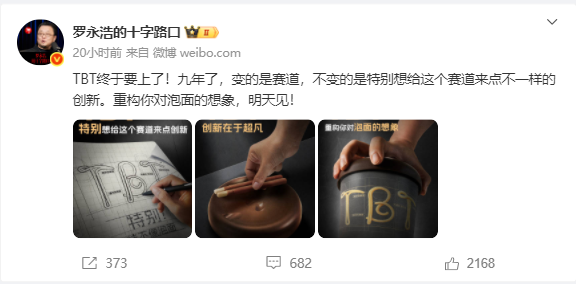
罗永浩宣布将做泡面 曾称该项目间接导致锤子失败
Qi Lu Wan Bao· 2025-08-21 03:37
Group 1 - The core idea of the news is that Luo Yonghao announced the launch of an innovative instant noodle project called "TBT," which he claims has been in development for nine years, aiming to "reconstruct the imagination of instant noodles" [1][4]. - Luo Yonghao's previous focus on this project diverted attention from his other ventures, contributing to the failure of his smartphone company, Smartisan [3][4]. - The new product, "Specially Fresh Instant Noodles," utilizes a unique cooking method that mimics the taste of freshly boiled noodles, highlighting a significant innovation in the instant noodle market [4]. Group 2 - Luo Yonghao's entrepreneurial history includes a failed attempt to enter the AR market with his company, Xihongxian Technology, which faced significant financial losses and operational challenges [7]. - Currently, Luo Yonghao's business landscape is shrinking, with only 11 out of 33 associated companies still operational, while over 20 have been dissolved [7]. - Despite claims of having cleared previous debts, his company Smartisan is facing new legal challenges, with recent execution cases amounting to over 21.42 million yuan [7].