Artificial Intelligence

Search documents
阿里推出RynnBrain,机器人AI赛道再添猛将
Sou Hu Cai Jing· 2026-02-11 04:44
Group 1 - Alibaba has launched a new AI model named RynnBrain specifically designed for robots, further expanding its presence in the rapidly growing robotics sector [1][3] - RynnBrain aims to help robots understand their physical surroundings and recognize various objects, showcasing complex AI technology that enables precise movement control [3] - The global technology landscape is seeing significant investment in embodied intelligence, with China prioritizing this area for development [3] Group 2 - Other tech giants are also developing AI models for robotics, including NVIDIA's "Cosmos" series and Google's DeepMind with its Gemini Robotics-ER 1.5 [3] - Alibaba plans to adopt an open-source strategy for RynnBrain, allowing developers to use the model for free, which is a key method for promoting its AI technology globally [4] - The humanoid robot sector in China is experiencing strong growth, with multiple companies planning to expand production capacity this year [4]


AI与机器人盘前速递丨Alphabet募资320亿美元加码AI军备竞赛,红包大战千问日活暴增!
Mei Ri Jing Ji Xin Wen· 2026-02-11 04:35
Market Review - The A-share market for artificial intelligence and robotics continues to show strong performance, with both thematic ETFs rising and a stable market atmosphere, indicating a sustained bullish sentiment [1] - The Huaxia Sci-Tech AI ETF (589010) opened higher and maintained a narrow range of fluctuations, closing at 1.587 yuan, up 2.255% from the opening price, with 23 out of 30 constituent stocks rising, led by Chip Original Co. with an 8.54% increase [1] - The Robot ETF (562500) showed resilience, closing at 1.079 yuan, up 0.841% from the opening price, with 45 out of 66 constituent stocks rising, indicating strong core support for the sector [1] - The liquidity for the Robot ETF was robust, with a trading volume of 1.34 billion yuan and a turnover rate of 5.20%, reflecting an active trading atmosphere [1] Hot News - Alphabet, Google's parent company, raised approximately $32 billion through the issuance of bonds in multiple currencies, including a rare 100-year bond, highlighting the intensifying global AI arms race [2] - QuestMobile reported a significant increase in daily active users for the Qianwen App, which grew by 727.7% to 58.48 million, surpassing the growth of the Yuanbao app [2] - The Beijing Humanoid Robot Innovation Center launched the next-generation general-purpose robot platform, TGC 3.0, which enhances stability and motion control, marking a significant advancement in the industry [2] Institutional Viewpoints - Guohai Securities reported that AI has become the core engine driving growth in the cloud computing industry, significantly raising the market ceiling due to the massive computing power demands from large model training and inference [3] Popular ETFs - The Robot ETF (562500) is the only ETF in the market with a scale exceeding 20 billion, offering the best liquidity and comprehensive coverage of the Chinese robotics industry [4] - The Huaxia Sci-Tech AI ETF (589010) is positioned as the brain of robotics, capturing the "singularity moment" in the AI industry with a 20% fluctuation limit and flexibility in small and mid-cap stocks [4]
里程碑时刻,100B扩散语言模型跑出892 Tokens /秒,AI的另一条路走通了
3 6 Ke· 2026-02-11 04:31
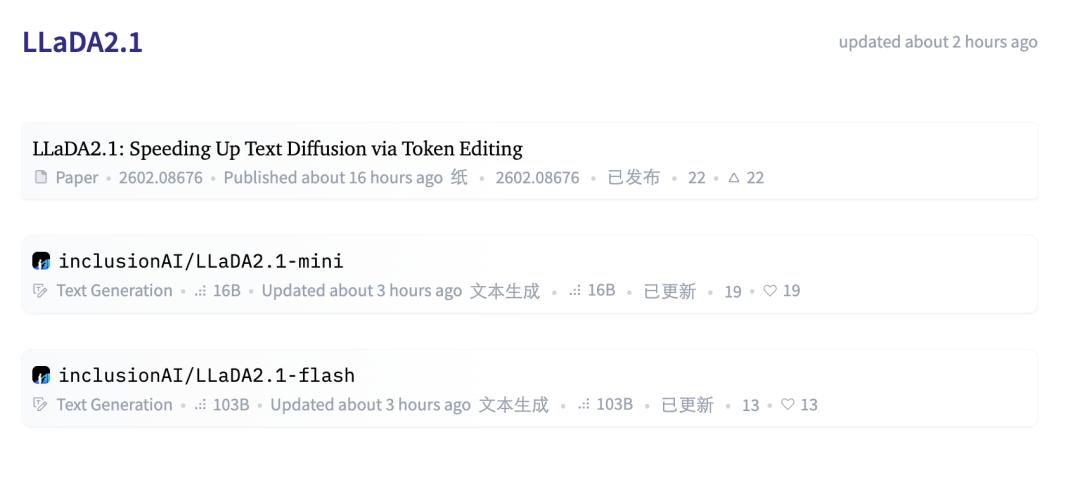
Core Insights - The release of LLaDA2.1 marks a significant transformation in the field of diffusion language models (dLLM), which was previously considered a niche area. The new version includes LLaDA2.1-Mini (16 billion parameters) and LLaDA2.1-Flash (100 billion parameters) [1][3] - LLaDA2.1 achieves a peak speed of 892 tokens per second, demonstrating a practical efficiency advantage and breaking the "fast but inaccurate" paradigm with its error-correcting mechanism [3][10] - The model introduces a dual-mode system allowing users to switch between quality and speed, addressing the trade-off between these two aspects effectively [15][19] Model Performance - LLaDA2.1's 100 billion parameter version achieved a peak speed of 892 tokens per second, which is particularly notable given the complexity of tasks it can handle, such as programming benchmarks [10][11] - The model's architecture allows for parallel generation and self-correction, which enhances its usability compared to traditional autoregressive models that lack this capability [13][14] - In experimental evaluations, LLaDA2.1 outperformed its predecessor LLaDA2.0 in quality mode across various benchmarks, while also showing significant improvements in throughput in speed mode [20][22] Technical Innovations - The introduction of an Error-Correcting Editable (ECE) mechanism allows LLaDA2.1 to draft answers quickly and then edit them, enabling a more flexible and accurate output generation process [13][18] - The model employs a reinforcement learning phase to enhance its understanding of instructions and alignment with user intent, marking a first for diffusion models at this scale [16][17] - The dual-mode design allows users to configure the model for either speed or quality, simplifying user experience and model management [15][19] Industry Implications - LLaDA2.1's advancements suggest a potential shift in the landscape of AI models, challenging the dominance of autoregressive architectures and opening up new avenues for research and application in language modeling [26] - The successful implementation of a 100 billion parameter diffusion model indicates that the barriers to scaling such models may be diminishing, encouraging further investment and exploration in this area [11][26] - The model's ability to handle complex tasks efficiently positions it as a competitive alternative in the AI landscape, potentially influencing future developments in language processing technologies [10][26]
港股异动 | 七牛智能(02567)盘中涨近17% MaaS业务快速增长 成港股AI Infra稀缺标的
智通财经网· 2026-02-11 04:15
Core Insights - Qiniu Intelligent (02567) saw a significant stock price increase, rising nearly 17% during trading and closing up 7.55% at HKD 0.57, with a trading volume of HKD 8.0614 million [1] Group 1: Company Developments - Qiniu Intelligent has officially launched its MaaS platform "AI Model Plaza," which is being regarded as the "Chinese version of OpenRouter" [1] - The platform features a unified API architecture, multi-model scheduling capabilities, and agent services, establishing itself as a neutral hub for AI development [1] Group 2: User Growth and Market Position - Since the launch of the MaaS platform in 2025, the number of MaaS-related users has rapidly exceeded 180,000, indicating strong market adoption [1] - As of January 14, 2026, the total number of registered users on Qiniu Cloud has surpassed 1.92 million, demonstrating a non-linear growth trend and signaling the emergence of scale effects within the MaaS ecosystem [1] - With the anticipated explosion in demand for multi-agent reasoning in 2026, Qiniu Intelligent is expected to evolve from a "service provider" to the "core of the ecosystem" [1]
马斯克xAI雪崩!24小时两联创离职,一月内连失三位华人创始人,12人梦之队只剩一半
量子位· 2026-02-11 04:10
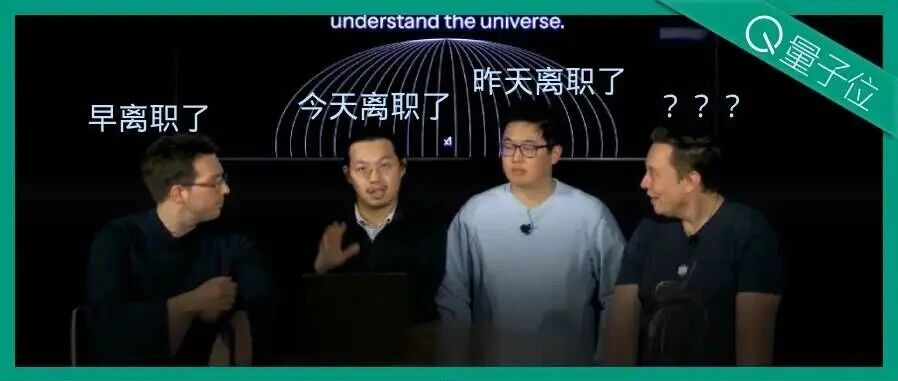
梦晨 发自 凹非寺 量子位 | 公众号 QbitAI 24小时内,马斯克的xAI连失两位华人联合创始人。 xAI联合创始人 吴宇怀 (Tony Wu)和 Jimmy Ba 先后在社交平台上宣布离职。 而就在一个月前,另一位华人联合创始人 杨格 (Greg Yang)刚刚因病退出。 三位华人核心科学家,一个月内全部离开。算上此前已出走的三人,xAI成立不到三年,最初12人创始团队已走6人。 同时,一些后加入的核心成员,也纷纷宣布离职。 马斯克的AI团队,发生了什么? 一月三别:从因病退出到师徒接连告别 这一波离职潮最先离开的是 杨格 。 2026年1月,这位Grok核心架构师宣布,自己被诊断出患有 莱姆病 (Lyme disease) ,不得不退出日常工作,转为公司的非正式顾问。 杨格拥有哈佛大学数学系学位, 师从著名数学家丘成桐 ,曾是微软研究院的研究员。 他在声明中解释自己可能早已感染此病,但在xAI创立期间的 "长期高强度工作"和"把自己逼得太狠" 导致免疫系统受损,最终使病情显现和 恶化。 紧接着是 吴宇怀 。2月10日,他在X平台上发布离职声明: 是时候开启我的下一章了,这是一个充满可能性的时代:一个 ...
速递|冲刺“世界模型”:Runway获E轮3.15亿美金弹药,英伟达、Adobe共同押注
Z Potentials· 2026-02-11 04:08
图片来源: Runway 知情人士 透露, AI 视频生成初创公司 Runway 已完成 3.15 亿美元 E 轮融资,公司估值飙升至 53 亿美元,较之前水平近乎翻倍。 公司在其宣布融资的博客中表示,新资金将使 Runway 能够 " 预训练下一代世界模型,并将其引入新产品和行业 " 。 世界模型是一种能够构建环 境内部表征的人工智能系统,从而能够对未来事件进行规划,许多顶尖学者认为这类模型对突破大语言模型的局限至关重要。 据公司发言人透露,展望未来, Runway 计划运用新资金将其约 140 人的团队在研发、工程和市场拓展等岗位进行快速扩容。 本轮融资由 General Atlantic 领投,参投方包括英伟达、富达管理与研究公司、 AllianceBernstein 、 Adobe Ventures 、未来资产、 Emphatic Capital 、 Felicis 、 Premji 以及 AMD Ventures 。 参考资料: https://techcrunch.com/2026/02/10/ai-video-startup-runway-raises-315m-at-5-3b-valuatio ...
深度|Loopit 预示的交互生成未来,比Sora更革命的一步
Z Potentials· 2026-02-11 04:08
Core Insights - The article discusses the evolution of AI-generated content, highlighting the transition from static content production to interactive experiences with the introduction of Loopit, which allows users to create dynamic, interactive environments rather than just viewing content [2][5][13]. Group 1: Evolution of AI Content Generation - In 2024, Sora demonstrated that AI could generate realistic worlds, but it remained limited to linear narratives [2]. - Loopit, set to launch before the 2026 Spring Festival, represents a significant advancement by enabling the creation of interactive scenes that respond to user input, moving beyond simple content generation [2][5]. - This shift allows users to become "lightweight developers," defining behavior logic with simple commands, thus changing the relationship between content and users [5][11]. Group 2: Interactive Generation and User Engagement - Loopit introduces a new content form where interaction is central, allowing users to influence and evolve the experience through their actions [14][20]. - The platform's design emphasizes immediate feedback, enhancing user engagement by providing a sense of control and agency over the created environment [15][17]. - This interactive model contrasts with traditional content consumption, where users were passive recipients, thus redefining the creator-user dynamic [14][20]. Group 3: Overcoming the "Impossible Triangle" - The article identifies a structural dilemma in interactive content creation, termed the "impossible triangle," which struggles to balance high freedom, high quality, and low barriers to entry [21]. - Loopit addresses this challenge by simplifying the creation process, allowing users to generate interactive scenes with minimal input, thus broadening creative possibilities [21][24]. - Advances in technology, such as cloud rendering and lightweight engines, enable high-quality visuals on mobile devices, further enhancing user experience [21]. Group 4: Future of Content and Experience - The future landscape suggests a shift from traditional content consumption to immersive experiences, where users actively participate in creating narratives [24]. - Loopit symbolizes a transition from static content to interactive systems, positioning users as "Prompt Engineers" who shape their experiences [24]. - This evolution indicates a potential decline in the relevance of traditional content formats, emphasizing the importance of user interaction and experience over passive consumption [24].

过劳病倒、职权被削、联创跑路:xAI 48小时内上演最惨烈人才地震
3 6 Ke· 2026-02-11 04:00
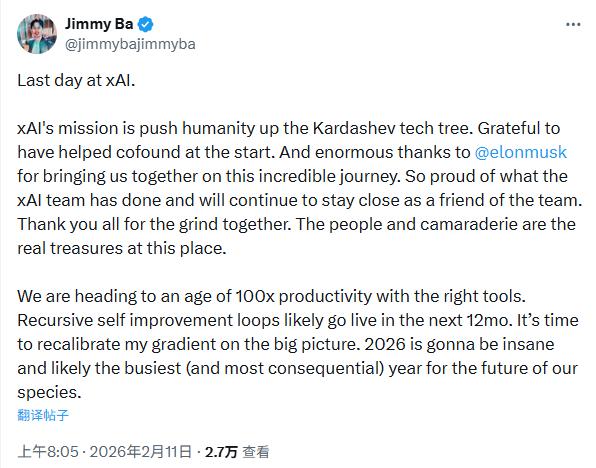
Core Viewpoint - The recent departure of two co-founders from xAI, Yuhuai (Tony) Wu and Jimmy Ba, has raised concerns about the company's future and the potential difficulties in developing its Grok model [1][7][11]. Group 1: Departures and Reactions - Yuhuai (Tony) Wu expressed gratitude for his time at xAI and hinted at new opportunities ahead, emphasizing the potential of AI to redefine productivity [3][39]. - Jimmy Ba, known for his contributions to deep learning, also reflected on his time at xAI and mentioned a new direction involving recursive self-improvement cycles for AI models [6][11]. - The departures have sparked speculation among the public and industry insiders regarding the challenges xAI may be facing, particularly with the Grok model being behind schedule [7][11]. Group 2: Background of Co-founders - Yuhuai (Tony) Wu was a key member of the technical and research team at xAI, previously working at Google and contributing to significant AI research [8]. - Jimmy Ba, a prominent figure in deep learning, was responsible for optimizing the Grok model and had a direct reporting line to Elon Musk [10]. - The departures of Wu and Ba are part of a larger trend, with five co-founders leaving xAI in the past year, raising questions about the company's internal dynamics [11][14]. Group 3: Company Culture and Management - Elon Musk's management style at xAI is characterized by high expectations for productivity and a culture of extreme commitment, which has been both praised and criticized [40][45]. - The intense work environment has led to discussions about employee well-being and the sustainability of such a high-pressure culture [45][48]. - Musk's approach emphasizes rapid execution and innovation, which may contribute to high turnover rates among staff [45][48].

破解人工智能技术场景对接障碍,广州推出“广智能”平台
Nan Fang Du Shi Bao· 2026-02-11 03:52
Core Insights - Guangzhou's AI industry service platform "Guangzhineng" aims to address the disconnect between technology supply and application scenarios, consolidating key resources such as computing power, models, algorithms, and talent [2][3] Group 1: Platform Features - The platform includes six core functional modules: demonstration cases, terminal products, supply-demand matching, intelligent computing supermarket, talent management, and policy assistance, tailored to user needs [3] - It features 129 typical demonstration cases across various fields, including smart manufacturing and urban governance, serving as an "application sample library" [3] - The platform integrates over 14 computing power centers, providing more than 16,000 P of reliable computing support [6] Group 2: Product Offerings - Terminal products cover key areas such as smart manufacturing and intelligent security, with detailed information on patent layout and market conditions [4] - Examples include a drone networking solution for urban governance and an AI-based smart meter reading system, both of which have been successfully implemented [4] Group 3: Supply-Demand Matching - The platform features a "supply supermarket" and "demand square" to facilitate efficient matching between technology providers and application scenario needs [5] - Users can easily connect with potential partners by expressing interest in specific technologies or scenarios [5] Group 4: Talent and Policy Support - The platform includes resources from over 190 AI experts and executives, facilitating collaboration between academia and industry [6] - It provides a channel for talent to apply for housing, streamlining the process for skilled individuals [6] Group 5: User Experience Enhancements - The platform allows users to quickly access AI-related policy documents and features an intelligent query function for efficient information retrieval [7] - A digital assistant, "Sui Xiaozhi," offers policy interpretations and updates, enhancing user engagement [7] Group 6: Future Developments - The platform will continue to update its resources and improve supply-demand matching algorithms, aiming to become a leading AI industry service platform in China [7]

不到48小时,xAI两位联合创始人相继离职
3 6 Ke· 2026-02-11 03:43
Group 1 - Jimmy Ba, co-founder of xAI, has left the company, stating it is time to recalibrate his perspective on the future, particularly highlighting the significance of the year 2026 [1] - Ba expressed gratitude towards Elon Musk and emphasized his commitment to maintaining a close relationship with the company as a friend [1] - Ba's departure follows a restructuring at xAI, where many of his core responsibilities were transferred to fellow co-founders Tony Wu and Guodong Zhang [2] Group 2 - Tony Wu also announced his departure from xAI, expressing nostalgia and gratitude towards the team and Musk for their trust in the mission [2] - Wu was a key figure in mathematical reasoning and symbolic AI at xAI, having previously worked at Google and OpenAI, and was responsible for the development of the Grok model's reasoning capabilities [3] - The company has experienced significant talent loss, with six out of twelve co-founders having left, five of whom departed within the past year [3] Group 3 - xAI recently completed a $20 billion funding round, with a post-money valuation exceeding $230 billion, attracting major tech investors like Nvidia and Cisco [4] - SpaceX completed a stock-for-stock acquisition of xAI, resulting in a combined valuation of $1.25 trillion, making it the highest-valued private company globally [4] - xAI faces regulatory challenges, particularly concerning compliance issues related to its Grok model, which has generated controversial content leading to temporary bans in several countries [4]