电子商务

Search documents
暴涨12%!阿里发生了什么?二季度电话会全文:AI芯片供给有B计划,重申3800亿Capex,闪购和即时三年零售带来1万亿元
美股IPO· 2025-08-29 15:15
Core Insights - The company has achieved significant growth in its instant retail business, with monthly active users of Taobao Flash Purchase exceeding 300 million, a 200% increase compared to before April [3][4] - The cloud business has shown resilience, with revenue growth of 26% year-on-year, driven by strong demand for AI-related products [3][6] - The company plans to invest 380 billion RMB in AI infrastructure over the next three years, with a focus on diversifying supply chains to mitigate risks [4][11] Group 1: Instant Retail Business - Taobao Flash Purchase has reached a daily average order volume of 120 million in July, maintaining around 80 million in August [3][24] - The number of active riders for the flash purchase service has tripled to 2 million since April, indicating significant operational expansion [3][4] - The company anticipates over 1 trillion RMB in new transaction volume from integrating more than one million offline brand stores into the instant retail platform over the next three years [4][28] Group 2: Cloud Business - The cloud segment's revenue reached 333.98 billion RMB, with AI-related revenue contributing over 20% to external commercial income [4][18] - The company has invested over 100 billion RMB in AI infrastructure and product development over the past four quarters, with plans for continued investment [11][35] - The cloud business is expected to maintain strong growth momentum, driven by increasing demand for AI applications and services [32][34] Group 3: Financial Performance - The company's Non-GAAP net profit decreased by 18% year-on-year, but core business revenues remained strong [3][15] - The adjusted EBITDA margin for the cloud segment stabilized at 8.8%, reflecting operational efficiency improvements [18] - Free cash flow showed a net outflow of 18.8 billion RMB, primarily due to accelerated investments in AI and infrastructure [15][19] Group 4: Strategic Initiatives - The company is integrating various business units, including Taobao and Tmall, to create a comprehensive consumer platform that enhances user experience [10][19] - A new loyalty program has been launched to connect different business units, improving customer engagement across platforms [16][19] - The company is focusing on enhancing operational efficiency and profitability while expanding its instant retail and cloud services [14][19]



阿里二季度即时零售收入增长12%,蒋凡首谈淘宝闪购战略
Nan Fang Du Shi Bao· 2025-08-29 15:10
Core Insights - Alibaba's investment in instant retail has shown rapid results since May, with monthly active buyers reaching 300 million in August, leading to a 25% increase in monthly active buyers on the Taobao app [1][4] - The company's Q1 FY2026 revenue was 247.65 billion RMB, a 10% year-over-year increase, with net profit rising 76% to 42.38 billion RMB, exceeding market expectations [2][4] - The stock price surged over 10% to $131.67 following the earnings report [1] Financial Performance - Alibaba's revenue from its China e-commerce group was 1,400.72 billion RMB, a 10% increase year-over-year, while adjusted EBITA decreased by 21% to 383.89 billion RMB due to investments in user experience and technology [4][5] - The international digital commerce group's revenue grew by 19% to 34.74 billion RMB, with adjusted EBITA losses narrowing significantly [5] - Sales and marketing expenses rose to 531.78 billion RMB, accounting for 32.5% of revenue, up from 13.4% the previous year, driven by investments in user acquisition [5] Business Segments - Instant retail revenue reached 14.78 billion RMB, a 12% increase, attributed to the growth in orders from Taobao Flash Sales [4][5] - The cloud computing segment saw a 26% increase in revenue to 333.98 billion RMB, marking the highest growth rate in three years, driven by AI-related services [9] - The company plans to invest 380 billion RMB in cloud and AI infrastructure over three years, with 38.6 billion RMB already allocated in the second quarter [9] Strategic Developments - The integration of Ele.me and Fliggy into the China e-commerce group aims to transform Alibaba into a comprehensive consumer platform [4] - The Taobao Flash Sales initiative has exceeded initial user growth targets, with daily orders peaking at 12 million and monthly active users reaching 300 million [7][8] - The company is focusing on enhancing operational efficiency in its instant retail segment, with plans to optimize order structures and logistics costs [8]
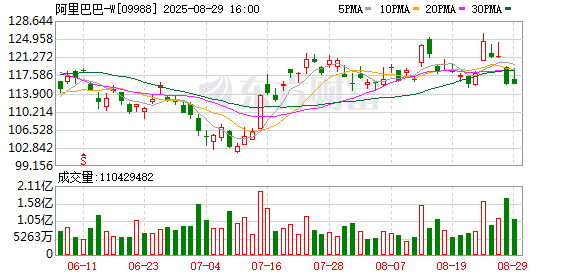
阿里电话会:AI芯片供给有B计划,重申3800亿资本支出,未来三年闪购和即时零售有望带来1万亿元新成交
Hua Er Jie Jian Wen· 2025-08-29 14:55
Core Insights - Alibaba's management revealed that Taobao Flash Sale has surpassed 300 million monthly active users within four months of launch, achieving a 200% increase compared to before April, exceeding initial targets [1][9] - The company is preparing backup plans for global AI chip supply and policy changes, establishing a diversified supply chain to ensure the timely execution of its investment plans [2][10] - Alibaba's latest financial report shows a 18% year-on-year decline in Non-GAAP net profit for Q2, but core businesses demonstrate strong resilience, with cloud revenue growing by 26% and Taobao Flash Sale being a significant driver of user growth [1][16] Financial Performance - Total revenue for the quarter reached 247.7 billion RMB, with a 10% year-on-year increase in customer management revenue for the Chinese e-commerce business [12][14] - Cloud revenue increased by 26% to 33.398 billion RMB, driven by strong demand for AI-related products, which accounted for over 20% of external commercial revenue [1][16] - Adjusted EBITDA decreased by 14%, primarily due to strategic focus on rapidly expanding the flash sale business, which is expected to capture new consumer patterns [13][16] Business Developments - The company plans to invest 380 billion RMB in AI capital expenditures over the next three years, with quarterly investment amounts subject to supply chain fluctuations [2][11] - Taobao Flash Sale's daily average order volume reached 120 million in July, maintaining an average of 80 million orders per week in August, with active riders increasing to 2 million, tripling since April [1][9] - The integration of Taobao and Tmall, along with the strategic merger of Ele.me and Fliggy, aims to create a comprehensive consumer platform, enhancing user experience and operational efficiency [8][12] AI and Cloud Strategy - Alibaba has invested over 100 billion RMB in AI infrastructure and product development over the past four quarters, with AI-related revenue continuing to grow at a triple-digit rate [5][10] - The company emphasizes the importance of AI in driving cloud revenue growth, with AI applications accelerating demand for traditional products such as computing and storage [5][10] - A strategic partnership with SAP focuses on cloud and AI, allowing SAP customers to utilize Alibaba's platform for core software management [6][10] Future Outlook - Alibaba anticipates that over one million offline brand stores will join the flash sale platform within the next three years, potentially generating an additional 1 trillion RMB in transaction volume [1][27] - The company aims to create a comprehensive consumption platform to meet the needs of one billion consumers, targeting a market potential of 30 trillion RMB [10][11] - Management believes that the integration of AI and cloud services will provide significant opportunities for growth in the next decade, with a commitment to maintaining a healthy balance sheet and strong cash flow [18][48]
AI技术深度赋能新零售 天音控股旗下能良电商店铺数量同比增长25%
Zheng Quan Shi Bao Wang· 2025-08-29 14:50
Core Viewpoint - Tianyin Holdings (000829) reported a revenue of 46.326 billion yuan for the first half of 2025, with its subsidiary Nengliang E-commerce showing significant growth, expanding its store count by 25% to 441, becoming a key driver for the company's "second growth curve" [1] Group 1: Business Performance - Nengliang E-commerce is a comprehensive e-commerce enterprise driven by digitalization, focusing on procurement, sales, and operational services [1] - The company has rapidly expanded its platform presence from major platforms like Taotian, JD, and Pinduoduo to include Douyin and Kuaishou, leveraging a multi-platform strategy and integrating "short video + live streaming" to thrive in the digital age [1] - The e-commerce transformation is fundamentally a result of deep integration between artificial intelligence, data elements, and traditional industries [1] Group 2: Technological Integration - Nengliang E-commerce developed the "Nengliang AI Intelligent Agent," which provides 24/7 intelligent responses on the customer service side, significantly reducing wait times [2] - On the operational side, the AI acts as a data analyst, offering precise analysis reports and decision-making suggestions to optimize business processes [2] - The company also launched the HR intelligent agent "Able," which answers all HR-related queries in real-time, enhancing management efficiency [2] Group 3: Market Strategy - In the first half of 2025, Nengliang E-commerce actively participated in national subsidy policies, collaborating with major platforms to offer consumers more affordable electronic products [2] - The company emphasizes quality by partnering with leading industry brands and strictly controlling the introduction of new brands to enhance customer satisfaction and loyalty [2] - Nengliang E-commerce is expanding its business channels by developing online and offline distribution and government-enterprise client services, collaborating with 417 business partners and establishing over 3,000 cooperative relationships [2] Group 4: Strategic Alignment - The achievements of Nengliang E-commerce are a result of its deep integration with the overall development of Tianyin Holdings, which is advancing its "industry-integrated digital network platform" strategy [3] - Nengliang E-commerce is positioned as a crucial component in Tianyin Holdings' transition from traditional distribution to new retail [3] - The company employs a "1+N" category expansion strategy, starting from core mobile phone categories and expanding into PCs and home appliances, leveraging Tianyin Holdings' supply chain resources as a core channel for brands like Apple, Samsung, and Huawei [3]

阿里2026财年一季度收入同比增2%
Bei Jing Shang Bao· 2025-08-29 14:28
Core Insights - Alibaba Group reported Q1 FY2026 (Q2 2025) financial results with total revenue of 247.65 billion yuan, a year-on-year increase of 2% [1] - Net profit reached 42.38 billion yuan, showing a significant year-on-year growth of 76% [1] - Operating cash flow decreased by 39% year-on-year, amounting to 20.67 billion yuan [1] Business Performance - The newly formed Alibaba China E-commerce Group, resulting from the integration of Taotian Group, Ele.me, and Fliggy, generated revenue of 140.07 billion yuan, a 10% increase year-on-year [1] - The monthly active consumers on the Taobao app grew by 25% year-on-year in the first three weeks of August, driven by the Taobao Flash Sale business [1] - The number of Taobao 88VIP members surpassed 53 million, continuing to grow at a double-digit rate [1] Flash Sale Business - In August, Taobao Flash Sale reached a peak daily order volume of 120 million, with a weekly average of 80 million orders [2] - The monthly transaction buyer count for Flash Sale increased to 300 million, representing a 200% growth compared to April [2] - CEO Jiang Fan indicated that Flash Sale is expected to contribute an additional 1 trillion yuan in transactions over the next three years as more brands join the platform [1]
阿里巴巴-W8月28日斥资998.95万美元回购66.72万股
Zhi Tong Cai Jing· 2025-08-29 14:23
阿里巴巴-W(09988)发布公告,于2025年8月28日该公司斥资998.95万美元回购66.72万股,回购价格为每 股14.74-15.00美元。 ...
1H 2025亚马逊零售媒体:品牌如何出现在领先的零售媒体网络内部揭秘
Sensor Tower· 2025-08-29 14:06
Investment Rating - The report indicates that Amazon is the leading retail media network (RMN) with significant advertising spending, suggesting a strong investment rating for the retail media sector, particularly for Amazon [17][28]. Core Insights - Amazon's advertising spending in the first half of 2025 reached $618 million, more than double that of Walmart and nearly six times that of Chewy, highlighting its dominant market position [28][31]. - The report emphasizes that Amazon attracted over 9,500 advertisers, nearly nine times more than its closest competitor, indicating its extensive reach and appeal to brands [7][33]. - Major advertisers include CPG and technology brands, with significant spending in personal care, electronics, and food and beverage categories [8][41]. - Most advertising strategies on Amazon are performance-driven, focusing on discounts and immediate purchase calls to action, which may limit creative differentiation [9][70]. Summary by Sections Key Points - Amazon is at the forefront of the rapidly growing retail media sector, with advertising expenditures far exceeding those of other retailers [17]. - The report provides insights into how advertisers can optimize their presence on Amazon and the potential opportunities available [18]. Sensor Tower's Retail Media Insights - The report utilizes Sensor Tower's data to analyze the advertising landscape on Amazon, focusing on brand strategies and channel effectiveness [21]. Contextualizing Amazon's Scale - In the first half of 2025, Amazon's advertising spending was $618 million, significantly outpacing competitors like Walmart and Chewy [28]. - The report highlights that other top retailers had revenues below $100 million, underscoring Amazon's substantial market share [29]. Top Advertisers & Categories - The top advertisers on Amazon include Samsung, Unilever, and L'Oréal, with spending concentrated in personal care and electronics [41][44]. - Personal care products led the advertising spending categories, followed by electronics and home goods [46][48]. Amazon's Activation Strategies - Approximately 50% of Amazon's advertising spending occurs on-site, indicating a focus on direct consumer engagement during the shopping process [57]. - The report notes that Amazon's channel strategy is less diverse compared to other retailers, with a heavy reliance on on-site display advertising [65][66].

透视半年报|闪购带动淘宝月活买家增25%,阿里加码AI和消费
Bei Ke Cai Jing· 2025-08-29 13:44
Core Insights - Alibaba Group reported a 2% year-on-year increase in total revenue for Q1 FY2026, reaching 247.65 billion yuan (approximately 34.57 billion USD), with a 10% growth rate when excluding disposed businesses [1] - The company is focusing on consumer and AI + cloud strategies, with significant growth in instant retail and a 25% year-on-year increase in monthly active consumers on the Taobao app [2] - Net profit for the quarter was 43.12 billion yuan (approximately 6.02 billion USD), representing a 76% year-on-year increase, driven by positive changes in equity investments and gains from the disposal of the Trendyol local services business [3] Financial Performance - Operating profit for the quarter was 34.99 billion yuan (approximately 4.88 billion USD), with a decrease in adjusted EBITA by 14% to 38.84 billion yuan (approximately 5.42 billion USD) [3] - Alibaba's China e-commerce group revenue reached 140.07 billion yuan, showing a 10% year-on-year growth [3] - The company announced a capital expenditure of 38.6 billion yuan for AI + cloud, a 220% increase year-on-year, with cloud revenue growing by 26%, marking the highest growth rate in three years [6] Business Strategy and Developments - Alibaba completed the integration of its businesses into the "Alibaba China E-commerce Group," simplifying its financial reporting structure [4] - The company reported 300 million monthly active buyers in its instant retail segment, attributing this growth to significant investments and synergies from platform integration [4] - The international digital commerce group (AIDC) saw a 19% year-on-year revenue increase to 34.74 billion yuan (approximately 4.85 billion USD), with cross-border business contributing significantly [7] Shareholder Actions - Alibaba repurchased 56 million ordinary shares for a total of 815 million USD, with 19.3 billion USD remaining under its authorized buyback plan, which is valid until March 2027 [7]
看图:阿里巴巴第一财季营收2477亿元 将继续投资消费与AI+云两大战略支柱
Xin Lang Ke Ji· 2025-08-29 13:22
Revenue Breakdown - The total revenue of the company is 140.072 billion yuan, with a year-on-year growth of 10% [2] - The international digital segment generated 34.741 billion yuan [2] - The commercial group achieved a revenue of 33.398 billion yuan, reflecting a year-on-year growth of 19% [2] - The cloud intelligence group reported a revenue of 58.599 billion yuan, with a year-on-year growth of 26% [2] - The "all other" category experienced a decline of 28% [2] Business Highlights - In the current quarter, the company repurchased 56 million ordinary shares at a total price of 815 million USD, equivalent to 7 million American depositary shares [3] - Flash sales in the first three weeks of August drove a 25% year-on-year increase in monthly active consumers on the Taobao app [3] - Revenue from AI-related products has seen triple-digit year-on-year growth for eight consecutive quarters [3]
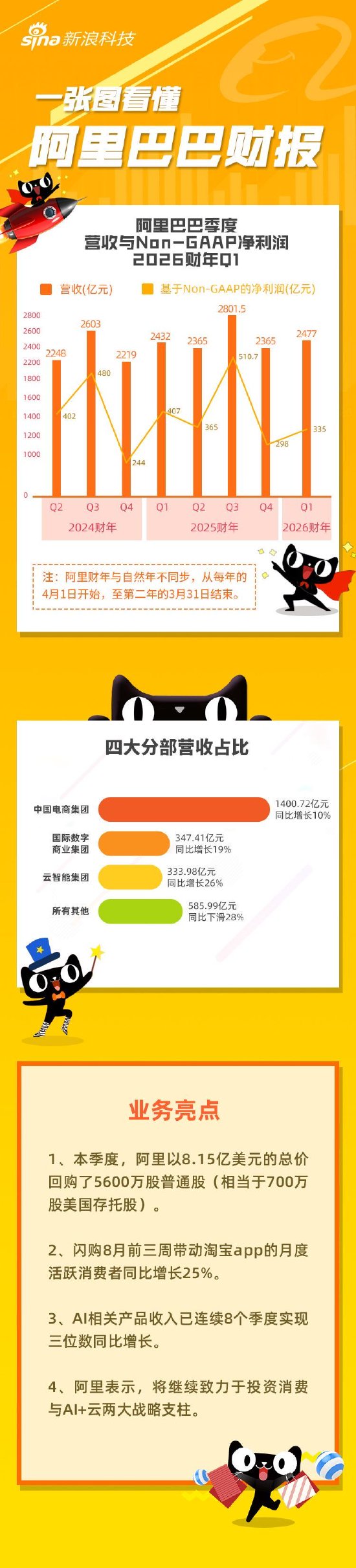
盘前大涨超7%!阿里Q2资本开支超预期!净利润同比下降18%,云业务收入增26%,淘宝闪购提振月活增25%
美股IPO· 2025-08-29 13:03
Core Insights - Alibaba's Q2 revenue grew by 2% year-on-year, reaching RMB 247.65 billion, which was below the expected RMB 253.17 billion [4][3] - Net profit surged by 76% to RMB 42.38 billion, while Non-GAAP net profit decreased by 18% to RMB 33.51 billion [4][3] - Capital expenditures increased significantly from approximately RMB 119 billion in the same quarter last year to about RMB 387 billion this quarter [10][4] Revenue Breakdown - Instant retail business revenue increased by 12% year-on-year, reaching RMB 14.78 billion [6][7] - Alibaba's China e-commerce group revenue grew by 10%, with customer management revenue also up by 10% to RMB 89.25 billion [6][8] - Cloud Intelligence Group revenue accelerated by 26% to RMB 33.40 billion, driven by public cloud growth and AI-related products [9][6] Profitability and Cash Flow - Adjusted EBITA for the core Chinese e-commerce group fell by 21% to RMB 38.84 billion, primarily due to significant investments in the instant retail business [7][6] - Free cash flow turned negative, recording a net outflow of RMB 18.8 billion compared to a net inflow of RMB 17.4 billion in the same period last year [10][4] Investment and Future Outlook - The company is heavily investing in AI infrastructure and new business initiatives, as reflected in the substantial increase in capital expenditures [10][4] - Despite the pressure on profitability, the company continues to execute its shareholder return plan, having repurchased approximately 7 million ADS for $815 million [10][4]